Indiana Advances Bitcoin Rights Law as U.S. States Deepen Crypto Integration

bitcoinistPublicado a 2026-02-26Actualizado a 2026-02-26

Resumen

Indiana lawmakers have passed House Bill 1042, known as the Bitcoin Rights Bill, which now awaits the governor's signature. If enacted, the law would allow state-managed investment funds—including retirement plans for public employees and education savings programs—to offer cryptocurrency ETFs as voluntary investment options. It also establishes legal protections for individuals using or holding digital assets, including the right to accept crypto payments and use self-custodied wallets, while prohibiting public agencies from restricting lawful crypto activities. The bill aligns with a broader trend of U.S. states integrating digital assets into public financial systems and is set to take effect in July 2026.

Indiana is moving closer to formally embedding crypto into its public financial system after lawmakers approved House Bill 1042, commonly referred to as the Bitcoin Rights Bill. The legislation has cleared both legislative chambers and now awaits the signature of Governor Mike Braun.

Related Reading: Binance Faces US Senate Inquiry Tied To $1.7 Billion In Sanctions-Related Transactions

If enacted, the law would allow certain public investment programs to provide exposure to crypto through regulated ETFs and establish legal protections for individuals who use or hold digital assets. The measure reflects a broader shift among U.S. states as they explore how crypto fits within traditional finance.
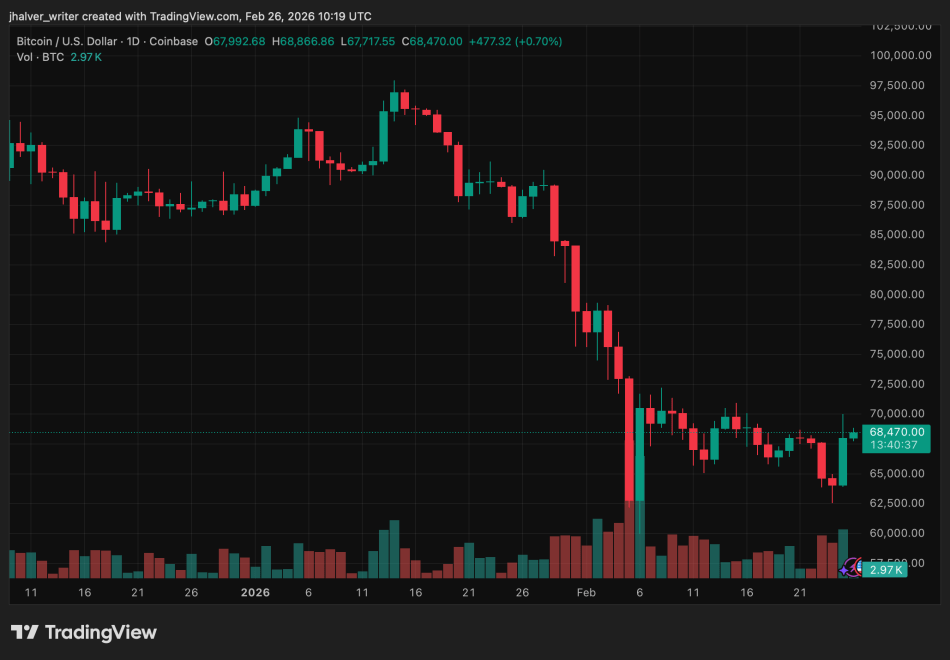
BTC's price trends to the downside with some sideways action on low timeframes as seen on the daily chart. Source: BTCUSD on Tradingview

Public Funds and Retirement Plans Open to Crypto ETFs

HB 1042 permits state-managed investment funds to include cryptocurrency ETFs as investment options rather than allowing direct token purchases. The approach aims to provide exposure through regulated financial products while maintaining oversight mechanisms.

Under the bill, several state-administered programs must offer self-directed brokerage accounts containing at least one digital asset investment option. These include retirement plans for teachers, public employees, and legislators, as well as the Hoosier START 529 education savings program.

Participation would remain voluntary, meaning individuals could choose whether to allocate funds toward crypto-related investments. Before rollout, the state must establish approved investment structures designed to manage compliance and risk oversight.

The legislation also allows eligible investment funds from outside Indiana to allocate assets into crypto ETFs under the state’s framework, potentially expanding institutional participation beyond state borders.

Legal Protections for Digital Asset Users

Beyond access to investment, the bill introduces protections for cryptocurrency users. Public agencies, with limited exceptions, would be restricted from banning or limiting lawful digital asset activities.

Residents would retain the right to accept crypto payments for legal goods and services and to store assets in self-custodied or hardware wallets. The proposal also prevents the state from imposing special taxes on crypto transactions and requires taxation rules to align with those applied to other financial activities.

Supporters argue that these provisions provide legal clarity for individuals and businesses operating in the digital asset space, while critics continue to highlight concerns about market volatility and retirement risk exposure.

Part of a Broader U.S. Policy Shift

Indiana’s move comes amid growing institutional interest in cryptos, following the expansion of crypto ETFs and evolving federal policy discussions on retirement portfolio diversification. Other states are considering similar measures, signaling a gradual shift toward incorporating digital assets into public finance structures.

HB 1042, introduced by State Representative Kyle Pierce, completed the legislative process after the House approved Senate amendments. If Governor Braun signs the bill, the law is scheduled to take effect on July 1, 2026, triggering implementation by state agencies and retirement administrators.

Related Reading: Netherlands To Amend Controversial 36% Tax On Unrealized Crypto, Stock Gains

As more states evaluate crypto-focused legislation, Indiana’s decision could serve as another trigger to the continued adoption of crypto in other states’ financial systems.

Cover image from ChatGPT, BTCUSD chart on Tradingview

Preguntas relacionadas

QWhat is the main purpose of Indiana's House Bill 1042, also known as the Bitcoin Rights Bill?

AThe main purpose is to allow certain public investment programs to provide exposure to cryptocurrency through regulated ETFs and to establish legal protections for individuals who use or hold digital assets.

QWhich specific state-administered programs must offer a digital asset investment option under this bill?

AThe programs include retirement plans for teachers, public employees, and legislators, as well as the Hoosier START 529 education savings program.

QWhat are some of the key legal protections for cryptocurrency users provided by this legislation?

AThe bill prevents public agencies from banning lawful digital asset activities, allows residents to accept crypto payments and use self-custodied wallets, and prohibits special taxes on crypto transactions, requiring taxation to align with other financial activities.

QHow does the bill propose to provide crypto exposure to public funds without allowing direct token purchases?

AIt permits state-managed investment funds to include cryptocurrency ETFs as investment options, providing exposure through these regulated financial products.

QWhen is the Indiana Bitcoin Rights Bill scheduled to take effect if signed by the governor?

AThe law is scheduled to take effect on July 1, 2026, if signed by Governor Mike Braun.

Lecturas Relacionadas

How Does Codex Use a Computer? Three Entry Points and Permission Boundaries

This article explains the three primary methods for Codex to interact with a computer, each with distinct use cases, permission boundaries, and trust levels. **1. Computer Use:** This offers the broadest access, allowing Codex to visually control and interact with the graphical user interface of authorized macOS/Windows apps, system settings, and even iOS simulators. It's ideal for tasks lacking APIs or structured tools, such as operating legacy software or multi-app workflows. However, it's the slowest method and has the widest permission scope, requiring careful supervision for sensitive actions. **2. Chrome Extension:** This grants Codex access to the user's logged-in Chrome browser state, including cookies, profiles, and open tabs. It's best for tasks requiring user identity across websites like Gmail, LinkedIn, Salesforce, or internal dashboards. Its key advantage is multi-tab control for complex workflows. While more powerful for browser-based tasks than Computer Use, it carries higher sensitivity as actions are performed under the user's identity. **3. In-App Browser:** This is a browser isolated within the Codex thread, separate from the user's personal browsing data. It excels in web development and debugging scenarios—previewing local servers, testing responsive layouts, or annotating designs directly on the page. Its isolation is a strength for development but a limitation for tasks requiring login sessions. The core principle is to choose the narrowest, safest, and most structured interface for the task. Use plugins or MCPs first, resort to visual control (Computer Use) only for GUI-dependent tasks, employ the Chrome extension for identity-reliant browser work, and prefer the In-App Browser for isolated development. **Appshots** are clarified as a fourth, complementary tool for *inputting* context—capturing a screenshot of a window to point Codex to something—rather than a method for Codex to *act*. Together, this layered approach highlights a key to AI agent productization: not granting unlimited permissions, but constraining them within clear boundaries for specific tasks while preserving user oversight.

marsbitHace 21 min(s)

How Does Codex Use a Computer? Three Entry Points and Permission Boundaries

marsbitHace 21 min(s)

The "Iron Rule" of Chip Equipment Is Being Broken

For years, the semiconductor equipment industry followed an unwritten "iron rule": suppliers offered steep discounts for new tool introductions (Design-in) and faced consistent price pressure during repeat orders, especially during market downturns. This long-standing buyer's market dynamic is now being upended. Recently, SK Hynix's primary equipment suppliers have reportedly requested a 3-4% price *increase*, a nearly unprecedented move. This shift is driven by a severe supply-demand imbalance fueled by the AI compute boom. Securing equipment has become an urgent arms race as chipmakers' expansion speed dictates their ability to fulfill massive AI chip orders. Key areas feeling the strain include: **TCB (Thermal Compression Bonding) Equipment:** Demand is exploding, driven by the simultaneous needs of HBM4 memory stacking, AI chip Chip-on-Substrate (C2S), and logic Chiplet Chip-on-Wafer (C2W) packaging. Players like Hanmi Semiconductor, Hanwha Semitech, and ASMPT are receiving major orders. While hybrid bonding is seen as the future, TCB remains the pragmatic choice for HBM4 mass production, with its lifecycle extended by relaxed specifications and ongoing technological upgrades. **Test Equipment Bottlenecks:** Ironically, AI-driven shortages are now crippling test equipment manufacturing. Critical components like FPGAs, Driver ICs, and CPUs face severe shortages and extended lead times (up to 52 weeks for FPGAs), as AI data center and server vendors prioritize supply. This creates a paradoxical cycle: AI chip shortages drive fab expansion, which requires more test equipment, whose production is delayed because its key parts are diverted to make AI chips. The industry is entering a broad, AI-powered upcycle. SEMI forecasts global semiconductor equipment sales to hit a record $156 billion by 2027, fueled by investment in advanced logic/foundry, HBM-driven DRAM, and advanced packaging (like CoWoS). Major players like TSMC, SK Hynix, and Micron are aggressively ramping capital expenditure. In conclusion, leading equipment vendors are no longer just selling tools; they are selling the critical capability to deliver AI-era capacity. Pricing power is shifting decisively to those with indispensable technology in key process nodes like advanced logic, HBM, and advanced packaging, rewriting the industry's traditional power structure.

marsbitHace 34 min(s)

The "Iron Rule" of Chip Equipment Is Being Broken

marsbitHace 34 min(s)

Trading

Spot
Futuros
活动图片