In July, prediction markets experienced a surge: World Cup drives trading volume to $54 billion

cryptonews.ruPublicado a 2026-08-04Actualizado a 2026-08-04

Resumen

Prediction markets, which allow trading contracts tied to future events, experienced a surge in activity driven by the FIFA World Cup, with total trading volume reaching $54.09 billion in July, up 8.3% from June. Kalshi dominated, handling 71.5% of the volume ($38.65B) and an estimated 77% of platform fees ($252.92M), while the Polymarket ecosystem accounted for roughly 24%. The event spurred nearly 365.92 million transactions and boosted open interest to about $1.91 billion at its peak. The tournament's sustained uncertainty attracted both traditional traders and new sports fans, expanding the user base. While the World Cup demonstrated how major global sports events can significantly boost market metrics, a key question remains whether this elevated activity can be sustained post-tournament.

Prediction markets allow people to buy and sell contracts tied to the outcome of future events, instead of acquiring traditional financial assets. Traders can speculate on everything from elections and economic data to sporting championships, with prices changing as expectations shift.

The FIFA World Cup, one of the world's largest sporting events, created ideal conditions for active trading, as each match opened up new opportunities.

Trading Activity Reaches New Heights

The figures recorded in June and July on the Dune.com prediction market dashboard clearly illustrate how sharp this growth has been. The total notional volume of the prediction market reached $54.09 billion in July compared to $49.95 billion in June, representing a growth of approximately 8.3% in one month.
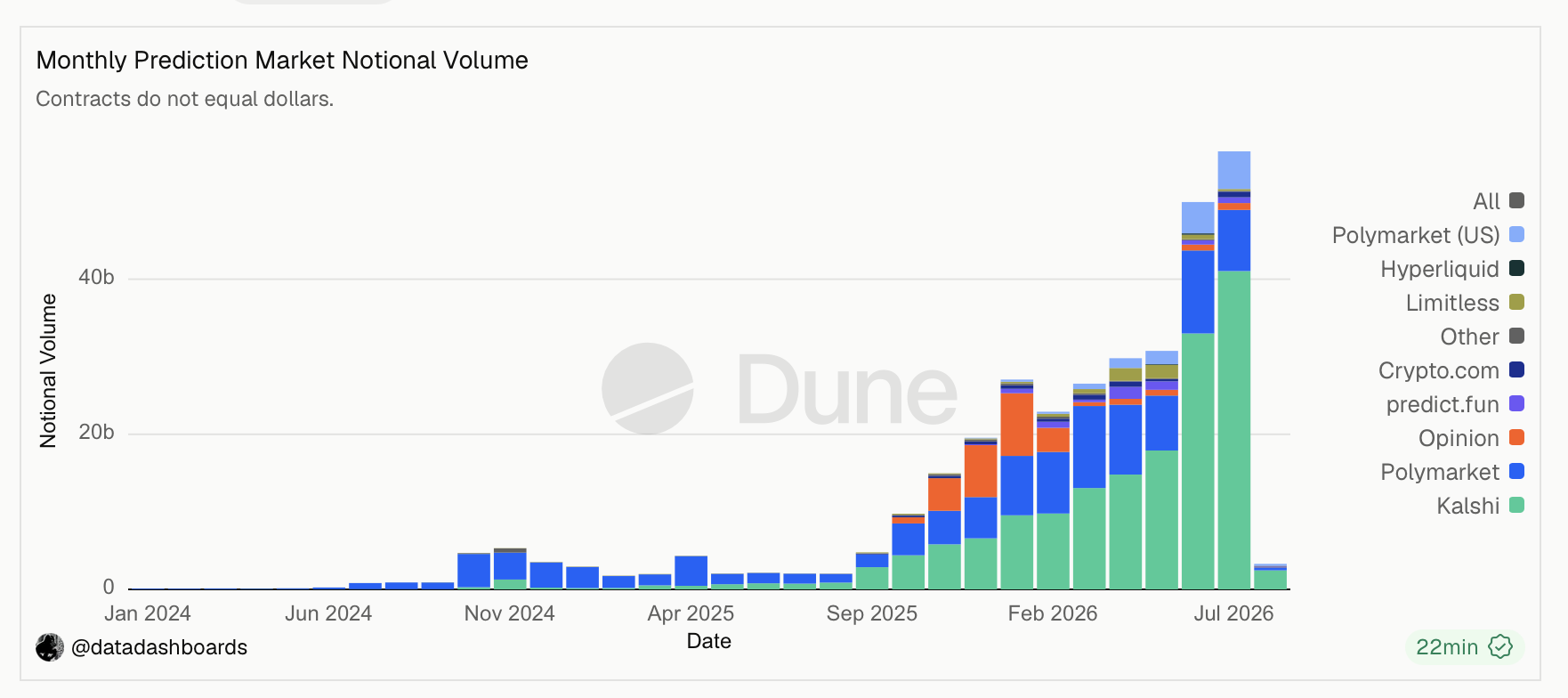
Image source: Dune Analytics

Kalshi dominated the market, processing $38.65 billion, or roughly 71.5% of the total volume. Polymarket generated $7.89 billion, and Polymarket (US) added another $4.86 billion, bringing the combined volume of the Polymarket ecosystem to nearly $12.75 billion, or about 24% of the monthly volume. The remaining share was taken by Opinion, predict.fun, Crypto.com, Limitless, and smaller platforms, highlighting how concentrated the industry has become around Polymarket and Kalshi.

Platform Revenues

Increased trading activity naturally led to higher platform revenues. According to Dune.com, estimated fees for prediction markets in July grew to approximately $327.67 million.

Kalshi again led the industry, earning roughly $252.92 million, or about 77% of all estimated fees. Polymarket earned $39.72 million, and Polymarket (US) earned $29.52 million. Predict added $4.44 million, Limitless just over $1 million, and Opinion about $50,000. The distribution of fees largely mirrored trading activity, reaffirming Kalshi's dominant position.

Increase in User Participation

The growing interest was equally evident in transaction count. In July, platforms processed nearly 365.92 million transactions as traders constantly adjusted their positions throughout the tournament.

Kalshi accounted for 246.73 million transactions, representing approximately 67.4% of the total activity. Polymarket recorded 62.03 million, and Polymarket (US) recorded 38.13 million. Combined, the two Polymarket platforms accounted for roughly 100 million transactions, or about 27% of all market activity. Predict.fun accounted for another 16.74 million, while the remaining platforms processed relatively small volumes.

Growth in Capital Deployed

The World Cup also prompted traders to hold more funds in open positions. Open interest, which measures the total value of active contracts yet to be settled, approached $1.91 billion at the beginning of July.
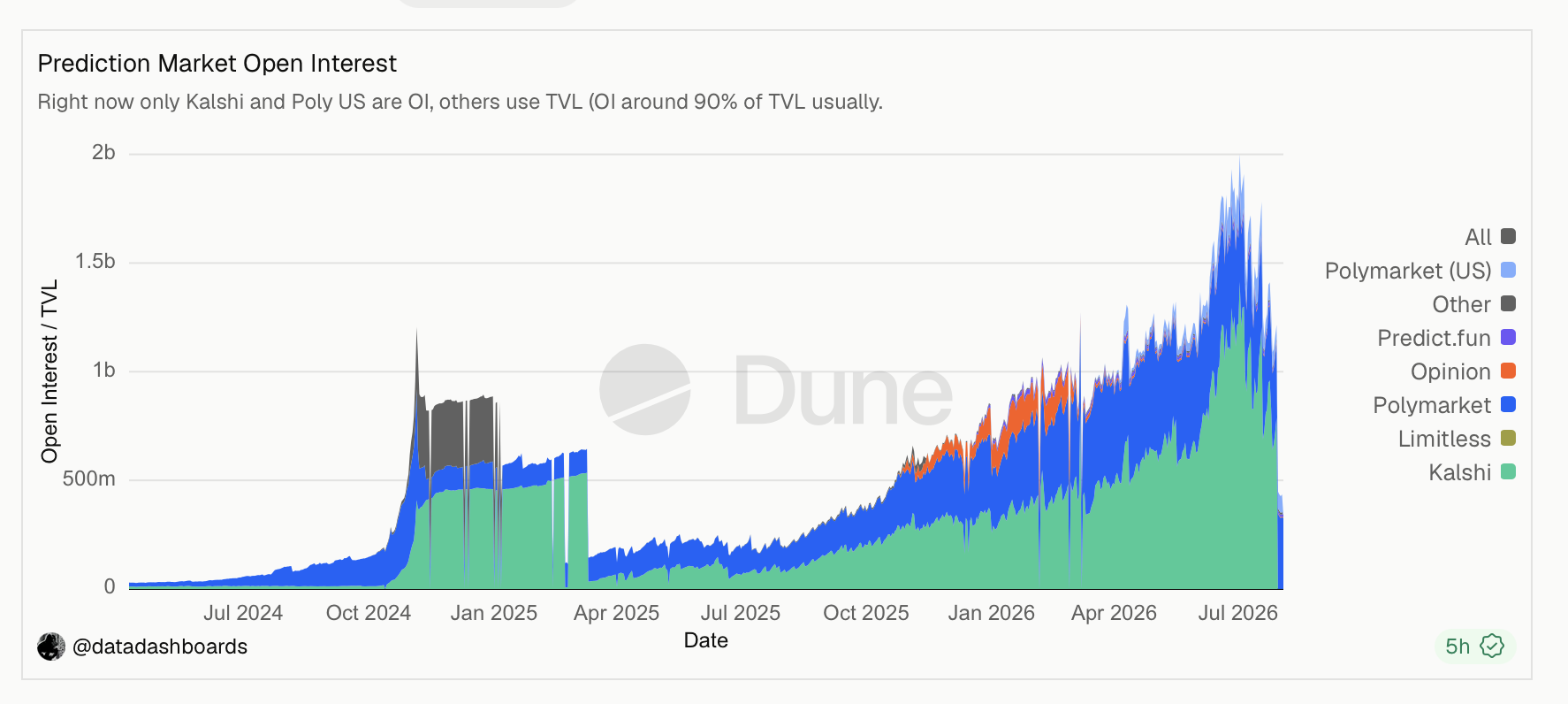
Image source: Dune Analytics

Kalshi accounted for approximately $1.30 billion, representing about 68% of the total open interest. Polymarket accounted for $419.21 million, and Polymarket (US) for another $154.30 million. Predict.fun accounted for $23.76 million, while Opinion, Limitless, and other platforms held only a small share of open interest.

Why Sports Matter

Unlike financial markets, prediction markets thrive on uncertainty and a constant influx of information. Every goal, injury, referee decision, and unexpected turn in a tournament instantly changes the perceived probability of future outcomes, prompting traders to adjust their positions throughout the competition. The World Cup's nearly month-long schedule created a continuous stream of tradeable events, sustaining high activity from the opening match to the final.

The tournament also broadened participation beyond traditional prediction market users. Sports fans who might never trade contracts tied to inflation or elections suddenly had the opportunity to follow familiar events, enhancing liquidity and bringing additional capital into the ecosystem.

What Comes Next

The FIFA World Cup demonstrated that global sporting events can dramatically expand participation in prediction markets far beyond election betting and other themes, driving growth across virtually all industry metrics. Whether these elevated levels will persist after the tournament concludes has become one of the sector's key questions.

Investors and platform operators will now watch upcoming sports calendars, major political events, and regulatory changes to determine whether prediction markets can retain their expanded user base or if activity will gradually return to pre-tournament levels. With the end of the FIFA World Cup, open interest in prediction markets has significantly declined.


Criptos en tendencia

Preguntas relacionadas

QWhat is the main reason for the surge in prediction markets' trading volume in July, according to the article?

AThe surge in trading volume in July was primarily driven by the FIFA World Cup, which created ideal conditions for active trading by offering new opportunities with every match.

QWhich platform dominated the prediction market in terms of trading volume and fees in July, and by what approximate percentage?

AKalshi dominated the prediction market in July, handling approximately 71.5% of the total trading volume (USD 38.65 billion) and earning about 77% of all estimated platform fees (around USD 252.92 million).

QWhat does the term 'Open Interest' refer to in the context of prediction markets, as mentioned in the article?

AIn the context of prediction markets, 'Open Interest' measures the total value of active contracts that have not yet been settled.

QHow did the FIFA World Cup potentially expand the participant base of prediction markets beyond traditional users?

AThe FIFA World Cup expanded the participant base by attracting sports fans who might never have traded contracts tied to inflation or elections. It allowed them to engage with familiar events, thereby increasing liquidity and bringing additional capital into the ecosystem.

QWhat is one of the key questions for the prediction market sector after the conclusion of the World Cup, as stated in the article?

AA key question for the sector is whether the elevated levels of user engagement and activity will be sustained after the tournament concludes or if activity will gradually return to pre-tournament levels.

Lecturas Relacionadas

AI Air Pocket Exceeds Apollo Moon Landing, Google Burns Through $200 Billion, Betting on the Biggest Gamble of the 21st Century

The article discusses the accelerating pursuit of AI self-improvement, known as Recursive Self-Improvement (RSI), viewed by Silicon Valley as the ultimate technological goal. Key figures like investor Chamath Palihapitiya and Google DeepMind's Jasjeet Sekhon suggest we are already in a cycle where AI designs progressively smarter AI, with the potential for models' marginal costs to approach zero. Sekhon frames the massive investments—Google alone plans $1950-$2050 billion in AI infrastructure—as the "biggest scientific bet in human history," surpassing endeavors like the Apollo program. This gamble aims to achieve a winner-takes-all advantage, despite the risk of an "AI air pocket" where capital expenditure outpaces revenue. Current RSI progress is showcased by Google's AlphaEvolve optimizing algorithms and hardware, Anthropic's experiments with AI research agents, and OpenAI's GPT-5.6 Sol improving its own systems. However, true RSI—where AI independently redesigns its own architecture—remains elusive. The discussion also highlights extreme risks, such as AI empowering cyberattacks or enabling the design of biological weapons, stressing the asymmetry between offense and defense. Experts predict true RSI could emerge within a few years, possibly by 2027-2028, marking a race against time. The conclusion is that the drive for self-improving AI is irreversible, pushing civilization toward an uncertain future milestone or "singularity."

marsbitHace 7 min(s)

AI Air Pocket Exceeds Apollo Moon Landing, Google Burns Through $200 Billion, Betting on the Biggest Gamble of the 21st Century

marsbitHace 7 min(s)

Coin-Equity Barometer | Strategy Sells 1,638 BTC for $105 Million; Michael Saylor Reiterates He Has Not Sold Any Bitcoin, Strategy's Trading Activity Unrelated to Personal Holdings (August 4th)

**Summary: Cryptocurrency & Stock Market Update (August 4th)** Global stock markets remain under pressure, with Korean markets facing liquidity outflows and US tech stocks showing mixed results during earnings season. Major US cloud providers (Microsoft, Amazon, Google) saw gains, reinforcing their pivotal role amid computing, energy, and storage demands. In crypto-related stocks, Coinbase and Strategy traded lower post-earnings, while Robinhood demonstrated strong long-term potential despite short-term declines. Key BTC Treasury Corporate Activity: * Global publicly listed companies (excluding miners) were net sellers of Bitcoin, with a weekly net outflow reaching $101 million. * **Strategy** sold 1,638 BTC for approximately $105 million, reducing its holdings to 842,138 BTC. Concurrently, it repurchased $81.2 million of its preferred stock. * Michael Saylor clarified he has **never sold any of his personal Bitcoin holdings**, stressing that Strategy's corporate treasury management is separate from his personal long-term investment philosophy. * Several other companies, including Strive, OrangeBTC, and Capital B, reported new Bitcoin purchases last week. * Hyperscale Data sold 100 BTC to establish a Bitcoin-backed credit facility for AI infrastructure funding. ETH Treasury Corporate Activity: * **Bitmine** significantly increased its Ethereum position, adding 10,399 ETH last week for a total holding of ~5.79 million ETH. * The company continues active staking, recently staking 28.8k ETH via Coinbase Prime and an additional 150.1k ETH directly, with roughly 87% of its total ETH now staked. Other Developments: * Nasdaq-listed **Solmate** partnered with Kraken Institutional for SOL staking and validator infrastructure support. * The total BTC held by tracked public companies (excluding miners) stands at 1,138,643 BTC, valued at ~$72.42 billion (5.7% of circulating supply). *(Note: Content is for informational purposes only and not investment advice.)*

marsbitHace 18 min(s)

Coin-Equity Barometer | Strategy Sells 1,638 BTC for $105 Million; Michael Saylor Reiterates He Has Not Sold Any Bitcoin, Strategy's Trading Activity Unrelated to Personal Holdings (August 4th)

marsbitHace 18 min(s)

Trading

Spot

Artículos destacados

Cómo comprar PEOPLE

¡Bienvenido a HTX.com! Hemos hecho que comprar ConstitutionDAO (PEOPLE) sea simple y conveniente. Sigue nuestra guía paso a paso para iniciar tu viaje de criptos.Paso 1: crea tu cuenta HTXUtiliza tu correo electrónico o número de teléfono para registrarte y obtener una cuenta gratuita en HTX. Experimenta un proceso de registro sin complicaciones y desbloquea todas las funciones.Obtener mi cuentaPaso 2: ve a Comprar cripto y elige tu método de pagoTarjeta de crédito/débito: usa tu Visa o Mastercard para comprar ConstitutionDAO (PEOPLE) al instante.Saldo: utiliza fondos del saldo de tu cuenta HTX para tradear sin problemas.Terceros: hemos agregado métodos de pago populares como Google Pay y Apple Pay para mejorar la comodidad.P2P: tradear directamente con otros usuarios en HTX.Over-the-Counter (OTC): ofrecemos servicios personalizados y tipos de cambio competitivos para los traders.Paso 3: guarda tu ConstitutionDAO (PEOPLE)Después de comprar tu ConstitutionDAO (PEOPLE), guárdalo en tu cuenta HTX. Alternativamente, puedes enviarlo a otro lugar mediante transferencia blockchain o utilizarlo para tradear otras criptomonedas.Paso 4: tradear ConstitutionDAO (PEOPLE)Tradear fácilmente con ConstitutionDAO (PEOPLE) en HTX's mercado spot. Simplemente accede a tu cuenta, selecciona tu par de trading, ejecuta tus trades y monitorea en tiempo real. Ofrecemos una experiencia fácil de usar tanto para principiantes como para traders experimentados.

588 Vistas totalesPublicado en 2024.12.12Actualizado en 2026.06.02

Cómo comprar PEOPLE

Discusiones

Bienvenido a la comunidad de HTX. Aquí puedes mantenerte informado sobre los últimos desarrollos de la plataforma y acceder a análisis profesionales del mercado. A continuación se presentan las opiniones de los usuarios sobre el precio de PEOPLE (PEOPLE).

活动图片