In 2026, Has the AI Agent Economy Truly Started to Operate?

Odaily星球日报Publicado a 2026-02-04Actualizado a 2026-02-04

Resumen

The AI Agent economy reached a critical inflection point in January 2026, with three foundational layers—payments, trust, and social collaboration—becoming production-ready. The x402 protocol processed over 20 million transactions, ERC-8004 launched on Ethereum mainnet, and over 1.2 million autonomous agents registered on Moltbook. Infrastructure is now mature, but the product layer is still underdeveloped. While protocols are validated, key gaps remain in discovery mechanisms, capability verification, and middleware connecting trust and payment systems. x402 has stabilized with 89.2% of services priced between $0.01–$0.10, making microtransactions viable. ERC-8004 enables composable on-chain identity, reputation, and verification for agents. Despite a 68% drop in transaction count and 77% in volume, this reflects a shift from artificial volume to organic usage, with the buyer-to-seller ratio improving significantly. The biggest opportunities lie in demand-side solutions: a unified discovery layer (an "App Store for agents"), capability benchmarking beyond payment trust, and trust-gated payment middleware integrating ERC-8004 with x402. Primary paid use cases include trading signals, compute power, and granular data access. The ecosystem is consolidating around Base and Solana. While infrastructure development is concluding, builders must now focus on application-layer products, with a critical 2–3 month window to capitalize on the transition from protocol-ready to produc...

Author | @bc1beat

Compiled by | Odaily Planet Daily (@OdailyChina)

Translator | DingDang (@XiaMiPP)

Editor's Note: Since OpenClaw ignited the AI Agent frenzy, the crypto industry has seen almost daily new related meme elements. We witnessed a rapid surge and an equally swift decline in an extremely short time, a dazzling and overwhelming spectacle. However, this does not mean the direction is wrong; rather, a more practical question is emerging: After the memes fade, has the Agent economy truly entered a "practical implementation" stage? It is precisely in this context that returning to the fundamentals—infrastructure, real data, and actual operational status—has become more critical than chasing the next buzzword.

The agent economy just experienced its most critical month to date. In January 2026, the three foundational layers—payments, trust, and social collaboration—almost simultaneously reached a production-ready stage: x402 processed over 20 million transactions, ERC-8004 launched on the Ethereum mainnet, and over 1 million autonomous agents began social activities on Moltbook. This report will梳理 (sort out) which infrastructures have matured, which are still missing, and the directions builders should focus on next.
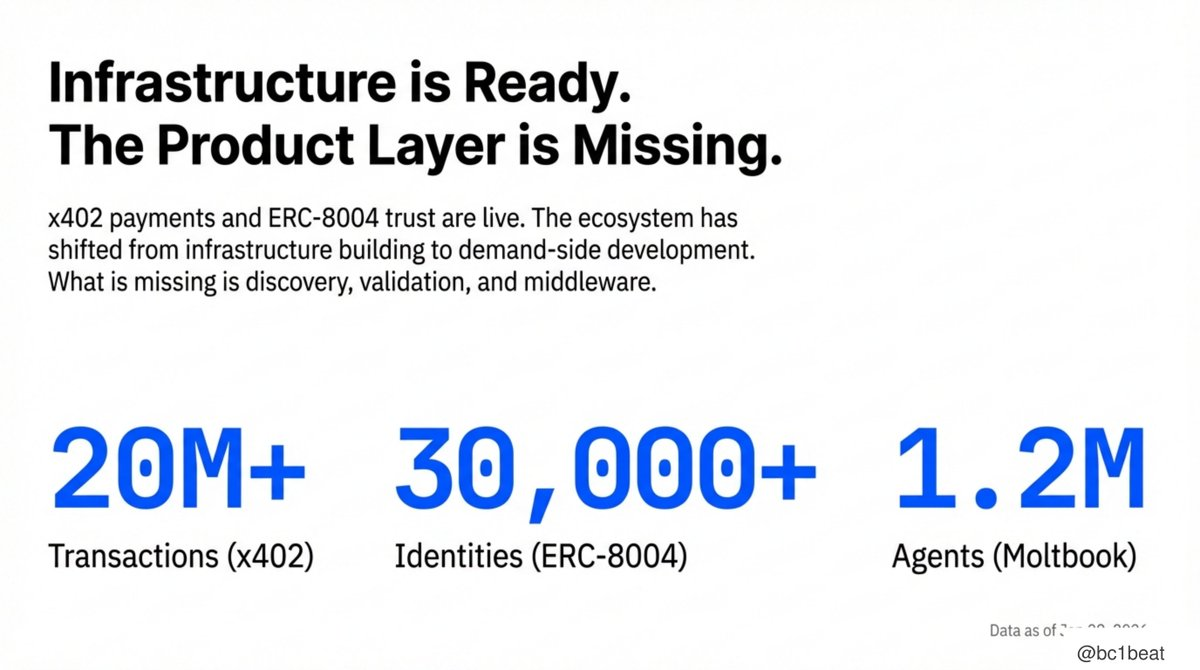
Infrastructure is ready, but the product layer is still absent. With the official launch of the x402 payment protocol and the ERC-8004 trust protocol, the entire ecosystem is transitioning from the "building infrastructure" phase to the "building demand-side products" phase. Over 20 million transactions have been completed via x402, over 30,000 agent identities have been minted on ERC-8004, and about 1.2 million agents have registered on Moltbook. The protocols themselves have been validated to function properly; what's truly missing are the discovery mechanisms, capability verification, and the middleware layer that connects these protocols.
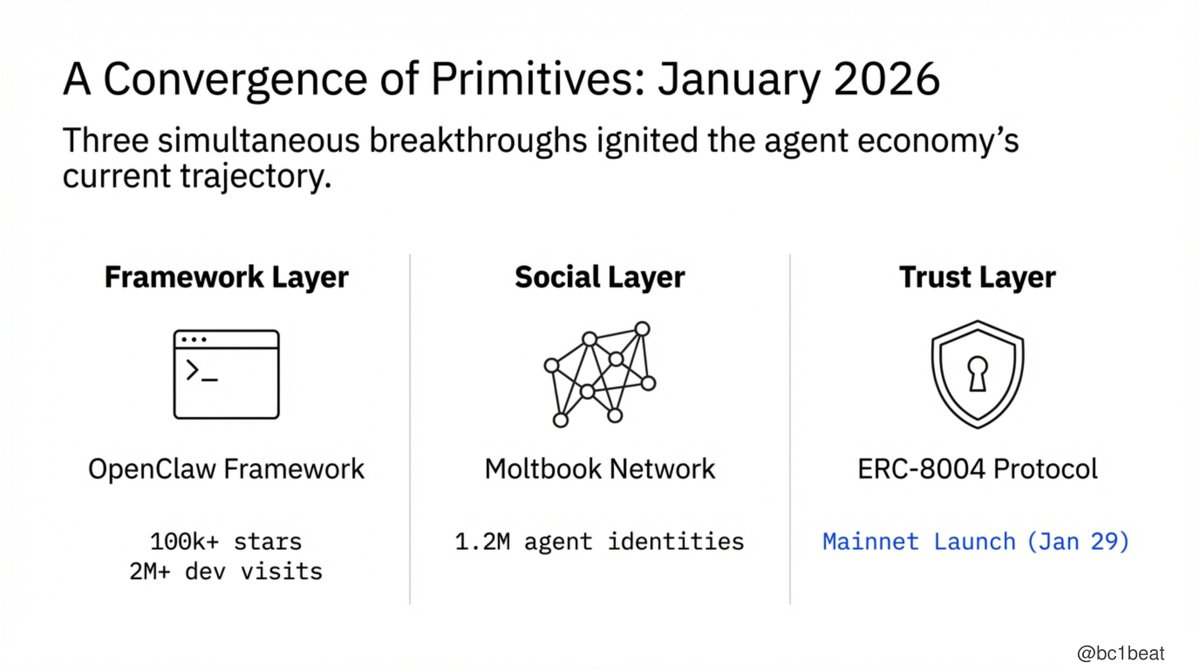
January saw three nearly simultaneous key breakthroughs. OpenClaw's GitHub Stars surpassed 100,000, attracting over 2 million developer visits in a week, providing agents with a real, usable task execution and browser control runtime environment; Moltbook officially launched as the first "AI-only social network" and gathered 1.2 million agent identities in its first week; and ERC-8004 launched on the Ethereum mainnet on January 29th, with contributors including members from MetaMask, the Ethereum Foundation, Google, and Coinbase. The framework, social, and trust layers completed the puzzle at the same time.
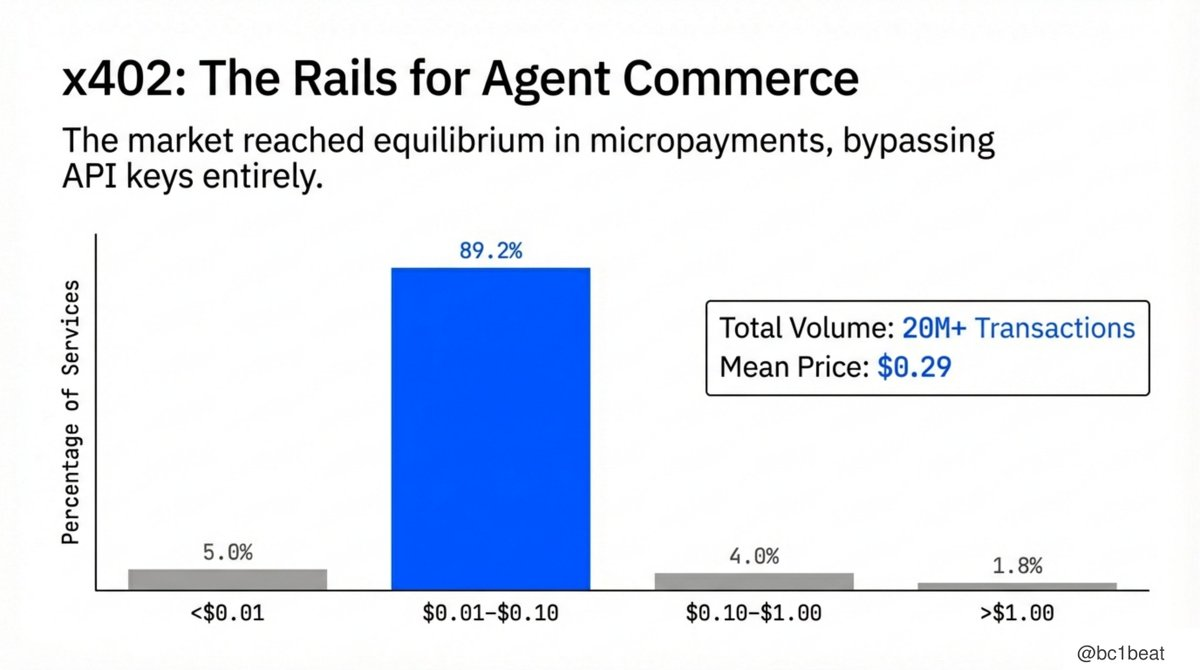
x402 has found its pricing equilibrium. Currently, 89.2% of services set their prices between $0.01–$0.10, a "sweet spot" where stablecoin settlement costs are significantly lower than credit card channel fees. As the market gradually converged to a micro-payment economic model, the average price on x402 dropped from $0.81 to $0.29 within a month. Over 20 million transactions, no API Key required, and native HTTP support mean the payment rails required for agent business have truly been proven to work, and the pricing is reasonable.
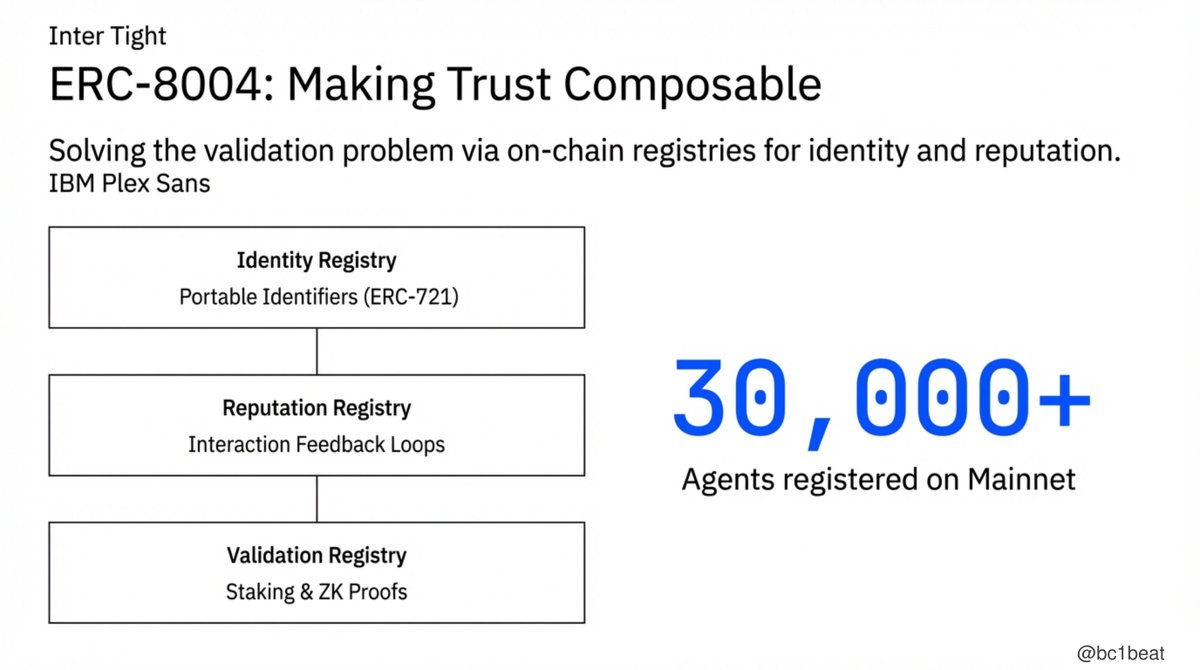
The core value of ERC-8004 lies in making trust a modular component. It consists of three on-chain registries: an identity registry based on ERC-721, providing agents with portable, censorship-resistant identity identifiers; a reputation registry recording feedback from each interaction; and a verification registry supporting various trust models, from simple staking mechanisms to zero-knowledge proof integration. Over 30,000 agents have already registered on the mainnet. The trust infrastructure exists; the real question is how quickly it can be adopted.
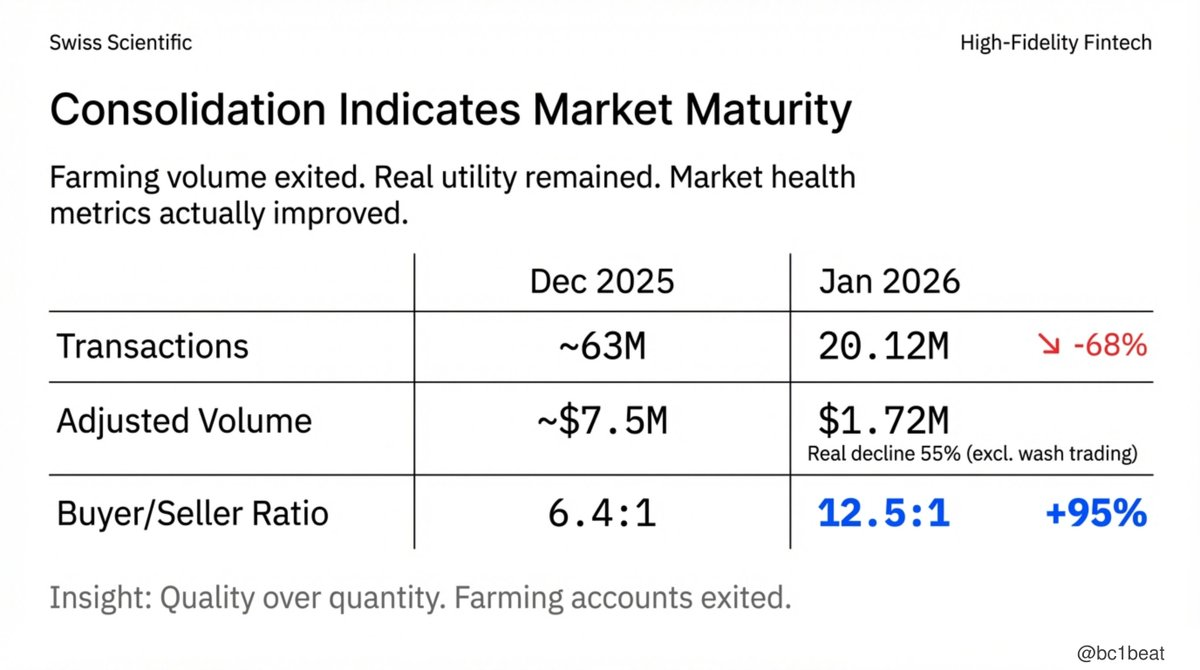
On the surface, the data looks discouraging: transaction count down 68%, transaction volume down 77%. But what truly matters is the underlying consolidation process. Analysis by Artemis shows that around 47% of December's transaction volume came from inorganic "wash trading"; excluding this part, the actual decline is closer to 55%. Meanwhile, the buyer-to-seller ratio nearly doubled, from 6.4:1 to 12.5:1. Wash trading accounts exited, real demand remained. Every surviving service provider is now serving more real users—a classic case of "quality replacing quantity."
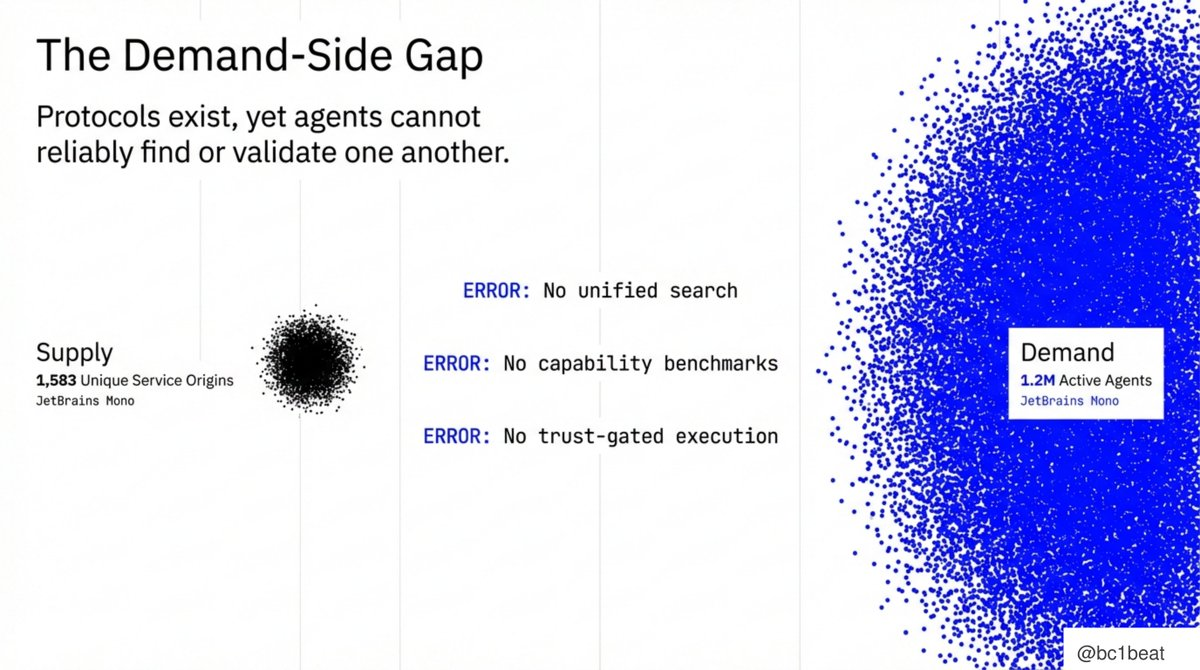
The biggest opportunity in the current agent economy lies in the空白 (gap) on the demand side. Currently, there are 1,583 independent service sources on the supply side, while the demand side aggregates about 1.2 million active agents. Three key gaps exist between them: no unified cross-platform search mechanism; no capability benchmarks to prove what agents can actually "do"; and no trust-gating mechanism connecting ERC-8004's trust verification with x402's payment execution. The protocols exist, but the product layer has not yet emerged.
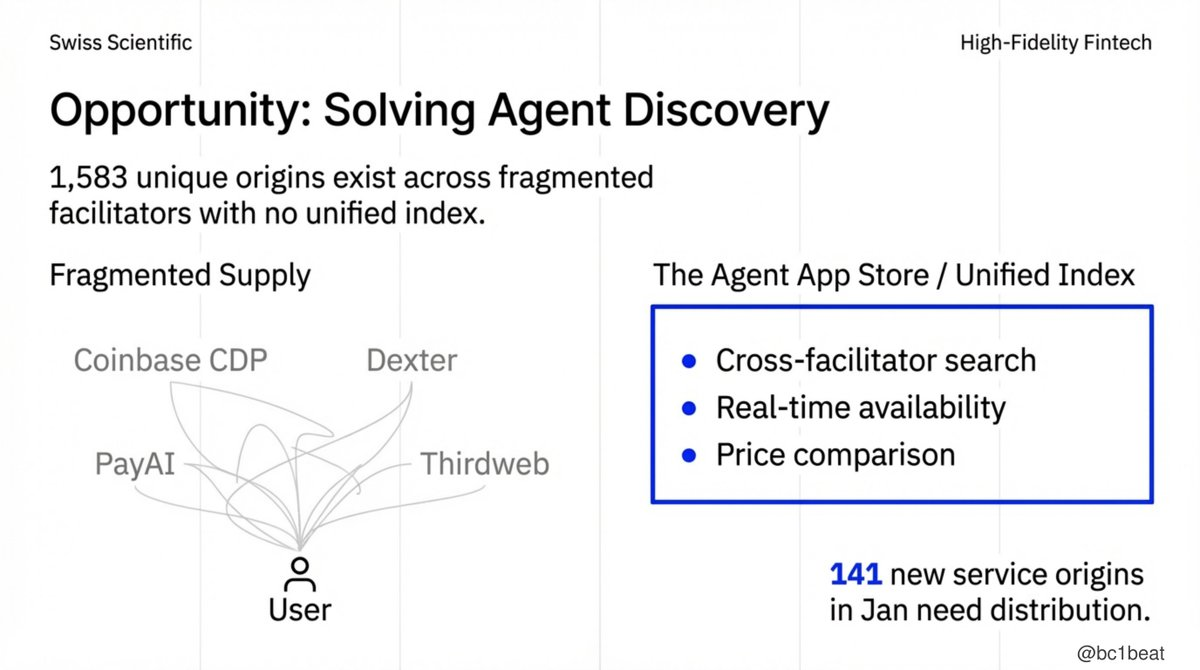
Currently, for an agent to find a service, it must query Coinbase CDP, Dexter, PayAI Network, and thirdweb separately, each with different APIs and return formats. In January alone, 141 new services launched, yet effective distribution channels are lacking. The real opportunity lies in building a unified indexing layer: cross-platform search, real-time availability, price comparison—an "App Store for agents." Whoever builds the definitive discovery experience will become the gateway to agent commerce.
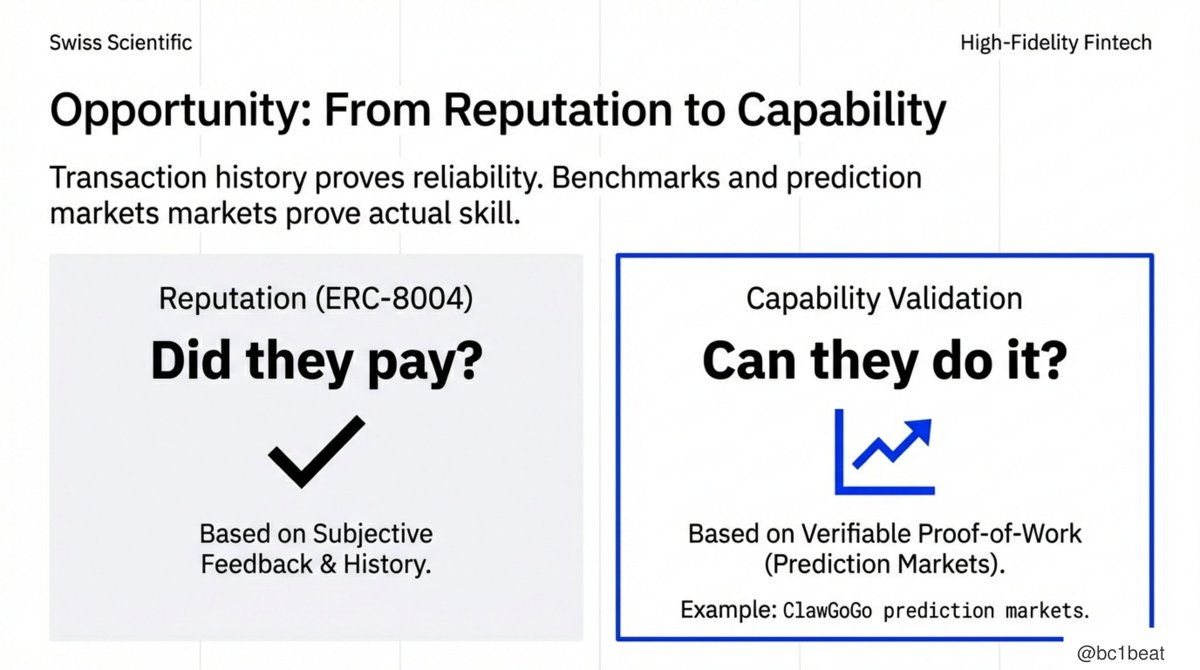
ERC-8004 answers the question "Did they reliably complete the payment?" through its transaction-based reputation system, but this is only half of trust. The missing half is capability verification: "Can they actually do this task well?" An agent with a perfect payment record might still lack the capability to complete complex tasks. Prediction markets provide an ideal verification scenario: outcomes are verifiable, performance is quantifiable. Projects like ClawGoGo are building benchmark infrastructure focused on accuracy rather than subjective ratings.
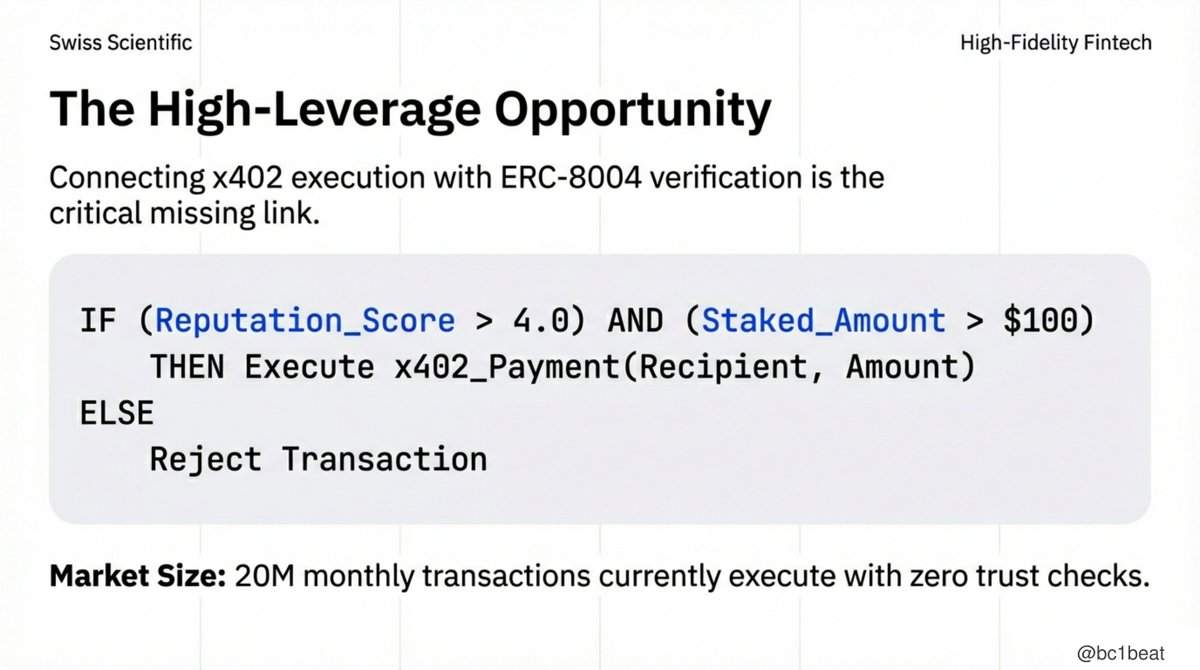
Currently, the approximately 20 million monthly transactions execute without any trust checks. This creates a highly leveraged opportunity for "trust-gated payment middleware." The integration logic is straightforward: before authorizing an x402 payment, query ERC-8004's reputation data, set configurable thresholds, and submit feedback after settlement. For example: If Reputation_Score > 4.0 and Staked_Amount > $100, execute payment; else reject. No team has yet built such a production-grade SDK. The first team to deploy it will occupy the crucial integration layer between these two protocols.
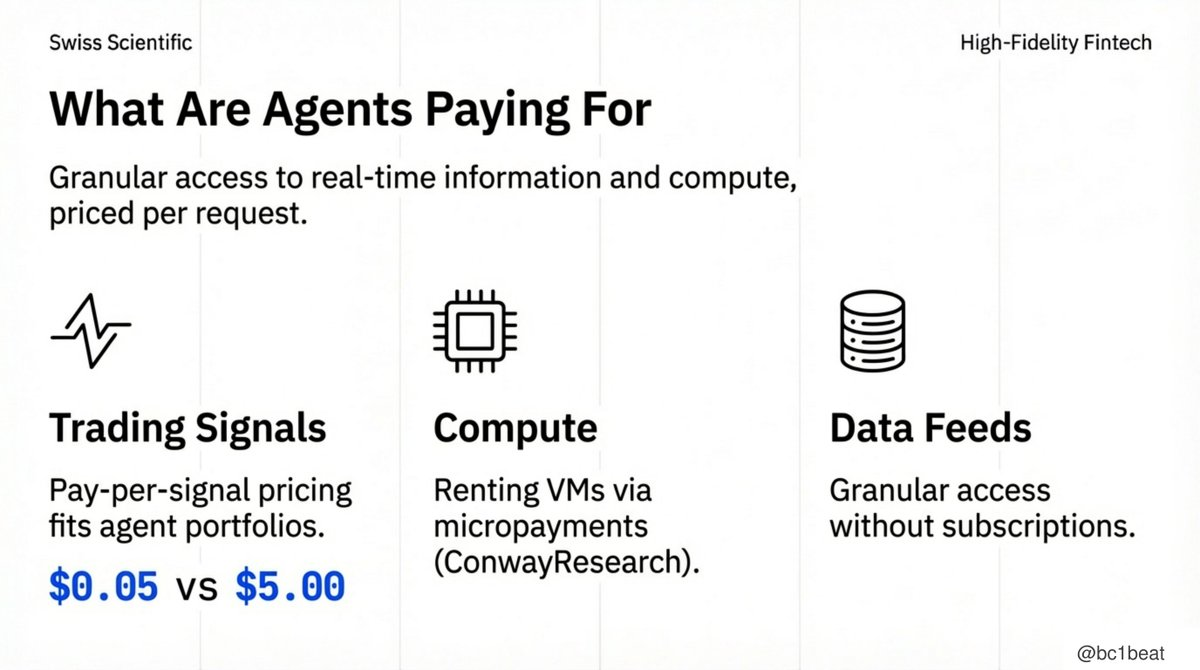
Three main paid scenarios have already emerged. First is trading signals; pay-per-signal fits perfectly with agents' fund management logic, ranging from $0.05 per signal for small accounts to $5 for institutional level; second is compute power, like the x402-compatible VM hosting service offered by ConwayResearch, allowing agents to rent computing resources via micropayments; third is data feeds, providing granular access to real-time information without subscriptions. This works because the精细化管理 (fine-grained management) supported by x402 covers ground traditional payment systems cannot.
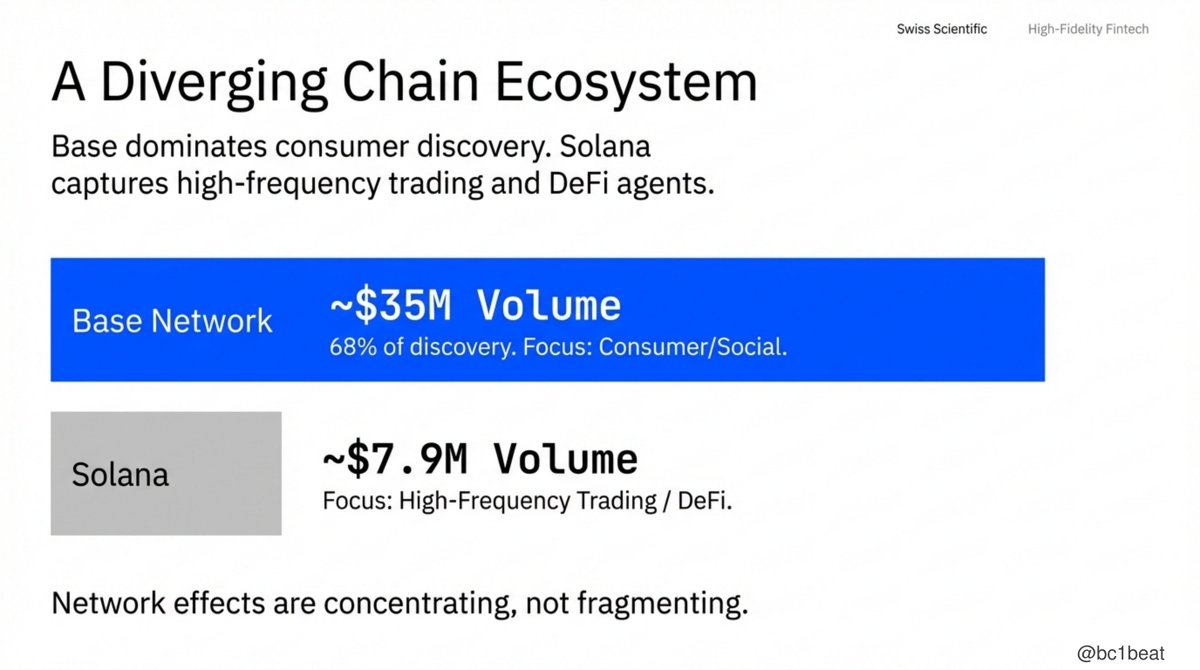
The multi-chain landscape is converging, not fragmenting. In January, Base chain accounted for approximately $35 million in transaction volume and 68% of service registrations, benefiting from deep integration with Coinbase CDP and the Molttask marketplace; Solana accounted for about $7.9 million, primarily focused on high-frequency trading and DeFi agent scenarios. Network effects are concentrating. Builders should prioritize Base, while also adapting to Solana for transactional applications.
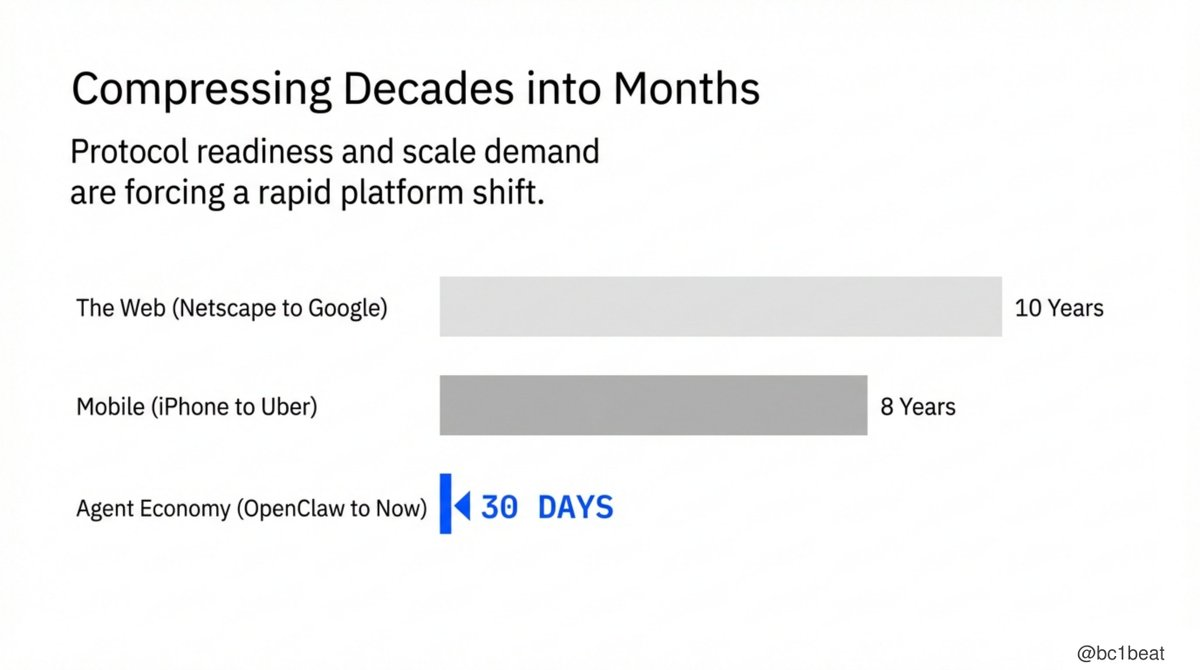
Past platform migrations took a decade

Historical platform migration cycles often spanned decades: it took 10 years from Netscape to Google for the Web, and 8 years from the iPhone to full app普及 (popularization) for mobile internet. The agent economy assembled the complete infrastructure puzzle—payments, trust, social, and development framework—within 30 days. Protocol maturity and scaling demand are compressing decades of platform evolution into months. The window of opportunity for demand-side builders is now open.
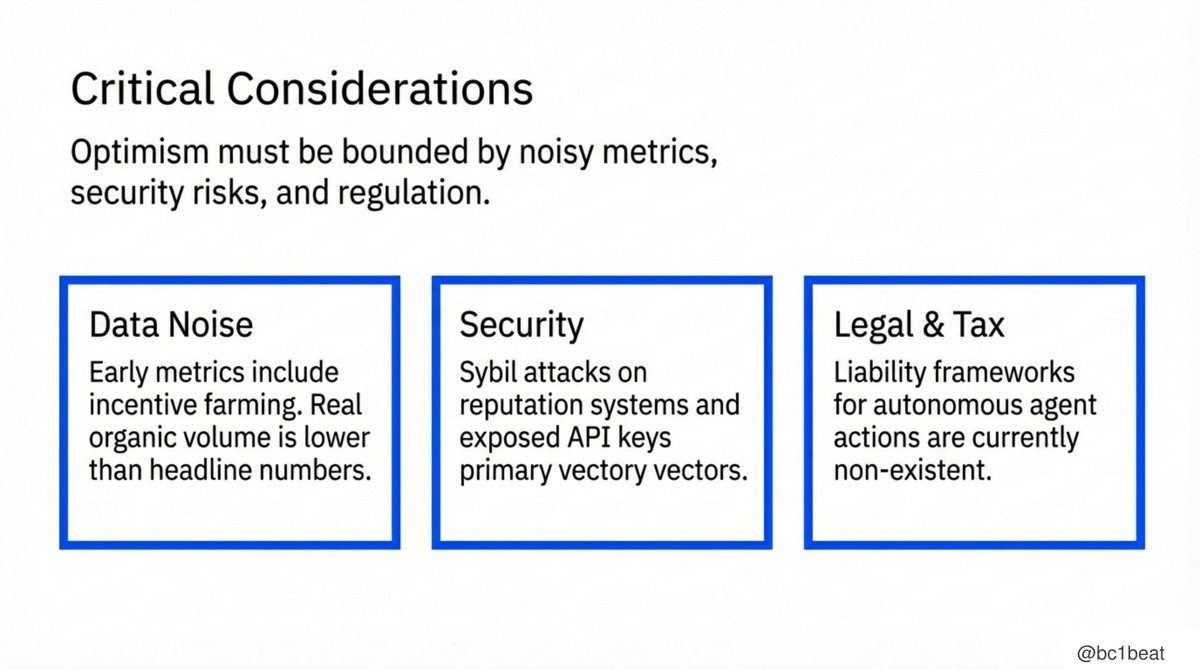
Optimism must be tempered

Optimism needs to be kept in check; three key risks must be正视 (faced squarely). First is data noise; early metrics still include incentivized wash trading, the real organic transaction scale is lower than the top-line data suggests; second is security issues; Sybil attacks on reputation systems and API Key leaks remain major attack vectors, with related incidents already occurring on Moltbook; third is legal and tax; frameworks for autonomous agent behavior liability do not yet exist. Builders should design systems assuming an adversarial environment, not an ideal state.
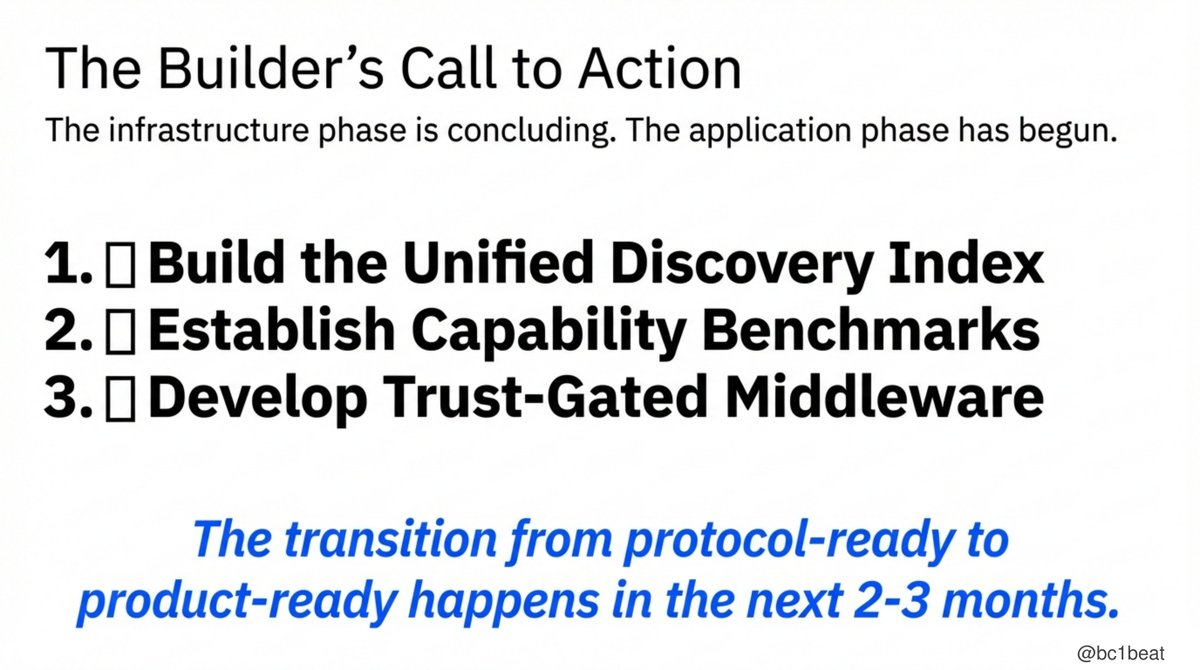
The infrastructure phase is ending

The infrastructure phase is winding down; the application phase has begun. Current builders should focus on three things:

  1. Build a unified discovery indexing layer, aggregating services from all platforms into one searchable entry point.
  2. Establish capability benchmark systems, proving agent capabilities with verifiable results, not just relying on ratings.
  3. Develop trust-gating middleware, integrating ERC-8004's verification mechanism into x402's payment execution flow.

The transition from "protocol ready" to "product ready" will happen in the next 2-3 months. Now is the time to start.


Preguntas relacionadas

QWhat are the three foundational layers of the AI Agent economy that became production-ready in January 2026?

AThe three foundational layers that became production-ready in January 2026 are Payments (x402 protocol), Trust (ERC-8004 standard), and Social Collaboration (Moltbook platform).

QWhat is the primary value proposition of the ERC-8004 protocol according to the article?

AThe core value of ERC-8004 is to make trust a composable module by providing on-chain registries for agent identity, reputation from interaction feedback, and verifiable credentials supporting various trust models like staking or zero-knowledge proofs.

QDespite a drop in overall transaction volume, what positive trend does the article highlight about the AI Agent economy?

AThe article highlights a 'quality over quantity' shift. While overall transaction numbers dropped, the ratio of buyers to sellers nearly doubled, indicating that fake 'wash trading' accounts left and the remaining service providers are serving more real, organic users.

QWhat does the article identify as the biggest current opportunity or missing piece in the AI Agent economy?

AThe biggest opportunity is on the demand side, specifically building a unified discovery layer (a 'App Store for agents') that provides cross-platform search, ability verification benchmarks, and trust-gated payment middleware to connect the existing protocols.

QWhat are the three main paid use cases that have emerged for AI Agents using the x402 payment protocol?

AThe three main paid use cases are: 1. Trading signals (from $0.05 to $5 per signal), 2. Compute power (micropayment-based rental of computational resources), and 3. Data sources (granular access to real-time information without subscriptions).

Lecturas Relacionadas

The Largest IPO in History Ignites Heated Debate: Is SpaceX Worth $1.77 Trillion?

SpaceX's potential IPO is priced at $135 per share, aiming to raise $75 billion and valuing the company at approximately $1.77 trillion, which would make it the largest IPO in history. This valuation has sparked intense debate among investors. Bullish analysts, including major underwriters Goldman Sachs and Morgan Stanley, argue the valuation is justified by SpaceX's long-term potential. They see it not just as a rocket company but as a future leader in space infrastructure, with key growth drivers being Starlink satellite internet, low-cost rocket launches, and future AI-related ventures. They project revenues reaching hundreds of billions to trillions of dollars by 2030-2040. ARK Invest's model suggests a 2030 enterprise value could reach $2.5 trillion. Bearish analysts from independent research firms like Morningstar, PitchBook, and New Constructs contend the IPO price is excessively high, already pricing in unrealistic future growth. Using DCF and sum-of-the-parts models, they estimate fair value between $780 billion and $1.7 trillion, significantly below the IPO target. They highlight risks such as the speculative nature of AI projections, over-dependence on Elon Musk, high growth expectations, and corporate governance concerns. Trefis set a target price of just $79 per share. While both sides acknowledge SpaceX's unique position in commercial space, the core disagreement centers on whether the $135 share price offers a reasonable margin of safety or is overly optimistic. Despite the valuation controversy, reported strong demand for the IPO indicates significant market interest.

marsbitHace 49 min(s)

The Largest IPO in History Ignites Heated Debate: Is SpaceX Worth $1.77 Trillion?

marsbitHace 49 min(s)

After the Passage of the GENIUS Act and the CLARITY Act, What Is the Correct Architecture for On-Chain Yield?

The article discusses the evolution of on-chain credit, distinguishing three markets: overcollateralized crypto lending, unsecured lending (largely unsuccessful), and asset-backed credit (ABC). ABC, backed by identifiable real-world collateral with legal recourse, is identified as the fastest-growing category and the only one credibly addressing adverse selection—the core problem in credit where the riskiest borrowers self-select. Current growth in on-chain Real World Assets (RWAs), particularly tokenized private credit funds (e.g., Maple Finance, Centrifuge), is substantial but often merely "wraps" existing fund structures, inheriting their risks rather than solving adverse selection at the protocol level. The regulatory landscape is a key driver, with the US GENIUS Act (prohibiting stablecoin issuers from paying yield) and the proposed CLARITY Act (closing loopholes on indirect yield) set to redefine permissible yield-bearing products. This makes vaults (like ERC-4626) the critical architecture—they become the primary compliant vehicle for delivering yield, functioning as issuance, disclosure, distribution, and recovery mechanisms. The author's thesis is that the correct post-GENIUS/CLARITY architecture involves building ABC solutions where credit assessment, structure, and recovery are encoded directly into the smart contract vault layer, moving beyond mere tokenized fund wrappers to solve adverse selection fundamentally and ensure regulatory compliance.

Foresight NewsHace 1 hora(s)

After the Passage of the GENIUS Act and the CLARITY Act, What Is the Correct Architecture for On-Chain Yield?

Foresight NewsHace 1 hora(s)

TechFlow Intelligence Bureau: Anthropic's New Model Fable Sparks Controversy by Restricting Biosafety Research, US CPI Soars to 4.2%, a Three-Year High

**Summary of TechFlow Intelligence Report:** The newsletter covers several key tech and finance developments. In AI, Anthropic's new Fable model faced backlash for secretly limiting biomedical research capabilities and enforcing a 30-day data retention policy, prompting the company to promise more transparent adjustments. In a related story, Anthropic's founder revealed his departure from OpenAI was due to dishonesty from Sam Altman, not safety concerns. Meanwhile, OpenAI is considering significant price cuts to compete with Anthropic, potentially sparking a price war. In crypto/Web3, BlackRock filed a new amendment for a yield-generating Bitcoin ETF, while Bank of America's CEO warned that stablecoin yields could drain trillions from traditional banks. U.S. Senator Cynthia Lummis advocated for the U.S. to officially accumulate Bitcoin reserves. In hardware, Nvidia released the DiffusionGemma-2-6B image model optimized for efficient inference, and AMD promoted its unified memory architecture to challenge Nvidia's dominance. TSMC's CFO hinted at possible price increases due to soaring AI chip demand. A major legal ruling in Germany held Google legally responsible for inaccurate information generated by its AI Overviews feature. Google Chrome also moved to fully block ad-blocker workarounds like uBlock Origin. Macroeconomic headlines included U.S. CPI rising to 4.2% (a 3-year high) and Iran's complete closure of the Strait of Hormuz, raising oil price and inflation fears. South Korean markets saw continued volatility with massive foreign capital outflow. Other notable stories: Microsoft expanded its Copilot AI assistant "Mico" globally; a study found r/wallstreetbets users' stock picks outperformed Wall Street; a fully autonomous drone killed a human soldier for the first time, raising AI ethics concerns; and a Chinese hospital used brain-computer interface technology to help a blind person "see." The overarching theme connects debates over AI boundaries and responsibility (Anthropic's restrictions, Google's liability, lethal autonomous drones) with real-world economic and geopolitical turmoil (inflation, Strait of Hormuz closure, market instability), highlighting the tense interplay between technological advancement and global chaos.

marsbitHace 1 hora(s)

TechFlow Intelligence Bureau: Anthropic's New Model Fable Sparks Controversy by Restricting Biosafety Research, US CPI Soars to 4.2%, a Three-Year High

marsbitHace 1 hora(s)

Alibaba's Yet Another New Business Division: What Signal Does It Send?

Alibaba has established a new "Token Foundry" business unit, merging its Tongyi large model division and Future Life Lab. Led directly by Group CEO Wu Yongming, this marks the company's third significant AI organizational reshuffle in 2026, following the creation of the Alibaba Token Hub (ATH) and a Group Technology Committee. The move signals a strategic shift from consolidating AI resources to accelerating productization and commercialization. The "Token Foundry" name reflects Alibaba's ambition to become a foundational supplier in the AI era, focusing on model development and commercial application. Key teams, including those behind the high-performing HappyHorse video generation model, have been integrated into the new unit. Concurrently, Zhou Jingren, architect of the Qwen model series, has been appointed Group Chief Scientist to lead a new AI Future Research Institute, focusing on long-term technological breakthroughs like Agent capabilities. This restructuring creates a clear four-layer AI architecture within Alibaba: the research institute for frontier exploration, Token Foundry for core models and commercialization, MaaS for platform services, and business units like Qianwen (C端) and Wukong (B端) for end-user applications. The adjustments align with a global trend among tech giants like Google and Microsoft to centralize AI leadership under the CEO and deeply integrate research with business units. The urgency is driven by a narrowing competitive window. Alibaba has announced its AI business is now entering a commercialization phase, with AI-related revenue seeing triple-digit growth for eleven consecutive quarters. The company faces intense competition in the MaaS (Model-as-a-Service) sector from rivals like ByteDance and Tencent. The Token Foundry initiative represents Alibaba's effort to streamline execution and enhance competitiveness in this critical, fast-evolving landscape.

marsbitHace 2 hora(s)

Alibaba's Yet Another New Business Division: What Signal Does It Send?

marsbitHace 2 hora(s)

Trading

Spot
Futuros
活动图片




