Illustrating the Capital Market After DeepSeek V4's Launch: Zhipu and MiniMax Plunge, NVIDIA Panics

marsbitPublicado a 2026-04-24Actualizado a 2026-04-24

Resumen

DeepSeek V4, a 1T parameter MoE model with a 285B Flash version, has been fully open-sourced under Apache 2.0, triggering significant reactions across capital markets. Chinese AI chipmakers like Cambricon and Hygon saw major stock gains, with Cambricon rising 60% monthly. In contrast, Hong Kong-listed AI firms Zhipu and MiniMax dropped over 7%, facing heavy short-selling. NVIDIA’s shares dipped, with analysts noting a "decoupling" of Chinese and North American AI inference demand. The launch intensified competition in the AI model space, following 11 major releases in 30 days, including GPT-5.5 and Llama 4. Unlike others, V4’s permissive licensing and full open-source release challenged closed-source models on performance, cost, and accessibility. Critically, V4 announced Day-0 support for domestic chips like Huawei’s Ascend 950PR and Cambricon’s Siyuan 590, offering better cost-performance than NVIDIA counterparts. This shift reduces reliance on CUDA, aligning with NVIDIA CEO’s earlier concerns about Chinese AI chips threatening its dominance. The move signals a tangible step in China’s AI supply chain independence, redirecting compute demand to local manufacturers like Hua Hong Semiconductor.

DeepSeek V4 is finally live. This is a moment that has been awaited for nearly five months. The main model with 1T MoE parameters + the 285B parameter Flash version, followed by the full 1.6T Pro version, all open-sourced on GitHub under the Apache 2.0 license, with weights and deployment code released simultaneously.

As soon as the model was released, the capital market responded in three distinct yet interconnected ways.

Different Reactions in the Capital Market

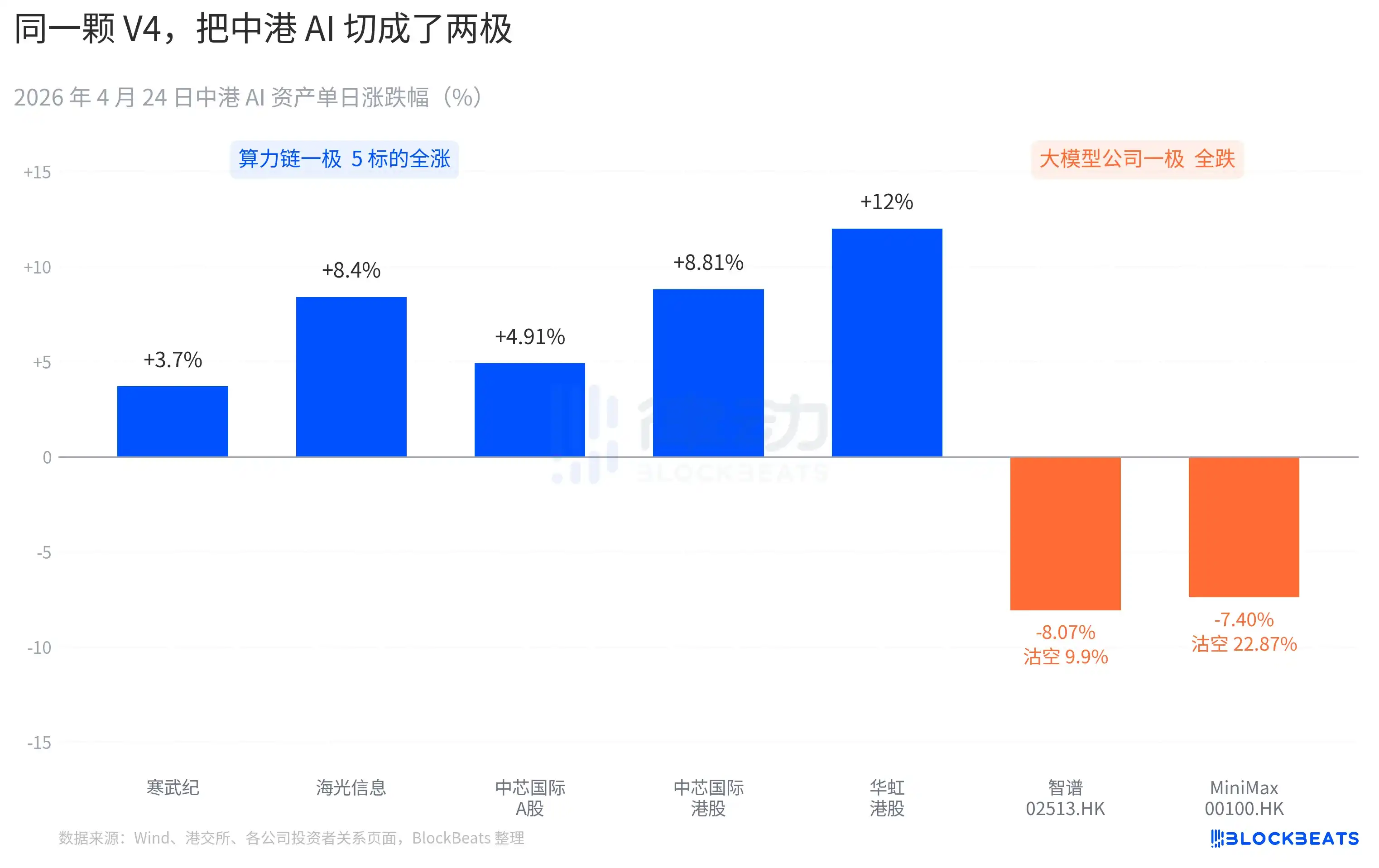
On the A-share computing power chain side, there was an almost across-the-board surge. Cambricon saw 11 consecutive days of gains, rising 3.7% in a single day, with a cumulative increase of over 60% within the month. Hygon Information hit a 10% daily limit during trading, closing up 8.4%. SMIC's A-shares rose 4.91%, while its Hong Kong shares climbed 8.81%. Huahong's Hong Kong shares surged as much as 18% before closing up 12%. The Cathay Pacific ETF for科创芯片 (Science and Technology Innovation Chip) attracted 2.4 billion yuan in a single day, reaching a historic high in scale.

On the Hong Kong stock market, large model companies showed a different color. Zhipu (02513.HK) fell 8.07%, with a short-selling ratio of 9.9%. MiniMax (00100.HK) dropped 7.40%, with its short-selling ratio soaring to 22.87%. The latter represents the highest single-day short-selling data for the Hong Kong AI sector in the past three months. Both companies are representatives of the Hong Kong AI listing wave expected in the second half of 2025, with their IPO prospectuses highlighting the same core competency: "self-developed foundational large models."
The reaction on the other side of the Pacific was equally specific. NVIDIA opened down 1.8% last night, falling as much as 2.6% during the session, and closed flat for the day. Bloomberg's market commentary compared this consolidation to the V3 "DeepSeek moment" on January 27. The difference is that the January episode was a panic sell-off, wiping out $600 billion in market value in a single day. This time, it was more like a repricing—milder in scale but clear in direction. A new phrase appeared in buy-side research notes: "China's AI inference demand is beginning to decouple from North America's AI inference demand."

Layering these three market reactions together, we get the first verdict written by the market within 24 hours of V4's launch. After open source prevailed, money began to reposition. What can be priced is no longer the model itself, but which card the model runs on and which supply chain it is embedded in.

11 New Models in 30 Days: V4 Adds Fuel to the Open-Source Camp

The timing of V4's release is part of the reason why the reaction was amplified.

Zooming out to the past 30 days: between March 26 and April 24, at least 11 significantly influential large models were released or received major updates, covering almost all major players. The list includes Anthropic Opus 4.6, Google Gemini 3.1 Pro, OpenAI GPT-5.5, Mistral Large 3, Meta Llama 4, Moonlight's Kimi K2.6, Alibaba Qwen3-Next, ByteDance Doubao 2.5 Pro, Tencent Hunyuan 3.0, Kimi K2.6 Plus, and finally, DeepSeek V4, released in the early hours of April 23.

On average, a new model was released every 2.7 days. This is a pace even fund managers can't keep up with in reading release notes. But looking at the K-lines of AI assets in China and Hong Kong over these 30 days, only one name left a lasting mark on the market. GPT-5.5 on April 8 drove NVIDIA up 4.2% in a single day, peaking that day. Then, DeepSeek V4 on April 23-24 drove consecutive jumps in the China-Hong Kong computing power chain.
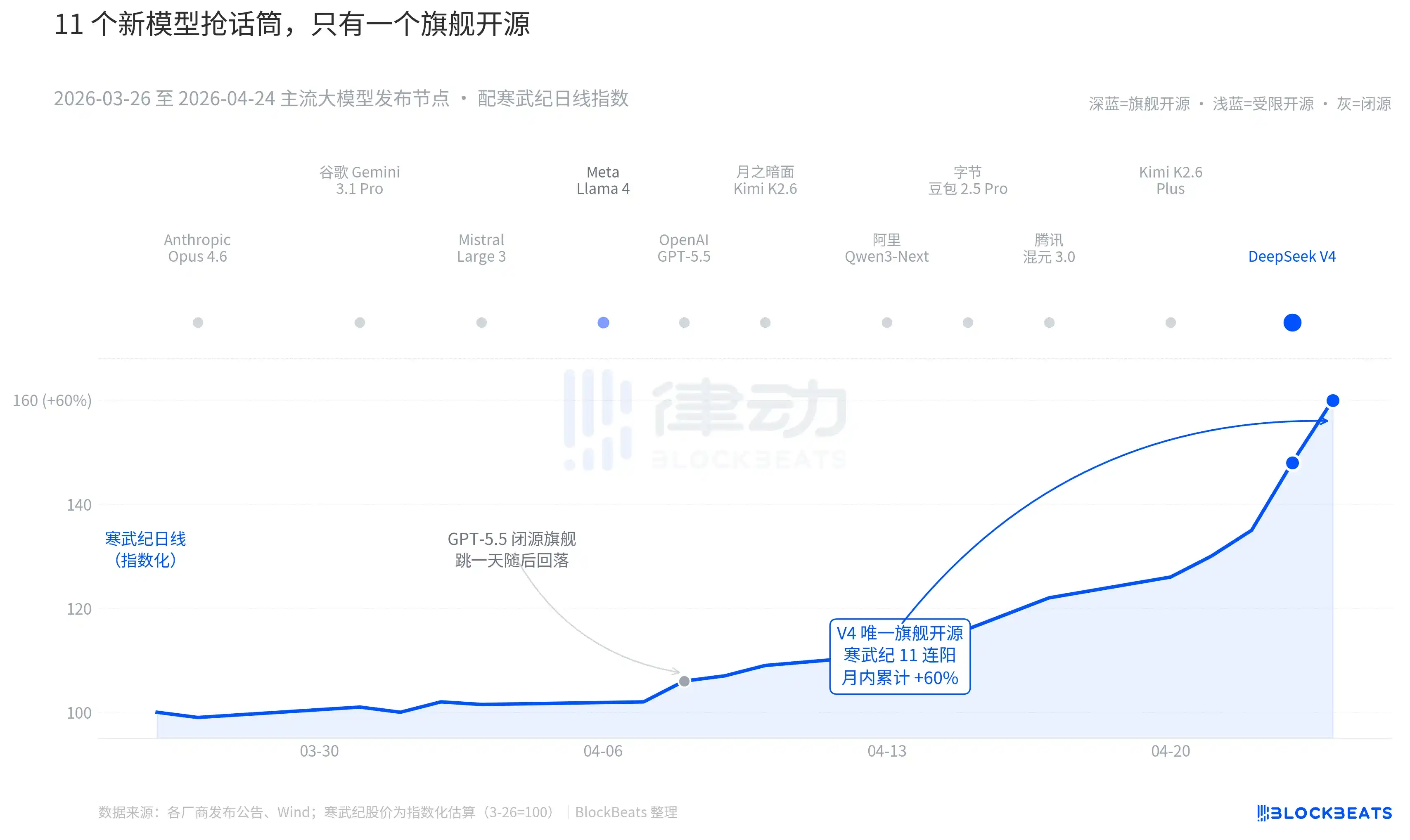
The difference does not lie in the model capabilities themselves. The gap between these 11 models on the LMArena leaderboard is mostly within 50 points, falling within a narrow band of the "same tier." The difference lies in the叠加 (superposition) of two things.

The first is open source. Among the first 10 models, only Llama 4 was open source, but Llama 4's weight协议 (license) came with a long list of commercial use restrictions, receiving冷淡 (lukewarm)评价 (evaluations) from the欧美 (European and American) developer community, and it fell out of the top ten on OpenRouter on the third day. V4's license is Apache 2.0, with no门槛 (barriers) for weights, no restrictions on commercial use, and推理代码 (inference code) released simultaneously. This is the first flagship open-source model in the past six months to simultaneously pressure the closed-source camp on three dimensions: performance, price, and openness.

The second is timing. Against the backdrop of the closed-source camp continuously releasing major updates, the open-source narrative is being repeatedly squeezed. Opus 4.6 pushed the SWE-Bench for code tasks to a new high, and GPT-5.5 set a下沉锚点 (downward anchor point) of $1.25 per million tokens. The debate over whether open source can catch up with closed source has been ongoing in Silicon Valley for two years. V4, with an open-source flagship whose estimated MAU surged to 90 million, pressed the pause button on this debate.

As one large domestic fund manager stated in a roadshow, "Before V4, we applied a discount to the valuation of open-source large models. After V4, this discount is starting to be收 (collected) in reverse."

DeepSeek Replaced the Pricing Table of the Computing Power Supply Chain

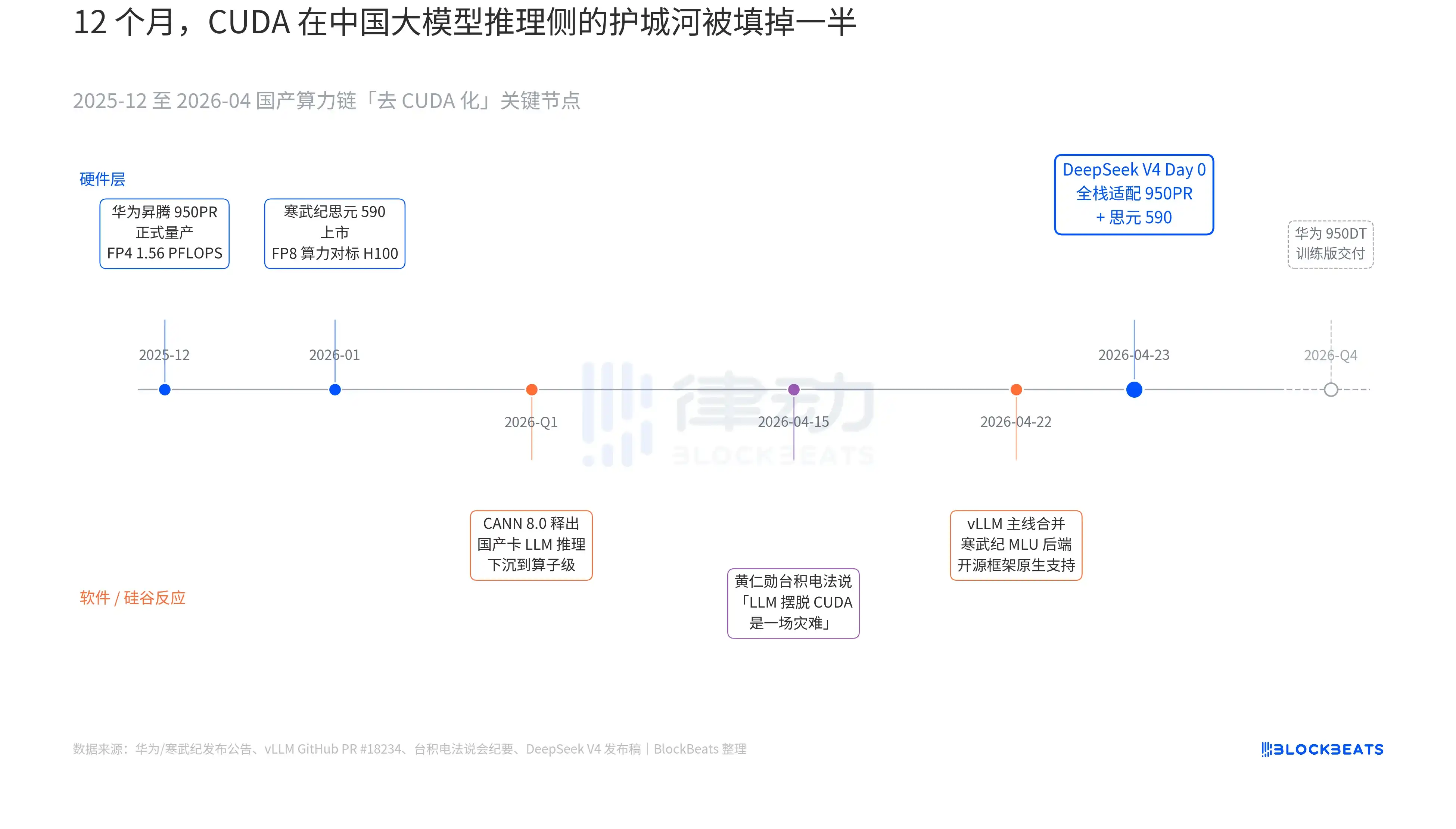
V4's release notes contained a line that had never appeared in any official document of a Chinese large model before: "Day 0 full-stack adaptation for Cambricon Siyuan 590 and Huawei Ascend 950PR, with deployment code open-sourced simultaneously." The weight of this line becomes clear only when three暗线 (undercurrents) that have been unfolding in parallel over the past 12 months are connected. These three undercurrents belong to hardware, software, and Silicon Valley's reaction, respectively.

The first undercurrent is on the chip side. Huawei's Ascend 950PR entered mass production in December 2025, with FP4算力 (computing power) of 1.56 PFLOPS and HBM capacity of 112GB, marking the first time domestic AI chips have matched NVIDIA's B-series on hard metrics. In推理任务 (inference tasks) for a 1T parameter MoE model like V4, single-card吞吐 (throughput) increased by 2.87 times compared to the H20. The配套 (supporting) CANN 8.0 software stack optimizes the LLM inference framework down to the算子级别 (operator level). DeepSeek's公开 (public) Benchmark shows that V4's end-to-end inference latency on an Ascend超节点 (super node) (8-card 950PR) is 35% lower than on an equivalent-scale H100 cluster. Cambricon Siyuan 590's data is even more aggressive, with single-chip FP8算力 (computing power)对标 (matching) the H100, at less than half the price.

The second undercurrent is on the software side. The vLLM mainline merged the Cambricon MLU backend PR on April 22, marking the first time an open-source inference framework natively supports non-NVIDIA domestic GPUs. Hygon Information's DCU takes another path through the ROCm ecosystem but can fully run V4's MoE routing layer. This means that deploying V4 is no longer "only runnable on a specific domestic card" but "choosable among multiple domestic cards." The ecosystem's dependence on a single supplier is broken, which is a critical拐点 (inflection point) for production.

The third undercurrent comes from Silicon Valley. On April 15, Jensen Huang's (NVIDIA CEO) was pressed by an analyst at TSMC's earnings call about the progress of China's domestic computing power. His原话 (original words) were冷峻而具体 (chillingly specific): "If they can really make LLMs摆脱 (break free from) CUDA, it would be a disaster for us." Nine days later, DeepSeek provided the answer with a single Day 0 announcement.
The phrase "国产替代" (domestic substitution) has been overused to the point of losing meaning over the past three years. But after the morning of April 24, this matter gained specific data that can be priced by the capital market for the first time. Single-card throughput, end-to-end inference latency, inference cost, and commercially deployable code quietly pushed this long war of words past the threshold into production.

The logic behind Cambricon's 11 consecutive阳线 (rising days) is hidden here. It is no longer a "domestic GPU concept stock" but a "DeepSeek V4推理基础设施供应商" (inference infrastructure supplier). The same logic explains Huahong's 12% surge in Hong Kong shares; it代工 (manufactures) the 7nm equivalent process for the 950PR. Every V4 token running on a domestic Ascend card means that capacity originally destined for NVIDIA and TSMC is partially截留 (retained) in the Pearl River Delta.

And the next step has long been laid out. In Huawei's roadmap, the 950DT (training version) is scheduled for delivery in Q4 2026, targeting "full-stack training of V5 or equivalent models on a 10,000-card cluster." If this path can be successfully traversed, CUDA's moat in the training side of China's large models will be downgraded from "necessary" to "optional."


Preguntas relacionadas

QWhat were the immediate market reactions to the release of DeepSeek V4?

AThe A-share computing power chain stocks surged, with Cambricon rising 60% monthly, Haiguang Information hitting a 10% limit up, and SMIC and Huahong also seeing significant gains. In contrast,港股大模型 companies like Zhipu and MiniMax saw sharp declines of over 7%, with high short-selling ratios. NVIDIA opened down 1.8% but closed flat, indicating a recalibration rather than panic selling.

QHow does DeepSeek V4's open-source approach differ from other major models released in the same period?

ADeepSeek V4 is released under the Apache 2.0 license, offering unrestricted commercial use, full weight access, and synchronized inference code. This contrasts with models like Llama 4, which had restrictive commercial clauses, and other closed-source models from Anthropic, Google, and OpenAI, making V4 the first flagship open-source model to pressure the closed-source camp on performance, price, and openness simultaneously.

QWhat specific hardware adaptations did DeepSeek V4 announce, and why are they significant?

ADeepSeek V4 announced Day 0 full-stack adaptation for Cambricon's Siyuan 590 and Huawei's Ascend 950PR, with deployment code open-sourced. This is significant as it marks the first time a Chinese LLM can natively run on multiple domestic GPUs, breaking dependency on single suppliers like NVIDIA, and providing concrete data on performance gains, such as higher throughput and lower latency compared to H100 clusters.

QHow did the release timing of DeepSeek V4 amplify its market impact?

AV4 was released amidst a crowded period of 11 major model releases or updates in 30 days, including from OpenAI, Google, and Anthropic. However, only V4 and GPT-5.5 had sustained market effects. V4's impact was magnified because it provided a high-performance, fully open-source alternative just as the closed-source narrative was dominating, leading to a reevaluation of open-source model valuations.

QWhat long-term implications does DeepSeek V4's success have for NVIDIA and the global AI supply chain?

AV4's success signals a potential decoupling of Chinese AI inference demand from North American supply, as it enables production-grade deployment on domestic hardware like Huawei Ascend and Cambricon chips. This could reduce reliance on NVIDIA's CUDA ecosystem and divert manufacturing capacity from TSMC to local foundries like Huahong, threatening NVIDIA's market dominance in China and prompting a strategic shift in global AI supply chains.

Lecturas Relacionadas

TaiJi Secures $3.5 Million Strategic Funding with Participation from Castrum Capital, Becker Ventures, and Coinvestor Ventures

TaiJi Secures $3.5 Million Strategic Funding TaiJi has announced the completion of a $3.5 million strategic funding round, with participation from Castrum Capital, Becker Ventures, and Coinvestor Ventures. The investment will support product development, upgrades to its AI inference engine, the construction of a multi-agent analysis system, improvements to market data infrastructure, global community expansion, and the advancement of ecosystem partnerships. Operating within the BSC ecosystem, TaiJi is building an AI-driven on-chain market intelligence network. The platform integrates market data, on-chain fund flows, liquidity changes, social media sentiment, news events, and project developments into a unified AI inference system. This approach aims to transform fragmented information into structured event inferences, impact pathways, risk assessments, and follow-up indicators, helping users navigate the increasingly complex and event-driven Web3 market. Unlike traditional market tools, TaiJi is constructing an intelligent analysis framework. It continuously aggregates real-time data to form a native market data network and builds a dataset of post-event market reactions for review. A core component is its multi-agent inference framework, where specialized agents—for markets, on-chain activity, sentiment, risk, and events—collaborate to analyze signals and generate insights. The first phase of TaiJi's product will focus on several key modules: Market Intelligence for real-time data aggregation; a Scenario Engine for AI-driven event inference; an Impact Map visualizing effects on assets and narratives; Risk Signals for identifying potential threats; and My TaiJi for personalized tracking and historical analysis. With this new funding, TaiJi plans to accelerate product development and testing, gradually rolling out its core features while expanding its presence within the BSC ecosystem and the broader global Web3 market.

链捕手Hace 4 min(s)

TaiJi Secures $3.5 Million Strategic Funding with Participation from Castrum Capital, Becker Ventures, and Coinvestor Ventures

链捕手Hace 4 min(s)

Eight Global Central Banks Enter the Fray, Aiming to Claim a Piece of the Stablecoin Pie?

The article discusses the Agorá project, a global cross-border payment system initiative led by the Bank for International Settlements (BIS) with participation from eight major central banks (including the Federal Reserve Bank of New York, Bank of England, and Bank of Japan) and over 40 private financial institutions like JPMorgan and SWIFT. Agorá aims to create a unified platform for the instant settlement of cross-border transactions using tokenized commercial bank deposits. A key feature is its strict "permissioned" design, where funds are pre-labeled by country and smart contracts enforce AML and sanctions checks. This contrasts with the "permissionless" ideal suggested by its ancient Greek namesake. The system employs a two-tier architecture: central banks retain full control over sovereign reserves on separate ledgers, while private entities manage a shared ledger for multi-currency clearing. The project, which completed a prototype in May 2026, seeks to streamline the slow, multi-step process of traditional cross-border payments. It is positioned as a centralized, regulatory-compliant alternative to decentralized stablecoins like Tether, targeting large-scale institutional transfers. The analysis highlights a potential future market split: projects like Agorá could dominate wholesale institutional payments, while public blockchain-based stablecoins retain their role in retail, remittance, and emerging market use cases. This represents an effort by traditional finance to establish boundaries for decentralized networks. The upcoming integration of the EU's Pontes framework with its core settlement system will test this dynamic.

marsbitHace 23 min(s)

Eight Global Central Banks Enter the Fray, Aiming to Claim a Piece of the Stablecoin Pie?

marsbitHace 23 min(s)

BitMart Research Institute Weekly Highlights: ETF Continued Outflows + AI Drain, Crypto Market Seeks Bottom Amid Volatility

**BitMart Research Weekly Highlights: ETF Outflows and AI Demand Weigh on Crypto Market** The crypto market saw a correction this past week, diverging from the all-time highs in U.S. equity markets. Bitcoin (BTC) fell roughly 6%, while Ethereum (ETH) declined about 4.5%. The primary pressure point was significant and sustained outflows from U.S. spot Bitcoin ETFs, which experienced a record nine consecutive days of net redemptions totaling approximately $2.8 billion. Spot Ethereum ETFs also faced continuous outflows. This weakness in digital assets contrasted with the continued surge in traditional markets, particularly AI-related stocks. The news of Anthropic's secret IPO filing, targeting a potential $750B IPO, and Alphabet's major new AI infrastructure funding further fueled the tech rally. The analysis suggests a potential "liquidity siphon" effect, where capital is being diverted from crypto into the dominant AI investment narrative. Other notable developments include DTCC's DTC announcing plans to integrate Stellar for tokenized asset services, signaling a major step for tokenized equities. Meanwhile, MicroStrategy paused its primary mechanism for funding Bitcoin purchases to focus on debt management, removing a key institutional buyer from the market. The report concludes that the crypto market remains under pressure from the competing AI narrative and major upcoming IPOs, with a potential for a broader market bottom if an AI-driven correction occurs later this cycle.

marsbitHace 38 min(s)

BitMart Research Institute Weekly Highlights: ETF Continued Outflows + AI Drain, Crypto Market Seeks Bottom Amid Volatility

marsbitHace 38 min(s)

The Death of the Three-Act Play: AI Ushers Enterprise Software Startups into the ‘Speedrun Era’

The Death of the Three-Act Play: How AI is Ushering in a 'Speedrun Era' for Enterprise Software Startups The traditional three-act play for building an enterprise software company—first, a niche wedge product; second, an expanded suite; third, a dominant platform—is becoming obsolete in the AI era. Previously, startups would spend 3-5 years perfecting a single-point solution to reach tens of millions in ARR (Act 1: The Wedge). Then, over another few years, they'd build adjacent products to form a suite and cross the $100M ARR threshold (Act 2: The Suite). Finally, with scale and user engagement, they could aim to become a foundational platform themselves (Act 3: The Platform). This model assumed a timeline measured in years. However, AI-driven tools have dramatically compressed software development costs and timelines. Companies like Cursor, Clay, and Harvey have scaled from near zero to approaching or surpassing $100M ARR in remarkably short periods, demonstrating a new competitive pace. The core argument is that in this rapidly changing market, relying on a small, "safe" wedge as a protective harbor may now be a conservative, even risky, strategy. The plummeting cost of building software means the time required for Acts 1 and 2 is approaching zero. Consequently, rational strategy now favors planning to build the entire vision from the outset. This shift changes the calculus for early-stage investment. The emphasis is moving from finding a defensible niche to backing founders with "unreasonable, relentless ambition" to reimagine entire workflows or replace incumbent platforms from day one. The age of gradual expansion is giving way to an era of immediate, full-scale ambition.

marsbitHace 58 min(s)

The Death of the Three-Act Play: AI Ushers Enterprise Software Startups into the ‘Speedrun Era’

marsbitHace 58 min(s)

Trading

Spot
Futuros

Artículos destacados

Qué es $S$

Entendiendo SPERO: Una Visión General Completa Introducción a SPERO A medida que el panorama de la innovación continúa evolucionando, la aparición de tecnologías web3 y proyectos de criptomonedas juega un papel fundamental en la configuración del futuro digital. Un proyecto que ha atraído la atención en este campo dinámico es SPERO, denotado como SPERO,$$s$. Este artículo tiene como objetivo reunir y presentar información detallada sobre SPERO, para ayudar a entusiastas e inversores a comprender sus fundamentos, objetivos e innovaciones dentro de los dominios web3 y cripto. ¿Qué es SPERO,$$s$? SPERO,$$s$ es un proyecto único dentro del espacio cripto que busca aprovechar los principios de descentralización y tecnología blockchain para crear un ecosistema que promueva la participación, la utilidad y la inclusión financiera. El proyecto está diseñado para facilitar interacciones de igual a igual de nuevas maneras, proporcionando a los usuarios soluciones y servicios financieros innovadores. En su esencia, SPERO,$$s$ tiene como objetivo empoderar a los individuos al proporcionar herramientas y plataformas que mejoren la experiencia del usuario en el espacio de las criptomonedas. Esto incluye habilitar métodos de transacción más flexibles, fomentar iniciativas impulsadas por la comunidad y crear caminos para oportunidades financieras a través de aplicaciones descentralizadas (dApps). La visión subyacente de SPERO,$$s$ gira en torno a la inclusividad, buscando cerrar brechas dentro de las finanzas tradicionales mientras aprovecha los beneficios de la tecnología blockchain. ¿Quién es el Creador de SPERO,$$s$? La identidad del creador de SPERO,$$s$ sigue siendo algo oscura, ya que hay recursos públicos limitados que proporcionan información de fondo detallada sobre su(s) fundador(es). Esta falta de transparencia puede derivarse del compromiso del proyecto con la descentralización, una ética que muchos proyectos web3 comparten, priorizando las contribuciones colectivas sobre el reconocimiento individual. Al centrar las discusiones en torno a la comunidad y sus objetivos colectivos, SPERO,$$s$ encarna la esencia del empoderamiento sin señalar a individuos específicos. Como tal, comprender la ética y la misión de SPERO sigue siendo más importante que identificar a un creador singular. ¿Quiénes son los Inversores de SPERO,$$s$? SPERO,$$s$ cuenta con el apoyo de una diversa gama de inversores que van desde capitalistas de riesgo hasta inversores ángeles dedicados a fomentar la innovación en el sector cripto. El enfoque de estos inversores generalmente se alinea con la misión de SPERO, priorizando proyectos que prometen avances tecnológicos sociales, inclusión financiera y gobernanza descentralizada. Estas fundaciones de inversores suelen estar interesadas en proyectos que no solo ofrecen productos innovadores, sino que también contribuyen positivamente a la comunidad blockchain y sus ecosistemas. El respaldo de estos inversores refuerza a SPERO,$$s$ como un contendiente notable en el dominio de proyectos cripto que evoluciona rápidamente. ¿Cómo Funciona SPERO,$$s$? SPERO,$$s$ emplea un marco multifacético que lo distingue de los proyectos de criptomonedas convencionales. Aquí hay algunas de las características clave que subrayan su singularidad e innovación: Gobernanza Descentralizada: SPERO,$$s$ integra modelos de gobernanza descentralizada, empoderando a los usuarios para participar activamente en los procesos de toma de decisiones sobre el futuro del proyecto. Este enfoque fomenta un sentido de propiedad y responsabilidad entre los miembros de la comunidad. Utilidad del Token: SPERO,$$s$ utiliza su propio token de criptomoneda, diseñado para servir diversas funciones dentro del ecosistema. Estos tokens permiten transacciones, recompensas y la facilitación de servicios ofrecidos en la plataforma, mejorando la participación y la utilidad general. Arquitectura en Capas: La arquitectura técnica de SPERO,$$s$ apoya la modularidad y escalabilidad, permitiendo la integración fluida de características y aplicaciones adicionales a medida que el proyecto evoluciona. Esta adaptabilidad es fundamental para mantener la relevancia en el cambiante paisaje cripto. Participación de la Comunidad: El proyecto enfatiza iniciativas impulsadas por la comunidad, empleando mecanismos que incentivan la colaboración y la retroalimentación. Al nutrir una comunidad sólida, SPERO,$$s$ puede abordar mejor las necesidades de los usuarios y adaptarse a las tendencias del mercado. Enfoque en la Inclusión: Al ofrecer tarifas de transacción bajas e interfaces amigables para el usuario, SPERO,$$s$ busca atraer a una base de usuarios diversa, incluyendo a individuos que anteriormente pueden no haber participado en el espacio cripto. Este compromiso con la inclusión se alinea con su misión general de empoderamiento a través de la accesibilidad. Cronología de SPERO,$$s$ Entender la historia de un proyecto proporciona información crucial sobre su trayectoria de desarrollo y hitos. A continuación se presenta una cronología sugerida que mapea eventos significativos en la evolución de SPERO,$$s$: Fase de Conceptualización e Ideación: Las ideas iniciales que forman la base de SPERO,$$s$ fueron concebidas, alineándose estrechamente con los principios de descentralización y enfoque comunitario dentro de la industria blockchain. Lanzamiento del Whitepaper del Proyecto: Tras la fase conceptual, se lanzó un whitepaper completo que detalla la visión, los objetivos y la infraestructura tecnológica de SPERO,$$s$ para generar interés y retroalimentación de la comunidad. Construcción de Comunidad y Primeras Interacciones: Se realizaron esfuerzos de divulgación activa para construir una comunidad de primeros adoptantes y posibles inversores, facilitando discusiones en torno a los objetivos del proyecto y obteniendo apoyo. Evento de Generación de Tokens: SPERO,$$s$ llevó a cabo un evento de generación de tokens (TGE) para distribuir sus tokens nativos a los primeros seguidores y establecer liquidez inicial dentro del ecosistema. Lanzamiento de la dApp Inicial: La primera aplicación descentralizada (dApp) asociada con SPERO,$$s$ se puso en marcha, permitiendo a los usuarios interactuar con las funcionalidades centrales de la plataforma. Desarrollo Continuo y Alianzas: Actualizaciones y mejoras continuas a las ofertas del proyecto, incluyendo alianzas estratégicas con otros actores en el espacio blockchain, han moldeado a SPERO,$$s$ en un jugador competitivo y en evolución en el mercado cripto. Conclusión SPERO,$$s$ se erige como un testimonio del potencial de web3 y las criptomonedas para revolucionar los sistemas financieros y empoderar a los individuos. Con un compromiso con la gobernanza descentralizada, la participación comunitaria y funcionalidades diseñadas de manera innovadora, allana el camino hacia un paisaje financiero más inclusivo. Como con cualquier inversión en el espacio cripto que evoluciona rápidamente, se anima a los posibles inversores y usuarios a investigar a fondo y participar de manera reflexiva con los desarrollos en curso dentro de SPERO,$$s$. El proyecto muestra el espíritu innovador de la industria cripto, invitando a una mayor exploración de sus innumerables posibilidades. Mientras el viaje de SPERO,$$s$ aún se desarrolla, sus principios fundamentales pueden, de hecho, influir en el futuro de cómo interactuamos con la tecnología, las finanzas y entre nosotros en ecosistemas digitales interconectados.

72 Vistas totalesPublicado en 2024.12.17Actualizado en 2024.12.17

Qué es $S$

Qué es AGENT S

Agent S: El Futuro de la Interacción Autónoma en Web3 Introducción En el paisaje en constante evolución de Web3 y las criptomonedas, las innovaciones están redefiniendo constantemente cómo los individuos interactúan con las plataformas digitales. Uno de estos proyectos pioneros, Agent S, promete revolucionar la interacción humano-computadora a través de su marco agente abierto. Al allanar el camino para interacciones autónomas, Agent S busca simplificar tareas complejas, ofreciendo aplicaciones transformadoras en inteligencia artificial (IA). Esta exploración detallada profundizará en las complejidades del proyecto, sus características únicas y las implicaciones para el dominio de las criptomonedas. ¿Qué es Agent S? Agent S se presenta como un marco agente abierto innovador, diseñado específicamente para abordar tres desafíos fundamentales en la automatización de tareas informáticas: Adquisición de Conocimiento Específico del Dominio: El marco aprende inteligentemente de diversas fuentes de conocimiento externas y experiencias internas. Este enfoque dual le permite construir un rico repositorio de conocimiento específico del dominio, mejorando su rendimiento en la ejecución de tareas. Planificación a Largo Plazo de Tareas: Agent S emplea planificación jerárquica aumentada por la experiencia, un enfoque estratégico que facilita la descomposición y ejecución eficiente de tareas complejas. Esta característica mejora significativamente su capacidad para gestionar múltiples subtareas de manera eficiente y efectiva. Manejo de Interfaces Dinámicas y No Uniformes: El proyecto introduce la Interfaz Agente-Computadora (ACI), una solución innovadora que mejora la interacción entre agentes y usuarios. Utilizando Modelos de Lenguaje Multimodal de Gran Escala (MLLMs), Agent S puede navegar y manipular diversas interfaces gráficas de usuario sin problemas. A través de estas características pioneras, Agent S proporciona un marco robusto que aborda las complejidades involucradas en la automatización de la interacción humana con las máquinas, preparando el terreno para una multitud de aplicaciones en IA y más allá. ¿Quién es el Creador de Agent S? Si bien el concepto de Agent S es fundamentalmente innovador, la información específica sobre su creador sigue siendo elusiva. El creador es actualmente desconocido, lo que resalta ya sea la etapa incipiente del proyecto o la elección estratégica de mantener a los miembros fundadores en el anonimato. Independientemente de la anonimidad, el enfoque sigue siendo en las capacidades y el potencial del marco. ¿Quiénes son los Inversores de Agent S? Dado que Agent S es relativamente nuevo en el ecosistema criptográfico, la información detallada sobre sus inversores y patrocinadores financieros no está documentada explícitamente. La falta de información disponible públicamente sobre las bases de inversión u organizaciones que apoyan el proyecto plantea preguntas sobre su estructura de financiamiento y hoja de ruta de desarrollo. Comprender el respaldo es crucial para evaluar la sostenibilidad del proyecto y su posible impacto en el mercado. ¿Cómo Funciona Agent S? En el núcleo de Agent S se encuentra una tecnología de vanguardia que le permite funcionar de manera efectiva en diversos entornos. Su modelo operativo se basa en varias características clave: Interacción Humano-Computadora Similar a la Humana: El marco ofrece planificación avanzada de IA, esforzándose por hacer que las interacciones con las computadoras sean más intuitivas. Al imitar el comportamiento humano en la ejecución de tareas, promete elevar las experiencias de los usuarios. Memoria Narrativa: Empleada para aprovechar experiencias de alto nivel, Agent S utiliza memoria narrativa para hacer un seguimiento de las historias de tareas, mejorando así sus procesos de toma de decisiones. Memoria Episódica: Esta característica proporciona a los usuarios una guía paso a paso, permitiendo que el marco ofrezca apoyo contextual a medida que se desarrollan las tareas. Soporte para OpenACI: Con la capacidad de ejecutarse localmente, Agent S permite a los usuarios mantener el control sobre sus interacciones y flujos de trabajo, alineándose con la ética descentralizada de Web3. Fácil Integración con APIs Externas: Su versatilidad y compatibilidad con varias plataformas de IA aseguran que Agent S pueda encajar sin problemas en ecosistemas tecnológicos existentes, convirtiéndolo en una opción atractiva para desarrolladores y organizaciones. Estas funcionalidades contribuyen colectivamente a la posición única de Agent S dentro del espacio cripto, ya que automatiza tareas complejas y de múltiples pasos con una intervención humana mínima. A medida que el proyecto evoluciona, sus posibles aplicaciones en Web3 podrían redefinir cómo se desarrollan las interacciones digitales. Cronología de Agent S El desarrollo y los hitos de Agent S pueden encapsularse en una cronología que resalta sus eventos significativos: 27 de septiembre de 2024: El concepto de Agent S fue lanzado en un documento de investigación integral titulado “Un Marco Agente Abierto que Usa Computadoras Como un Humano”, mostrando las bases del proyecto. 10 de octubre de 2024: El documento de investigación fue puesto a disposición del público en arXiv, ofreciendo una exploración profunda del marco y su evaluación de rendimiento basada en el benchmark OSWorld. 12 de octubre de 2024: Se lanzó una presentación en video, proporcionando una visión visual de las capacidades y características de Agent S, involucrando aún más a posibles usuarios e inversores. Estos marcadores en la cronología no solo ilustran el progreso de Agent S, sino que también indican su compromiso con la transparencia y la participación comunitaria. Puntos Clave Sobre Agent S A medida que el marco Agent S continúa evolucionando, varios atributos clave destacan, subrayando su naturaleza innovadora y potencial: Marco Innovador: Diseñado para proporcionar un uso intuitivo de las computadoras similar a la interacción humana, Agent S aporta un enfoque novedoso a la automatización de tareas. Interacción Autónoma: La capacidad de interactuar de manera autónoma con las computadoras a través de GUI significa un salto hacia soluciones informáticas más inteligentes y eficientes. Automatización de Tareas Complejas: Con su metodología robusta, puede automatizar tareas complejas y de múltiples pasos, haciendo que los procesos sean más rápidos y menos propensos a errores. Mejora Continua: Los mecanismos de aprendizaje permiten a Agent S mejorar a partir de experiencias pasadas, mejorando continuamente su rendimiento y eficacia. Versatilidad: Su adaptabilidad en diferentes entornos operativos como OSWorld y WindowsAgentArena asegura que pueda servir a una amplia gama de aplicaciones. A medida que Agent S se posiciona en el paisaje de Web3 y criptomonedas, su potencial para mejorar las capacidades de interacción y automatizar procesos significa un avance significativo en las tecnologías de IA. A través de su marco innovador, Agent S ejemplifica el futuro de las interacciones digitales, prometiendo una experiencia más fluida y eficiente para los usuarios en diversas industrias. Conclusión Agent S representa un audaz avance en la unión de la IA y Web3, con la capacidad de redefinir cómo interactuamos con la tecnología. Aunque aún se encuentra en sus primeras etapas, las posibilidades para su aplicación son vastas y atractivas. A través de su marco integral que aborda desafíos críticos, Agent S busca llevar las interacciones autónomas al primer plano de la experiencia digital. A medida que nos adentramos más en los reinos de las criptomonedas y la descentralización, proyectos como Agent S sin duda desempeñarán un papel crucial en la configuración del futuro de la tecnología y la colaboración humano-computadora.

467 Vistas totalesPublicado en 2025.01.14Actualizado en 2025.01.14

Qué es AGENT S

Cómo comprar S

¡Bienvenido a HTX.com! Hemos hecho que comprar Sonic (S) sea simple y conveniente. Sigue nuestra guía paso a paso para iniciar tu viaje de criptos.Paso 1: crea tu cuenta HTXUtiliza tu correo electrónico o número de teléfono para registrarte y obtener una cuenta gratuita en HTX. Experimenta un proceso de registro sin complicaciones y desbloquea todas las funciones.Obtener mi cuentaPaso 2: ve a Comprar cripto y elige tu método de pagoTarjeta de crédito/débito: usa tu Visa o Mastercard para comprar Sonic (S) al instante.Saldo: utiliza fondos del saldo de tu cuenta HTX para tradear sin problemas.Terceros: hemos agregado métodos de pago populares como Google Pay y Apple Pay para mejorar la comodidad.P2P: tradear directamente con otros usuarios en HTX.Over-the-Counter (OTC): ofrecemos servicios personalizados y tipos de cambio competitivos para los traders.Paso 3: guarda tu Sonic (S)Después de comprar tu Sonic (S), guárdalo en tu cuenta HTX. Alternativamente, puedes enviarlo a otro lugar mediante transferencia blockchain o utilizarlo para tradear otras criptomonedas.Paso 4: tradear Sonic (S)Tradear fácilmente con Sonic (S) en HTX's mercado spot. Simplemente accede a tu cuenta, selecciona tu par de trading, ejecuta tus trades y monitorea en tiempo real. Ofrecemos una experiencia fácil de usar tanto para principiantes como para traders experimentados.

879 Vistas totalesPublicado en 2025.01.15Actualizado en 2026.06.02

Cómo comprar S

Discusiones

Bienvenido a la comunidad de HTX. Aquí puedes mantenerte informado sobre los últimos desarrollos de la plataforma y acceder a análisis profesionales del mercado. A continuación se presentan las opiniones de los usuarios sobre el precio de S (S).

活动图片