Illicit Crypto Flows Hit Record $158 Billion In 2025, TRM Says

bitcoinistPublicado a 2026-01-30Actualizado a 2026-01-30

Resumen

According to TRM Labs, illicit crypto flows reached a record $158 billion in 2025, driven by increasingly sophisticated scams using AI tools. Large language models, deepfakes, and voice cloning were employed to create believable messages and fake personas, helping fraudsters build trust before soliciting money through fake investments or false emergencies. These operations often function like small companies, using phishing kits and AI services to scale their efforts. While scam proceeds slightly decreased to $35 billion, the overall volume of criminal activity rose significantly. Despite improvements in scam-detection technology, the use of AI makes scams harder to identify and more convincing.

Scammers used new tools to widen their reach and to seem more real. According to TRM Labs, the use of large language models in scams jumped fivefold in 2025, helping fraudsters write believable messages, run many conversations at once, and trick people in different languages.

AI Tools Helping Con Artists Build Trust

Reports say AI images, voice cloning, and deepfakes are cutting the cost of making fake people who look and sound legit. These tricks have fed a pattern where criminals first make a target feel safe and then ask for money.

In some cases, a romance angle is used to win trust, and that trust is later turned into fake investment offers or bogus tax demands. This staged approach has let scams run longer and capture bigger sums from fewer victims.
A Rise In Industrial-Scale Fraud

Behind many of these schemes are groups that act like small companies. They hire people, sell tools, and reuse scripts to run campaigns in many places.

Some providers now sell phishing kits or offer AI-as-a-service to automate messages and replies, lowering the bar for new fraudsters and making scams easier to copy and spread.

Deepfake Calls And Targeted Hacks

Reports note that attackers have even used fake video calls to trick crypto workers into installing malware. In several incidents, victims were invited to what looked like normal Zoom meetings, only to find AI-generated faces on the screen.

When the meeting “needed a patch,” victims were urged to install what was actually malicious software. These methods have been linked to North Korea–connected groups and were flagged by security researchers last year.

BTCUSD now trading at $87,971. Chart: TradingView

Crypto Price Action Enters The Story

While the scams became more sophisticated, the market evolved too. Bitcoin was trading in the range of $88,000 to $90,000 in late January 2026 as investors considered macro news and policy developments.

This market context is important: as prices increase, the urgency and authenticity of crypto scams may seem more plausible, and the risks for both victims and law enforcement may be higher.

Scam Proceeds Compared To Illicit Flows Overall

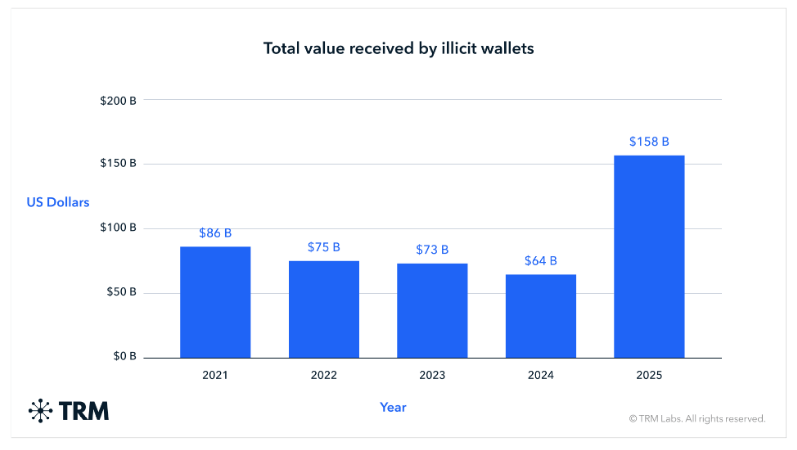
Illicit inflows to crypto assets reached a record high of $158 billion, a substantial increase due to improved monitoring that brought more illicit activity to light.

Meanwhile, scam-related wallets saw a slight decrease in proceeds to around $35 billion in 2025, from $38 billion in the previous year.

However, the total volume of criminal activity increased substantially, even as the portion attributed to scams increased marginally.

It appears that scam-detecting technology is improving, but scams are evolving rapidly. The increasing use of AI-based tools makes generic advice less helpful, as the scams now sound more authentic.

Featured image from Unsplash, chart from TradingView

Preguntas relacionadas

QWhat was the total value of illicit crypto flows in 2025 according to TRM Labs?

AIllicit crypto flows reached a record high of $158 billion in 2025.

QHow did the use of large language models in scams change in 2025?

AThe use of large language models in scams jumped fivefold in 2025.

QWhat was the approximate trading range of Bitcoin in late January 2026?

ABitcoin was trading in the range of $88,000 to $90,000 in late January 2026.

QHow much did scam-related wallet proceeds amount to in 2025?

AScam-related wallets saw proceeds of around $35 billion in 2025, down from $38 billion the previous year.

QWhat are some specific AI tools mentioned that are being used by scammers to build trust?

AScammers are using AI images, voice cloning, and deepfakes to create fake people who look and sound legitimate to build trust.

Lecturas Relacionadas

Three Consecutive Quarters of Decline: The Crypto Market is Experiencing Its Longest Ebb Since 2022

The cryptocurrency market experienced its third consecutive quarterly decline in Q2 2026, marking its longest downturn since 2022, according to a CoinGecko report. The total market capitalization fell 12.6% to $2.1 trillion, a retreat of roughly 52% from its October 2025 peak. Multiple indicators signal an orderly capital exit from the sector. For the first time since Q3 2023, the total stablecoin market cap shrank (-1.6% to $305.1B), indicating funds are leaving the ecosystem entirely, not just rotating to safer crypto assets. Trading volumes on centralized exchanges dropped 27.9%, while DeFi's Total Value Locked (TVL) plummeted 23.4%. Both Bitcoin (-14.2%) and Ethereum (-25.4%) underperformed traditional risk assets like equities in Q2, breaking from previous correlative narratives. Ethereum saw its first-ever three-quarter losing streak, with its market share falling to around 10%. A few areas saw growth. Prediction market volumes surged 48.7%, largely driven by sports betting. Hyperliquid's HYPE token entered the top 10 by market cap, and tokenized collectibles platforms grew, though primarily via gamified mechanics. Despite a ~9.8% Bitcoin rebound in July, historical trends suggest caution for August. The market, now ~49% below its 2025 high, is undergoing a measured retreat. Its recovery hinges on future Federal Reserve policy and the industry's ability to develop sustainable revenue streams beyond speculation.

marsbitHace 9 min(s)

Three Consecutive Quarters of Decline: The Crypto Market is Experiencing Its Longest Ebb Since 2022

marsbitHace 9 min(s)

Insurance Agent in Hong Kong Loses Over $3.3 Million Due to 'Romantic' Crypto Scam

An experienced Hong Kong insurance agent fell victim to a "romance scam" involving fake crypto investments, losing over HK$26 million (approximately US$3.3 million), according to local police. Authorities reported 25 similar cases of online romance-linked investment fraud in just one week in late July, with total losses nearing HK$70 million. The scam began when an acquaintance introduced the victim to a woman seeking insurance advice. The woman later connected him via WhatsApp to a man nicknamed "Uncle," who claimed to sell cars. Over time, "Uncle" built trust and an online romantic relationship with the victim. He then claimed to have successful investment experience and persuaded the victim to invest in cryptocurrencies, directing him to install a fake crypto investment platform app and introducing a person posing as the platform's owner to "help" manage a crypto wallet. Over roughly six months, the victim personally handed over more than HK$4 million in cash across various Hong Kong locations and transferred nearly HK$22 million to bank accounts provided by the scammers. Suspicion only arose when the fake app showed returns exceeding 800% and withdrawal attempts were blocked. Subsequently, both the "romantic partner" and the supposed expert cut off all contact. Police emphasized that even financially experienced individuals can be defrauded when scammers use emotional pressure and gradually build trust.

cryptonews.ruHace 42 min(s)

Insurance Agent in Hong Kong Loses Over $3.3 Million Due to 'Romantic' Crypto Scam

cryptonews.ruHace 42 min(s)

Trading

Spot
活动图片