IBIT ranking 6th in 2025 ETF flows despite negative returns is ‘a really good sign’

cointelegraphPublicado a 2025-12-20Actualizado a 2025-12-20

Resumen

Despite posting negative returns for the year, BlackRock’s iShares Bitcoin Trust (IBIT) ranked sixth in 2025 ETF net inflows with approximately $25 billion. This performance, noted by Bloomberg analyst Eric Balchunas as a "really good sign," highlights strong investor commitment amid a down market. In contrast, many top-performing equity and bond ETFs saw double-digit gains. Balchunas suggested that such inflows during a weak period indicate long-term confidence rather than short-term speculation. Meanwhile, sustained institutional buying via ETFs hasn't significantly boosted Bitcoin’s price, which he attributes to profit-taking and mature market behavior. BlackRock executives defended IBIT's outflows as normal for ETF liquidity management.

BlackRock’s spot Bitcoin ETF, iShares Bitcoin Trust (IBIT, has ranked sixth in net inflows despite being the only fund in the top cohort posting a negative return for the year.

Data shared by Bloomberg ETF analyst Eric Balchunas shows IBIT pulling in roughly $25 billion in year-to-date inflows, even as its annual performance sits in the red. By comparison, several traditional equity and bond ETFs ahead of IBIT on the leaderboard posted double-digit gains, while gold-backed ETF GLD, which is up more than 60% on the year, attracted less capital than IBIT.

Balchunas described the result as a “really good sign” over the long term, arguing that the flows reveal more about investor behavior than short-term price action.

“If you can do $25 billion in a bad year, imagine the flow potential in a good year,” he wrote, pointing to what he called a “HODL clinic” from older, long-term investors.
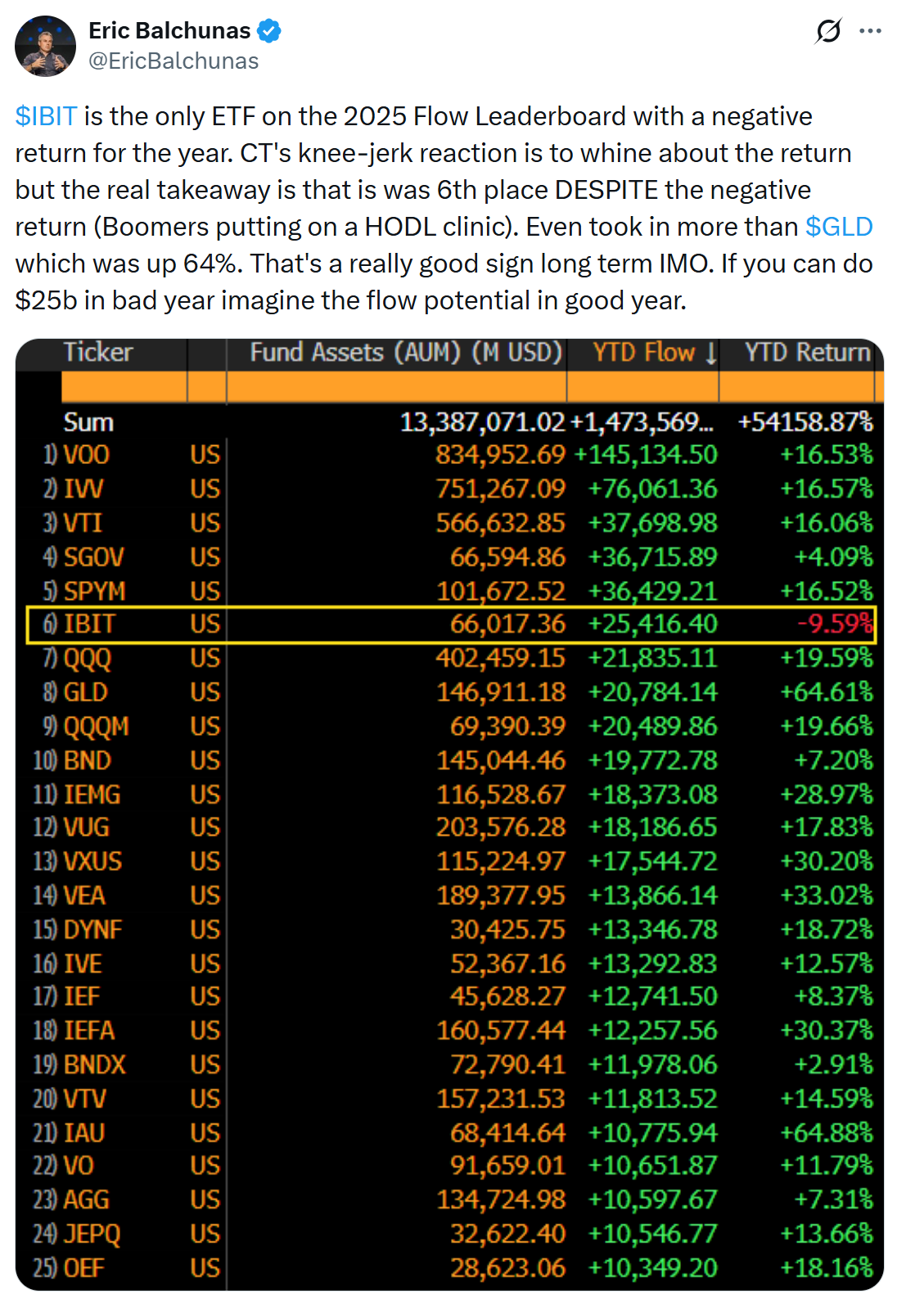
IBIT sees net inflows but negative returns. Source: Eric Balchunas

Related: BlackRock IBIT Bitcoin ETF achieves $70B AUM record

Why heavy ETF buying isn’t pushing Bitcoin higher?

Meanwhile, one crypto market participant questioned why sustained institutional buying through ETFs has not translated into stronger price performance.

In response, Balchunas suggested the market may be behaving more like a mature asset class, where early holders take profits and deploy income strategies, such as selling call options, rather than chasing immediate upside. He also noted Bitcoin had risen more than 120% the previous year, tempering expectations for continuous gains.

On Friday, US spot Bitcoin (BTC) ETFs saw $158 million in net outflows, with Fidelity’s FBTC the only fund to post inflows. Meanwhile, spot Ether (ETH) ETFs recorded $75.9 million in outflows, extending their losing streak to seven consecutive days.

Related: BlackRock's most profitable ETF is now a 'hair away' from $100B

BlackRock defends IBIT after outflows

BlackRock’s spot Bitcoin ETF faced heavy pressure in November, with its flagship IBIT fund recording about $2.34 billion in net outflows, including two large withdrawal days mid-month. Despite the pullback, BlackRock executives downplayed concerns.

Speaking at Blockchain Conference 2025 in São Paulo, BlackRock business development director Cristiano Castro said the firm’s Bitcoin ETFs have become one of its largest revenue drivers. He argued that ETFs are designed to facilitate capital allocation and cash-flow management, making periods of compression and outflows normal.

Magazine: 2026 is the year of pragmatic privacy in crypto — Canton, Zcash and more

Preguntas relacionadas

QWhat is the ranking of BlackRock's iShares Bitcoin Trust (IBIT) in 2025 ETF net inflows, and what is unique about its performance?

AIBIT ranked 6th in 2025 ETF net inflows, pulling in roughly $25 billion. It is unique because it was the only fund in the top cohort to post a negative return for the year.

QAccording to Eric Balchunas, why is IBIT's performance considered a 'really good sign'?

AHe argues that the substantial inflows during a period of negative returns reveal strong long-term investor behavior and commitment (a 'HODL clinic'), suggesting even greater flow potential during a good year, rather than being solely focused on short-term price action.

QWhat reason did Eric Balchunas suggest for why sustained institutional ETF buying hasn't pushed Bitcoin's price significantly higher?

AHe suggested the market may be maturing, with early holders taking profits and deploying income strategies like selling call options, rather than chasing immediate upside. He also noted that Bitcoin had risen over 120% the previous year, tempering expectations for continuous gains.

QHow did BlackRock executives respond to the significant net outflows from IBIT in November?

ABlackRock executives downplayed concerns. Director Cristiano Castro stated that Bitcoin ETFs have become one of the firm's largest revenue drivers and argued that ETFs are designed for capital allocation and cash-flow management, making periods of outflows normal.

QHow did the net flows for US spot Bitcoin and Ether ETFs perform on the Friday mentioned in the article?

AUS spot Bitcoin ETFs saw $158 million in net outflows, with only Fidelity's FBTC posting inflows. Spot Ether ETFs recorded $75.9 million in outflows, extending their losing streak to seven consecutive days.

Lecturas Relacionadas

How Risky is the "Death Spiral" of MSTR and STRC?

Summary: This article explores the perceived "death spiral" risk between MicroStrategy (MSTR), its Bitcoin holdings, and its perpetual preferred stock (STRC), drawing comparisons to the LUNA-UST collapse. While both systems feature price anchors, high yields for holders, and potential feedback loops, their core mechanisms differ fundamentally. The MSTR-STRC structure relies on continuous financing to sustain its high dividend payouts, primarily through stock ATM offerings. A negative feedback cycle could occur: falling MSTR stock price makes raising equity capital harder, increasing pressure to sell Bitcoin, which undermines STRC confidence and further depresses MSTR. However, unlike LUNA-UST's automated, direct linkage, the MSTR-STRC loop is weaker and has brakes: STRC dividends can be deferred or rates lowered, and STRC holders have a $100/share liquidation preference in bankruptcy, providing a price floor. The company's sustainability hinges on its ability to continue financing. Its current ~$900 million USD reserves cover only about 6.3 months of its ~$1.71 billion annual interest/dividend burden. The next six months are critical, aligning with both the potential bottom in Bitcoin's four-year cycle and the depletion timeline of its reserves. While a LUNA-style catastrophic collapse is deemed highly unlikely due to structural differences, the key question is whether MicroStrategy can navigate this period through healthy deleveraging to restart its capital engine.

Foresight NewsHace 3 min(s)

How Risky is the "Death Spiral" of MSTR and STRC?

Foresight NewsHace 3 min(s)

How Much Debt Does Strategy Really Have? Is There a Risk of Implosion?

MicroStrategy's Debt Risk: A Turning Point in the "Never Sell" Strategy As of June 3, 2026, MicroStrategy holds 843,706 bitcoins (valued at ~$53.1B) but faces significant financial obligations. Its capital structure includes $6.75B in convertible notes and $15.48B in perpetual preferred stock (led by the $8.5B STRC series), creating an annual payout burden of ~$1.71B. With software revenue at only ~$500M, interest and dividend obligations far exceed operating income. A critical shift occurred in late May 2026 when the company sold 32 bitcoins for ~$2.5M to cover dividends, breaking CEO Michael Saylor's long-standing "never sell" pledge. This symbolic move triggered a sharp decline in both Bitcoin's price and MSTR stock, reflecting market fears about cash flow sustainability. The core of the strain is the STRC perpetual preferred stock, designed as a "permanent loan" with no maturity date but requiring high monthly dividends (currently 11.5%). Its business model relies on a three-part cycle: issuing new STRC shares, using proceeds to buy more Bitcoin and fund a USD reserve, and using that reserve to pay dividends. This cycle depends on continuous investor demand for STRC and Bitcoin's price appreciation. Analysis shows Bitcoin needs to appreciate at least 2.3% annually to cover the $1.71B in yearly obligations at current holdings. With Bitcoin price down ~22% from March 2026 highs, this pressure has intensified. The company's $900M USD reserve can only cover about 7 months of payments if STRC issuance stalls. Key risks are not immediate bankruptcy or forced Bitcoin liquidation (as BTC is not collateral), but rather: 1) The erosion of MSTR's premium to its Bitcoin holdings (mNAV), which would cripple its ability to raise cheap capital; 2) A vicious cycle where stagnant Bitcoin prices reduce STRC demand, draining the USD reserve and forcing BTC sales, further depressing prices. The period from February 2027 to September 2028 is a crucial test, with over $5.9B in convertible notes facing put options or maturity. In essence, MicroStrategy has evolved from a simple Bitcoin holder into a complex financial entity acting like a "private Bitcoin bank," leveraging its BTC holdings to create layered financial products. Its survival depends on maintaining Bitcoin's price trend, its stock premium, and market appetite for its preferred shares. The recent token sale marks not a betrayal of its Bitcoin thesis, but an admission that the leveraged strategy must eventually be paid for.

marsbitHace 13 min(s)

How Much Debt Does Strategy Really Have? Is There a Risk of Implosion?

marsbitHace 13 min(s)

Anthropic Cries Wolf: Is the AGI Threat Real, or Just an IPO Story?

Anthropic has published an article titled "When AI builds itself," discussing the emerging concept of "recursive self-improvement," where AI begins to actively participate in designing, training, testing, and optimizing its own subsequent versions. The company presents internal data showing that by May 2026, over 80% of code merged into its codebase was written by Claude, its AI model. Claude's capabilities have expanded to handling complex, open-ended engineering tasks, achieving a 76% success rate in such areas, and even contributing to research processes, such as optimizing code performance and conducting AI safety experiments. Anthropic outlines an evolution from human-driven development to AI-assisted workflows, culminating in the current stage where AI agents can autonomously write, run, and delegate code. The company cautions that the path toward a "closed loop," where AI continuously improves itself, is becoming visible. It calls for coordinated global mechanisms to potentially slow or pause frontier AI development to allow safety research and societal structures to catch up. However, the timing of this warning coincides with Anthropic's preparations for an IPO, framing the narrative not just as a safety concern but also as a demonstration of Claude's advanced capabilities and its integral role in accelerating Anthropic's own R&D—creating a potential "flywheel" effect for competitive advantage. This contrasts with OpenAI's recent, more policy-oriented discussion of the same risks, highlighting the competitive dynamics in the AI industry as companies position themselves in both the technological and regulatory landscape.

marsbitHace 1 hora(s)

Anthropic Cries Wolf: Is the AGI Threat Real, or Just an IPO Story?

marsbitHace 1 hora(s)

Trading

Spot
Futuros

Artículos destacados

Cómo comprar BILL

¡Bienvenido a HTX.com! Hemos hecho que comprar Billions Network (BILL) sea simple y conveniente. Sigue nuestra guía paso a paso para iniciar tu viaje de criptos.Paso 1: crea tu cuenta HTXUtiliza tu correo electrónico o número de teléfono para registrarte y obtener una cuenta gratuita en HTX. Experimenta un proceso de registro sin complicaciones y desbloquea todas las funciones.Obtener mi cuentaPaso 2: ve a Comprar cripto y elige tu método de pagoTarjeta de crédito/débito: usa tu Visa o Mastercard para comprar Billions Network (BILL) al instante.Saldo: utiliza fondos del saldo de tu cuenta HTX para tradear sin problemas.Terceros: hemos agregado métodos de pago populares como Google Pay y Apple Pay para mejorar la comodidad.P2P: tradear directamente con otros usuarios en HTX.Over-the-Counter (OTC): ofrecemos servicios personalizados y tipos de cambio competitivos para los traders.Paso 3: guarda tu Billions Network (BILL)Después de comprar tu Billions Network (BILL), guárdalo en tu cuenta HTX. Alternativamente, puedes enviarlo a otro lugar mediante transferencia blockchain o utilizarlo para tradear otras criptomonedas.Paso 4: tradear Billions Network (BILL)Tradear fácilmente con Billions Network (BILL) en HTX's mercado spot. Simplemente accede a tu cuenta, selecciona tu par de trading, ejecuta tus trades y monitorea en tiempo real. Ofrecemos una experiencia fácil de usar tanto para principiantes como para traders experimentados.

233 Vistas totalesPublicado en 2026.05.07Actualizado en 2026.06.02

Cómo comprar BILL

Qué es ATWO

I. Introducción al ProyectoArena Two es una plataforma interactiva descentralizada que permite a los fanáticos jugar un papel activo y tokenizado en los resultados de eventos en tiempo real. A diferencia de los modelos de transmisión tradicionales que reducen a los fanáticos a espectadores pasivos, Arena Two aprovecha la tecnología blockchain para permitir que los fanáticos voten directamente en tiempo real e influyan en los resultados en el campo.II. Información del TokenNombre del token: ATWO (Arena Two)III. Enlaces RelacionadosSitio web: https://arenatwo.com/Exploradores: https://basescan.org/token/0x499D35eBE6cEe9B2Ac35Fd003fcBbeeB9CFc7B32Twitter: https://x.com/arenatwoXNota: La introducción del proyecto proviene de los materiales publicados o proporcionados por el equipo oficial del proyecto, que es solo para referencia y no constituye asesoramiento de inversión. HTX no se hace responsable de ninguna pérdida directa o indirecta resultante.

142 Vistas totalesPublicado en 2026.05.18Actualizado en 2026.06.02

Qué es ATWO

Cómo comprar ATWO

¡Bienvenido a HTX.com! Hemos hecho que comprar Arena Two (ATWO) sea simple y conveniente. Sigue nuestra guía paso a paso para iniciar tu viaje de criptos.Paso 1: crea tu cuenta HTXUtiliza tu correo electrónico o número de teléfono para registrarte y obtener una cuenta gratuita en HTX. Experimenta un proceso de registro sin complicaciones y desbloquea todas las funciones.Obtener mi cuentaPaso 2: ve a Comprar cripto y elige tu método de pagoTarjeta de crédito/débito: usa tu Visa o Mastercard para comprar Arena Two (ATWO) al instante.Saldo: utiliza fondos del saldo de tu cuenta HTX para tradear sin problemas.Terceros: hemos agregado métodos de pago populares como Google Pay y Apple Pay para mejorar la comodidad.P2P: tradear directamente con otros usuarios en HTX.Over-the-Counter (OTC): ofrecemos servicios personalizados y tipos de cambio competitivos para los traders.Paso 3: guarda tu Arena Two (ATWO)Después de comprar tu Arena Two (ATWO), guárdalo en tu cuenta HTX. Alternativamente, puedes enviarlo a otro lugar mediante transferencia blockchain o utilizarlo para tradear otras criptomonedas.Paso 4: tradear Arena Two (ATWO)Tradear fácilmente con Arena Two (ATWO) en HTX's mercado spot. Simplemente accede a tu cuenta, selecciona tu par de trading, ejecuta tus trades y monitorea en tiempo real. Ofrecemos una experiencia fácil de usar tanto para principiantes como para traders experimentados.

186 Vistas totalesPublicado en 2026.05.18Actualizado en 2026.06.02

Cómo comprar ATWO

Discusiones

Bienvenido a la comunidad de HTX. Aquí puedes mantenerte informado sobre los últimos desarrollos de la plataforma y acceder a análisis profesionales del mercado. A continuación se presentan las opiniones de los usuarios sobre el precio de A (A).

活动图片