'I Don't Have Time to Try to Convince You' — Satoshi's Famous Phrase Turns 16

cryptonews.ruPublicado a 2026-07-29Actualizado a 2026-07-29

On July 29, 2010, Satoshi Nakamoto posted a reply titled "Re: Scalability and transaction speed" on Bitcointalk. A user named bytemaster claimed that the 10-minute confirmation window was too slow and unfavorably compared it to credit card payments.

Satoshi referenced an earlier thread about vending machine payments, explaining that a payment processor with enough network connections could confirm a transaction with a fraud rate lower than credit cards in "about 10 seconds or less." This was followed by the phrase that has outlived almost everything else Satoshi wrote:

"If you don't believe me or don't get it, I don't have time to try to convince you, sorry."

Anyone who has taken the time to read Satoshi's emails and forum posts eventually notices how rarely irritation shows through. This exchange stands out precisely because it breaks this pattern. Taken in isolation, the quote can sound like the founder brushing off a skeptic. However, when viewed against the backdrop of years of measured and methodical correspondence, it becomes clear this was an exception rather than the rule, making Satoshi's usual patience and willingness to explain technical concepts even more striking.

The Trend Preceding the Outburst

By July 2010, Satoshi had already answered the same scalability criticism countless times, refining the explanation with each discussion rather than dismissing it. This reply reflected a consistent design philosophy evident throughout the correspondence: Bitcoin never assumed that every participant would need to run a full node.

Satoshi compared this expectation to requiring every Usenet user to run an NNTP server, explaining that most people would simply use the network, while a small number of specialized server farms would do the heavier work of generating blocks and supporting the system.
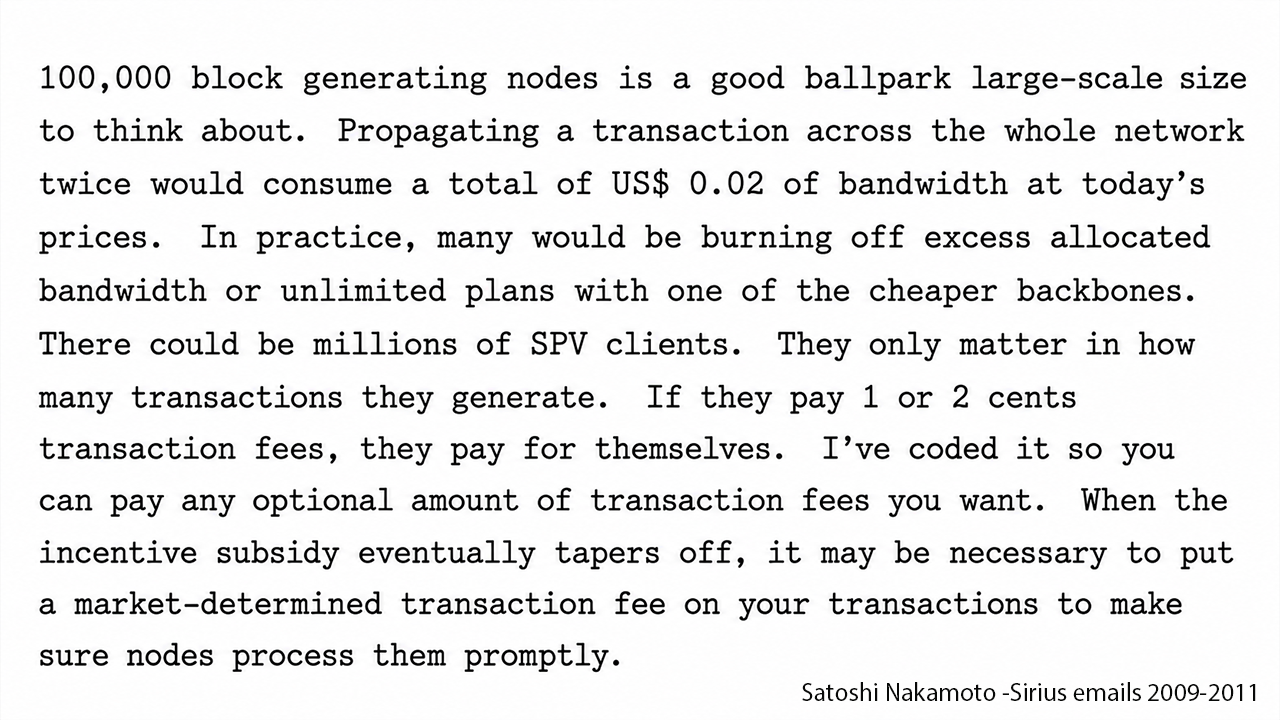
'Sirius' Emails, 2009–2011

Furthermore, in private correspondence, Satoshi estimated that 100,000 block-generating nodes could coexist with millions of lightweight verification clients and noted that transmitting a transaction across the network twice would cost about two cents in bandwidth. When users expressed concerns that SHA-256 might be broken, Satoshi compared moving from 128-bit to 256-bit hashing to doubling the address space, adding that if a vulnerability appeared, the network could adopt a new hash function via consensus.

This pattern becomes obvious after sequentially studying Satoshi's correspondence. The same technical objections arise again and again, and the replies almost always rely on a specific mechanism, specific numbers, or an analogy that facilitates understanding of the design, rather than simply brushing off the criticism. That's why the reply to bytemaster stands out against the general backdrop. It differs from the tone characteristic of almost all other correspondence, making it one of the few moments when Satoshi's patience noticeably ran out.

Firmness Without Personal Attacks

Satoshi's emails show he was willing to express disagreement directly but avoided personal attacks. In an early email to Wei Dai, the author of the b-money proposal that preceded Bitcoin, Satoshi characterized critics of digital money as "fairly Neanderthal," but immediately softened his words, noting that these critics were simply accustomed to a world built on fiat money.

Satoshi also directly acknowledged Dai's early work, inquiring about the original publication date of the "b-money" proposal before eventually informing Dai that the released Bitcoin software fulfilled "almost all the goals" of that early project.

Satoshi treated his own simplifications in the project the same way: he acknowledged them rather than justified them. Years later, when asked why the main source file was named main.cpp instead of something more descriptive like core.cpp, Satoshi admitted the second name would have been better but said it was too late to change. He didn't try to justify that choice retroactively. Satoshi simply acknowledged it, said, "Sorry to be a killjoy," and moved on to another question.

A Mentor in Private, an Educator in Public

This contrast becomes even more evident in Satoshi's personal emails with one of the first collaborators, Martti "Sirius" Malmi. The messages are informal, permeated by a collaborative spirit, and sometimes self-deprecating. In one exchange, Satoshi admitted, "I'm not much of a writer," before asking Malmi to compile a public FAQ. Instead of simply delegating the task, Satoshi personally answered long lists of questions about server settings, port forwarding, and website text, working through the details with him rather than just giving instructions.
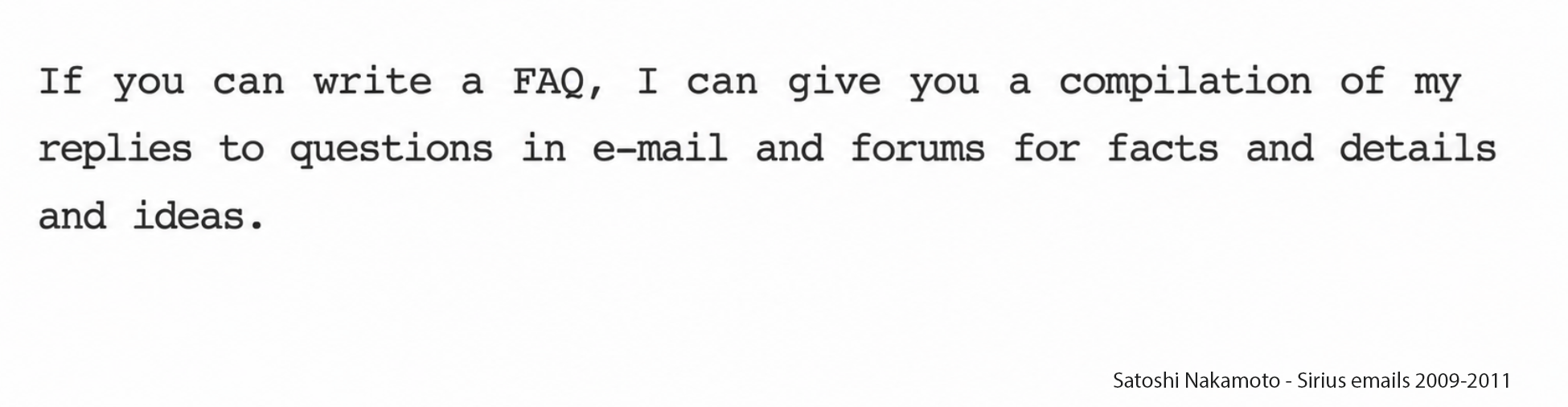
Sirius Letters 2009–2011

Satoshi's public posts read differently. In February 2009, in his introductory post on the P2P Foundation forum, Satoshi explained that traditional currency depends on trust in banks and central authorities and argued that Bitcoin replaces this trust with cryptographic proof, accessibly explaining digital signatures and the double-spending problem to a broad audience. In private correspondence, he negotiates and jokes. In public speeches, he teaches.

Satoshi also showed restraint regarding Bitcoin's public image. In his last known email, sent to Gavin Andresen in April 2011, Satoshi asked not to portray him as a "mysterious shadowy figure," instead urging Andresen to give credit to the broader group of developers contributing to the project.

Confidence Backed by Numbers, Not Boasting

Satoshi's confidence in Bitcoin's ability to scale never looked like empty hope. In correspondence with an early project participant, Mike Hearn, this argument was based on a specific assumption: that hardware performance, following Moore's Law, would grow faster than Bitcoin's transaction volume, allowing the network to surpass payment systems like Visa over time.

In the same correspondence with Hearn, Satoshi also acknowledged that transaction fees would likely be needed over time but argued competition would keep them low as users could choose which processors and fee levels to use. Even the 21 million coin limit was presented as a justified design decision, not an arbitrary rule. Satoshi characterized it as an informed guess, arguing scarcity would give bitcoin meaningful value in case of growing popularity, whereas a niche currency would naturally be worth much less per coin.

The same instinct of public justification manifested in Satoshi's reasoning about adoption. Instead of predicting instant demand, Satoshi pointed to virtual goods and gaming communities like World of Warcraft and Second Life as likely early use cases, arguing bitcoin needed a "killer app" to give it immediate utility before wider merchant adoption would follow.

Why This Still Defines Bitcoin

The scalability debates that spawned Satoshi's famous phrase never died down. They resurfaced during Bitcoin's block size wars and continue in current discussions about transaction fees and mining revenue, and recently, in what BIP-110 proponents call "spam."

Reading the original 2010 correspondence shows that the core trade-off described by Satoshi — full nodes for some and lightweight clients for most — was part of the plan from the beginning, not a later compromise. The correspondence with Malmi also presents a working template still traceable in Bitcoin's open-source development today: a founder who delegates, documents decisions in writing, and allows contributors to create materials for the public, rather than centralizing every response personally.

And the correspondence with bytemaster still serves as a useful reminder for anyone actively participating in Bitcoin communities now. Even the person who patiently explained cryptographic proofs, network incentives, and scarcity principles to newcomers for years had a limit to repeating an already given answer.

end-content

Criptos en tendencia

Lecturas Relacionadas

Must-Watch Events Next Week|CLARITY Act Could Face Senate Vote; SpaceX, Circle to Report Earnings (8.3-8.9)

**Summary: Key Events and Developments to Watch (August 3-9)** The upcoming week is marked by significant financial disclosures, key legislative deadlines, and notable product updates. **Major Financial Events:** Several companies are scheduled to release their Q2 2026 earnings. American Bitcoin (ABTC) will report on August 3, followed by SpaceX and Hut 8 Mining Corp. on August 4, and Circle on August 5. Notably, a significant portion of SpaceX shares (up to 12% of total shares) will be unlocked on August 6 following their earnings release. **Key Legislative Deadline:** The U.S. Senate faces an August 7 deadline to secure 60 votes for the CLARITY Act, a bipartisan bill aiming to establish a federal regulatory framework for cryptocurrencies. The Senate may hold a full vote on the bill during the week. **Economic Data:** The U.S. July Non-Farm Payrolls report will be released on August 7, providing crucial labor market data. **Technology & Product Updates:** * **Shutdowns:** DeFi portfolio tracker Zapper and wallet app Ctrl Wallet will cease operations on August 3. * **Upgrades:** LayerZero will deprecate its v1 relayers on August 3. XRP Ledger's new version 3.3.0, featuring five new functions, is expected next week. * **AI:** Elon Musk announced that the advanced Grok 4.6 AI model is set for release around August 7. * **Bitcoin:** The BIP-110 forced signaling for a potential Bitcoin network change is scheduled to begin around August 8. **Other Notable Events:** Chinese robotics firm Unitree Tech has set its preliminary price inquiry for its IPO for August 5. South Korean exchange Upbit will delist AQT and AERGO tokens on August 3.

marsbitHace 1 hora(s)

Must-Watch Events Next Week|CLARITY Act Could Face Senate Vote; SpaceX, Circle to Report Earnings (8.3-8.9)

marsbitHace 1 hora(s)

Stocks Are Plummeting More Sharply Than Cryptocurrencies. Where Has the Money Gone?

Stock Markets Plunge Deeper Than Cryptocurrencies: Where Did the Money Go? In late July, Seoul's Kospi index triggered circuit breakers for two consecutive days, plummeting over 40% from its June high. The collapse was led by heavyweight stocks like SK Hynix, whose record profits still disappointed investors, and devastating leveraged ETFs, with one major product losing over 83% of its value. This signaled a global, forced deleveraging targeting the most crowded trades. Interestingly, while stocks exhibited extreme volatility akin to crypto markets, Bitcoin rose nearly 15% in July after a prior steep drop. Analysis shows the money fleeing equities did not flow into Bitcoin. Instead, Bitcoin had already absorbed its sell-off in May-June, when U.S. spot Bitcoin ETFs saw historic outflows. The true safe-haven beneficiary was gold, whose price rose over 20% year-on-year, highlighting a decoupling between Bitcoin and gold as "digital gold." The sell-off was a targeted unwinding of leveraged positions in tech and semiconductors, accelerated by broker-dealer risk management and shifts in the AI narrative, including new competition from Chinese memory chipmakers. The retreat path was clear: from high-valuation tech stocks to cash and U.S. Treasuries, then to gold. For Bitcoin to attract sustained institutional inflows, conditions like eased global liquidity pressure, a "soft-landing" Fed rate cut, and U.S. regulatory clarity via legislation like the stalled CLARITY Act are needed. Currently, Bitcoin is not a safe haven but an already-cleared asset. Its low correlation with tech stocks, however, makes it a potential diversification play for institutional portfolios once the storm passes. The money isn't here yet, but the positioning is underway.

marsbitHace 1 hora(s)

Stocks Are Plummeting More Sharply Than Cryptocurrencies. Where Has the Money Gone?

marsbitHace 1 hora(s)

In Conversation with Ray Dalio: We Are Currently in an AI Bubble, with 1% of My Portfolio in Bitcoin

Ray Dalio, founder of Bridgewater Associates, warns in an interview that the current AI boom shows classic bubble characteristics, which could lead to significant economic downturns as seen in past cycles like 1929 or 2000. He explains that speculative enthusiasm, fueled by debt and overvaluation, often precedes a crash when rising rates or taxation force asset sales, causing widespread losses and recession. Dalio also outlines his "Big Cycle" theory, describing an approximate 80-year pattern where widening wealth gaps, massive government deficits, and shifting geopolitical power (like China's rise) create internal conflict and global instability. He emphasizes that we are in a late-cycle, transitional phase where traditional powers like the US and UK face decline. For personal wealth protection, Dalio advises diversification beyond cash into assets like stocks, bonds, real estate, and particularly gold, which he prefers over Bitcoin. While he holds about 1% of his portfolio in Bitcoin as a non-printable hard asset, he views gold as more secure from technological or governmental threats. Regarding AI's impact, Dalio believes it will disproportionately benefit capital owners, worsening inequality by replacing both physical and cognitive labor. He suggests that human intuition and emotional intelligence, combined with AI, will be key for future workers. On taxation, Dalio argues that wealth taxes are impractical and risk triggering asset sell-offs, reducing productive investment. He points to the UK as a cautionary example of debt, low productivity, and political strife. Geopolitically, Dalio foresees a more regionalized world, with the US showing weakness in prolonged conflicts like with Iran, akin to past imperial declines. The ideal outcome, he suggests, is coexisting powerful blocs (e.g., Americas, China-Asia Pacific) without major war.

marsbitHace 5 hora(s)

In Conversation with Ray Dalio: We Are Currently in an AI Bubble, with 1% of My Portfolio in Bitcoin

marsbitHace 5 hora(s)

Trading

Spot

Artículos destacados

Cómo comprar RE

¡Bienvenido a HTX.com! Hemos hecho que comprar Re (RE) sea simple y conveniente. Sigue nuestra guía paso a paso para iniciar tu viaje de criptos.Paso 1: crea tu cuenta HTXUtiliza tu correo electrónico o número de teléfono para registrarte y obtener una cuenta gratuita en HTX. Experimenta un proceso de registro sin complicaciones y desbloquea todas las funciones.Obtener mi cuentaPaso 2: ve a Comprar cripto y elige tu método de pagoTarjeta de crédito/débito: usa tu Visa o Mastercard para comprar Re (RE) al instante.Saldo: utiliza fondos del saldo de tu cuenta HTX para tradear sin problemas.Terceros: hemos agregado métodos de pago populares como Google Pay y Apple Pay para mejorar la comodidad.P2P: tradear directamente con otros usuarios en HTX.Over-the-Counter (OTC): ofrecemos servicios personalizados y tipos de cambio competitivos para los traders.Paso 3: guarda tu Re (RE)Después de comprar tu Re (RE), guárdalo en tu cuenta HTX. Alternativamente, puedes enviarlo a otro lugar mediante transferencia blockchain o utilizarlo para tradear otras criptomonedas.Paso 4: tradear Re (RE)Tradear fácilmente con Re (RE) en HTX's mercado spot. Simplemente accede a tu cuenta, selecciona tu par de trading, ejecuta tus trades y monitorea en tiempo real. Ofrecemos una experiencia fácil de usar tanto para principiantes como para traders experimentados.

410 Vistas totalesPublicado en 2026.06.18Actualizado en 2026.06.29

Cómo comprar RE

Discusiones

Bienvenido a la comunidad de HTX. Aquí puedes mantenerte informado sobre los últimos desarrollos de la plataforma y acceder a análisis profesionales del mercado. A continuación se presentan las opiniones de los usuarios sobre el precio de RE (RE).

活动图片












