I Built a Bitcoin Buying System: $64,000, The Lower the Score, The More I Buy

marsbitPublicado a 2026-07-27Actualizado a 2026-07-27

Resumen

Australian trader Jake Pahor shares his personal Bitcoin investment system. After losing money on altcoins in the last cycle, he now holds 100% Bitcoin, viewing it as the benchmark for the crypto asset class. His strategy centers on a dynamic dollar-cost averaging plan driven by the CSH Risk Score (a proprietary metric). He buys only when the score is between 10 and 30, purchasing more when the score is lower. Exit rules are also predefined. Currently, the CSH score is 25.6, indicating an "early cycle" phase, so his regular buying continues while larger purchases await a drop below 20. He emphasizes that a robust system, written calmly in advance, is crucial for withstanding market emotions. He also monitors key metrics like Bitcoin dominance and the TOTAL3/BTC ratio, noting that altcoin season hasn't begun yet based on historical patterns. The article's core message is that the right answer to "Should I buy now?" is not a specific recommendation but a personalized system that fits one's life and risk tolerance.

Author: Jake Pahor

Compiled by: Deep Tide TechFlow

Deep Tide Guide: Australian trader Jake Pahor publicly discloses his real portfolio: 100% Bitcoin, zero altcoins. This isn't blind faith; it's the choice of an ordinary person with a full-time job and a family to care for, made after heavy losses in the last cycle—complex strategies have a time cost, and Bitcoin beat nearly every altcoin he held last cycle. He uses a CSH scoring system for dynamic dollar-cost averaging (DCA), buying more when the score is lower, with exit plans also hardcoded. The value of this system isn't in copying it, but in letting you see clearly: the only thing that can withstand market sentiment at 11 PM is the rules you wrote down during calm times.

Every SMSF (self-managed super fund) consultation ends the same way.

We finish the paperwork. Trust deeds, bank accounts, custody, audit trails. All the things that keep you out of trouble. Then there's a pause. I know exactly what's coming next.

"So. Should I buy now? Should I wait? What should I even buy?"

I can't answer. Not unwilling. Unable. The person asking might be 42 with twenty years left, or 68 with three. They might sleep soundly through a 30% drawdown or panic at 10%. No one can answer this for someone else. Anyone who gives an answer is just guessing.

But by now, hundreds have asked me this, and it's why Tom and I built CSH. So this week I'm giving the only honest answer: how my own money actually works, and the system that drives it. Not for you to copy. For you to see what a system looks like, and then build your own.

Everything below runs on the free tier of the app.

CSH Risk Dashboard

CSH Score: 25.6/100 — Early Cycle (Stable, +0.7 this week). In the bottom 22% of all readings since 2011, has remained in the 20-30 range for 52 consecutive days.

Key Metrics:

BTC: $64,492 / A$91,717 (7-day: essentially flat)

BTC Dominance: 59.2%

ETH/BTC: 0.029

TOTAL3/BTC (Altcoin market cap priced in Bitcoin): 0.37 — Previous cycle bottoms have probed around 0.25

Fear & Greed Index: 26 - Fear

Total Market Cap: $2.27 Trillion

Review: Last issue, I said three things must happen before this bear market ends. None of them have happened. A week later, still zero for three. The only notable change: BTC climbed back above the 200-week moving average (~$63,300). A necessary condition, far from sufficient.

Jake's Take: Two weeks of sideways chopping between roughly $62k and $66k, with the score stuck in the 20s the entire time. Boring price action, noisy macro. My plan didn't change this week. That is the plan.
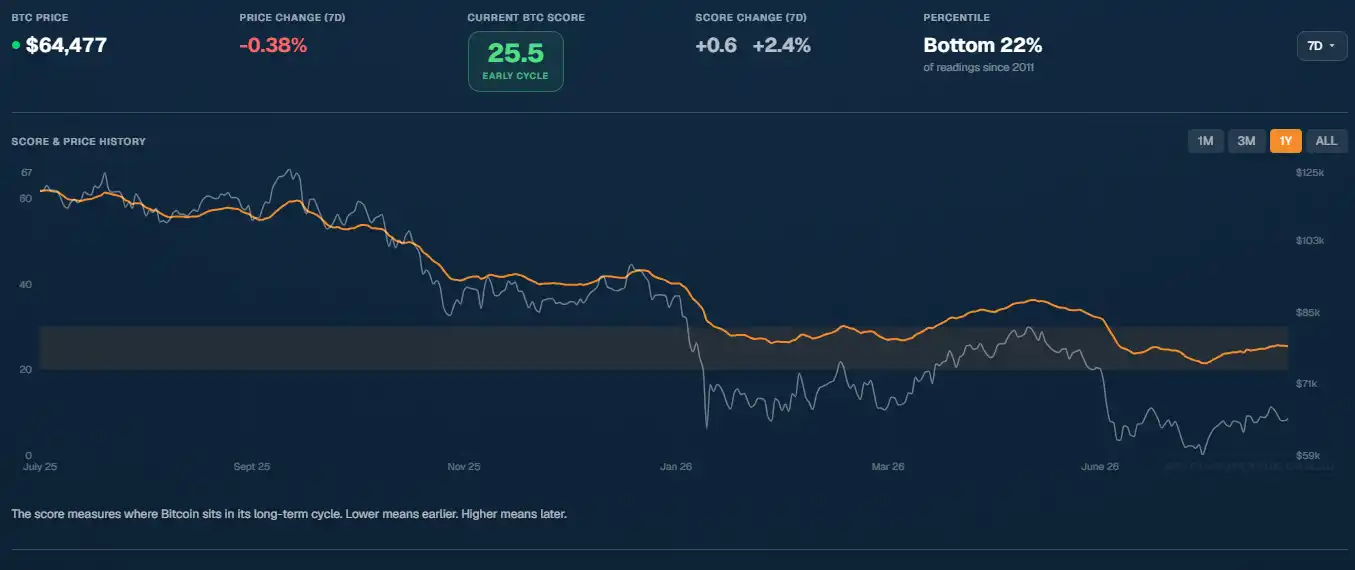
Image: CSH Risk Score Dashboard, score 25.6/100, in Early Cycle, has remained in the 20-30 range for 52 consecutive days. Source: Crypto Super Hub

How I Invest My Own Money

No headline this week. The question above is more important than any news cycle, so here's my answer, three rules.

Rule One: Benchmark against two things. I track my portfolio in two currencies: USD and Bitcoin. The second number keeps me honest. If your altcoin doubles but Bitcoin triples, you lost. You just didn't notice because you were only watching the dollar number. Fifteen years in, BTC is still the benchmark for the entire asset class. If I'm going to hold anything else, it's because I genuinely believe it will outperform Bitcoin. Otherwise, why hold it?

Rule Two: Core first, know your limits. Right now, I'm 100% Bitcoin. Zero altcoins. This isn't forever, it just fits my life. I have a family, a full-time job at an exchange, and I'm building CSH on the side. Altcoin rotation is a job for people with time. I know because I tried it last cycle, holding a bunch of alts with no plan, and got smashed, while Bitcoin quietly outperformed almost everything I held. The lesson wasn't that alts are bad. It's that my portfolio has to fit my real life. Start with BTC as your core. Add complexity only when you have the time and skill to take it on.

Rule Three: Let the system do the buying. My money runs a dynamic DCA through the CSH score. Buying on schedule, but only when the score is within my 10 to 30 range. The sizing is dynamic: the lower the score, the bigger the buy. Score 30 gets a modest allocation. Score 15 gets several times more. Every decision was made months ago, in the calm. The market can't renegotiate with me at 11 PM.

The same mechanism runs in reverse. My plan sells dynamically in tranches above an exit range. Last cycle, writing down the exit rules was the difference between realizing cycle gains and riding the rollercoaster back down. Bitcoin has followed a rhythm very close to four years its entire life. I'm not going to wing it against that.

Where am I this week? Score 25.6, scheduled buying running within the range, bigger buys still waiting for a sub-20 score that hasn't appeared yet. Two weeks of deliberately taking no new action. Inaction is a position, and right now it's my position.

Jake's Workbench

Big update this week: A full revamp of my Plans feature. Email alerts are live. You can set portfolio targets and watch them fill. Order history is two clicks away, and the portfolio view now shows your average buy price next to the live score. It's becoming the screen I check, not price.

This is my own plan, screenshotted directly from the app:
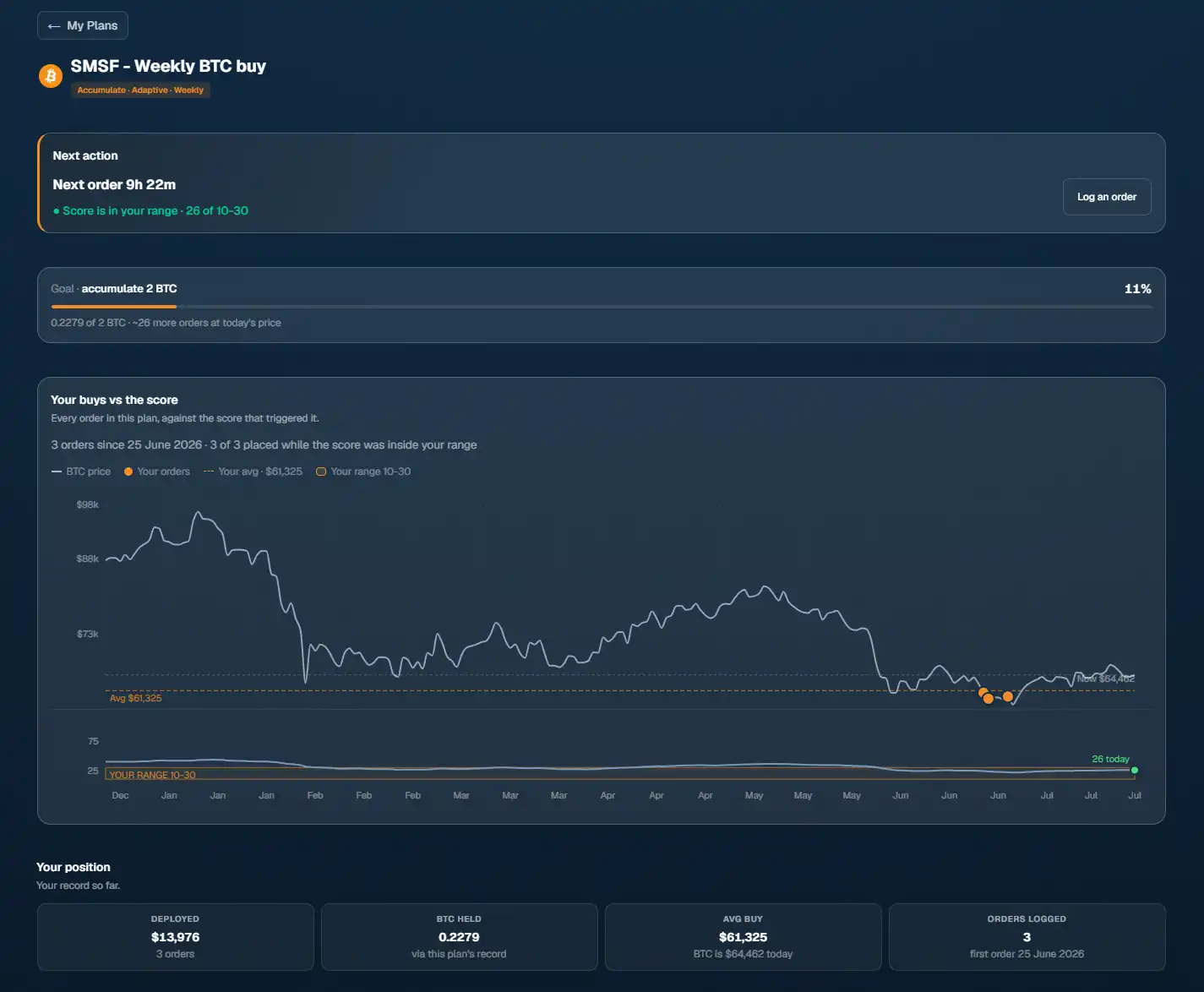
Image: The author's own DCA plan, having bought 0.2279 BTC since late June at an average price of A$87,755, targeting 2 BTC. Source: Crypto Super Hub

Three orders logged since late June, 0.2279 BTC bought towards a 2 BTC target, average buy price A$87,755. A quick note before anyone misreads this screen: this plan only tracks the portion I've bought since the feature went live a few weeks ago. It's a slice of my holdings, not the whole thing. But this is the system from the section above, running publicly, with the log accumulating from here.

Next for Workbench: CSV upload and exchange sync, to make order logging simpler.

Altseason talk is back. My feed is full of rotation calls. My watched metric says not yet: the altcoin market cap priced in BTC is at 0.37. Every cycle bottom sees it probe the 0.25 area before alts start running. Dominance is still rising, ETH/BTC is still flat. So: If someone pitches you an altcoin rotation this week, ask what benchmark they're using.
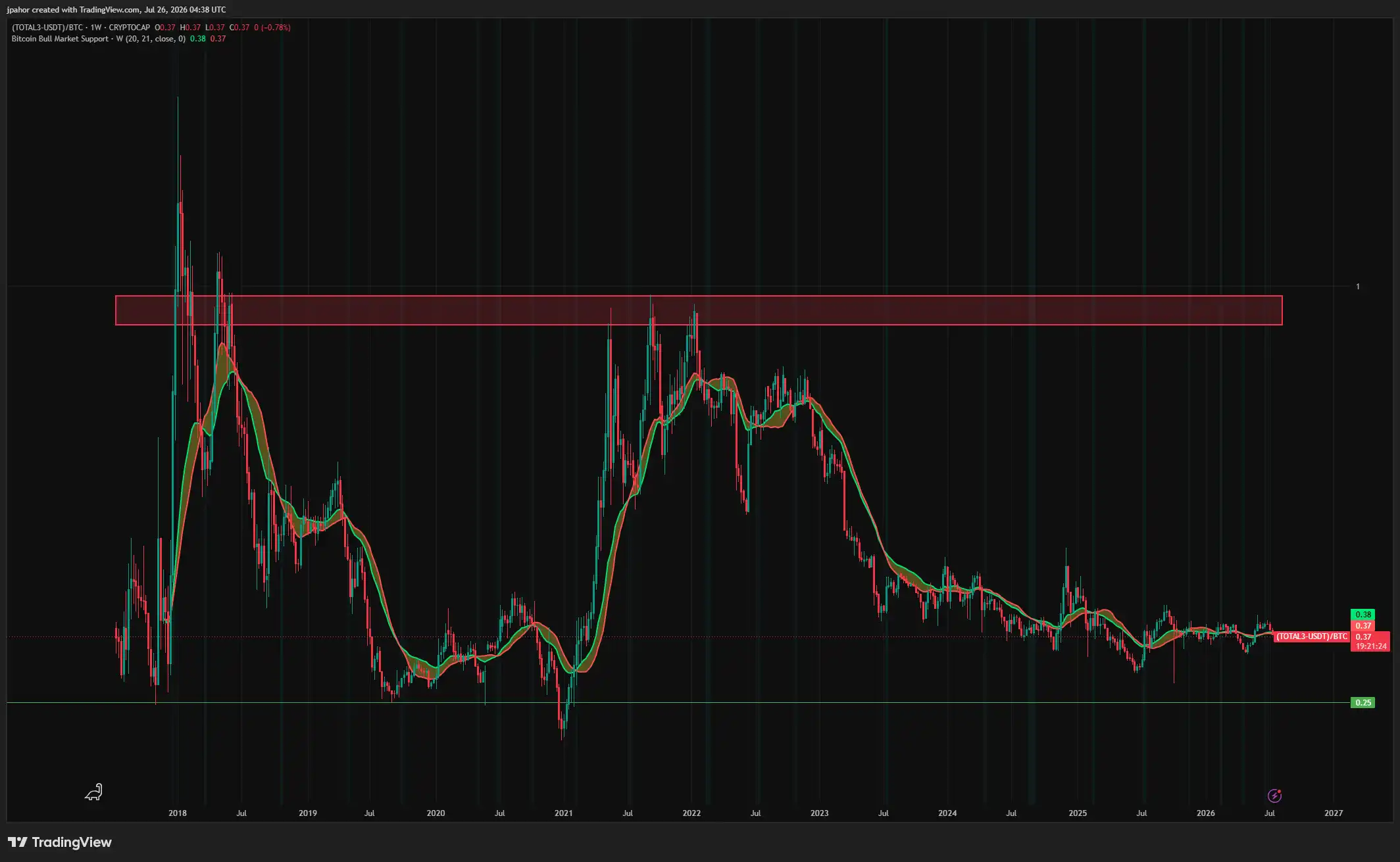
Image: (TOTAL3 - USDT)/BTC chart, altcoin market cap priced in Bitcoin at 0.37, previous cycle bottoms probed around 0.25. Source: Trading View

The Fed meets Wednesday (US time). ~85% probability of rates on hold, but whispers of a hike are getting louder. So: Unless your plan hinges on next month's rate, this is noise. My plan doesn't.

Visa launches a stablecoin platform, letting banks issue their own stablecoins without building the infrastructure. So: This is what bear markets are for. While nobody's watching, infrastructure gets built.

Morgan Stanley enables BTC, ETH, and SOL spot trading for E*TRADE clients. So: Millions of ordinary brokerage accounts are now one click away from Bitcoin. The next wave of buyers isn't coming from Crypto Twitter. They're coming from the screens they already use.

Watching Next Week

FOMC decision, 4 AM Thursday (AEST). Hold is largely priced in, so the reaction will depend on the wording. Expect two-way chop. Chop is not a signal.

The 200-week MA, ~$63,300. BTC is sitting almost exactly on it. A weekly close above or below this line is something the whole market watches.

Sub-20 score. Still zero days below 20 this cycle. This is the trigger my larger buys are waiting for. If it arrives, you'll hear it here first.

One question spawned an entire company: "Should I buy now?" The honest answer was never a date or a coin. It was a system that fits your life, matches your nerves, and is written down before the market gets loud.

Mine is above. If you want to build your own, the score and plan builder are free.

I'm curious: Reply directly with a number—the percentage of Bitcoin in your portfolio right now. I'll share the stats next week.

See you next week.

Thanks for reading. Share this with someone who'd find it valuable.

Criptos en tendencia

Preguntas relacionadas

QWhat is the core principle behind Jake Pahor's Bitcoin buying system?

AThe core principle is a dynamic dollar-cost averaging system based on the CSH (Crypto Super Hub) risk score. He buys more Bitcoin when the CSH score is lower (within his predetermined buy zone of 10-30). The system automates decisions to remove emotional bias, with buying and selling rules written in advance.

QWhat percentage of Jake Pahor's crypto portfolio is currently in Bitcoin, and why has he chosen this allocation?

AHe is currently 100% allocated to Bitcoin with zero altcoins. He chose this because it aligns with his life situation (having a family, a full-time job, and building CSH). His past experience trying to actively trade altcoins without a plan resulted in losses, while Bitcoin outperformed most of his holdings. He believes starting with Bitcoin as a core is crucial before adding complexity if one has the time and skill.

QAccording to the article, what key market condition has NOT yet been met for the author to confirm the bear market is over?

AThe key condition not yet met is the CSH risk score dropping below 20. The author states this cycle has had zero days below a score of 20, and a score below 20 is the trigger for his larger buy orders. He also mentions that the altcoin market cap denominated in Bitcoin (TOTAL3/BTC) has not yet bottomed around 0.25, which historically precedes altcoin seasons.

QWhat are the two benchmarks Jake Pahor uses to track his investment performance?

AHe tracks his investment performance against two benchmarks: 1) The US Dollar (fiat currency value), and 2) Bitcoin itself. Tracking against Bitcoin keeps him honest about relative performance, ensuring that if an altcoin gains value in USD but underperforms Bitcoin, he recognizes it as an opportunity cost loss.

QWhat is the significance of the "TOTAL3/BTC" chart mentioned and shown in the article?

AThe TOTAL3/BTC chart shows the total market capitalization of all cryptocurrencies (excluding Bitcoin and Ethereum) denominated in Bitcoin. The author points out that its current value of 0.37 has not yet reached the approximate 0.25 level seen near the bottom of previous cycles. This metric is used to gauge whether altcoins are undervalued relative to Bitcoin and to identify potential turning points for an 'altcoin season.'

Lecturas Relacionadas

Must-Watch Events Next Week|CLARITY Act Could Face Senate Vote; SpaceX, Circle to Report Earnings (8.3-8.9)

**Summary: Key Events and Developments to Watch (August 3-9)** The upcoming week is marked by significant financial disclosures, key legislative deadlines, and notable product updates. **Major Financial Events:** Several companies are scheduled to release their Q2 2026 earnings. American Bitcoin (ABTC) will report on August 3, followed by SpaceX and Hut 8 Mining Corp. on August 4, and Circle on August 5. Notably, a significant portion of SpaceX shares (up to 12% of total shares) will be unlocked on August 6 following their earnings release. **Key Legislative Deadline:** The U.S. Senate faces an August 7 deadline to secure 60 votes for the CLARITY Act, a bipartisan bill aiming to establish a federal regulatory framework for cryptocurrencies. The Senate may hold a full vote on the bill during the week. **Economic Data:** The U.S. July Non-Farm Payrolls report will be released on August 7, providing crucial labor market data. **Technology & Product Updates:** * **Shutdowns:** DeFi portfolio tracker Zapper and wallet app Ctrl Wallet will cease operations on August 3. * **Upgrades:** LayerZero will deprecate its v1 relayers on August 3. XRP Ledger's new version 3.3.0, featuring five new functions, is expected next week. * **AI:** Elon Musk announced that the advanced Grok 4.6 AI model is set for release around August 7. * **Bitcoin:** The BIP-110 forced signaling for a potential Bitcoin network change is scheduled to begin around August 8. **Other Notable Events:** Chinese robotics firm Unitree Tech has set its preliminary price inquiry for its IPO for August 5. South Korean exchange Upbit will delist AQT and AERGO tokens on August 3.

marsbitHace 1 hora(s)

Must-Watch Events Next Week|CLARITY Act Could Face Senate Vote; SpaceX, Circle to Report Earnings (8.3-8.9)

marsbitHace 1 hora(s)

Stocks Are Plummeting More Sharply Than Cryptocurrencies. Where Has the Money Gone?

Stock Markets Plunge Deeper Than Cryptocurrencies: Where Did the Money Go? In late July, Seoul's Kospi index triggered circuit breakers for two consecutive days, plummeting over 40% from its June high. The collapse was led by heavyweight stocks like SK Hynix, whose record profits still disappointed investors, and devastating leveraged ETFs, with one major product losing over 83% of its value. This signaled a global, forced deleveraging targeting the most crowded trades. Interestingly, while stocks exhibited extreme volatility akin to crypto markets, Bitcoin rose nearly 15% in July after a prior steep drop. Analysis shows the money fleeing equities did not flow into Bitcoin. Instead, Bitcoin had already absorbed its sell-off in May-June, when U.S. spot Bitcoin ETFs saw historic outflows. The true safe-haven beneficiary was gold, whose price rose over 20% year-on-year, highlighting a decoupling between Bitcoin and gold as "digital gold." The sell-off was a targeted unwinding of leveraged positions in tech and semiconductors, accelerated by broker-dealer risk management and shifts in the AI narrative, including new competition from Chinese memory chipmakers. The retreat path was clear: from high-valuation tech stocks to cash and U.S. Treasuries, then to gold. For Bitcoin to attract sustained institutional inflows, conditions like eased global liquidity pressure, a "soft-landing" Fed rate cut, and U.S. regulatory clarity via legislation like the stalled CLARITY Act are needed. Currently, Bitcoin is not a safe haven but an already-cleared asset. Its low correlation with tech stocks, however, makes it a potential diversification play for institutional portfolios once the storm passes. The money isn't here yet, but the positioning is underway.

marsbitHace 1 hora(s)

Stocks Are Plummeting More Sharply Than Cryptocurrencies. Where Has the Money Gone?

marsbitHace 1 hora(s)

In Conversation with Ray Dalio: We Are Currently in an AI Bubble, with 1% of My Portfolio in Bitcoin

Ray Dalio, founder of Bridgewater Associates, warns in an interview that the current AI boom shows classic bubble characteristics, which could lead to significant economic downturns as seen in past cycles like 1929 or 2000. He explains that speculative enthusiasm, fueled by debt and overvaluation, often precedes a crash when rising rates or taxation force asset sales, causing widespread losses and recession. Dalio also outlines his "Big Cycle" theory, describing an approximate 80-year pattern where widening wealth gaps, massive government deficits, and shifting geopolitical power (like China's rise) create internal conflict and global instability. He emphasizes that we are in a late-cycle, transitional phase where traditional powers like the US and UK face decline. For personal wealth protection, Dalio advises diversification beyond cash into assets like stocks, bonds, real estate, and particularly gold, which he prefers over Bitcoin. While he holds about 1% of his portfolio in Bitcoin as a non-printable hard asset, he views gold as more secure from technological or governmental threats. Regarding AI's impact, Dalio believes it will disproportionately benefit capital owners, worsening inequality by replacing both physical and cognitive labor. He suggests that human intuition and emotional intelligence, combined with AI, will be key for future workers. On taxation, Dalio argues that wealth taxes are impractical and risk triggering asset sell-offs, reducing productive investment. He points to the UK as a cautionary example of debt, low productivity, and political strife. Geopolitically, Dalio foresees a more regionalized world, with the US showing weakness in prolonged conflicts like with Iran, akin to past imperial declines. The ideal outcome, he suggests, is coexisting powerful blocs (e.g., Americas, China-Asia Pacific) without major war.

marsbitHace 5 hora(s)

In Conversation with Ray Dalio: We Are Currently in an AI Bubble, with 1% of My Portfolio in Bitcoin

marsbitHace 5 hora(s)

Trading

Spot

Artículos destacados

Qué es BITCOIN

Entendiendo HarryPotterObamaSonic10Inu (ERC-20) y Su Posición en el Espacio Cripto En los últimos años, el mercado de criptomonedas ha sido testigo de un aumento en la popularidad de las monedas meme, capturando el interés no solo de los comerciantes, sino también de aquellos que buscan compromiso comunitario y valor de entretenimiento. Entre estos tokens únicos se encuentra HarryPotterObamaSonic10Inu (ERC-20), un proyecto intrigante que mezcla referencias culturales en el tejido de las criptomonedas. Este artículo profundiza en los aspectos clave de HarryPotterObamaSonic10Inu, explorando sus mecanismos, ethos impulsado por la comunidad y su relación con el paisaje cripto más amplio. ¿Qué es HarryPotterObamaSonic10Inu (ERC-20)? Como su nombre sugiere, HarryPotterObamaSonic10Inu es una moneda meme construida sobre la blockchain de Ethereum, clasificada bajo el estándar ERC-20. A diferencia de las criptomonedas tradicionales que pueden enfatizar la utilidad práctica o el potencial de inversión, este token prospera en el valor de entretenimiento y la fuerza de su comunidad. El proyecto tiene como objetivo fomentar un entorno donde los usuarios comprometidos puedan reunirse, compartir ideas y participar en actividades inspiradas por diversos fenómenos culturales. Una característica notable de HarryPotterObamaSonic10Inu es su cero impuestos en las transacciones. Este atractivo elemento tiene como objetivo incentivar el comercio y la participación comunitaria, sin cargos adicionales que puedan disuadir a los comerciantes de pequeña escala. El suministro total de la moneda está establecido en mil millones de tokens, una cifra que marca su intención de mantener una circulación sustancial dentro de la comunidad. Creador de HarryPotterObamaSonic10Inu (ERC-20) Los orígenes de HarryPotterObamaSonic10Inu están algo envueltos en misterio; los detalles sobre el creador siguen siendo desconocidos. El desarrollo de este token carece de un equipo identificable o de un plan explícito, lo cual no es inusual dentro del sector de monedas meme. En cambio, el proyecto ha surgido de manera orgánica, con su progreso muy dependiente del entusiasmo y la participación de su comunidad. Inversores de HarryPotterObamaSonic10Inu (ERC-20) En cuanto a inversiones externas y respaldo, HarryPotterObamaSonic10Inu también sigue siendo ambiguo. El token no lista ninguna fundación de inversión conocida o apoyo organizacional significativo. En cambio, la savia del proyecto es su comunidad de base, que informa su crecimiento y sostenibilidad a través de la acción colectiva y el compromiso en el espacio cripto. ¿Cómo Funciona HarryPotterObamaSonic10Inu (ERC-20)? Como una moneda meme, HarryPotterObamaSonic10Inu opera principalmente fuera de los marcos tradicionales que a menudo rigen el valor de los activos. Hay varios aspectos distintivos que definen cómo funciona el proyecto: Transacciones Sin Impuestos: Sin tarifas impositivas en las transacciones, los usuarios pueden comprar y vender el token libremente sin preocuparse por costos ocultos. Compromiso Comunitario: El proyecto prospera en la interacción comunitaria, aprovechando plataformas de redes sociales para crear entusiasmo y facilitar la participación. Las discusiones, el intercambio de contenido y el compromiso son elementos cruciales que ayudan a expandir su alcance y fomentar la lealtad entre los seguidores. Sin Utilidad Práctica: Cabe señalar que HarryPotterObamaSonic10Inu no ofrece utilidad concreta dentro del ecosistema financiero. Más bien, se clasifica como un token principalmente para actividades de entretenimiento y comunitarias. Referencia Cultural: El token incorpora astutamente elementos de la cultura popular para atraer interés, conectando con entusiastas de los memes y seguidores de las criptomonedas por igual. HarryPotterObamaSonic10Inu ejemplifica cómo las monedas meme operan de manera diferente a los proyectos de criptomonedas más tradicionales, ingresando al mercado como construcciones sociales innovadoras en lugar de activos utilitarios. Cronología de HarryPotterObamaSonic10Inu (ERC-20) La historia de HarryPotterObamaSonic10Inu está marcada por varios hitos notables: Creación: El token surgió de un meme viral, capturando la imaginación de muchos entusiastas de las criptomonedas. Las fechas específicas de creación no están disponibles, subrayando su ascenso orgánico. Listado en Exchanges: HarryPotterObamaSonic10Inu ha llegado a varios exchanges, permitiendo un acceso y comercio más fácil por parte de la comunidad. Iniciativas de Compromiso Comunitario: Actividades continuas destinadas a mejorar la interacción comunitaria, incluyendo concursos, campañas en redes sociales y generación de contenido por parte de fanáticos y defensores. Planes de Expansión Futuros: La hoja de ruta del proyecto incluye el lanzamiento de una colección de NFT, mercancía y un sitio de comercio electrónico relacionado con sus temas culturales, involucrando aún más a la comunidad e intentando añadir más dimensiones a su ecosistema. Puntos Clave Sobre HarryPotterObamaSonic10Inu (ERC-20) Naturaleza Impulsada por la Comunidad: El proyecto prioriza la participación colectiva y la creatividad, asegurando que la involucración de los usuarios esté a la vanguardia de su desarrollo. Clasificación como Moneda Meme: Representa la epítome de las criptomonedas basadas en el entretenimiento, diferenciándose de los vehículos de inversión tradicionales. Sin Afiliación Directa con Bitcoin: A pesar de la similitud en el nombre del ticker, HarryPotterObamaSonic10Inu es distinto y no tiene relación con Bitcoin u otras criptomonedas establecidas. Enfoque en la Colaboración: HarryPotterObamaSonic10Inu está diseñado para crear un espacio para la colaboración y el intercambio de historias entre sus poseedores, proporcionando una vía para la creatividad y el vínculo comunitario. Perspectivas Futuras: La ambición de expandirse más allá de su premisa inicial hacia NFTs y mercancías describe un camino para que el proyecto potencialmente ingrese a avenidas más tradicionales dentro de la cultura digital. A medida que las monedas meme continúan capturando la imaginación de la comunidad de criptomonedas, HarryPotterObamaSonic10Inu (ERC-20) se destaca debido a sus lazos culturales y su enfoque centrado en la comunidad. Si bien puede no encajar en el molde típico de un token impulsado por la utilidad, su esencia radica en la alegría y la camaradería fomentadas entre sus seguidores, destacando la naturaleza en evolución de las criptomonedas en una era cada vez más digital. A medida que el proyecto continúa desarrollándose, será importante observar cómo las dinámicas comunitarias influyen en su trayectoria en el cambiante paisaje de la tecnología blockchain.

2.4k Vistas totalesPublicado en 2024.04.01Actualizado en 2024.12.03

Qué es BITCOIN

Cómo comprar BTC

¡Bienvenido a HTX.com! Hemos hecho que comprar Bitcoin (BTC) sea simple y conveniente. Sigue nuestra guía paso a paso para iniciar tu viaje de criptos.Paso 1: crea tu cuenta HTXUtiliza tu correo electrónico o número de teléfono para registrarte y obtener una cuenta gratuita en HTX. Experimenta un proceso de registro sin complicaciones y desbloquea todas las funciones.Obtener mi cuentaPaso 2: ve a Comprar cripto y elige tu método de pagoTarjeta de crédito/débito: usa tu Visa o Mastercard para comprar Bitcoin (BTC) al instante.Saldo: utiliza fondos del saldo de tu cuenta HTX para tradear sin problemas.Terceros: hemos agregado métodos de pago populares como Google Pay y Apple Pay para mejorar la comodidad.P2P: tradear directamente con otros usuarios en HTX.Over-the-Counter (OTC): ofrecemos servicios personalizados y tipos de cambio competitivos para los traders.Paso 3: guarda tu Bitcoin (BTC)Después de comprar tu Bitcoin (BTC), guárdalo en tu cuenta HTX. Alternativamente, puedes enviarlo a otro lugar mediante transferencia blockchain o utilizarlo para tradear otras criptomonedas.Paso 4: tradear Bitcoin (BTC)Tradear fácilmente con Bitcoin (BTC) en HTX's mercado spot. Simplemente accede a tu cuenta, selecciona tu par de trading, ejecuta tus trades y monitorea en tiempo real. Ofrecemos una experiencia fácil de usar tanto para principiantes como para traders experimentados.

5.7k Vistas totalesPublicado en 2024.12.12Actualizado en 2026.06.02

Cómo comprar BTC

Qué es $BITCOIN

ORO DIGITAL ($BITCOIN): Un Análisis Integral Introducción al ORO DIGITAL ($BITCOIN) ORO DIGITAL ($BITCOIN) es un proyecto basado en blockchain que opera en la red Solana, cuyo objetivo es combinar las características de los metales preciosos tradicionales con la innovación de las tecnologías descentralizadas. Aunque comparte un nombre con Bitcoin, a menudo referido como “oro digital” debido a su percepción como un refugio de valor, ORO DIGITAL es un token separado diseñado para crear un ecosistema único dentro del paisaje Web3. Su meta es posicionarse como un activo digital alternativo viable, aunque los detalles sobre sus aplicaciones y funcionalidades aún están en desarrollo. ¿Qué es ORO DIGITAL ($BITCOIN)? ORO DIGITAL ($BITCOIN) es un token de criptomoneda diseñado explícitamente para su uso en la blockchain de Solana. A diferencia de Bitcoin, que proporciona un papel de almacenamiento de valor ampliamente reconocido, este token parece centrarse en aplicaciones y características más amplias. Aspectos notables incluyen: Infraestructura Blockchain: El token está construido sobre la blockchain de Solana, conocida por su capacidad para manejar transacciones de alta velocidad y bajo costo. Dinámicas de Suministro: ORO DIGITAL tiene un suministro máximo limitado a 100 cuatrillones de tokens (100P $BITCOIN), aunque los detalles sobre su suministro circulante no se han divulgado actualmente. Utilidad: Si bien las funcionalidades precisas no están delineadas explícitamente, hay indicios de que el token podría ser utilizado para diversas aplicaciones, potencialmente involucrando aplicaciones descentralizadas (dApps) o estrategias de tokenización de activos. ¿Quién es el Creador de ORO DIGITAL ($BITCOIN)? En la actualidad, la identidad de los creadores y el equipo de desarrollo detrás de ORO DIGITAL ($BITCOIN) sigue siendo desconocida. Esta situación es típica entre muchos proyectos innovadores dentro del espacio blockchain, particularmente aquellos alineados con las finanzas descentralizadas y fenómenos de monedas meme. Si bien tal anonimato puede fomentar una cultura impulsada por la comunidad, intensifica las preocupaciones sobre la gobernanza y la responsabilidad. ¿Quiénes son los Inversores de ORO DIGITAL ($BITCOIN)? La información disponible indica que ORO DIGITAL ($BITCOIN) no tiene patrocinadores institucionales conocidos ni inversiones destacadas de capital de riesgo. El proyecto parece operar en un modelo de peer-to-peer centrado en el apoyo y la adopción de la comunidad en lugar de rutas de financiamiento tradicionales. Su actividad y liquidez se sitúan principalmente en intercambios descentralizados (DEX), como PumpSwap, en lugar de plataformas de trading centralizadas establecidas, lo que resalta aún más su enfoque de base. Cómo Funciona ORO DIGITAL ($BITCOIN) Los mecanismos operativos de ORO DIGITAL ($BITCOIN) pueden elaborarse en función de su diseño blockchain y atributos de red: Mecanismo de Consenso: Al aprovechar el único proof-of-history (PoH) de Solana combinado con un modelo de proof-of-stake (PoS), el proyecto asegura una validación de transacciones eficiente que contribuye al alto rendimiento de la red. Tokenómica: Si bien los mecanismos deflacionarios específicos no se han detallado extensamente, el vasto suministro máximo de tokens implica que podría atender microtransacciones o casos de uso nicho que aún están por definirse. Interoperabilidad: Existe el potencial de integración con el ecosistema más amplio de Solana, incluyendo varias plataformas de finanzas descentralizadas (DeFi). Sin embargo, los detalles sobre integraciones específicas permanecen no especificados. Cronología de Eventos Clave Aquí hay una cronología que destaca hitos significativos relacionados con ORO DIGITAL ($BITCOIN): 2023: El despliegue inicial del token ocurre en la blockchain de Solana, marcado por su dirección de contrato. 2024: ORO DIGITAL gana visibilidad al estar disponible para trading en intercambios descentralizados como PumpSwap, permitiendo a los usuarios comerciar contra SOL. 2025: El proyecto presencia actividad de trading esporádica y potencial interés en compromisos liderados por la comunidad, aunque no se han documentado asociaciones notables o avances técnicos hasta el momento. Análisis Crítico Fortalezas Escalabilidad: La infraestructura subyacente de Solana soporta altos volúmenes de transacciones, lo que podría mejorar la utilidad de $BITCOIN en varios escenarios de transacción. Accesibilidad: El potencial bajo precio de trading por token podría atraer a inversores minoristas, facilitando una participación más amplia debido a oportunidades de propiedad fraccionada. Riesgos Falta de Transparencia: La ausencia de patrocinadores, desarrolladores o un proceso de auditoría conocidos públicamente puede generar escepticismo sobre la sostenibilidad y confiabilidad del proyecto. Volatilidad del Mercado: La actividad de trading depende en gran medida del comportamiento especulativo, lo que puede resultar en una volatilidad de precios significativa y en incertidumbre para los inversores. Conclusión ORO DIGITAL ($BITCOIN) surge como un proyecto intrigante pero ambiguo dentro del ecosistema de Solana en rápida evolución. Si bien intenta aprovechar la narrativa del “oro digital”, su alejamiento del papel establecido de Bitcoin como refugio de valor subraya la necesidad de una diferenciación más clara de su utilidad y estructura de gobernanza previstas. La aceptación y adopción futura dependerán probablemente de abordar la actual opacidad y de definir sus estrategias operativas y económicas de manera más explícita. Nota: Este informe abarca información sintetizada disponible hasta octubre de 2023, y pueden haber ocurrido desarrollos más allá del período de investigación.

340 Vistas totalesPublicado en 2025.05.13Actualizado en 2025.05.13

Qué es $BITCOIN

Discusiones

Bienvenido a la comunidad de HTX. Aquí puedes mantenerte informado sobre los últimos desarrollos de la plataforma y acceder a análisis profesionales del mercado. A continuación se presentan las opiniones de los usuarios sobre el precio de BTC (BTC).

活动图片














