Hyperliquid's AQAv2 Converts USDC Yield into HYPE Token Buybacks

cryptonews.ruPublicado a 2026-08-26Actualizado a 2026-08-26

Resumen

Hyperliquid validators have approved the AQAv2 (Aligned Quote Asset v2) structure with 69.08% support. It extends "aligned" status to non-exclusive stablecoins on the platform, starting with USDC, and directs approximately 90% of the yield generated by these reserve assets (after cost adjustments) back into the protocol. With roughly $5-5.5 billion in USDC currently on Hyperliquid, this new yield distribution scheme is expected to generate an additional $135-160 million annually for token buybacks. This supplements the existing ~$771 million already generated yearly from trading fee buybacks. The first payment to the buyback fund is scheduled for October 3rd. This update follows a May agreement with Circle and Coinbase, which saw Hyperliquid phase out its own stablecoin (USDH) in favor of USDC as its primary reserve asset. Coinbase became the official treasury custodian for USDC on Hyperliquid, while Circle handles technical implementation. Circle also committed to staking 500,000 HYPE tokens, aligning its incentives directly with the token's performance. The AQAv2 mechanism adds to an already aggressive buyback program. The Hyperliquid Assistance Fund has purchased over 45 million HYPE tokens for about $1.1 billion. Combined, fee-based and new USDC-yield buybacks could exceed $900 million annually—estimated at four to five times the buyback intensity relative to market cap seen in Ethereum or BNB Chain. A key risk is the AQAv2 payout's dependence on interest rates. The ma...

Hyperliquid validators approved the AQAv2 (Aligned Quote Asset v2) framework with 69.08% support. It extends the "aligned" status to stablecoins used on Hyperliquid that are not exclusive to the platform, starting with $USDC, and directs approximately 90% of the reserve yield generated by these assets back to the protocol after cost adjustments.
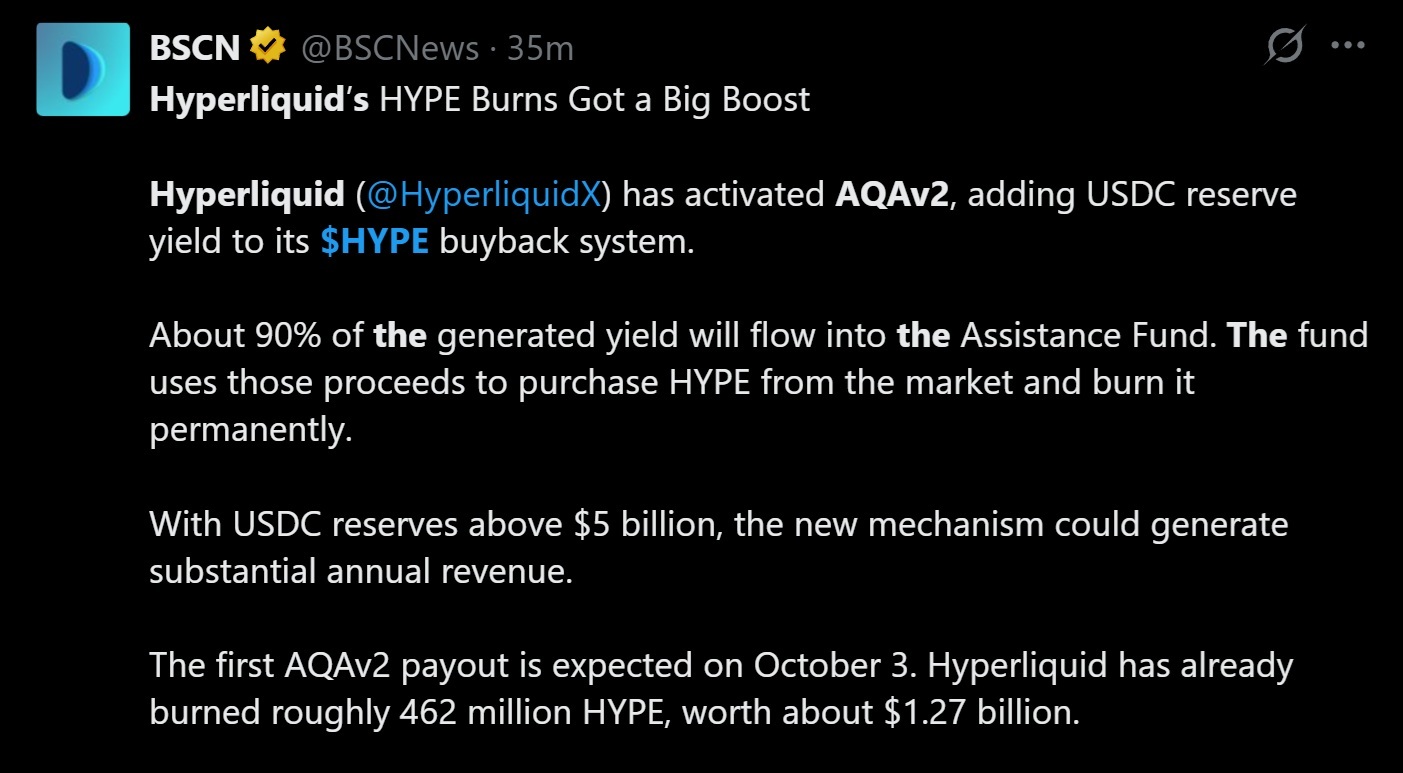
Given that Hyperliquid currently holds approximately $5 to $5.5 billion in $USDC, this yield distribution scheme is expected to generate $135 to $160 million annually in new funds for buybacks, in addition to the roughly $771 million already flowing in annually from fee-based buybacks.

Funds move through the system in 30-day cycles, with the first payment to the buyback fund scheduled for October 3rd.

The Roles of Circle and Coinbase

This update builds upon an agreement made by Circle and Coinbase with Hyperliquid back in May, which effectively phased out Hyperliquid's native stablecoin, USDH, in favor of $USDC as the exchange's primary reserve asset. Under this agreement, Coinbase became the official custodian for the $USDC treasury on Hyperliquid, while Circle is responsible for technical implementation and cross-chain infrastructure, including its Cross-Chain Transfer Protocol.

Circle has also committed to staking 500,000 $HYPE tokens in preparation for becoming a network validator, directly linking its own incentives to the performance of $HYPE, not just the share of $USDC on the platform.

A Buyback Mechanism Already Running at Full Throttle

AQAv2 complements a buyback program that is already quite aggressive. In detail, the Hyperliquid Assistance Fund, which channels most trading fees into buying $HYPE tokens on the open market, has acquired over 45 million $HYPE tokens for approximately $1.1 billion since its inception, at an average price of about $24.90 each.

More recently, it added another 26,000 $HYPE tokens worth about $1.5 million at a price of around $60 per token. Furthermore, Hyperliquid officially approved a $30 million buyback authorization to legally cement this program. Combined, the fee-based token buybacks and the new revenue stream from $USDC point to an annual buyback volume exceeding $900 million, which analysts estimate is roughly four to five times the buyback intensity relative to market capitalization observed in Ethereum or BNB Chain.

The obvious risk is that AQAv2 payouts are tied to interest rates: if $USDC reserve yields decline, so will the funds directed to buybacks, even though Hyperliquid's fee-based buybacks will continue regardless of rates. There is also a structural question analysts have noted since the Circle/Coinbase deal announcement in May: will redirecting more $USDC volume toward $HYPE buybacks squeeze Circle and Coinbase's own margins on this reserve business, even if it benefits the Hyperliquid token's growth.

The first real test will come on October 3rd when the first AQAv2 payment is made and the market can see for the first time if the mechanism works as advertised.

end-content

Criptos en tendencia

Preguntas relacionadas

QWhat is the key feature of the newly approved AQAv2 structure on Hyperliquid, and what does it do with the yield?

AAQAv2 (Aligned Quote Asset v2) extends 'aligned' status to non-exclusive stablecoins on Hyperliquid, starting with USDC. It directs approximately 90% of the reserve yield generated by these assets, after cost adjustments, back to the protocol for buybacks.

QBased on the current USDC deposits on Hyperliquid, what is the expected annual additional funding for buybacks from the AQAv2 scheme?

AGiven deposits of roughly $5 to $5.5 billion in USDC, the AQAv2 scheme is expected to generate an additional $135 to $160 million per year for buybacks.

QWhat new roles did Circle and Coinbase take on as part of their May agreement with Hyperliquid?

AAs part of the agreement, Coinbase became the official treasury custodian for USDC on Hyperliquid. Circle is responsible for the technical implementation and cross-chain infrastructure, including its Cross-Chain Transfer Protocol.

QWhat is a potential risk associated with the AQAv2 buyback payments mentioned in the article?

AA key risk is that AQAv2 payments are tied to interest rates. If the yield on USDC reserves decreases, the amount of funds directed to buybacks will also decrease, even though the fee-based buybacks continue independently.

QWhen is the first AQAv2 payment to the buyback fund scheduled, and why is it significant?

AThe first payment to the buyback fund is scheduled for October 3rd. This date is significant as it will be the first real test where the market can see if the AQAv2 mechanism works as advertised.

Lecturas Relacionadas

Breaking: Opus 5.1 Rumored for Release This Week, Threatening a Major Reshuffle of Top AI Agents

Breaking: Rumors suggest the new Opus 5.1 model from Anthropic will be released this week, potentially reshaping the AI agent landscape. The model reportedly focuses on dramatically improving "intelligence per token," with key upgrades in coding prowess, complex reasoning, and long-running autonomous agent capabilities. This rapid release follows the recent Opus 5 launch and appears to be a response to intense competition. OpenAI is rumored to have completed pre-training of a massive 10-trillion parameter model called "Bel," the foundation for its upcoming Astra and GPT-6. A market prediction site indicates a 74% probability that Anthropic will release its next flagship model (likely Mythos or Fable 5.1) within about two weeks, signaling an unprecedentedly dense wave of major model releases in the coming months. However, a business challenge is emerging. Despite its capabilities, Anthropic's top-tier Fable 5 model reportedly accounts for only about 11% of enterprise AI tool spending, as clients opt for more cost-effective "good enough" alternatives like Opus 5. This highlights a potential crisis where the most advanced models may not be the most commercially viable. The context is Anthropic's impending IPO, with a potential valuation reaching $2 trillion. CEO Dario Amodei has reportedly raised a pointed question in interviews, asking candidates if they would accept the company's stock price falling to zero for AI safety reasons, underscoring the tension between commercial ambition and ethical mission. The stage is set for a major reshuffle in the AGI/ASI race, driven by capital, compute power, and competing visions for the future of AI.

marsbitHace 35 min(s)

Breaking: Opus 5.1 Rumored for Release This Week, Threatening a Major Reshuffle of Top AI Agents

marsbitHace 35 min(s)

Trading

Spot

Artículos destacados

Cómo comprar HYPE

¡Bienvenido a HTX.com! Hemos hecho que comprar Hyperliquid (HYPE) sea simple y conveniente. Sigue nuestra guía paso a paso para iniciar tu viaje de criptos.Paso 1: crea tu cuenta HTXUtiliza tu correo electrónico o número de teléfono para registrarte y obtener una cuenta gratuita en HTX. Experimenta un proceso de registro sin complicaciones y desbloquea todas las funciones.Obtener mi cuentaPaso 2: ve a Comprar cripto y elige tu método de pagoTarjeta de crédito/débito: usa tu Visa o Mastercard para comprar Hyperliquid (HYPE) al instante.Saldo: utiliza fondos del saldo de tu cuenta HTX para tradear sin problemas.Terceros: hemos agregado métodos de pago populares como Google Pay y Apple Pay para mejorar la comodidad.P2P: tradear directamente con otros usuarios en HTX.Over-the-Counter (OTC): ofrecemos servicios personalizados y tipos de cambio competitivos para los traders.Paso 3: guarda tu Hyperliquid (HYPE)Después de comprar tu Hyperliquid (HYPE), guárdalo en tu cuenta HTX. Alternativamente, puedes enviarlo a otro lugar mediante transferencia blockchain o utilizarlo para tradear otras criptomonedas.Paso 4: tradear Hyperliquid (HYPE)Tradear fácilmente con Hyperliquid (HYPE) en HTX's mercado spot. Simplemente accede a tu cuenta, selecciona tu par de trading, ejecuta tus trades y monitorea en tiempo real. Ofrecemos una experiencia fácil de usar tanto para principiantes como para traders experimentados.

458 Vistas totalesPublicado en 2024.12.11Actualizado en 2026.06.02

Cómo comprar HYPE

Discusiones

Bienvenido a la comunidad de HTX. Aquí puedes mantenerte informado sobre los últimos desarrollos de la plataforma y acceder a análisis profesionales del mercado. A continuación se presentan las opiniones de los usuarios sobre el precio de HYPE (HYPE).

活动图片