Hyperliquid: Why HYPE’s pullback from $38 could be healthy

ambcryptoPublicado a 2026-02-24Actualizado a 2026-02-24

Resumen

The recent pullback in Hyperliquid (HYPE) from its high of $38.42 is viewed as a healthy retracement within a broader bullish structure. Despite a cluster of long liquidations and a drop below $30, the weekly and daily charts maintain a bullish outlook. Key support is identified at the $24.3 level, which aligns with the 78.6% Fibonacci retracement and a daily chart imbalance. A break below $23.4 could signal weakening bullish momentum, while a drop under $20 would invalidate the bullish setup. However, strong fundamentals, capital inflows, and the defense of the $20 long-term support level suggest HYPE is poised for a potential rally.

In a recent report, the large cluster of long liquidations below $30 for Hyperliquid [HYPE] led AMBCrypto to conclude that there was potential for a drop below $28 to hunt down the long positions.

This has since come true, aided by the Bitcoin [BTC] drop to $64.3k on Sunday. Hyperliquid was attracting capital, with high capital inflows to the ecosystem. This boded well for the token and the DEX in the long-term.

Based on the evidence at hand, HYPE bulls were setting up for an explosive rally. The macro conditions and BTC volatility were challenges that could delay the upward move, but the fundamentals were strong.
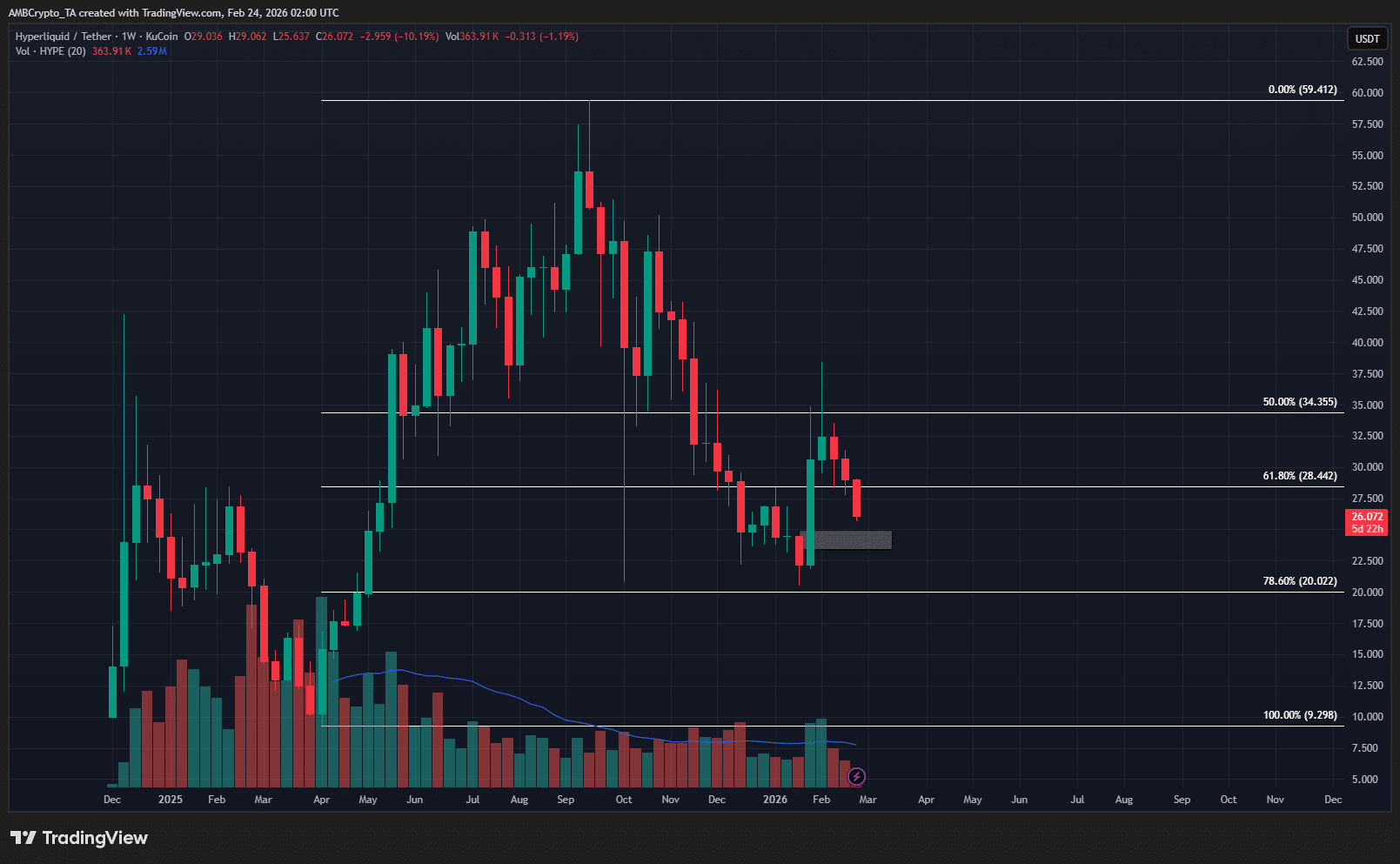
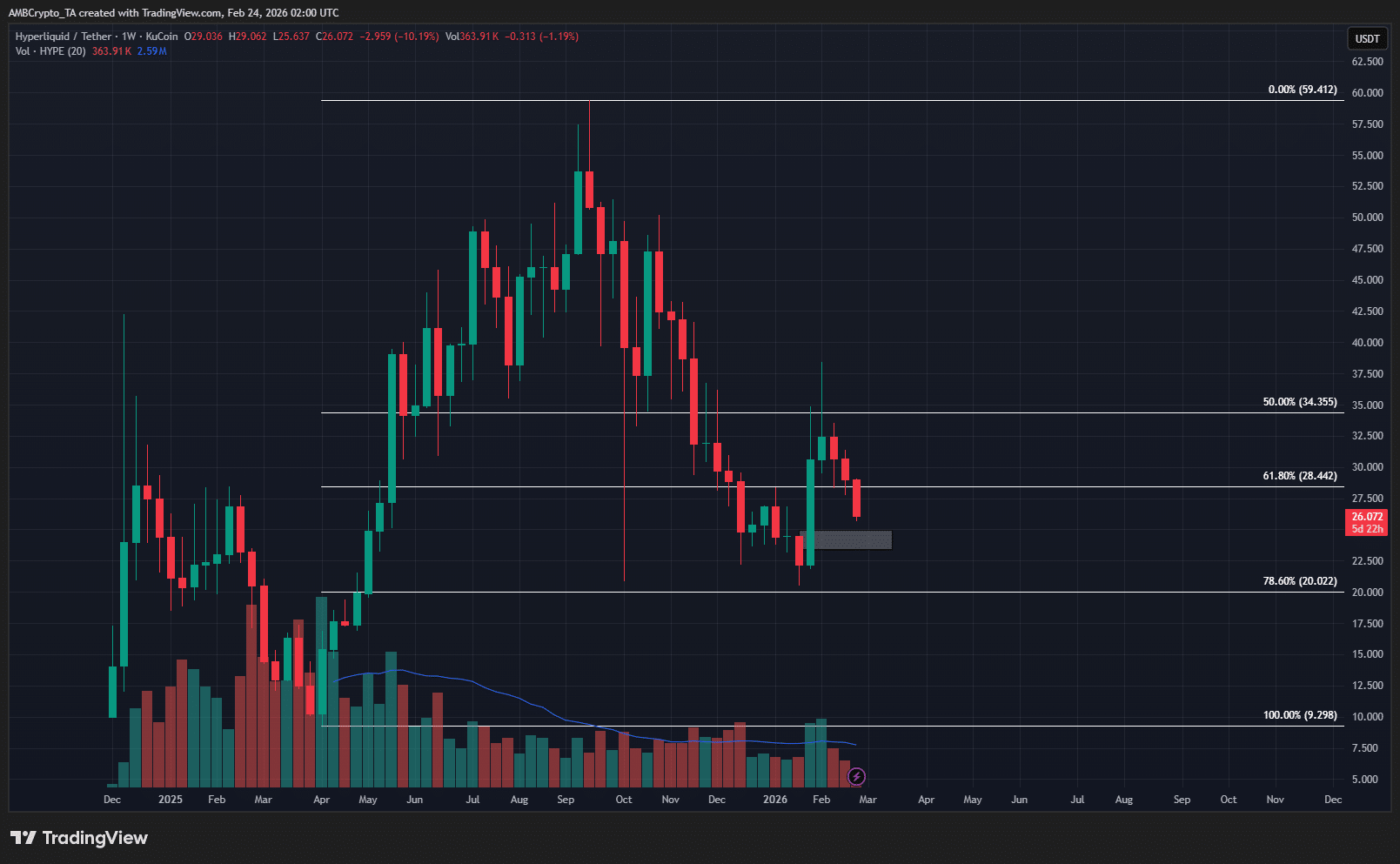
The 1-week chart has a bullish structure. The Fibonacci retracement levels showed that the fall to $20.48 in January was part of a retracement, with the golden pocket extending from $28.44 to $20.02.

Why you should think of buying this HYPE dip
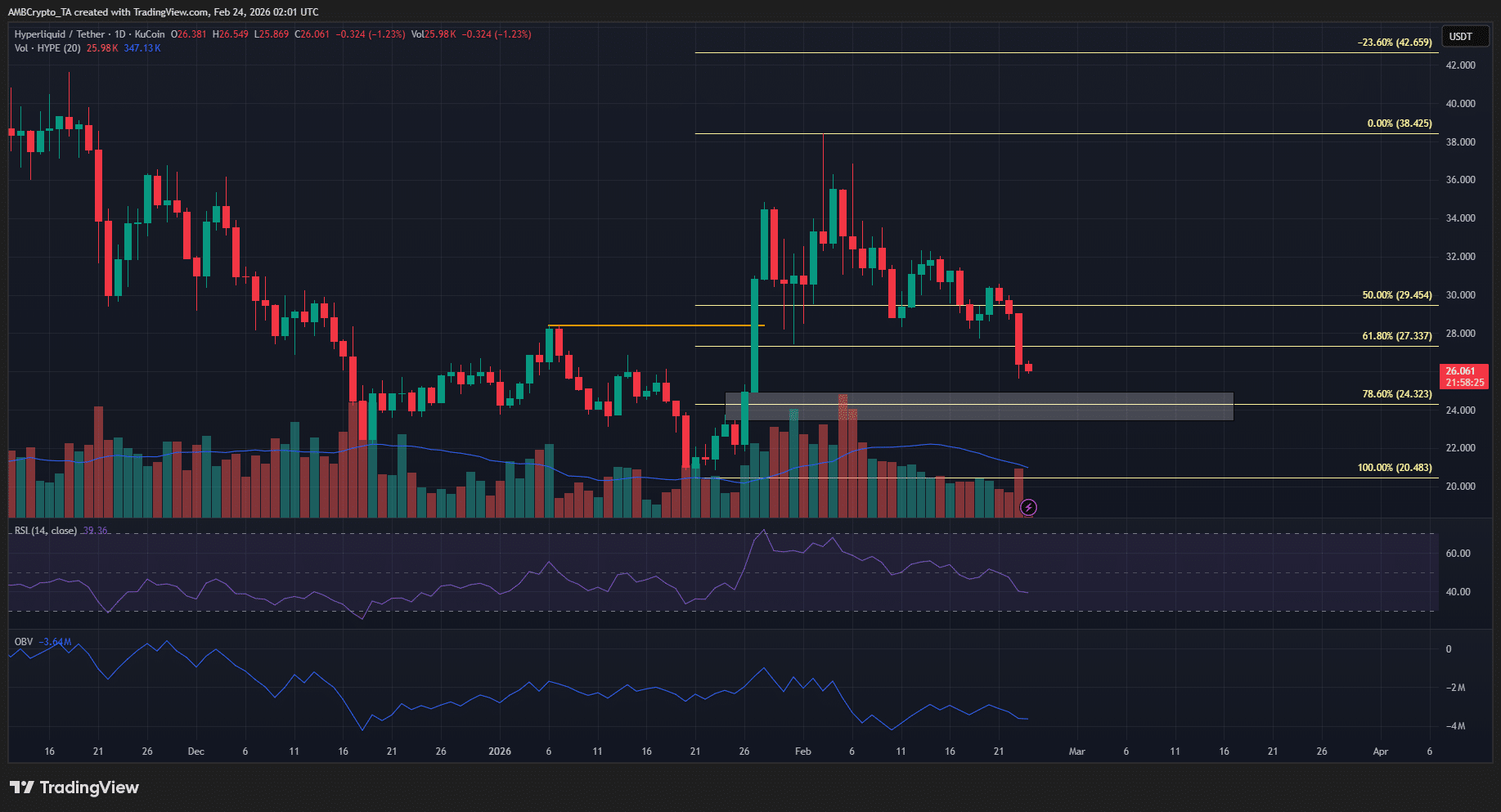
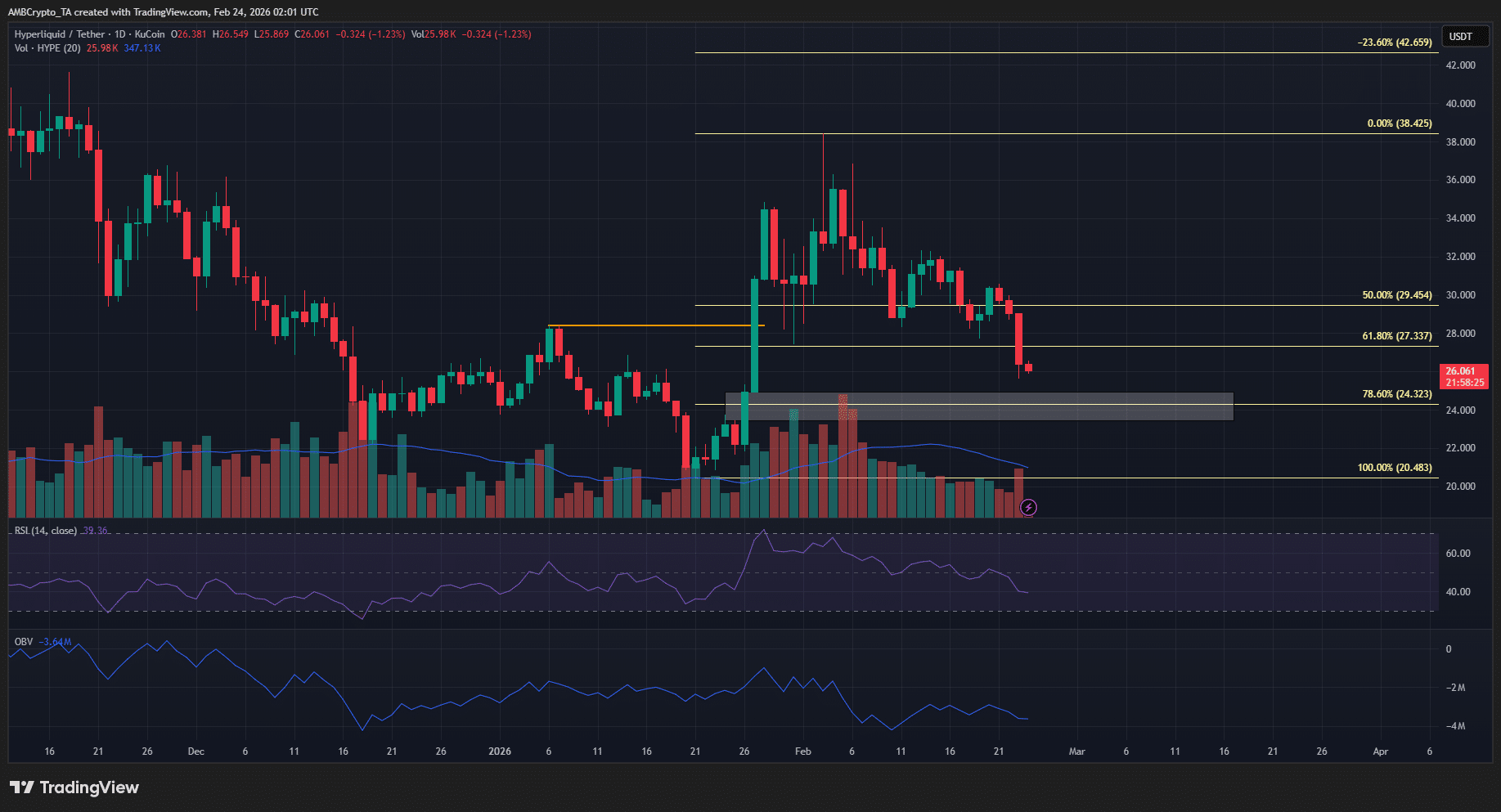
The 1-day chart showed a bullish swing structure in place for HYPE. This occurred after the lower high at $28.4, set in the first week of January, was breached. That rally reached $38.42 in the first week of February.

It also outperformed major crypto assets by a sizeable margin. However, traders who bet on a bullish continuation faced losses and liquidations as the DEX token retraced its rally, falling below $30 on the 10th of February.

Yet, this was part of a healthy retracement. HYPE swing traders and investors can wait for the $24.3 level to be defended before looking to go long. This level was the 78.6% Fibonacci retracement level for the bullish swing move.

It also has confluence with an imbalance on the daily chart (white box) that could get filled.

A drop below $23.4 would be an early sign that the bulls lacked the strength to drive a recovery. In this scenario, traders and long-term buyers need to prepare for the bullish setup to get invalidated.

A move below $20 would confirm bearish strength, and buyers will need to wait for an internal structure shift before looking to go long again.


Final Summary

  • The Hyperliquid volatility in February was a bullish structure shift and a subsequent retracement.
  • Given that the weekly structure was also bullish and the $20 was a long-term support, HYPE appears nearly ready for its next rally.

Disclaimer: The information presented does not constitute financial, investment, trading, or other types of advice and is solely the writer’s opinion.


Preguntas relacionadas

QWhat was the main reason behind Hyperliquid's [HYPE] recent drop below $30?

AThe drop was driven by a large cluster of long liquidations below $30, which was further aided by Bitcoin's decline to $64.3k.

QAccording to the article, why could HYPE's pullback be considered healthy?

AThe pullback is seen as a healthy retracement within a bullish structure, with key support levels like the 78.6% Fibonacci retracement at $24.3 providing potential buying opportunities.

QWhat key support level should HYPE watch for before considering a long position?

ASwing traders and investors should watch for the $24.3 level, which is the 78.6% Fibonacci retracement level and has confluence with a daily chart imbalance.

QWhat would invalidate the bullish setup for HYPE according to the analysis?

AA drop below $23.4 would indicate a lack of bullish strength, and a move below $20 would confirm bearish dominance, invalidating the bullish setup.

QWhat evidence suggests HYPE has strong long-term fundamentals despite recent volatility?

AHigh capital inflows into the Hyperliquid ecosystem and a bullish weekly chart structure indicate strong long-term fundamentals for both the token and the DEX.

Lecturas Relacionadas

Investors Are Now Hunting for AI Projects on Bilibili and Xiaohongshu

Investors Turn to Bilibili and Xiaohongshu to Source AI Projects The AI hardware boom is in full swing in 2025, with a surge in smart wearables like AI glasses, rings, toys, and companion robots. This frenzy has investors scrambling, not just sifting through business plans, but actively hunting for promising "under-the-radar" projects on youth and tech-enthusiast content platforms like Bilibili and Xiaohongshu. The logic is straightforward: for consumer-facing AI hardware, genuine user demand and potential pitfalls are often revealed earlier in public discussions, comments, and critiques on these communities than in formal pitches. As one industry insider notes, these products must ultimately be tested and understood by real people. This shift highlights a crucial challenge in the sector: user education. The success of AI hardware depends on moving beyond mere efficiency gains to fulfilling higher-order needs like "unleashing personal creativity." Products must convince users they are natural, unobtrusive additions to daily life. Early hype, as seen with devices like the Rabbit R1, often fades if the product fails to clearly solve real-world problems, leading to high return rates and market rejection. The market is now entering a shakeout phase. 2026 is seen as a year of commercial validation. Some projects have already stalled or been canceled due to market resistance, lack of differentiation, or financial woes. However, the long-term opportunity remains vast, with forecasts predicting a multi-trillion dollar global AI hardware market by 2030. The competition is intensifying. With giants like OpenAI and Meta preparing their own hardware, and Chinese companies launching diverse AI-powered products, the battle for user attention, product excellence, and market understanding is just beginning. The core principle endures: in the AI era, it remains a user-sovereign market.

marsbitHace 13 min(s)

Investors Are Now Hunting for AI Projects on Bilibili and Xiaohongshu

marsbitHace 13 min(s)

"Agents' Last Exam", Claude Fable 5 Actually Loses to GPT 5.5

Surprisingly, in the newly released "Agents' Last Exam" (ALE) benchmark from UC Berkeley, GPT-5.5 has outperformed the recently launched and highly-regarded Claude Fable 5. ALE tests AI agents on their ability to perform real-world tasks across 55 professional domains—such as 3D modeling in Siemens NX, creating game scenes in Unreal Engine, and visual effects work in Adobe After Effects—by granting them full GUI and command-line access. In the core task completion rate ranking, GPT-5.5 configurations secured the top two spots (24.0% and 23.0%), while Claude Fable 5 with Claude Code came in third (22.0%). Notably, the highest pass rate was only 24%, and the most difficult "Last-Exam" tier saw most top models, including GPT-5.5 and Fable 5, scoring zero. The benchmark also revealed significant cost and efficiency gaps: Fable 5 spent over four times more money than GPT-5.5's most expensive configuration for a slightly lower score, and was much slower. ALE differs from previous knowledge-based benchmarks by evaluating practical "ability to do" rather than static knowledge retrieval. Its tasks are derived from real expert projects, automatically scored, and designed to prevent cheating through a rotating pool of private challenges. The results suggest that high performance on traditional benchmarks does not necessarily translate to proficiency in complex, open-ended real-world work. The study also notes that agents often fail by prematurely declaring tasks complete without proper verification, and that no single model excels uniformly across all diverse domains.

marsbitHace 19 min(s)

"Agents' Last Exam", Claude Fable 5 Actually Loses to GPT 5.5

marsbitHace 19 min(s)

Trading

Spot
Futuros

Artículos destacados

Cómo comprar HYPE

¡Bienvenido a HTX.com! Hemos hecho que comprar Hyperliquid (HYPE) sea simple y conveniente. Sigue nuestra guía paso a paso para iniciar tu viaje de criptos.Paso 1: crea tu cuenta HTXUtiliza tu correo electrónico o número de teléfono para registrarte y obtener una cuenta gratuita en HTX. Experimenta un proceso de registro sin complicaciones y desbloquea todas las funciones.Obtener mi cuentaPaso 2: ve a Comprar cripto y elige tu método de pagoTarjeta de crédito/débito: usa tu Visa o Mastercard para comprar Hyperliquid (HYPE) al instante.Saldo: utiliza fondos del saldo de tu cuenta HTX para tradear sin problemas.Terceros: hemos agregado métodos de pago populares como Google Pay y Apple Pay para mejorar la comodidad.P2P: tradear directamente con otros usuarios en HTX.Over-the-Counter (OTC): ofrecemos servicios personalizados y tipos de cambio competitivos para los traders.Paso 3: guarda tu Hyperliquid (HYPE)Después de comprar tu Hyperliquid (HYPE), guárdalo en tu cuenta HTX. Alternativamente, puedes enviarlo a otro lugar mediante transferencia blockchain o utilizarlo para tradear otras criptomonedas.Paso 4: tradear Hyperliquid (HYPE)Tradear fácilmente con Hyperliquid (HYPE) en HTX's mercado spot. Simplemente accede a tu cuenta, selecciona tu par de trading, ejecuta tus trades y monitorea en tiempo real. Ofrecemos una experiencia fácil de usar tanto para principiantes como para traders experimentados.

202 Vistas totalesPublicado en 2024.12.11Actualizado en 2026.06.02

Cómo comprar HYPE

Discusiones

Bienvenido a la comunidad de HTX. Aquí puedes mantenerte informado sobre los últimos desarrollos de la plataforma y acceder a análisis profesionales del mercado. A continuación se presentan las opiniones de los usuarios sobre el precio de HYPE (HYPE).

活动图片