Author: Changan I Biteye Content Team
Over the weekend, the US and Israel jointly launched airstrikes on Iran, targeting central Tehran and missile facilities. This marks the most severe escalation of the Middle East situation in decades. Iran immediately issued a warning: if the conflict continues, the Strait of Hormuz will no longer be safe.
Everyone's first reaction was the same: open the trading software, wanting to do something. But not only were US stock markets closed, crude oil and gold futures were also shut down all day on Saturday. Panic needed an outlet, capital needed a place to go. So, everyone's eyes fell on these two platforms: Polymarket and Hyperliquid.
Hyperliquid offers 24/7 trading of commodity futures. Polymarket offers prediction markets that price war-related news.
This article will compare: What roles did these two platforms play in this event? Which one has more edge?
I. First, Understand: What Assets Do the Two Platforms Trade?
Before discussing who has more edge, we must first understand what these two platforms are actually trading.
1.1 Polymarket: Converting Information Asymmetry into Probability
On Polymarket, what is traded are "events." It breaks down a vague geopolitical event into markets that can be priced.
Price is probability. A market price of 0.65 means the market believes there is a 65% probability the event will happen.
During this US-Israel airstrike on Iran event, a series of markets directly corresponding to the crisis appeared on Polymarket, such as: "US strikes Iran by...?", "Khamenei out as Supreme Leader of Iran by...?", etc.
1.2 Hyperliquid: Pricing Assets 24/7
Hyperliquid is an on-chain perpetual contract exchange. Contracts trade 24/7 without closing, prices fluctuate continuously, and leveraged trading is supported.
In this event, the two most directly affected assets were:
-
Crude Oil: The Strait of Hormuz is the choke point for global oil transportation. The threat of blockade is directly reflected in oil prices.
-
Gold: The classic safe-haven asset. The higher the intensity of the geopolitical conflict, the more capital flows into gold.
In a nutshell: Polymarket trades "the probability of this event happening," while Hyperliquid trades "the price movement after this event happens."
II. Practical Review: Timeline from Evacuation Order to Airstrike Outbreak
Let's review the key timeline of this conflict.
2.1 Polymarket Timeline: Abnormal Fluctuations Under the Evacuation Order
-
Before the Conflict
Several new wallets collectively bet $59.1k on "US will strike Iran before 2.28". Subsequently, two more accounts bet $164.5k on "US will strike Iran before 2.28/3.15/3.31". At that time, the market probability was only 9%.
That night, the Chinese Ministry of Foreign Affairs issued a warning, urging Chinese citizens in Iran to evacuate as soon as possible. The US State Department authorized the departure of non-emergency US government personnel and their families from Israel. US Ambassador to Israel Huckabee said, if you want to leave Israel, "leave today." That night, the Yes probability in the "US will strike Iran before 2.28" market rose to 30%.
-
February 28th (Saturday) — Airstrike Outbreak
Israel launched military strikes inside Iran, with multiple missiles hitting targets in downtown Tehran.
The probability for "Will Israel strike Iran before 2.28?" surged to 99%, about to settle as "Yes".
At the same moment, in the "Who will strike Iran first, US or Israel?" market, the probability for "US strikes first" plummeted from 58.5% to 3.5%.
Subsequently, multiple media outlets reported a joint US-Israel strike. The probability for "US strikes first" rebounded from a low of 4.5% to 33%.
-
Joint US-Israel Airstrike Confirmed
After the airstrike was confirmed and news of Khamenei being targeted spread, the probability for "Will Iran close the Strait of Hormuz?" vertically skyrocketed to 93%.
2.2 Hyperliquid Timeline: 24/7 Pricing of Asset Prices
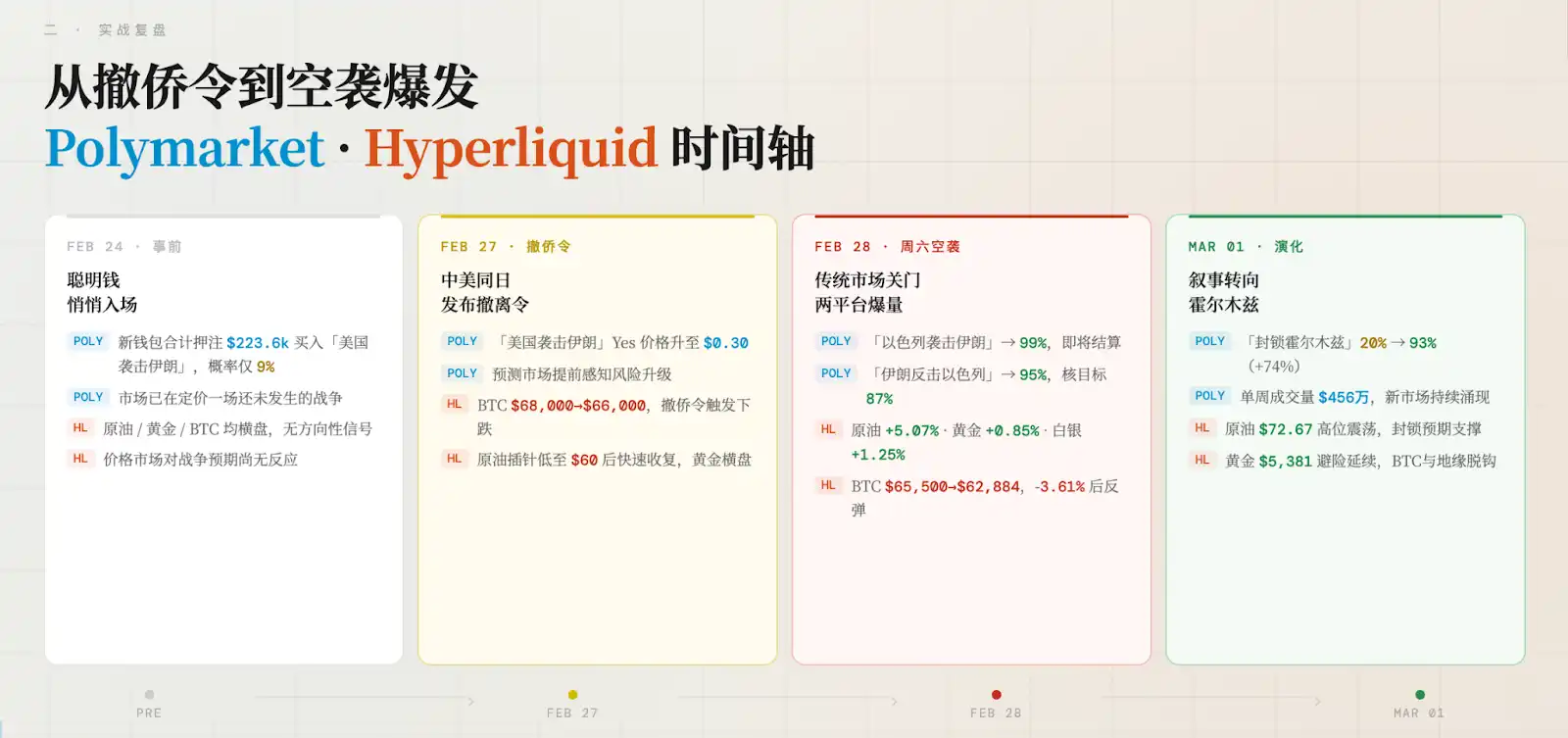
-
Evacuation Order Issued
Crude Oil: Ranging between $66-68, with a spike down to $60 that was quickly recovered — some people positioned early but were quickly stopped out.
Gold: Low consolidation around $5,160 — safe-haven funds had not yet entered on a large scale.
BTC: After the evacuation order was issued, it started falling from around $68,000 to around $66,000.
-
Airstrike Outbreak
Crude Oil: Jumped directly from $68 to $71.76 — the Strait of Hormuz blockade expectation was priced in immediately, something traditional futures markets couldn't do on a Saturday.
Gold: Rose from $5,160 to $5,480 — safe-haven funds flowed in, but the increase was far less than crude oil, indicating the market believed the conflict intensity was limited.
BTC: After the airstrike was confirmed, it fell rapidly from $65,500 to a low of $62,884, a drop of about -3.61%.
Comparing the two timelines reveals: Polymarket's probability anomalies significantly led Hyperliquid's price reactions. This means prediction markets are not just trading outcomes; they act more like an early warning system, completing initial pricing through smart money and insider bets before traditional commodity asset prices react.
III. Dimension Battle: Comparison of Asset Boundaries and Time Boundaries
3.1 Data Comparison
First, let's compare the data from both platforms during this event.
1️⃣ Polymarket
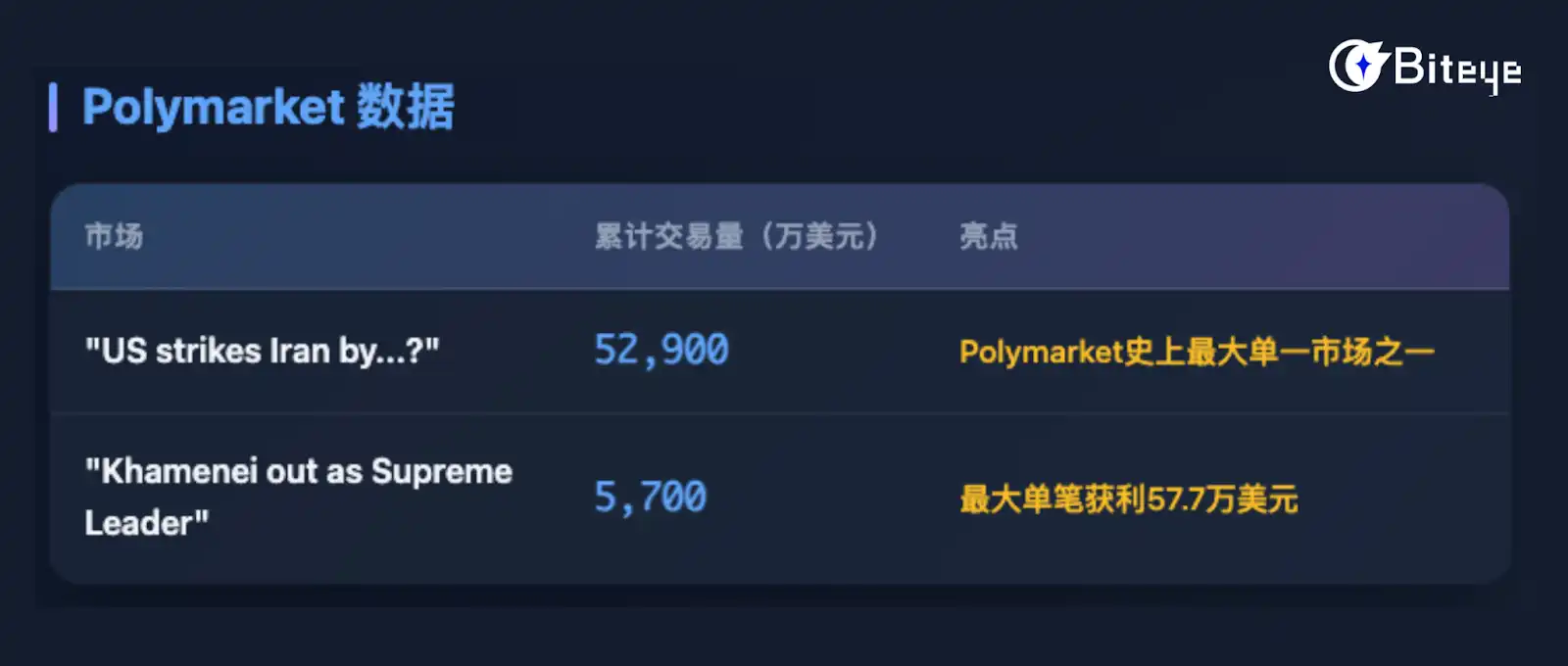
The "US strikes Iran by...?" contract has reached a cumulative trading volume of $529 million since its launch last December, becoming one of the largest single markets in Polymarket's history.
The "Khamenei out as Supreme Leader" market reached a cumulative trading volume of $57 million. The single largest winner made $577,000.
Six newly created wallets, by accurately betting "Yes" on "US strikes Iran before 2.28", collectively profited about $1.2 million. The largest single wallet turned $61,000 into over $493,000.
2️⃣ Hyperliquid
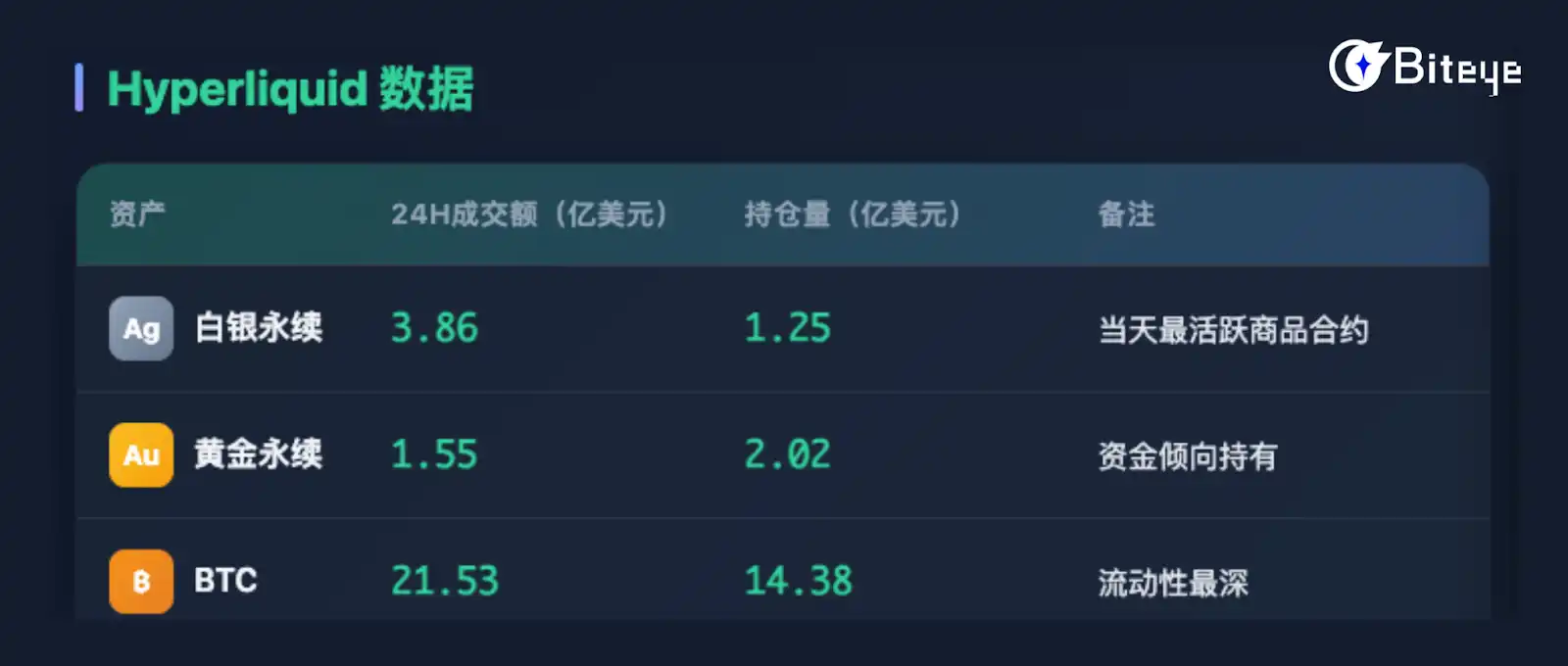
Silver perpetual contract 24h trading volume: $386 million, the most actively traded commodity contract on HL that day.
Gold perpetual contract 24h trading volume: $154.9 million, open interest: $201.6 million — funds tended to hold rather than short-term speculate.
BTC 24h trading volume: $2.153 billion, open interest: $1.438 billion — the asset with the deepest liquidity that day.
Crude oil trading volume: nearly $7.45 million, open interest: $6.91 million,涨幅 +5.07% — the top gainer among all assets.
In this event, both Polymarket and Hyperliquid performed well. But if you look closely, you'll notice something interesting:
-
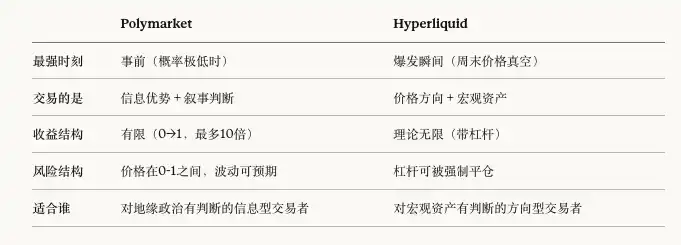
The active markets on Polymarket simply do not have corresponding trading instruments in traditional finance. No tool lets you directly bet on war probability. Polymarket has created a completely new asset class.
-
The assets traded on Hyperliquid have long existed in traditional markets. It brings traditional commodity futures on-chain, enabling true 24/7 trading, making previously untradeable times tradeable.
This is their difference: Polymarket makes previously untradeable events tradeable; Hyperliquid makes previously untradeable times tradeable.
3.2 Synergy: 1+1>2 Coordinated Strategies
Strategy 1: Using Probability Changes as a Leading Indicator for Trades
Polymarket's probability changes often lead the price fluctuations of physical assets.
When the probability of "US strikes Iran" on Polymarket climbs from 9% to 30%, it means Middle East geopolitical risk is intensifying, and the risk of future conflict is higher.
At this point, you can position on both sides simultaneously:
-
On Polymarket: Buy Yes
-
On Hyperliquid: Simultaneously go long on crude oil and gold
Strategy 2: Using Prediction Markets as Risk Hedging Tools
You can use Polymarket as a risk hedging platform to reduce risks brought by the conflict.
Suppose you hold a long position in crude oil on Hyperliquid, but you are unsure if the conflict will actually erupt. You can simultaneously buy "No" on Polymarket as a hedge.
-
If the conflict does not happen, oil prices fall. Your HL long position loses, but the Polymarket No position profits, partially covering the loss.
-
If the conflict erupts, oil prices rise. The HL long position profits. The Polymarket No position goes to zero, but overall still makes money.
Strategy 3: Identifying Insider Warning Signals on Polymarket
Large trades from new wallets on Polymarket are widely considered "insider trading." When people with asymmetric information enter the market early, insiders provide valuable warning signals to the outside world.
When new wallets start buying large amounts of "Yes" on "US strikes Iran," pay attention to whether the risk is intensifying.
IV. Conclusion: The Social Value of On-Chain Finance
When smoke filled the Middle East, traditional financial markets paused for the weekend, while the on-chain world operated 24/7 without interruption. Polymarket is responsible for pricing the truth, Hyperliquid is responsible for providing a venue for volatility.
Betting on war on a platform might evoke a sense of immorality similar to "The Hunger Games," where participants gamble money on others' suffering from the stands. But from another perspective, the probability signals generated by this gambling have extremely high social value.
For locals caught in the vortex of the crisis, the real-time fluctuations of financial markets are a more honest early warning than news releases. When Polymarket probabilities surge and crude oil prices fluctuate violently, this data provides ordinary people with leading signals for evacuation and precaution.
In this order, on-chain finance is not just a gaming tool but also a system for ordinary people to access information.






