Hyperliquid Rally Stalls Near $30, Will HYPE Slide Further or Recover Toward $35?

bitcoinistPublicado a 2026-02-19Actualizado a 2026-02-19

Resumen

Hyperliquid's (HYPE) rally has stalled after failing to hold a breakout above $31, pulling back to a key support zone between $28 and $30. The token is now in a consolidation phase, with the $27.50–$28.50 region being critical support. A hold above this level could pave the way for a retest of $32.28 or even $35. However, a breakdown may lead to further declines toward $25–$26. Bearish signals are emerging, including a bearish MACD crossover and a more than 50% drop in weekly protocol revenue. Despite this, traders are watching for a potential bounce from support or a breakdown, which could determine the next directional move. Market sentiment remains cautious as volume declines, with price action near current levels seen as a decision zone.

Momentum around Hyperliquid cooled quickly this week after HYPE failed to hold a breakout above $31, sending the token back to a familiar battleground between buyers and sellers. With price hovering near key support, traders are now watching closely for signals that could define the next directional move.

Related Reading: Crypto Lobby Group Sounds Alarm Over Senate’s Crypto Bill Threat

The recent pullback reflects a broader consolidation trend that has defined price action for months, as shifting market sentiment, weakening technical momentum, and cooling network activity reshape short-term expectations.

Data tracked across major market platforms shows HYPE fluctuating within a well-established range, roughly $28 to $30. While the structure has offered predictable trading levels, repeated rejection near resistance suggests buyers are becoming cautious after recent gains.
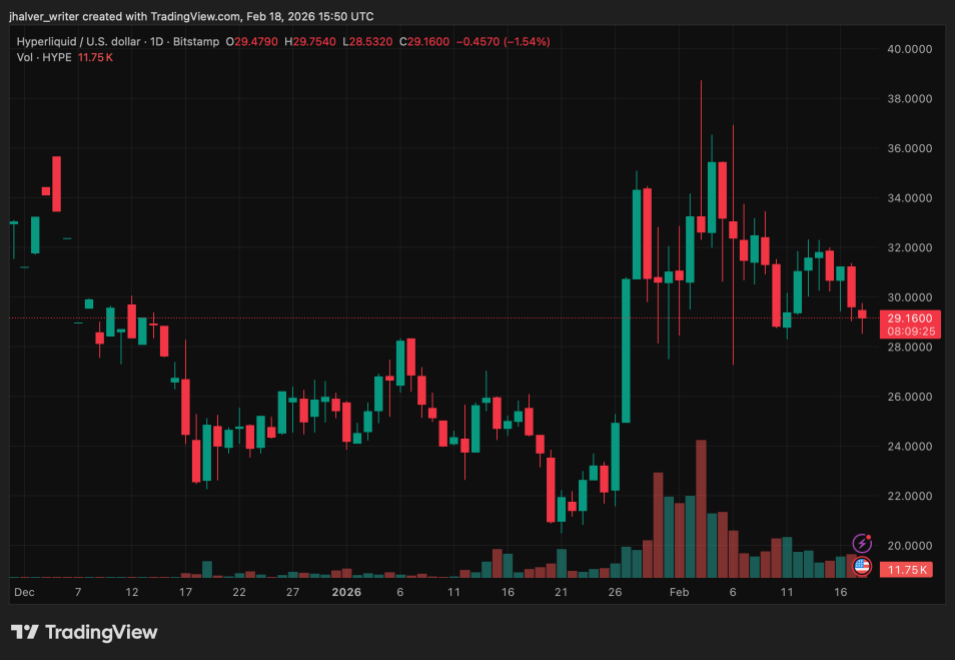
HYPE's price trends to the downside on the daily chart. Source: HYPEUSD on Tradingview

Range Trading Defines the Current Market

Hyperliquid (HYPE) briefly moved above $31 earlier this week before retracing, supporting resistance between $32 and $35. Analysts note that the $27.50–$28.50 region remains the most important support area, where buyers have consistently stepped in during recent volatility.

Holding above roughly $28.98 is viewed as critical for maintaining bullish continuation. A successful defense could allow a renewed attempt toward $32.28 and potentially $35 if momentum returns.

However, failure to hold this zone may expose the token to deeper downside, with projections pointing toward $25–$26 as the next support band. The consolidation comes after the token declined nearly 25% from its yearly high near $37.8, reflecting broader crypto market weakness and reduced risk appetite across digital assets.

Bearish Signals Emerge as Hyperliquid’s Activity Slows

Technical indicators are sending mixed signals. A bearish MACD crossover and weakening momentum readings suggest selling pressure has increased, while neutral RSI levels indicate the market has not yet reached oversold conditions.

Fundamentals have also softened. Weekly protocol revenue recently dropped more than 50%, alongside a decline in total value locked. Lower activity reduces the platform’s capacity to fund token buybacks, easing deflationary pressure that previously supported price recovery.

Despite this, market participants continue to monitor institutional developments around Hyperliquid, including expanding liquidity access through integrations and growing participation from larger traders.

Can HYPE Reclaim Momentum?

Short-term direction now depends largely on whether support near $28 holds. A bounce from this region could trigger renewed buying interest and reopen the path toward $34–$35. Conversely, a confirmed breakdown may accelerate losses if broader crypto market conditions remain weak.

Related Reading: Bitcoin ‘Ghost Whale’ Emerges: New Hong Kong Filer Tops Q4 IBIT Buys

Declining volume and cautious sentiment suggest traders are waiting for clearer confirmation. Price action near current levels is increasingly viewed as a decision zone, one that may determine whether HYPE resumes its upward trend or enters a deeper corrective phase.

Cover image from ChatGPT, HYPEUSD chart on Tradingview

Preguntas relacionadas

QWhat is the critical support level for Hyperliquid (HYPE) to maintain bullish continuation, according to the article?

AHolding above roughly $28.98 is viewed as critical for maintaining bullish continuation.

QWhat are the two potential price targets mentioned for HYPE if it successfully defends its key support and momentum returns?

AA renewed attempt toward $32.28 and potentially $35.

QWhat fundamental metrics have recently softened for the Hyperliquid protocol, contributing to the bearish pressure?

AWeekly protocol revenue recently dropped more than 50%, alongside a decline in total value locked.

QWhat technical indicator is mentioned as having a bearish crossover, suggesting increased selling pressure?

AA bearish MACD crossover.

QWhat broader market condition is cited as a factor in HYPE's decline from its yearly high?

ABroader crypto market weakness and reduced risk appetite across digital assets.

Lecturas Relacionadas

Understanding Hash in One Article: The "Browser Miner" on Ethereum

Hash is an Ethereum-based ERC-20 token described as a "browser-minable post-quantum token." Its key features include enabling browser-based GPU mining without specialized hardware, a fixed supply cap of 21 million tokens, immutable and permissionless smart contracts with no team allocation or pre-mining, and an emphasis on post-quantum security using Keccak256 hashing. The mining mechanism is a simplified on-chain proof-of-work where miners solve unique challenges tied to their wallet address. Key design elements prevent answer theft, with epochs resetting every 100 blocks (~20 minutes) and a per-block minting limit. Emission follows a Bitcoin-like halving schedule every 100,000 mints, starting at 100 tokens per mint. Projections suggest all tokens could be mined within approximately 294 days if a target rate of one mint per minute is sustained. Hash emphasizes "post-quantum" security by leveraging hash-based primitives like Keccak256, which are considered more resistant to quantum attacks compared to elliptic-curve cryptography. While not a fully post-quantum asset, it aligns with Ethereum's broader post-quantum research narrative. The project completed its Genesis sale at $0.03 and began trading on Uniswap, with its price reaching around $0.19. The initial circulating supply is small, with 5% sold in Genesis and 5% allocated to liquidity. The majority (47.6% of total supply) is allocated to early-stage mining, leading to a front-loaded emission schedule. This structure, combined with low initial liquidity, makes Hash a high-volatility, high-risk project dependent on sustained miner participation and market demand to absorb new supply.

marsbitHace 9 min(s)

Understanding Hash in One Article: The "Browser Miner" on Ethereum

marsbitHace 9 min(s)

OpenAI's Largest Internal Wealth Creation: 600 People Cash Out a Total of $6.6 Billion, 75 Take Home the Maximum $30 Million Each

A Wall Street Journal report reveals OpenAI's unprecedented pre-IPO wealth creation. In a single employee stock sale last October, over 600 current and former employees sold shares, collectively cashing out approximately $6.6 billion. Due to high investor demand, the company tripled the individual sale cap to $30 million, with about 75 employees selling the maximum amount. This event represents the largest such transaction in tech industry history for a private company. OpenAI's valuation was $500 billion for this tender offer. Employees with over two years of tenure were eligible, allowing many post-ChatGPT hires their first liquidity event. The company's stock has reportedly grown over 100-fold in seven years. Following a restructuring, employees collectively hold about 26% of OpenAI. The scale of executive wealth is also staggering. In court testimony related to Elon Musk's lawsuit, President and co-founder Greg Brockman confirmed his OpenAI stake is worth around $30 billion. Analysis indicates about 165 current and former employees hold a combined ~$164.9 billion in equity, averaging nearly $1 billion per person in paper wealth. OpenAI's per-employee stock-based compensation is estimated to be 34 times the average of major tech firms before their IPOs. OpenAI continues its rapid ascent, closing a $122 billion funding round at an $852 billion valuation in March. With monthly revenue hitting $2 billion, over 900 million weekly ChatGPT users, and plans for a potential trillion-dollar IPO in late 2026, this wealth-creation engine shows no signs of stopping.

链捕手Hace 32 min(s)

OpenAI's Largest Internal Wealth Creation: 600 People Cash Out a Total of $6.6 Billion, 75 Take Home the Maximum $30 Million Each

链捕手Hace 32 min(s)

Trading

Spot
Futuros
活动图片





