Huawei Cloud Rejects Token Price War, Zhou Yuefeng Seeks a New Winning Formula for AI Cloud

marsbitPublicado a 2026-06-06Actualizado a 2026-06-06

Resumen

At the 2026 Huawei Cloud INSPIRE Creator Conference, CEO Zhou Yuefeng outlined Huawei Cloud's distinct strategy in the competitive AI cloud market. Instead of engaging in price wars based on token volume or Maas revenue—a common focus for rivals like Alibaba Cloud and ByteDance's Volcano Engine—Huawei Cloud is shifting the competition towards real-world productivity gains. Zhou highlighted three core differentiators: a fully domestic computing stack (Ascend, Kunpeng), a focus on government and enterprise clients rather than consumer internet, and a deep commitment to open-source ecosystems. To this end, Huawei Cloud launched a suite of new products under the "Agentic Infra" paradigm, including the AICS Lingqu computing cluster, AMS memory storage, and the ModelArts Next platform. These aim to solve enterprise challenges in deploying AI agents, such as latency, memory, scheduling, and security. The strategy further involves creating specialized industry zones ("AI Dream Factories") for sectors like healthcare and embodied intelligence. For example, a smart medical zone developed with Shanghai Ruijin Hospital aims to democratize expert-level diagnostic capabilities. In essence, Huawei Cloud is positioning itself not as a commodity token provider, but as the foundational infrastructure for industrial AI, leveraging its domestic supply chain and hybrid cloud solutions to serve sectors where productivity, not just scale, is the ultimate measure of value.

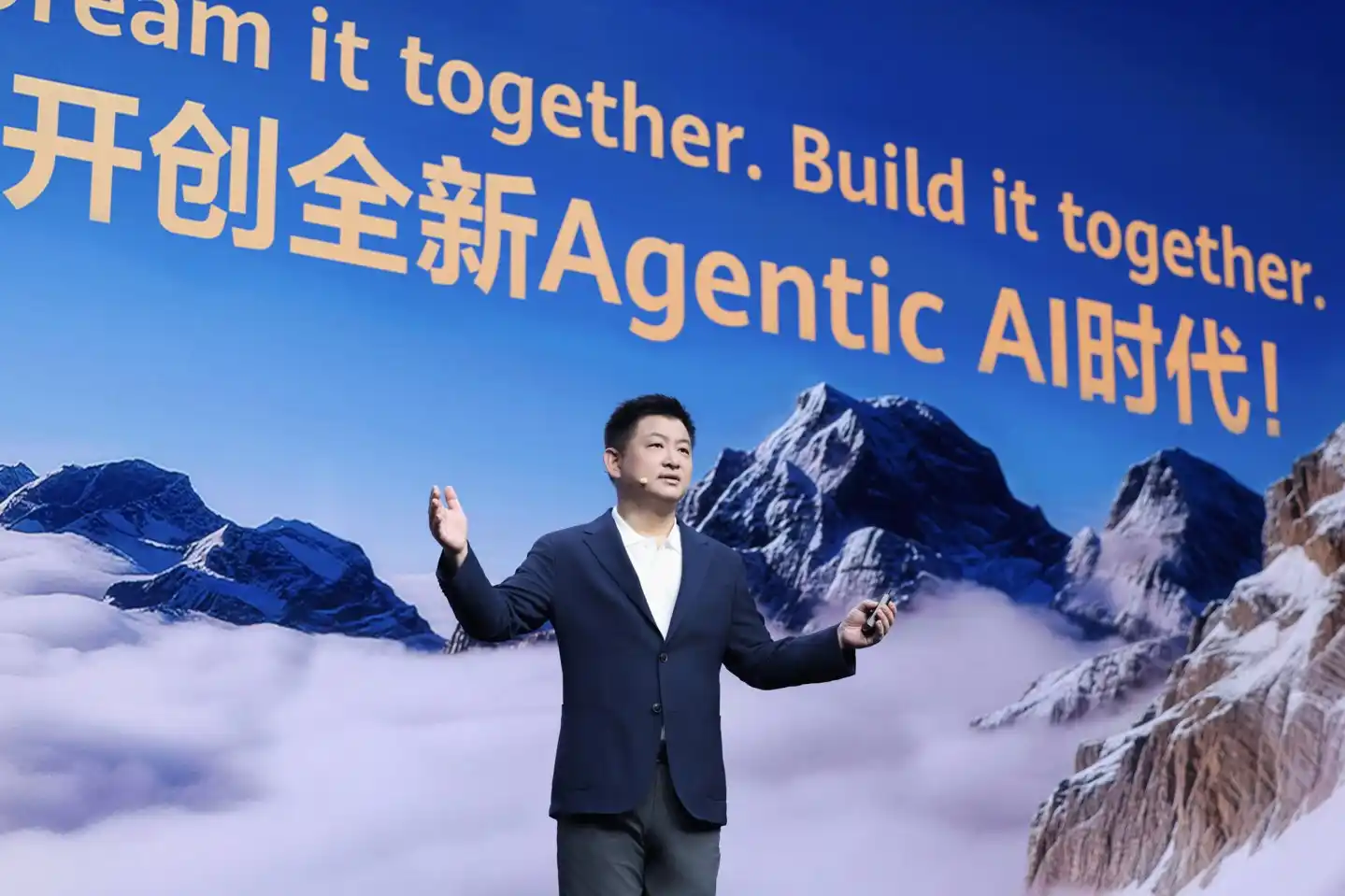
"I don't care much about the total amount of Tokens, nor do I care much about the total revenue." At the Huawei Cloud INSPIRE Creator Conference held on June 5, 2026, Zhou Yuefeng, Director of Huawei and CEO of Huawei Cloud, gave his first media interview since taking office, clearly and unequivocally conveying the current strategic focus of Huawei Cloud.

This is a rare statement in the current Chinese AI cloud market.

Over the past six months, cloud vendors represented by Alibaba Cloud and Volcano Engine have continuously emphasized the narrative of AI cloud, using daily Token call volume and MaaS revenue scale as new growth anchors. Even large model vendors like MoonShot AI, DeepSeek, and Zhipu have repeatedly lowered inference prices. The industry's key focus has been model call volume and scale.

Huawei Cloud is choosing a different way to enter this crowded battlefield. Huawei Cloud released its most intensive batch of new products oriented towards AI since last year in one go: AICS Lingqu Intelligent Computing Cluster, AMS Agentic Memory Storage, CCE Volcano Next - Integrated General-Purpose & AI Scheduling Engine, AgentSphere Secure Autonomous Operation Foundation, as well as ModelArts Next, the enterprise-grade intelligent agent platform AgentArts (open-source version openJiuwen), and collectively proposed a new "Agentic Infra" paradigm.

The KPI Zhou Yuefeng defined for Huawei Cloud is not Token count, but "whether each Token truly enhances productivity." During the window period of limited domestic computing power supply and a reshaping business model, Huawei Cloud has extracted itself from the "competition for second place in the AI cloud" race.
Not Competing on Token Scale

Zhou Yuefeng, at the press meeting, made a rare direct response regarding the differences with Alibaba Cloud and Volcano Engine. He said Huawei Cloud differs from other cloud vendors for three reasons.

First, the computing power route is different. Huawei Cloud uses an entirely domestically developed computing power hardware and software system, including Ascend, Kunpeng, CANN, Euler, etc. This path is more challenging because Huawei cannot use others' computing power; it can only turn domestic solutions into an industry-grade answer.

Consequently, Huawei Cloud must build a second computing plane, offering another ecological choice alongside the globally dominant path formed by NVIDIA + mainstream public clouds. Huawei Cloud cannot and does not intend to use hardware from "all nations" to compete with peers on computing power scale. Zhou Yuefeng said, "I am not willing to compare revenue or scale rankings with other cloud companies, it's meaningless."

Second, the commercial focus is different. Internet-based cloud vendors naturally rely on C-end traffic and developer ecosystems, whereas Huawei Cloud places its main focus on government & enterprise sectors and industries vital to the national economy and people's livelihood. For example, Huawei Hybrid Cloud has held the top market share in government, finance, and central & state-owned enterprises for multiple consecutive years, serving over 5,500 customers globally.

Zhou Yuefeng stated that the iteration speed of models and computing power is too fast; models could become outdated soon after deployment. Therefore, he advises that government and enterprise clients should not build their own 10,000-card clusters. Instead, they should combine local data with remote public cloud AI computing power/model services, leveraging technologies like confidential inference, confidential training, and confidential computing to balance data sovereignty and computing power sharing. Essentially, this delivers the iteration benefits of the public cloud to clients who cannot fully migrate to the public cloud.

Third, the ecosystem approach is different. Huawei Cloud has embraced open-source quite thoroughly: Ascend CANN, Euler operating system, CCE Volcano scheduling, and the ModelArts toolchain are all open-source. The open-source version of the intelligent agent platform AgentArts, openJiuwen, shares over 90% codebase commonality with its commercial version.

The conference also jointly launched the "Hundred Models, Thousand Forms, Gather on Cloud for Win-Win" plan with over 20 leading model vendors including Zhipu, DeepSeek, MiniMax, Kimi, StepFun, Baidu, Meituan LongCat, iFLYTEK Spark, etc.

When domestic computing power is still limited in capability and supply, expanding the ecosystem and increasing model choices is the way to solidify the second computing plane.

Agentic Infra: Shifting the Battlefield from Selling Tokens to Selling Productivity

If the computing power route determines what Huawei Cloud "does not fight," then Agentic Infra determines what it "wants to fight."

Zhou Yuefeng presented a judgment on the evolution of the AI industry: four years ago, doing AI meant buying computing power cards; three years ago, it was training large models; this year, it is using intelligent agents. Computing power and models are receding to the background, while intelligent agents are stepping to the forefront.

The competitive focus of AI cloud is shifting from Token throughput to whether intelligent agents can truly run effectively within enterprises.

Huawei Cloud's product matrix is also realigned according to this judgment. The "four components" of Agentic Infra — efficient Token factory, continuous learning, integrated general-purpose & AI scheduling, and secure autonomy — each address critical engineering challenges enterprises face when deploying intelligent agents.

AICS Lingqu reduces the Token latency for a 100,000-card cluster to under 10 milliseconds; AMS provides petabyte-level memory space via NPU-direct CMS, solving the Agent's long-term task memory bottleneck; CCE Volcano Next improves resource utilization by over 30% through shared training and inference pools; AgentSphere achieves 100-millisecond-level startup and hundreds of thousands of batch creations per minute with its lightweight sandbox.

ModelArts Next restructures the MaaS playbook. Its model routing supports cost-priority, effect-priority, and balanced strategies, already integrated with over 15 SOTA models, achieving scheduling accuracy over 95%, and reducing average calling costs by 20%.

But Huawei Cloud's truly differentiated bet lies in the industry zones. At this conference, Huawei Cloud launched four "Industry AI Dream Factory" zones at once: Smart Healthcare, Embodied AI, Smart Manufacturing, and Scientific Computing.

The Smart Healthcare zone, co-developed with Shanghai Ruijin Hospital, features the RuiPath large model. Over 20 hospitals including Handan, Rui'an, Qianxinan, and Wu'an, ranging from top-tier to municipal and county-level, have collectively joined. This marks the first time that capabilities like pathological diagnosis, highly dependent on expert experience, are being delivered as a "cloud service" to county-level hospitals at scale.

The Embodied AI zone launched the world's first full-process embodied AI development platform, CloudRobo, aiming to meet the full-link toolchain demands of over 300 embodied AI startups in China.

Zhou Yuefeng stated that healthcare and finance are the most mature and data-rich industries in China's digitalization, "If AI cannot succeed in these industries, it will be even harder in others." In these fields, the yardstick for measuring AI value should not be daily active users or Token counts, but rather the proportion of financial risk prevention, the improvement in credit efficiency, the probability of accurate diagnoses for remote patients.

Connecting these threads, the strategic outline of Huawei Cloud becomes clear: using a domestically developed computing power + open-source ecosystem as the foundation; covering government and enterprise sectors with hybrid cloud + confidential computing; and shifting the competition from "selling Tokens" to "selling productivity" through Agentic Infra + industry zones.

This path is much slower than chasing MaaS revenue and harder to present attractive year-on-year data, but it circumvents the current intense price war in the AI cloud. It bets on a market not yet priced: who can secure the underlying infrastructure position when intelligent agents truly enter the industry.

On the AI cloud track, Huawei Cloud can only adopt a different solution. Zhou Yuefeng concluded, "I cannot build a silicon-based 'black land' made of hardware from all nations." While other cloud vendors compare whose Tokens offer higher cost-performance, Huawei Cloud is striving to see if this domestic computing power system can meet the real future needs of China's industrial AI.(Author | Zhang Shuai, Editor | Yang Lin)


Criptos en tendencia

Preguntas relacionadas

QAccording to the article, what is Huawei Cloud's strategic focus, and how does it differ from other major AI cloud providers in China?

AHuawei Cloud's strategic focus is not on maximizing token volume or revenue, but on ensuring that 'every token truly enhances productivity.' This contrasts with other major Chinese AI cloud providers like Alibaba Cloud and Volcano Engine, who emphasize daily token calls and MaaS revenue scale as key growth metrics and engage in intense price competition on inference costs.

QWhat are the three key reasons CEO Zhou Yuefeng gives for Huawei Cloud's different approach compared to other cloud companies?

AZhou Yuefeng cites three reasons: 1. Different compute path: Huawei Cloud relies entirely on a domestic R&D system (Ascend, Kunpeng, CANN, Euler), creating a 'second compute plane' distinct from the dominant NVIDIA path. 2. Different commercial focus: Huawei Cloud heavily targets government and enterprise (G/ICT) and key national industries, rather than relying on consumer internet traffic. 3. Different ecosystem strategy: Huawei Cloud employs a thorough open-source approach for its core technologies and collaborates broadly with model vendors through initiatives like the 'Hundred Models, Thousand Forms' plan.

QWhat is 'Agentic Infra,' and what role does it play in Huawei Cloud's strategy for the AI cloud market?

A'Agentic Infra' (Agentic Infrastructure) is a new paradigm introduced by Huawei Cloud. It represents a shift in the AI cloud competition focus from token throughput to enabling agents to operate effectively within enterprises. It consists of a 'four-piece suite' addressing key engineering challenges: efficient token factories (AICS), continuous learning/memory (AMS), integrated scheduling for training and inference (CCE Volcano Next), and secure autonomous operation (AgentSphere). This moves the battlefield from 'selling tokens' to 'selling productivity.'

QWhat are 'Industry AI Dream Factory' zones, and can you name two specific examples mentioned in the article?

A'Industry AI Dream Factory' zones are specialized platforms launched by Huawei Cloud to provide AI solutions and tools tailored to specific vertical industries. Two examples mentioned are: 1. The Smart Healthcare Zone, which features the RuiPath large model co-developed with Shanghai Ruijin Hospital and serves over 20 hospitals. 2. The Embodied Intelligence Zone, which introduced CloudRobo, a full-process development platform aimed at serving over 300 embodied AI startups in China.

QHow does Huawei Cloud propose to serve government and enterprise clients who cannot fully migrate to the public cloud, according to Zhou Yuefeng?

AZhou Yuefeng suggests a hybrid approach for such clients. He advises against them building large-scale AI clusters themselves due to the rapid iteration of models and compute. Instead, he recommends keeping data locally while leveraging remote public cloud AI compute/model services. This is combined with technologies like confidential inference, training, and computing to balance data sovereignty with access to shared compute power. This model essentially delivers the iteration benefits of the public cloud to clients with stricter data requirements.

Lecturas Relacionadas

HIP-3 Perpetual Futures Arbitrage in Action: SK Hynix ADR Premium Trading Opportunity

HIP-3 Perpetual Futures Arbitrage in Practice: The SK Hynix ADR Premium Trade Following its Nasdaq listing, a significant price gap emerged between SK Hynix's ADR (SKHY) and its underlying share (SKHX). During this period, the HIP-3 builder TradeXYZ launched perpetual futures markets for both on Hyperliquid. The divergent funding rates between these two markets offer a clear case study on the capabilities and limitations of stock perpetuals. The premium, which soared to 51% on July 14th, was primarily driven by closed arbitrage channels. The new ADR issuance did not involve depositing existing shares, and conversion between the underlying share and the ADR is not permitted until after July 29th. With strong US institutional demand facing constrained supply, the price gap widened. On Hyperliquid, the funding rates for SKHX and SKHY moved in opposite directions, revealing traders executing a pairs trade to bet on the premium narrowing—buying SKHX (underlying) and shorting SKHY (ADR). This highlights key insights: 1. **Ability to bypass traditional market friction:** The trade can be executed with USDC on a single platform, avoiding complexities like currency conversion, foreign accounts, and ADR borrowing. 2. **Missing tools to separate funding costs:** The trade inherently carries the cost of funding rate payments/receipts, as perpetuals reflect but do not force convergence between the two underlying indices. Instruments to hedge this variable cost are not yet available for HIP-3 stocks. 3. **Function as a leading indicator:** The SKHY pre-IPO market accurately predicted the Nasdaq opening price, and SKHX trades during KRX closures, providing price discovery. 4. **Inverse relationship with accessibility:** The SKHX perpetual, serving a market with fewer native hedging tools, sees much higher volume and sustained funding rates than the SKHY perpetual, which exists alongside a deep spot and options market. The focus now shifts to July 29th, when share conversion may partially open, though structural limits on creating new ADRs may persist. Regardless of the premium's path, Hyperliquid remains the primary venue to express a view on this spread via perpetual futures.

Foresight NewsHace 11 min(s)

HIP-3 Perpetual Futures Arbitrage in Action: SK Hynix ADR Premium Trading Opportunity

Foresight NewsHace 11 min(s)

AI Claims Erdős's $100 Bounty, Solves in One Page What a 44-Page Top Journal Paper Couldn't

An AI, in collaboration with a mathematician, has produced a one-page proof for a long-standing Erdős problem (#119), claiming the $100 bounty originally offered by Paul Erdős. The problem concerns the maximum modulus of polynomials with zeros on the unit circle. The new result, generated with the help of GPT-5.6 Sol and posted on the erdosproblems.com forum, is notably simpler than a famous 44-page proof by József Beck published in the Annals of Mathematics in 1991, which addressed a related but distinct part of the problem. Thomas Bloom, a mathematician and the maintainer of the Erdős problems website, stated that the AI's proof uses straightforward harmonic analysis techniques and contains "interesting ideas," suggesting the problem was less inherently difficult than previously believed. This follows other recent AI-assisted proofs, such as for the Cycle Double Cover conjecture. The development has sparked debate within the mathematical community. While some argue AI has hit a wall in pure mathematics, others point to incremental but genuine progress on tough problems, indicating that AI's relentless, non-intuitive exploration can uncover overlooked paths that human mathematicians might dismiss after initial failures. This event highlights a potential shift: some "open" problems may persist not due to sheer difficulty, but due to the limits of human patience in exploring all possible avenues.

marsbitHace 13 min(s)

AI Claims Erdős's $100 Bounty, Solves in One Page What a 44-Page Top Journal Paper Couldn't

marsbitHace 13 min(s)

HIP-4 Enables Permissionless Deployment, Can Hyperliquid Kill Polymarket?

Hyperliquid announced that its HIP-4 prediction markets will soon support permissionless deployments, similar to its successful HIP-3 model for perpetual contracts. This move aims to ignite growth in its underperforming prediction market segment by allowing third parties to create their own prediction markets upon staking 500,000 HYPE (worth approximately $30 million), with the potential to earn up to 50% fee shares. While this strategy mirrors the approach that propelled HIP-3 and platforms like Trade.xyz to dominance in tokenized trading, the article raises significant challenges for HIP-4. Its current performance is weak, with only $216 million in total volume over three months—pales in comparison to Polymarket's $4.6 billion monthly volume. The high staking barrier may exclude smaller teams, potentially limiting innovation and event diversity. Furthermore, Hyperliquid missed the crucial timing window of the 2026 World Cup, a major catalyst for prediction market activity, which competitors like Polymarket capitalized on heavily. The success of HIP-3 was partly due to perfect timing, such as during the U.S.-Iran conflict when traditional markets were closed. Without a similar catalytic event and facing an established leader like Polymarket, it remains uncertain whether Hyperliquid's "decentralized" strategy can successfully disrupt the prediction market landscape.

marsbitHace 46 min(s)

HIP-4 Enables Permissionless Deployment, Can Hyperliquid Kill Polymarket?

marsbitHace 46 min(s)

1.2 Million in Line for Margin Calls: The Collapse of South Korea's National "Gamble" by Retail Investors

In July 2026, the South Korean stock market, fueled by a national "all-in" bet on semiconductor stocks, experienced a catastrophic meltdown. The KOSPI index plummeted from record highs, triggering seven market-wide trading halts in the first half of the year—more than half the total since the mechanism's inception in 2000. The crisis stemmed from the market's extreme concentration on two giants: Samsung Electronics and SK Hynix, which accounted for 60% of the KOSPI index. Amid an AI-driven boom, rampant retail speculation, particularly among young investors seeking to overcome high living costs and social immobility, led to a surge in leveraged trading. In a pivotal move, regulators allowed the launch of 2x leveraged ETFs tied solely to these two stocks in May 2026. This set the stage for disaster. When signs of an HBM chip glut emerged in July, prices for Samsung and SK Hynix fell. The leveraged ETFs' mandatory daily rebalancing mechanism forced them to sell shares aggressively to maintain their leverage ratios. This triggered a vicious cycle: ETF selling drove prices down further, which triggered margin calls and forced liquidations of retail investors' leveraged positions, leading to more selling. The market entered a self-reinforcing "death spiral" of cascading liquidations. The aftermath was devastating. Over 1.2 million retail margin accounts faced liquidation warnings, with an estimated 320,000 to 460,000 accounts completely wiped out, many left owing money to their brokers. Approximately 62% of these affected investors were in their 20s and 30s. Total losses from leveraged positions were estimated at around 2.15 trillion won (~$1.6 billion USD). Regulators later expressed regret for approving the high-risk ETFs, highlighting the dangers of financial innovation outpacing proper risk controls and investor protection. The episode serves as a stark warning: when market frenzy, structural fragility, and complex leverage products converge, the outcome can be a rapid and brutal wealth destruction, disproportionately impacting the most vulnerable participants.

marsbitHace 1 hora(s)

1.2 Million in Line for Margin Calls: The Collapse of South Korea's National "Gamble" by Retail Investors

marsbitHace 1 hora(s)

Trading

Spot

Artículos destacados

Cómo comprar WAR

¡Bienvenido a HTX.com! Hemos hecho que comprar WAR (WAR) sea simple y conveniente. Sigue nuestra guía paso a paso para iniciar tu viaje de criptos.Paso 1: crea tu cuenta HTXUtiliza tu correo electrónico o número de teléfono para registrarte y obtener una cuenta gratuita en HTX. Experimenta un proceso de registro sin complicaciones y desbloquea todas las funciones.Obtener mi cuentaPaso 2: ve a Comprar cripto y elige tu método de pagoTarjeta de crédito/débito: usa tu Visa o Mastercard para comprar WAR (WAR) al instante.Saldo: utiliza fondos del saldo de tu cuenta HTX para tradear sin problemas.Terceros: hemos agregado métodos de pago populares como Google Pay y Apple Pay para mejorar la comodidad.P2P: tradear directamente con otros usuarios en HTX.Over-the-Counter (OTC): ofrecemos servicios personalizados y tipos de cambio competitivos para los traders.Paso 3: guarda tu WAR (WAR)Después de comprar tu WAR (WAR), guárdalo en tu cuenta HTX. Alternativamente, puedes enviarlo a otro lugar mediante transferencia blockchain o utilizarlo para tradear otras criptomonedas.Paso 4: tradear WAR (WAR)Tradear fácilmente con WAR (WAR) en HTX's mercado spot. Simplemente accede a tu cuenta, selecciona tu par de trading, ejecuta tus trades y monitorea en tiempo real. Ofrecemos una experiencia fácil de usar tanto para principiantes como para traders experimentados.

217 Vistas totalesPublicado en 2024.12.11Actualizado en 2026.06.02

Cómo comprar WAR

Discusiones

Bienvenido a la comunidad de HTX. Aquí puedes mantenerte informado sobre los últimos desarrollos de la plataforma y acceder a análisis profesionales del mercado. A continuación se presentan las opiniones de los usuarios sobre el precio de WAR (WAR).

活动图片