HSBC Bank and Anchorpoint Financial win Hong Kong’s first stablecoin licenses – Details

ambcryptoPublicado a 2026-04-10Actualizado a 2026-04-10

Resumen

Hong Kong has issued its first stablecoin licenses to institutional, bank-backed entities HSBC Bank and Anchorpoint Financial (backed by Standard Chartered, Animoca Brands, and HKT). This marks the formal launch of the city's strict stablecoin regulatory framework, which prioritizes established players with strong compliance, capital reserves, and regulatory respect. The cautious, limited approval process may slow broader market participation and innovation in the near term but is designed to ensure user protection, risk management, and overall trust. The regime, which came into effect in August 2025, includes stringent rules on reserves, governance, and anti-money laundering controls.

Hong Kong has granted its first stablecoin issuer licenses. The initial batch is small and institutional, which sets a cautious tone.

Here’s what you need to know.

Bank-backed issuers dominate first approvals

The first stablecoin licenses went to Anchorpoint Financial and HSBC’s Hong Kong banking arm, both well-known TradFi players. Anchorpoint itself is backed by Standard Chartered, Animoca Brands, and HKT.

The initiative is happening under a new framework, led by the Hong Kong Monetary Authority (HKMA). Both entities are set to begin operations in the coming months.

These approvals are the formal launchpad for the city’s stablecoin regime, which took effect in August 2025.
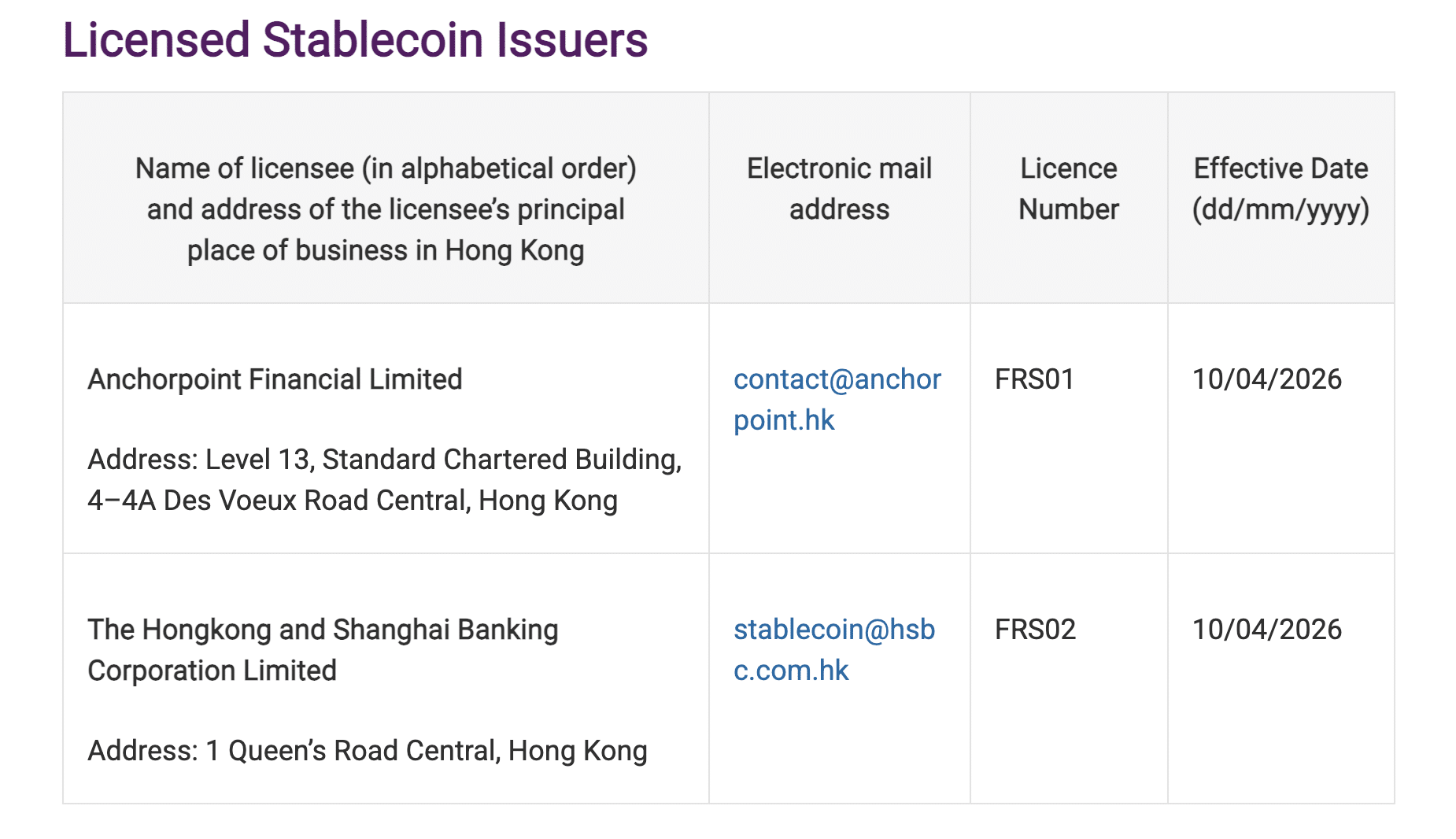
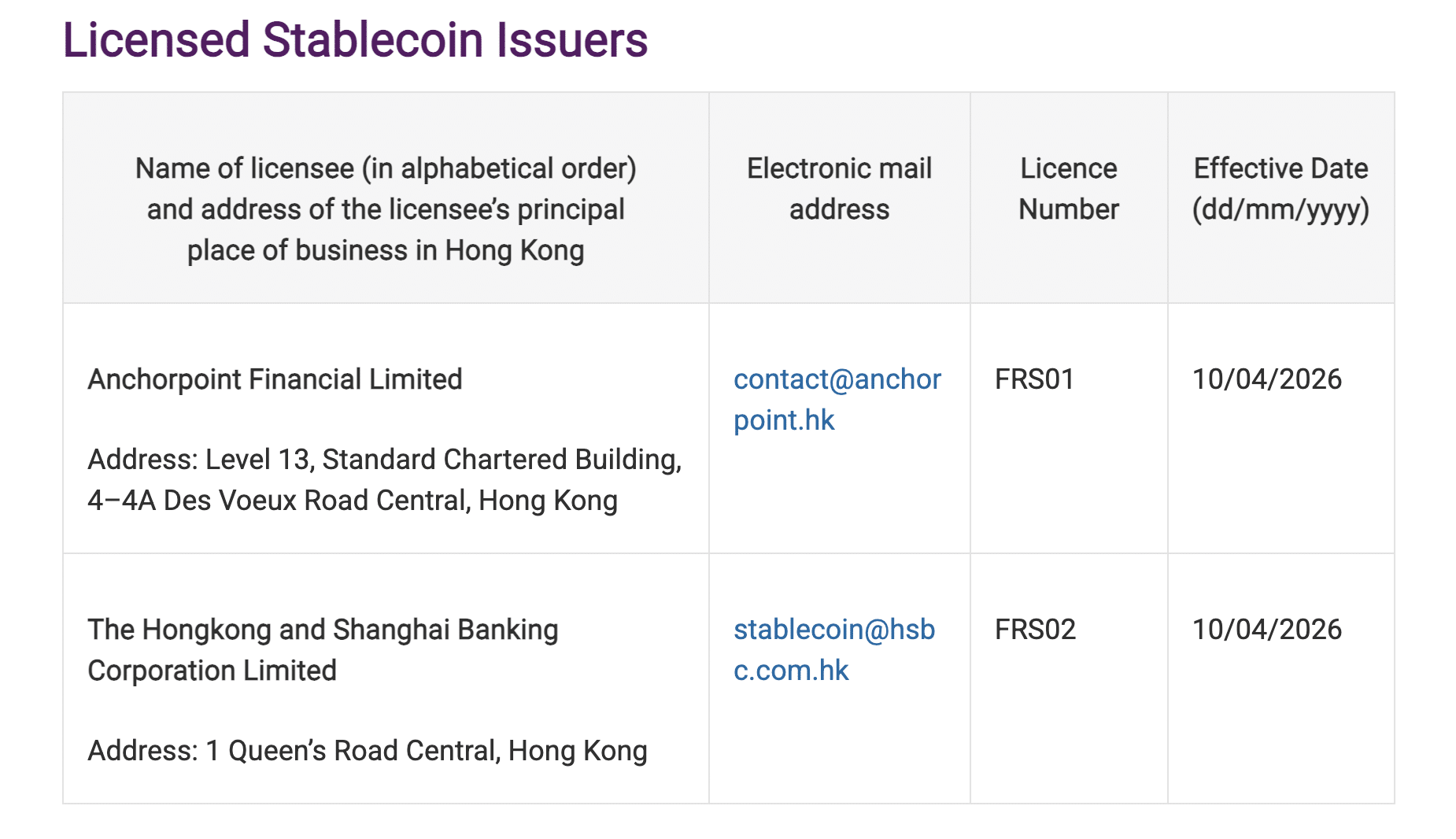
Source: HKMA

They’re prioritizing entities with established compliance systems, capital backing, and regulatory respect.

HKMA Chief Executive Eddie Yue stated that the regime would provide –

An orderly operating environment... while ensuring robust user protection and effective risk management.

AMBCrypto previously reported that Hong Kong expanded its licensing regime to cover crypto dealers and custodians. This brought trading and asset storage under the same regulatory perimeter.

The announcement came after a delayed timeline

The HKMA had earlier stated that initial licenses could be issued as early as March. However, approvals only materialized in April.

This is in line with the regime itself, with its strict requirements on reserve backing, redemption mechanisms, governance, and AML controls. The framework also lays out enforcement powers, including fines and license revocations.

Institutions first, broader access later?

In the near term, Hong Kong’s stablecoin market is likely to remain held by institutional players. Limited licenses and stringent compliance thresholds will slow participation from crypto-native firms.

It will certainly increase trust and stability among the masses, but early innovation impediment is a concern. The key question in time, will be whether the HKMA expands access or maintains a bank-led model.


Final Summary

  • Hong Kong’s first stablecoin licenses go to bank-backed players.
  • Strict rules and limited approvals could slow innovation but increase trust.

Criptos en tendencia

Preguntas relacionadas

QWhich two companies received Hong Kong's first stablecoin licenses?

AHSBC's Hong Kong banking arm and Anchorpoint Financial received the first stablecoin licenses.

QWhich regulatory authority is leading the new stablecoin framework in Hong Kong?

AThe Hong Kong Monetary Authority (HKMA) is leading the new stablecoin framework.

QWhat are some of the key requirements of Hong Kong's stablecoin regime?

AThe regime has strict requirements on reserve backing, redemption mechanisms, governance, and Anti-Money Laundering (AML) controls.

QWhat is a potential concern regarding the new licensing approach according to the article?

AA potential concern is that limited licenses and stringent compliance could slow participation from crypto-native firms and create an early innovation impediment.

QWhen did Hong Kong's stablecoin regulatory regime officially take effect?

AThe stablecoin regulatory regime took effect in August 2025.

Lecturas Relacionadas

Bitcoin Withdrawals Continue: 8 Years of Storage in a Coldcard Cold Wallet Ended in Zero

Coldcard Hardware Wallet Hacked: Losses Mount Due to Vulnerable Seed Generation A critical vulnerability in Coldcard hardware wallets has led to a continued wave of fund thefts. According to Galaxy Research, the total stolen has reached 1,367.05 BTC (approx. $88.6 million) from 4,585 addresses, a significant increase from the initial 594.5 BTC reported on July 30, 2026. Most of the stolen funds remain on the attackers' addresses. The issue is not with the current firmware, which Coinkite has updated, but with seed phrases generated on vulnerable devices between March 2021 and the release of fixed firmware versions. Due to a programmer error, devices switched from using a hardware random number generator to the software-based Yasmarang generator, which was initialized with publicly accessible data like the chip's serial number. This made the seed phrases predictable through offline brute-force attacks, meaning wallets remain at risk until funds are moved to a new wallet generated with the patched firmware. Affected devices include Mk2/Mk3 with firmware 4.0.1–4.1.9 (and up to 5.0.3), Mk4/Mk5 up to version 5.6.0, and Q models up to 1.5.0Q. The only exceptions are seeds created with a high-entropy method like at least 50 independent dice rolls or a strong unique BIP-39 passphrase. All other owners must generate a new seed on the fixed firmware and transfer their assets. A case highlighting the human impact involves a 39-year-old long-term investor who lost 2 BTC (approx. $130,000) in minutes. He had accumulated the Bitcoin over eight years through physical labor, viewing it as a financial lifeline and a retirement plan in a country suffering from hyperinflation. His story underscores that even conservative "buy and hold in cold storage" strategies can be compromised by such underlying technical flaws. From a technical perspective, this incident echoes historical failures where weak random number generators undermined cryptographic security, challenging the assumption that offline storage is automatically foolproof.

cryptonews.ruHace 2 hora(s)

Bitcoin Withdrawals Continue: 8 Years of Storage in a Coldcard Cold Wallet Ended in Zero

cryptonews.ruHace 2 hora(s)

Trading

Spot

Artículos destacados

Cómo comprar WIN

¡Bienvenido a HTX.com! Hemos hecho que comprar WINkLink (WIN) sea simple y conveniente. Sigue nuestra guía paso a paso para iniciar tu viaje de criptos.Paso 1: crea tu cuenta HTXUtiliza tu correo electrónico o número de teléfono para registrarte y obtener una cuenta gratuita en HTX. Experimenta un proceso de registro sin complicaciones y desbloquea todas las funciones.Obtener mi cuentaPaso 2: ve a Comprar cripto y elige tu método de pagoTarjeta de crédito/débito: usa tu Visa o Mastercard para comprar WINkLink (WIN) al instante.Saldo: utiliza fondos del saldo de tu cuenta HTX para tradear sin problemas.Terceros: hemos agregado métodos de pago populares como Google Pay y Apple Pay para mejorar la comodidad.P2P: tradear directamente con otros usuarios en HTX.Over-the-Counter (OTC): ofrecemos servicios personalizados y tipos de cambio competitivos para los traders.Paso 3: guarda tu WINkLink (WIN)Después de comprar tu WINkLink (WIN), guárdalo en tu cuenta HTX. Alternativamente, puedes enviarlo a otro lugar mediante transferencia blockchain o utilizarlo para tradear otras criptomonedas.Paso 4: tradear WINkLink (WIN)Tradear fácilmente con WINkLink (WIN) en HTX's mercado spot. Simplemente accede a tu cuenta, selecciona tu par de trading, ejecuta tus trades y monitorea en tiempo real. Ofrecemos una experiencia fácil de usar tanto para principiantes como para traders experimentados.

421 Vistas totalesPublicado en 2024.12.11Actualizado en 2025.03.21

Cómo comprar WIN

Discusiones

Bienvenido a la comunidad de HTX. Aquí puedes mantenerte informado sobre los últimos desarrollos de la plataforma y acceder a análisis profesionales del mercado. A continuación se presentan las opiniones de los usuarios sobre el precio de WIN (WIN).

活动图片













