How Weakening US Labor Data Could Impact Bitcoin Market — Report

bitcoinistPublicado a 2026-03-29Actualizado a 2026-03-29

Resumen

A report analyzes how weakening US labor data could negatively impact Bitcoin and broader financial markets. Citing analysis from Alphractal CEO Wedson, the article highlights a steep decline in the US labor force participation rate (LFP), an underrated macroeconomic signal. Historically, a falling LFP—indicating fewer people working, less consumption, and weaker economic output—has preceded downturns in the S&P 500. Similarly, Bitcoin has shown vulnerability to such macro stress, as seen during the 2008 crisis and the 2020 COVID lockdowns. The key risk for Bitcoin is a potential macro shock that triggers a risk-off sentiment, causing investors to flee to safety. Unlike in 2020, there is currently no massive liquidity injection to cushion this blow and propel prices higher. This bearish outlook is further supported by a steadily declining Coinbase Premium, indicating waning demand from US investors. At the time of writing, Bitcoin's price is approximately $66,750, down over 5% for the week despite a minor 24-hour gain.

The global macro environment has been one of the major defining factors in Bitcoin and the broader crypto market so far this year. From the brewing geopolitical tensions in the Middle East to the rising inflation expectations in the United States, the global financial markets have barely caught a break in 2026. A prominent market expert has come forward with interesting US labor data, breaking down how the rising macroeconomic pressure could impact Bitcoin and the broader financial markets.

Macro Shock Could Trigger Risk-Off Behavior Among BTC Investors

In a March 28th post on the X platform, Alphractal founder and CEO shared that the participation of the United States labor force has been in a steep decline over the past few weeks. According to the crypto pundit, the Labor Force Participation is one of the most underrated macroeconomic signals in the current market landscape.

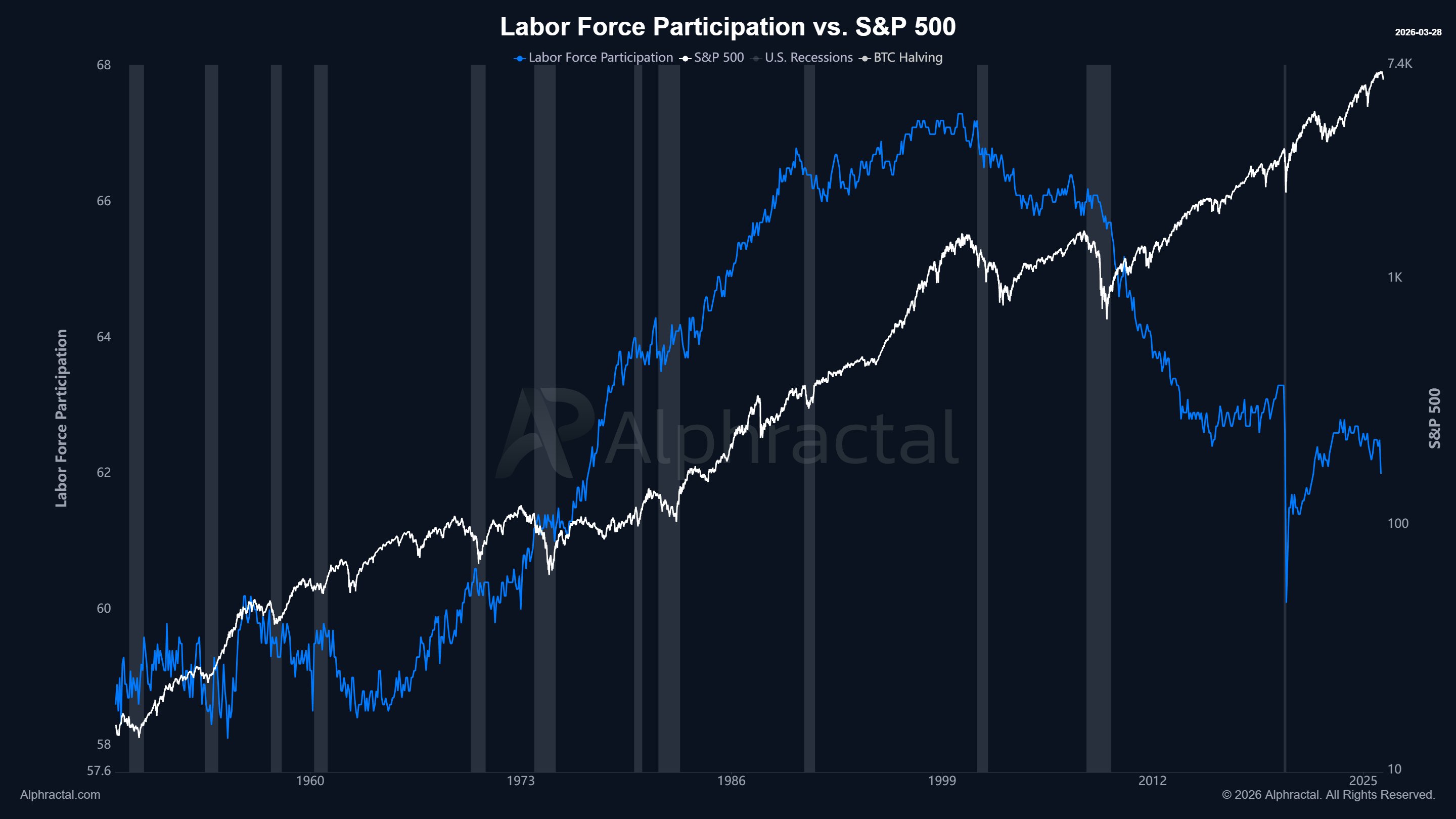
Wedson highlighted the major trends of the Labor Force Participation over the last two decades and its impact on the S&P 500 index. According to the highlighted data, participation reached its peak around 2000, before collapsing during 2008 financial crisis, briefly recovering, and then falling to historic lows during the COVID-19 pandemic.
Source: @joao_wedson on X

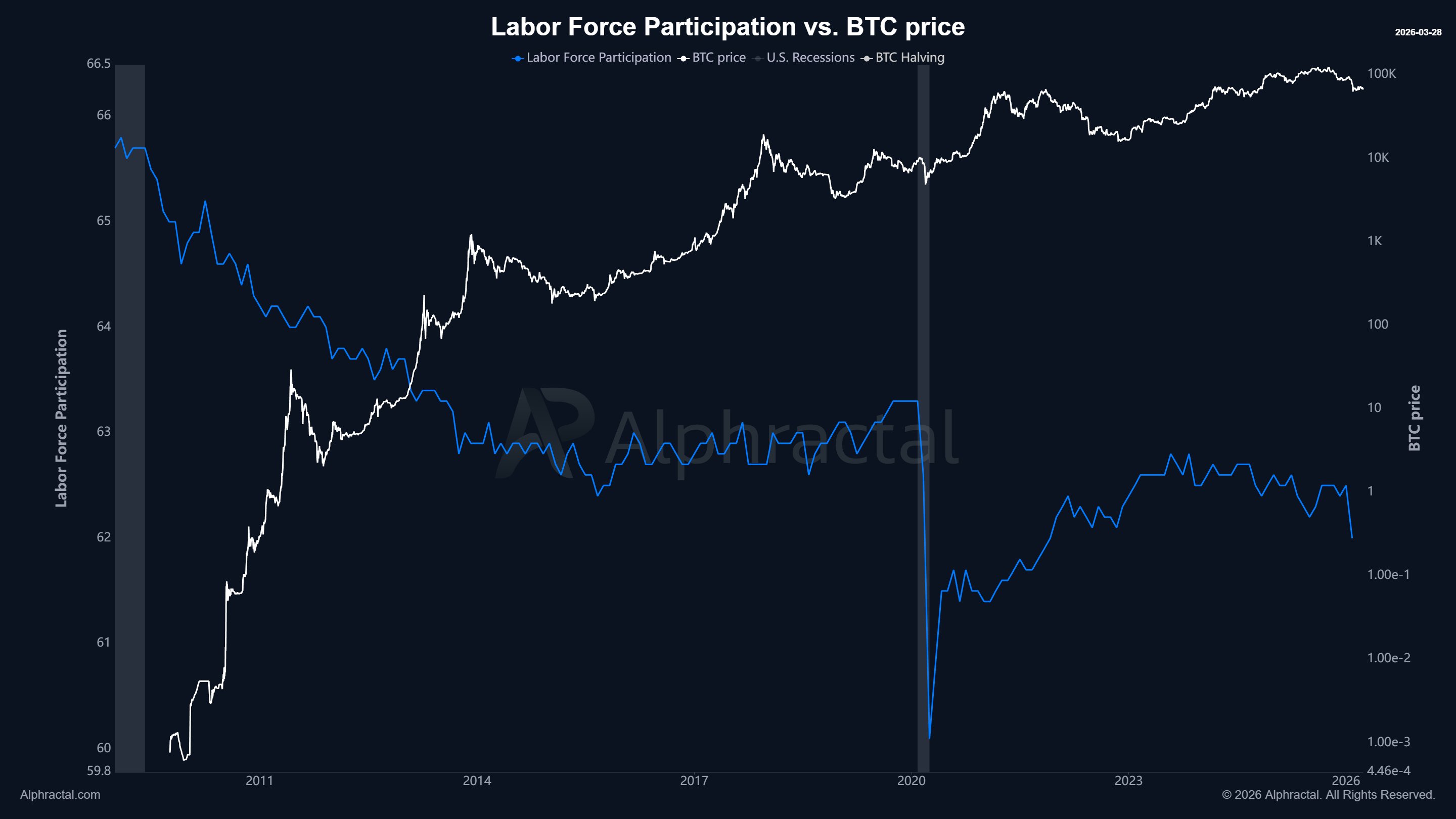
As the labor force participation rate dwindled, the S&P 500 soon followed despite its initial show of resilience. The same can be seen for Bitcoin in the chart below, which seemed to succumb to the macro stress each time the LFP suffered a nosedive.
Source: @joao_wedson on X

Wedson noted that, before the “liquidity” flood sent the Bitcoin price to new highs, the market leader initially fell to cycle lows as the labor participation crashed during the COVID lockdown in 2020. What’s different now is that there’s no obvious liquidity fuel to take advantage in the current labor participation plunge.

Wedson wrote in his post:

A falling participation rate means fewer people working, less consumption, weaker real economic output. The stock market can diverge from that reality for a while but not forever.

According to the Alphractal founder, the specific risk for Bitcoin is a macro shock that triggers a risk-off behavior among investors, with most market participants fleeing to safety before the next accumulation phase begins. And, as rightly baked in the steadily-declining Coinbase Premium, the demand for BTC among US investors seems to be in a steady downturn.

Bitcoin Price Overview

As of this writing, the flagship cryptocurrency is valued at around $66,750, reflecting a roughly 1% jump in the past 24 hours. The single-day action has not been enough to wipe out losses from the past week, which still stand at more than 5%.

The price of BTC on the daily timeframe | Source: BTCUSDT chart on TradingView


Criptos en tendencia

Preguntas relacionadas

QWhat is the main macroeconomic factor discussed in the article that could impact the Bitcoin market?

AThe weakening US labor data, specifically the decline in Labor Force Participation, is highlighted as a major macroeconomic factor that could impact the Bitcoin market.

QAccording to the expert, what does a falling labor force participation rate indicate for the economy?

AA falling labor force participation rate means fewer people working, less consumption, and weaker real economic output.

QWhat specific risk does the Alphractal founder identify for Bitcoin in the current market environment?

AThe specific risk for Bitcoin is a macro shock that triggers a risk-off behavior among investors, causing them to flee to safety.

QHow did the article describe the current demand for Bitcoin among US investors?

AThe demand for BTC among US investors is in a steady downturn, as indicated by the steadily declining Coinbase Premium.

QWhat was the price of Bitcoin at the time of writing, and what was its weekly performance?

AAt the time of writing, Bitcoin was valued at around $66,750, reflecting a weekly loss of more than 5% despite a 1% gain in the last 24 hours.

Lecturas Relacionadas

Ethereum Q1 2026 Report: Fees Decline, Users and Transaction Volume Hit New Highs

Ethereum Q1 2026 Report: Fees Down, Users & Transactions Hit New Highs Token Terminal's Q1 2026 report on Ethereum presents a pivotal development: the network achieved record highs in monthly active users (13.2M, +85.9% YoY), total transactions (200.4M, +81.5% YoY), and throughput (25.78 TPS), while transaction fees on the mainnet plummeted by 47.9% quarter-over-quarter. This shift is attributed to the network's strategic move into a "low fees for scale" phase, exemplified by the Fusaka upgrade which increased data capacity and lowered block space costs, releasing pent-up demand (a manifestation of Jevons's Paradox). The report highlights a core narrative shift for Ethereum: from a DeFi-centric blockchain to a global financial settlement layer. It maintains a dominant position in tokenized assets, holding majority market shares among top chains in stablecoins (61.8%), tokenized funds (73.0%), and tokenized commodities (84.0%). Growth in tokenized funds (+73.1% YoY) and commodities (+325.9% YoY) was particularly strong, driven by institutions like BlackRock and JPMorgan entering the space. Contrasting these usage gains, several USD-denominated value metrics declined in Q1: fully diluted market cap fell 30.3% QoQ, total value locked (TVL) dropped 11.0%, and ecosystem transaction volume decreased 24.0%. The report interprets this as Ethereum prioritizing long-term network expansion and cementing its role as the default settlement layer for finance over short-term fee capture. The commentary from Etherealize argues that, much like the early internet, Ethereum's open, permissionless model is poised to win over closed alternatives as institutional tokenization accelerates.

marsbitHace 1 hora(s)

Ethereum Q1 2026 Report: Fees Decline, Users and Transaction Volume Hit New Highs

marsbitHace 1 hora(s)

He Just Raised 2.7 Billion, and Li Fei-Fei Also Invested

Pete Florence, a former senior research scientist at Google DeepMind and a key contributor to the Vision-Language-Action (VLA) model architecture, is deliberately distancing his startup, Generalist AI, from the trendy "world model" label. He argues that the industry should prioritize concrete goals over buzzwords. His goal is to create robots that can perform a vast range of unseen tasks with high speed and success rates, without needing task-specific training data. Recently, his company raised $400 million (¥2.7 billion) at a $2 billion valuation. Notable investors include NVIDIA's NVentures, Bezos Expeditions, NFDG, as well as Xiaomi co-founder Lin Bin, Zoom founder Eric Yuan, and renowned AI scientist Fei-Fei Li. Florence's approach stems from his academic background at MIT under Professor Russ Tedrake, focusing on understanding the physical world. After joining DeepMind, he developed models like Transporter Network and co-created the VLA framework. He left in 2025 to found Generalist AI. The company has launched two models: GEN-0, which demonstrated that scaling laws apply to physical motion, and GEN-1. GEN-1 was trained on over 500,000 hours of physical interaction data collected via a specialized wearable device. It achieves a 99% success rate on precise mechanical tasks like folding boxes and maintains performance three times faster than its predecessor. Florence believes GEN-1 is reaching a commercial utility threshold similar to the GPT-3 inflection point. The substantial funding round, following GEN-1's release, signifies strong investor confidence in Generalist AI's practical, goal-driven path to creating versatile, useful robots, regardless of the "world model" terminology.

marsbitHace 1 hora(s)

He Just Raised 2.7 Billion, and Li Fei-Fei Also Invested

marsbitHace 1 hora(s)

Two Legends Lost in Three Days: Is Google's AI Talent Dam Cracking?

In three days, Google lost two AI legends. On June 18, Noam Shazeer, co-author of the seminal "Attention is All You Need" paper and Gemini co-lead, left for OpenAI. Just 48 hours later, John Jumper, 2024 Nobel laureate and AlphaFold lead, departed DeepMind for Anthropic. This follows Andrej Karpathy joining Anthropic in May. These moves highlight a structural trend: top AI talent is concentrating at mission-driven, pre-IPO firms like OpenAI and Anthropic, while Google becomes a primary source. The exodus stems from a core mission mismatch. Google's ad-centric model often subordinates AI research to product and revenue goals, creating friction for pioneers like Shazeer, who returned in 2024 only to leave again. In contrast, OpenAI and Anthropic offer singular focus on pushing AI boundaries, whether towards AGI or safety-aligned models, which deeply appeals to top researchers like Jumper. Financial incentives amplify the pull. With both OpenAI and Anthropic nearing IPO, employees stand to gain immensely from equity, an upside Google's mature stock cannot match. Furthermore, the 2023 merger of Google Brain and DeepMind, intended to consolidate strength, has instead created cultural tension and slowed the path from research to product, as evidenced by Gemini's pace. This talent redistribution is reshaping the AI landscape. While Google retains vast data and compute resources, its true crisis is the quiet, continuous loss of the people who define the field's future. The real moat in AI is not infrastructure, but the concentration of brilliant minds—a battle Google is currently losing.

marsbitHace 3 hora(s)

Two Legends Lost in Three Days: Is Google's AI Talent Dam Cracking?

marsbitHace 3 hora(s)

Behind the AI Report Card, Lies a Chinese 'Exam Setter'

Beyond the familiar performance charts like MMLU-Pro and MMMU, which major AI models strive to ace, stands a key "examiner": Chinese-Canadian researcher Wenhu Chen. An assistant professor at the University of Waterloo and founder of TIGERLab, Chen addresses the crucial need for more rigorous AI evaluation. As models like GPT-4 began scoring near-perfect results on older benchmarks like MMLU, it became difficult to distinguish their true capabilities. In response, Chen introduced MMLU-Pro in 2024, featuring harder, more reasoning-focused questions with more answer choices, successfully reintroducing meaningful performance gaps. His work extends to multi-modal evaluation with MMMU and its enhanced version, MMMU-Pro. These benchmarks test a model's ability to understand and reason with complex information from images, charts, and text across diverse academic subjects, exposing the significant challenges even top models face in genuine comprehension. Chen's background in complex QA, table reasoning, and his experience at Google DeepMind on projects like Gemini inform his approach. He understands that effective benchmarks must anticipate how models might "cheat" by memorizing data or avoiding visual analysis. His lab also actively researches video understanding and generation models (e.g., UniVideo, Vamba), ensuring his evaluation work is grounded in practical model-building challenges. Now at Meta's Super Intelligence Lab, Chen continues his focus on multi-modal data and evaluation, representing the deep yet often unseen contributions of Chinese talent in shaping the fundamental tools of the AI industry.

marsbitHace 3 hora(s)

Behind the AI Report Card, Lies a Chinese 'Exam Setter'

marsbitHace 3 hora(s)

Trading

Spot
Futuros

Artículos destacados

Cómo comprar ONE

¡Bienvenido a HTX.com! Hemos hecho que comprar Harmony (ONE) sea simple y conveniente. Sigue nuestra guía paso a paso para iniciar tu viaje de criptos.Paso 1: crea tu cuenta HTXUtiliza tu correo electrónico o número de teléfono para registrarte y obtener una cuenta gratuita en HTX. Experimenta un proceso de registro sin complicaciones y desbloquea todas las funciones.Obtener mi cuentaPaso 2: ve a Comprar cripto y elige tu método de pagoTarjeta de crédito/débito: usa tu Visa o Mastercard para comprar Harmony (ONE) al instante.Saldo: utiliza fondos del saldo de tu cuenta HTX para tradear sin problemas.Terceros: hemos agregado métodos de pago populares como Google Pay y Apple Pay para mejorar la comodidad.P2P: tradear directamente con otros usuarios en HTX.Over-the-Counter (OTC): ofrecemos servicios personalizados y tipos de cambio competitivos para los traders.Paso 3: guarda tu Harmony (ONE)Después de comprar tu Harmony (ONE), guárdalo en tu cuenta HTX. Alternativamente, puedes enviarlo a otro lugar mediante transferencia blockchain o utilizarlo para tradear otras criptomonedas.Paso 4: tradear Harmony (ONE)Tradear fácilmente con Harmony (ONE) en HTX's mercado spot. Simplemente accede a tu cuenta, selecciona tu par de trading, ejecuta tus trades y monitorea en tiempo real. Ofrecemos una experiencia fácil de usar tanto para principiantes como para traders experimentados.

299 Vistas totalesPublicado en 2024.12.12Actualizado en 2026.06.02

Cómo comprar ONE

Discusiones

Bienvenido a la comunidad de HTX. Aquí puedes mantenerte informado sobre los últimos desarrollos de la plataforma y acceder a análisis profesionales del mercado. A continuación se presentan las opiniones de los usuarios sobre el precio de ONE (ONE).

活动图片