How Wagyu Is Changing the Monero Narrative: One Tool Lifting Years of Price Suppression

比推Publicado a 2026-01-14Actualizado a 2026-01-14

Resumen

Wagyu, a new exchange tool, is breaking years of price suppression on Monero (XMR) by addressing a critical flaw in its acquisition process. Since 2018, despite strong demand, XMR's price remained stagnant, primarily because major exchanges delisted it, forcing over 60% of users to rely on instant swap services. These offshore services charged exorbitant fees (effectively 3-4%) and often froze funds under "AML checks," creating constant sell pressure as they immediately converted XMR profits to stablecoins. This parasitic cycle drained an estimated $30,000-$100,000 daily from the market. Wagyu v2 routes orders to Hyperliquid, providing exchange-level pricing and near-zero fees, eliminating the need for exploitative swap services. By removing this sell pressure and allowing true price discovery, Wagyu has already processed millions in trades, contributing to XMR's recent breakout above $600. The tool is effectively saving Monero by connecting genuine demand directly to real market liquidity.

Written by: PerpetualCow.hl

Compiled by: AididiaoJP, Foresight News

Original Title: How Wagyu Is Saving Monero: How One Tool Is Breaking Years of Price Suppression?


A few days ago, I exposed the trillion-dollar instant exchange industry. Today, I'm connecting the dots that haven't been pieced together yet on Crypto Twitter.

Since 2018, while almost every other cryptocurrency has been surging, the price of Monero (XMR) has been stuck in a range.

Most attribute this to exchange delistings, regulatory pressure, or the narrative that 'privacy coins are dead.'

They are all wrong.

To understand what's happening, you must first delve deep into the history of Monero XMR, including all the exchange delistings, and how most people actually buy this coin.

The Real Demand for Monero XMR

People have always wanted Monero, not just for privacy, but because it's seen as a store of value alternative to Bitcoin, like a 21st-century Swiss bank account.

Its utility didn't change just because exchanges got scared of regulation and delisted it.

This can be compared to illegal drug trade: when it's impossible to buy from a legitimate pharmacy, addicts will seek out more dubious channels, paying a higher price to get what they need.

As a result, the demand for Monero flowed to instant exchange services, not centralized exchanges.

Think from the perspective of an average user in 2024:

You want to buy Monero, but Binance just delisted it, and Coinbase won't touch it. Other small exchanges that still trade Monero are likely to freeze your funds for dealing with this coin.
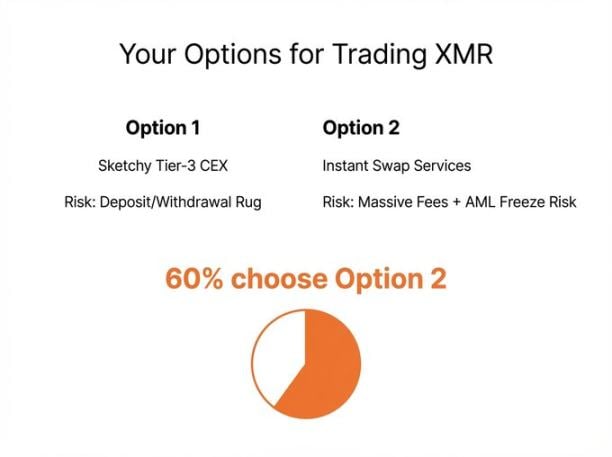
You only have two choices:

Find a third-rate exchange that still lists Monero and pray they don't run off with the money.

Use an instant exchange service, pay high fees, and pray they don't freeze your funds indefinitely under the pretext of 'AML review'.

Over 60% of users chose the second path.

These services became the de facto on/off ramps for the Monero ecosystem.

They are, of course, unregulated and offer terrible exchange rates, but users have no other choice.

After all legitimate exchanges abandoned Monero, the instant exchange industry became the only channel, absorbing all Monero trading volume.

Tracking the Flow of Funds

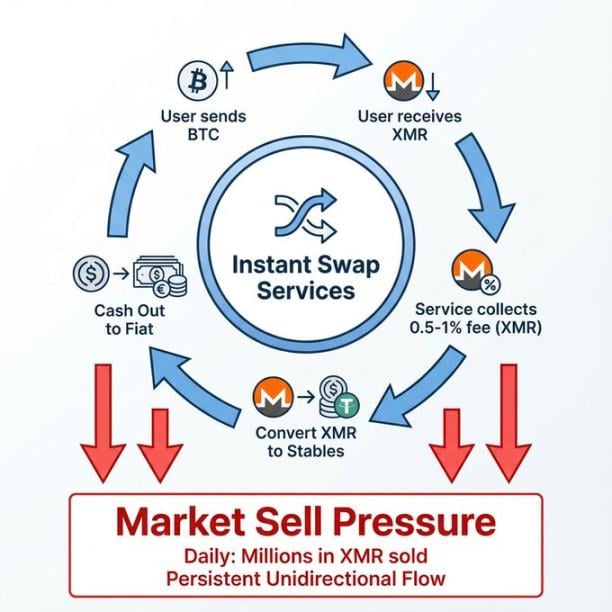
All instant exchange services operate the same way:

The user sends Bitcoin and receives Monero, with the service secretly charging a 3-4% fee (while ostensibly only charging 0.5-1%).

But these fees are priced in Monero.

So how do these service providers handle the Monero they receive?

They don't hold it long-term; they are not believers. These are offshore companies chasing fiat profits, who immediately convert Monero to stablecoins and cash out.

Just like that, millions of dollars worth of Monero are sold into the market every day.

In market microstructure terms, this creates a persistent one-way outflow of funds. Regardless of overall market conditions, these services are constantly selling. While this is just their business model, the impact on price is devastating.
Quantifying the Capital Drain

In my previous article, I estimated the instant exchange industry handles about $1.5 trillion in transactions annually (across all chains), and that's just the on-chain verifiable part.

Monero's volume is invisible due to its privacy features, but industry estimates suggest it accounts for about 20% of total instant exchange flow.

Assume $30 billion worth of Monero is exchanged through these services annually.

Conservatively, the actual figure might be half of that, around $15 billion.

At an average fee of 0.75% (most actually charge 1%), the Monero fees collected annually are worth about $112.5 million.

All of this Monero is sold into the market.

This means over $300,000 in passive selling pressure every day. It's like an invisible pump constantly draining value from Monero.

And this is a conservative estimate. If Monero truly accounts for 20% of the volume and fees are 1%, that's $300 million annually, approaching $1 million in daily selling pressure.

But it doesn't end there; there's also the 'AML Trap'.

The AML Trap

This is the 'dirty secret' I exposed in my last article: these services, while advertising 'No KYC', arbitrarily freeze user funds under the pretext of 'AML review'.

It's estimated that 2-5% of transactions through instant exchange services get frozen. The rate is higher for large transactions.

This creates a vicious cycle:

Small transactions go through but are charged fees 10-20 times higher than normal

Large transactions are completely frozen, often permanently

Only a fraction of the actual buying demand actually reaches the market
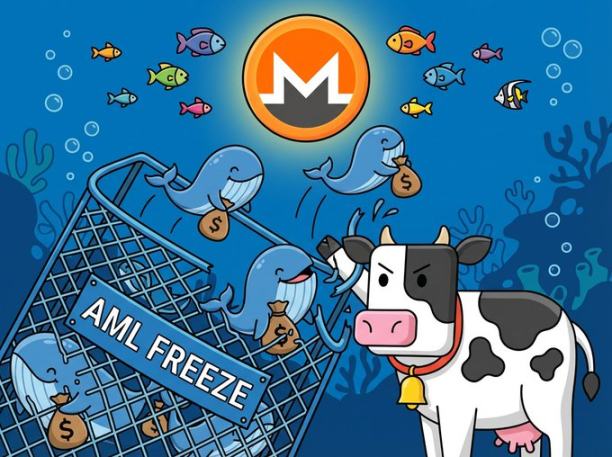
This creates the most brutal price discovery barrier: buyers who could actually influence the price are systematically excluded from the market.

The real demand for Monero has always been far higher than its price reflects. The instant exchange industry either extracts from this demand or outright chokes it off.

A Captive Market

Let me be clear about this vicious cycle:

The instant exchange industry did not win the market through competitiveness. They gained a monopoly position when all exchanges delisted Monero, and then proceeded to extract the maximum possible from users who had nowhere else to go.
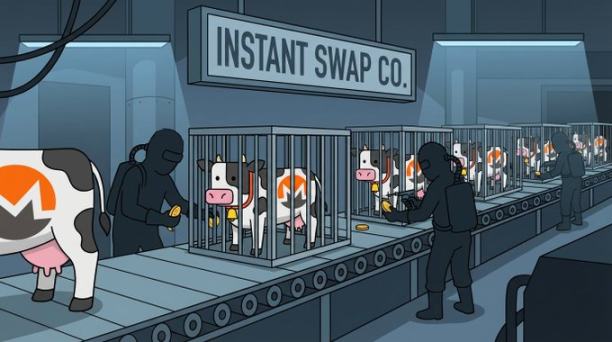
1% fees plus terrible exchange rates, plus random fund freezes.

Users tolerate it because they have no choice, and these service providers know it.

This is what happens when an entire asset class is forced into a single channel controlled by anonymous offshore operators: they extract with an uncompetitive product.

Every cent they extract turns into selling pressure on Monero.

Wagyu's Solution

Two days ago, Wagyu v2 launched.
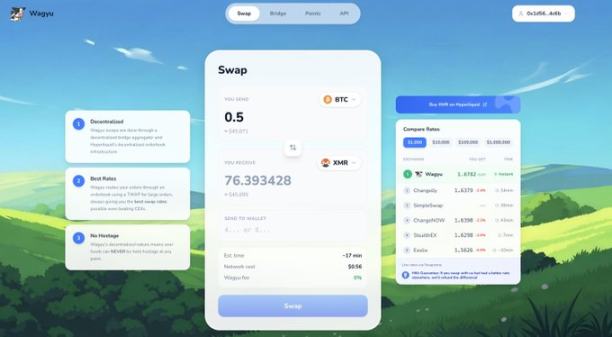
The core idea is simple: let Monero users enjoy the same pricing level as exchange traders.

When you exchange through Wagyu, your order is routed to @Hyperliquidx—where the most competitive market makers in crypto compete for orders.

These are the same market makers that provide liquidity for Binance, Bybit, and OKX, offering tiny spreads.

The result: you get exchange-level prices and fees. No more 1% or 0.5%, but ultra-low rates like professional traders.

For the first time since Monero was delisted from exchanges, users don't have to get 'ripped off' just for using their own assets.
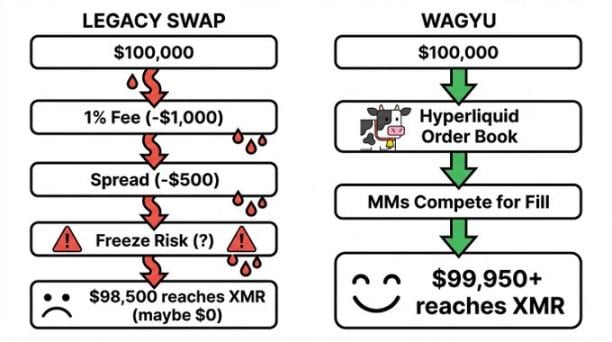
A single $100,000 transaction prevents over $1,000 in selling pressure from hitting the market.

Within 48 hours of launch, Wagyu v2 has already processed millions in exchanges, offering the best market prices:
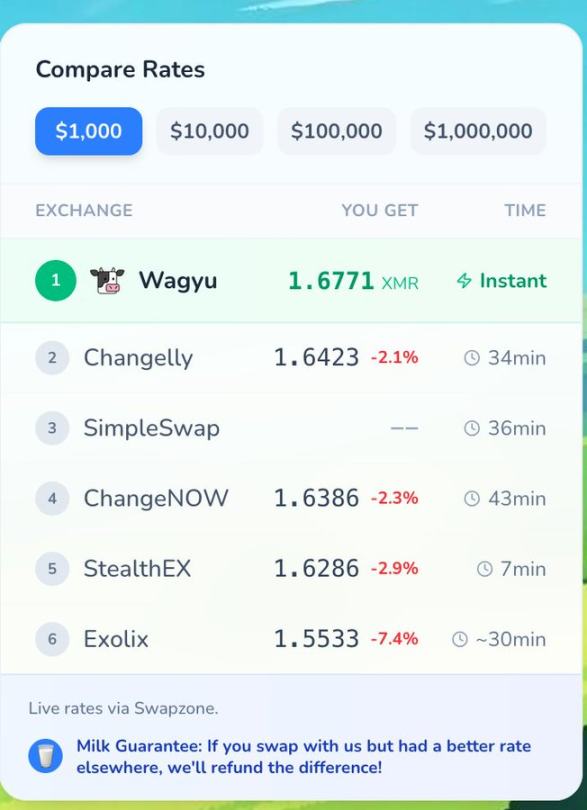
Trades that would have gone through traditional services, been charged over 1% in fees, and caused the market to instantly absorb tens of thousands in selling pressure, are now happening through Wagyu.

$1 million exchange through traditional services = $10,000 worth of Monero sold

The same $1 million exchange through Wagyu = Zero forced selling

Multiply this effect by every large Monero buyer who discovers they no longer have to be 'robbed'.

Reversing the Vicious Cycle

For years, Monero has been trapped in a negative feedback loop:
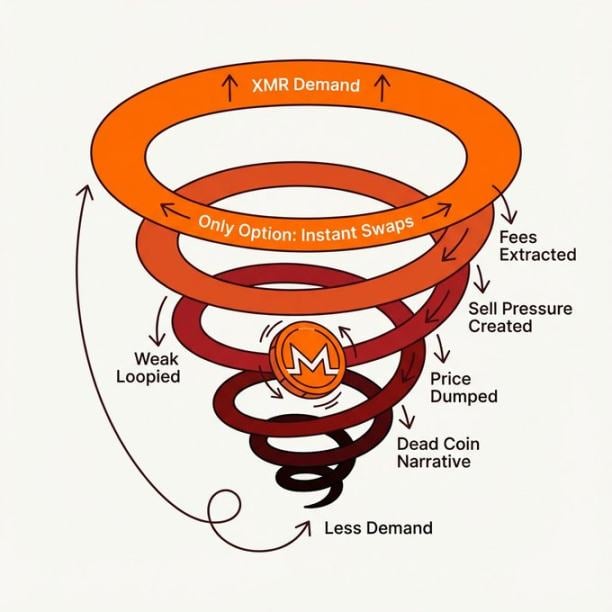
The instant exchange industry acted as a value extraction layer, sitting between buyers and the real price. They intercepted demand, extracted profits, and distorted price signals. Users couldn't bypass them because there was no alternative.

Now, that has changed.

Just two days after launch, volume is already migrating to Wagyu. People are realizing they can get Binance-level pricing for an asset Binance won't even list, and the word is spreading fast.

The cycle is reversing:
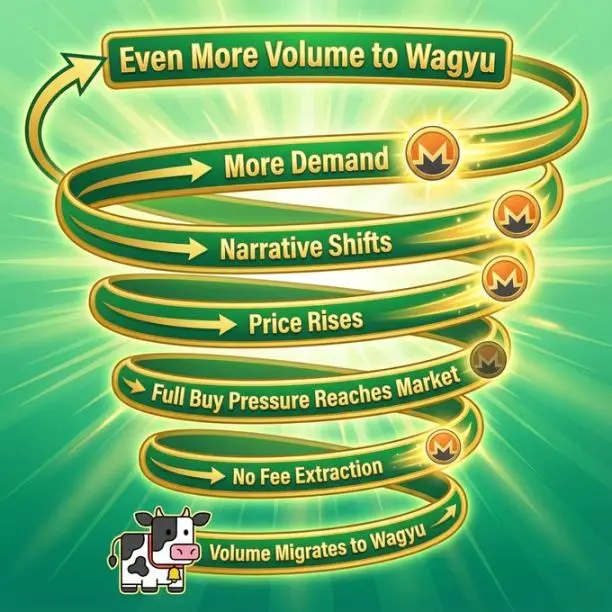
It's no coincidence that Monero broke through $600 and began its first price discovery in years.

Wagyu Is Saving Monero

I'm not going to be modest about this:

Every exchange made through Wagyu instead of a traditional service is real buying pressure that reaches the market.

Every million-dollar trade that flows through us means over $10,000 won't be sold onto other holders.

We are not extracting from the Monero ecosystem; we are plugging it directly into real liquidity.

The parasitic layer that has suppressed Monero for years has finally met its competitor. And we are not competing on their terms—we are making their entire model obsolete.

When users can get exchange-level pricing with zero freeze risk through Wagyu, who will pay 1% fees to anonymous offshore services that might freeze their funds?

No one will.

What This Means

I'm not here to give price predictions. I don't know if Monero will go to $1,000, $2,000, or fall back to $400.

But I know for sure: for the first time since being delisted from exchanges, demand for Monero can truly translate into price.

We've been live for only two days and are already processing millions in trades—trades that would have continuously 'bled' the market.

With the 'ceiling' removed, Monero at $600 is still undervalued. At least now, the market will truly decide its value.

Price discovery is finally possible, and Wagyu is making it happen.


Twitter:https://twitter.com/BitpushNewsCN

Bitpush TG Group:https://t.me/BitPushCommunity

Bitpush TG Subscription: https://t.me/bitpush

Original link:https://www.bitpush.news/articles/7602589

Criptos en tendencia

Preguntas relacionadas

QWhat is the main reason the author argues that Monero's price was suppressed for years?

AThe author argues that Monero's price was suppressed due to the parasitic extraction by instant exchange services, which acted as the primary on/off-ramp after centralized exchanges delisted XMR. These services charged high fees (effectively 3-4%) and immediately sold the XMR fees for stablecoins, creating constant sell pressure of an estimated $30,000 to $100,000 daily.

QHow did the instant exchange industry impact Monero's price discovery according to the article?

AThe instant exchange industry severely distorted Monero's price discovery by intercepting demand, charging exorbitant fees, and systematically freezing large transactions. This created a one-way outflow of value, preventing genuine buy-side demand from reaching the market and influencing the price.

QWhat solution does Wagyu v2 provide to the problem described in the article?

AWagyu v2 routes user orders to the Hyperliquid exchange, where professional market makers provide highly competitive, exchange-level pricing and minimal fees. This allows users to trade XMR without the excessive fees and freezing risks of traditional instant exchanges, eliminating the forced selling pressure those services created.

QWhat was the estimated annual volume of Monero processed by instant exchanges, and what was the resulting sell pressure?

AThe article estimates that instant exchanges processed approximately $150 billion to $300 billion in annual Monero volume. With an average fee of 0.75% to 1%, this resulted in $112.5 million to $300 million worth of XMR being sold annually, creating a daily sell pressure of over $300,000 to nearly $1 million.

QHow does the author describe the change in the market cycle for Monero after the introduction of Wagyu?

AThe author states that the negative feedback loop, where instant exchanges extracted value and suppressed the price, is now reversing. With Wagyu providing a efficient, non-extractive on-ramp, genuine buy-side demand can finally reach the market, allowing for true price discovery for the first time since XMR was delisted from major exchanges.

Lecturas Relacionadas

Ethereum's 11th Year: Why Is This Year Particularly Crucial?

Ethereum's 11th year proved pivotal, marked by a dual evolution in its technical roadmap and organizational structure. The year saw the completion of the Fusaka upgrade, introducing PeerDAS to make data availability sampling more efficient and laying groundwork for future L2 scaling. This was followed by a significant reorganization of the Ethereum Foundation (EF). The EF downsized, redefining its core mandate around user sovereignty and CROPS principles, while spinning off key functions. Independent entities like Ethlabs (non-profit R&D), Ethereum Institutional (institutional onboarding), and EthSystems (institutional privacy solutions) now operate separately. Technologically, the community debated a bold, long-term vision outlined in Justin Drake's "Lean Ethereum" proposal and the collaborative "Strawmap." These point toward a "third major iteration" for Ethereum, targeting goals like faster finality (~1 second), gigagas-scale L1 throughput, teragas-scale L2 capacity, post-quantum cryptography, and protocol-level privacy. Data underscores Ethereum's dominant position: its L1 still holds roughly half of all stablecoin value, leads in tokenized Real-World Assets (RWA), and commands over 55% of total DeFi TVL. While L2s now handle over 10x more transactions than the mainnet, high-value assets remain concentrated on L1. The launch of Robinhood Chain, an EVM-compatible L2 for stock tokens, signals growing institutional adoption. The immediate roadmap includes the Glamsterdam upgrade (featuring ePBS for in-protocol proposer-builder separation and Block Access Lists for parallelism), potentially followed by Hegotá focusing on anti-censorship via FOCIL. In summary, Ethereum's 11th year was defined by setting ambitious technical foundations for its next decade and restructuring its core development ecosystem to be more modular and sustainable, all while maintaining its role as the leading settlement layer for decentralized finance and assets.

marsbitHace 2 min(s)

Ethereum's 11th Year: Why Is This Year Particularly Crucial?

marsbitHace 2 min(s)

Notable Forecast from an Analytical Company Regarding Bitcoin (BTC): After This Date, a New Bull Season Could Begin!

Bitcoin continues to trade sideways around $64,000 amid ongoing uncertainty regarding U.S. monetary policy and geopolitical risks in the Middle East. As BTC struggles for direction, an analyst predicts the next major uptrend could commence after the U.S. midterm elections. João Wedson, founder and CEO of crypto analytics firm Alphractal, revisited the connection between Bitcoin's price movements and the U.S. election calendar in his latest analysis. Wedson claims that analyzing past market cycles reveals similar patterns in Bitcoin's price behavior, particularly around U.S. midterm and presidential elections. Historically, Bitcoin has faced headwinds leading up to midterms but tends to recover once election-related uncertainty subsides. Based on historical data, Bitcoin entered bear markets roughly a year before past midterm elections, only to initiate prolonged bull markets after the elections concluded. In some cycles, price bottoms formed just days before the vote, while in others, the low occurred immediately after. The analyst also noted presidential elections have a distinct impact: Bitcoin experiences strong rallies each time a president wins re-election and approaches the peak of its main cycle shortly after the presidential inauguration. As an example, Wedson pointed to XRP, which began a sharp rise on the day Donald Trump won the 2024 election and reached a local peak on January 20, 2025, his inauguration day.

cryptonews.ruHace 17 min(s)

Notable Forecast from an Analytical Company Regarding Bitcoin (BTC): After This Date, a New Bull Season Could Begin!

cryptonews.ruHace 17 min(s)

Lummis: The CLARITY Act mechanism "is not working" as the Senate drags its feet

U.S. Senator Cynthia Lummis has argued that the current regulatory framework for digital assets is inadequate, harming industry, investors, and regulators alike. She is urgently pushing for the Senate to pass the Digital Asset Market Clarity Act (H.R. 3633/CLARITY Act) before the August recess, warning the current momentum for the bill is a unique opportunity this decade. The legislation aims to divide oversight between the SEC and CFTC. Time is running out, as the Senate must act before its August 8th recess. Delays would push the debate to September, further squeezing the legislative calendar before the midterm elections. Forecasting platforms now estimate only a 30% chance of the bill becoming law in 2026, a sharp drop from over 80% in February. Passage requires 60 votes, meaning at least seven Democrats must join Republicans, a task complicated by Democratic opposition. Key objections from figures like Senator Elizabeth Warren center on concerns the bill could weaken oversight of decentralized finance (DeFi) and consumer protection, potentially endangering the financial system. Over 200 crypto industry organizations, including Coinbase and Ripple, are lobbying for a vote, arguing continued uncertainty drives innovation and jobs overseas. Lummis contends the bill's custody and disclosure rules are precisely the consumer protections needed to close existing loopholes. The bill's fate now hinges on whether Senate Majority Leader John Thune schedules a vote this week or delays it until the fall session, where it would face an even more constrained political environment.

cryptonews.ruHace 17 min(s)

Lummis: The CLARITY Act mechanism "is not working" as the Senate drags its feet

cryptonews.ruHace 17 min(s)

Trading

Spot

Artículos destacados

Cómo comprar ONE

¡Bienvenido a HTX.com! Hemos hecho que comprar Harmony (ONE) sea simple y conveniente. Sigue nuestra guía paso a paso para iniciar tu viaje de criptos.Paso 1: crea tu cuenta HTXUtiliza tu correo electrónico o número de teléfono para registrarte y obtener una cuenta gratuita en HTX. Experimenta un proceso de registro sin complicaciones y desbloquea todas las funciones.Obtener mi cuentaPaso 2: ve a Comprar cripto y elige tu método de pagoTarjeta de crédito/débito: usa tu Visa o Mastercard para comprar Harmony (ONE) al instante.Saldo: utiliza fondos del saldo de tu cuenta HTX para tradear sin problemas.Terceros: hemos agregado métodos de pago populares como Google Pay y Apple Pay para mejorar la comodidad.P2P: tradear directamente con otros usuarios en HTX.Over-the-Counter (OTC): ofrecemos servicios personalizados y tipos de cambio competitivos para los traders.Paso 3: guarda tu Harmony (ONE)Después de comprar tu Harmony (ONE), guárdalo en tu cuenta HTX. Alternativamente, puedes enviarlo a otro lugar mediante transferencia blockchain o utilizarlo para tradear otras criptomonedas.Paso 4: tradear Harmony (ONE)Tradear fácilmente con Harmony (ONE) en HTX's mercado spot. Simplemente accede a tu cuenta, selecciona tu par de trading, ejecuta tus trades y monitorea en tiempo real. Ofrecemos una experiencia fácil de usar tanto para principiantes como para traders experimentados.

366 Vistas totalesPublicado en 2024.12.12Actualizado en 2026.06.02

Cómo comprar ONE

Discusiones

Bienvenido a la comunidad de HTX. Aquí puedes mantenerte informado sobre los últimos desarrollos de la plataforma y acceder a análisis profesionales del mercado. A continuación se presentan las opiniones de los usuarios sobre el precio de ONE (ONE).

活动图片