How The Bitcoin Price Movement Is Stopping XRP From Rising Again

bitcoinistPublicado a 2026-02-09Actualizado a 2026-02-09

Resumen

XRP's attempt to recover from last week's sharp decline has stalled below the key $1.50 resistance level, primarily due to Bitcoin's influence on the broader crypto market. According to analyst Tara, XRP has technically met a critical Fibonacci resistance at $1.53 but lacks follow-through buying pressure. This is because Bitcoin remains in an unfinished corrective phase, causing cautious market sentiment and limiting capital inflow into altcoins like XRP. If Bitcoin corrects to $65,800 before rallying to $75,400, XRP may drop to $1.30 support before potentially rising to $1.65. However, a more bearish scenario—where Bitcoin falls to $52,200—could drag XRP down to $0.87. Bitcoin's price movement is thus seen as the decisive factor for XRP's near-term trajectory.

XRP’s efforts to regain upward momentum following last week’s sharp decline have so far stalled, with $1.50 now rising as the most important price level.

A new technical analysis shared by crypto analyst Tara points to Bitcoin’s unfinished price structure as the main reason why XRP’s price action is still stuck below $1.5, with the leading cryptocurrency’s next moves likely to determine whether the altcoin can recover or sink further in the days ahead.

XRP Hits Resistance, Bitcoin’s Structure Remains Incomplete

As the largest cryptocurrency, Bitcoin is known for strongly influencing how other large market-cap cryptocurrencies like XRP move. Interestingly, technical analysis of the altcoin’s price action on the daily candlestick price chart done by crypto analyst Tara links the two cryptos, and the outlook of XRP depends on how the Bitcoin price moves from here.

Expert Says If You Hold XRP, Pay Attention To These Things XRP has already completed a move into its textbook 0.382 Fibonacci resistance, which is sitting around $1.53. As shown on the daily candlestick price chart below, the token filled the liquidity zone around the October 10 flash crash low before bouncing at $1.15. However, this bounce was subsequently rejected at $1.53. The rejection from that region shows that the altcoin’s bulls have done their part technically, but the required follow-through is missing.
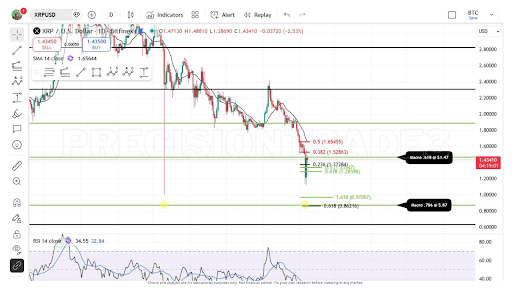
Source: Chart from TARA on X

The reason, according to the analysis, lies with Bitcoin. The waves on Bitcoin’s chart are still developing, meaning the entire crypto market has not reached a resolution. As it stands, Bitcoin is currently in an unfinished corrective phase, and many analysts are projecting more lows. This has led to cautious capital inflows across the market. As a result, XRP is struggling to attract sustained buying pressure even after reaching important technical milestones on its own chart.

Short-Term Bitcoin Corrections Could Drag It Lower

At the time of writing, Bitcoin is trading at $69,800. The outlook by Tara is that Bitcoin will undergo a corrective move to the $65,800 region before making another push higher toward its 0.5 resistance around $75,400. This type of pullback and continuation scenario has implications for XRP’s price action.

If Bitcoin does correct as expected, the altcoin could be pulled back toward the $1.30 area, which is highlighted as short-term support. The continuation wave up by Bitcoin is then expected to take it as high as the 0.5 Fib at $1.65.

The more bearish scenario outlined in the analysis will occur if Bitcoin fails to hold higher support levels and instead breaks down to $52,200. Such a move would likely trigger a much deeper reaction across altcoins, because it would mandate Bitcoin breaking below its recent $62,800 low on February 5. In that case, the altcoin could be drawn down to its 0.786 Fibonacci support, which is currently sitting at $0.87.

XRP trading at $1.40 on the 1D chart | Source: XRPUSDT on Tradingview.com

Preguntas relacionadas

QAccording to the technical analysis by Tara, what is the main reason why XRP's price action is stuck below $1.5?

AThe main reason is Bitcoin's unfinished price structure. Bitcoin is currently in an unfinished corrective phase, and its waves are still developing, which has led to cautious capital inflows across the entire crypto market.

QWhat is the Fibonacci resistance level that XRP reached and was subsequently rejected from?

AXRP reached and was rejected from the 0.382 Fibonacci resistance, which is sitting around $1.53.

QWhat is the expected short-term support level for XRP if Bitcoin corrects to $65,800?

AIf Bitcoin corrects to $65,800, XRP could be pulled back toward the $1.30 area, which is highlighted as its short-term support.

QIn the more bearish scenario, what Bitcoin price level could trigger a much deeper reaction across altcoins?

AIf Bitcoin fails to hold higher support levels and instead breaks down to $52,200, it would likely trigger a much deeper reaction across altcoins.

QWhat is the projected higher target for XRP (the 0.5 Fib level) if Bitcoin's continuation wave upward occurs?

AIf Bitcoin's continuation wave upward occurs, it is expected to take XRP as high as the 0.5 Fib resistance at $1.65.

Lecturas Relacionadas

The U.S. Government Blocked the Anthropic Model. It Wasn't About 'Jailbreaking' at All.

Last Friday, the U.S. Commerce Department issued an enforcement letter that forced Anthropic to take its two most advanced AI models, Fable 5 and Mythos 5, offline. The stated reason was unspecified national security concerns, initially linked to potential "jailbreaks" of the models' safeguards. However, new details suggest the action stemmed more from a deteriorating relationship between the Trump administration and Anthropic, rather than a genuine technical threat. According to reports, the government cited a little-known export control regulation, compelling Anthropic to block access for all non-U.S. persons, including its own international employees. The company complied, shutting down the models without a court order or specific technical details from the government. Cybersecurity expert Katie Moussouris revealed she was privately shown a research paper detailing a potential safeguard bypass in Fable 5. She argued the described method was minor and did not warrant an export ban, stating that attempts to "fix" it would only weaken the model's defensive capabilities. Moussouris and other experts have since called for the order to be revoked, warning it dangerously removes advanced cybersecurity tools from U.S. defenders. Analysts like Justin Hendrix suggest the move appears retaliatory and sets a dangerous precedent, signaling that the U.S. government can unilaterally shut down a tech company's products. The incident has raised concerns about the reliability of American AI and the potential for political interference in the tech industry, serving as a warning to the broader sector.

marsbitHace 4 min(s)

The U.S. Government Blocked the Anthropic Model. It Wasn't About 'Jailbreaking' at All.

marsbitHace 4 min(s)

Ray Dalio: AI Bull Market Continues to Soar, Should Investors Go All In or Cash Out and Leave the Field?

In his latest notes, Ray Dalio addresses a critical question for investors amid the AI-driven stock market surge: how should one allocate assets during a transformative technological revolution? Dalio emphasizes that technological advancement does not automatically make related stocks attractive. Historical tech cycles—marked by excitement, crowding, volatility, and eventual shakeouts—show that even long-term winners like Microsoft and Apple experienced severe drawdowns. Today's AI sector faces similar uncertainties: overinvestment, intensifying competition, geopolitical tensions (e.g., Taiwan's chip supply), tax policy shifts, anti-AI sentiment, and potential disruption from future technologies like quantum computing. Dalio's core argument focuses on the highly concentrated market structure, where a few tech giants dominate major indices. He warns investors against unknowingly holding concentrated, correlated exposures. Instead of chasing a handful of AI leaders, he advocates for a robust, diversified portfolio of 15 or more high-quality, uncorrelated investments, risk-balanced to match an investor's volatility tolerance. Mathematically, such diversification significantly improves the risk-return ratio—for example, holding 15 uncorrelated assets can boost the ratio by over four times compared to a single concentrated bet. Dalio cautions that future equity returns appear low, with his bubble indicator suggesting real returns could be negative over the next 5-10 years. He stresses that knowing what you don't know is as important as knowing what you do. In an environment of high uncertainty and concentration, avoiding large, concentrated bets on AI stocks is prudent. The optimal strategy is disciplined diversification—the "holy grail" of investing—to navigate this technologically driven cycle with lower risk and comparable or better returns.

marsbitHace 8 min(s)

Ray Dalio: AI Bull Market Continues to Soar, Should Investors Go All In or Cash Out and Leave the Field?

marsbitHace 8 min(s)

The World Cup has only been played for a few days, but some AI prediction models have already been crowned as oracles, while others have stumbled badly.

The 2026 FIFA World Cup has sparked significant interest not only on the pitch but also in AI-driven match prediction. Major models like Qwen, Copilot, and ChatGPT are being used to forecast outcomes, scores, upsets, red cards, and key player performances. Qwen gained early attention by accurately predicting Mexico's 2-0 win over South Africa (including a red card risk) and South Korea's 2-1 victory over the Czech Republic in the opening matches. Copilot's pre-tournament predictions had notable successes, such as correctly calling the Mexico 2-0 scoreline, South Korea's 2-1 win, and Brazil's 1-1 draw with Morocco. However, it also had clear misses, failing to predict upsets like Australia's 2-0 win over Turkey or Switzerland's draw with Qatar. ChatGPT provided detailed analytical reasoning, correctly predicting Mexico's 2-0 win, but its full-tournament predictions tended to favor favorites, missing several underdog results and draws. Tests pitting multiple models (ChatGPT, Gemini, Grok, Claude) against the same match, like Mexico vs. South Africa, showed varying predictions, with only some hitting the exact score. In summary, while AI models like Qwen have shown promising early results in specific match details, and others have had isolated successes, they collectively struggle to consistently identify upsets and underdog performances. AI is becoming an additional reference tool for prediction markets but is far from a definitive source.

marsbitHace 8 min(s)

The World Cup has only been played for a few days, but some AI prediction models have already been crowned as oracles, while others have stumbled badly.

marsbitHace 8 min(s)

Missed Out on SpaceX's IPO? Take a Look at SpaceX's Complete Supply Chain

SpaceX is now public, but its high valuation and losses may deter some investors. However, the real opportunity, as seen with Apple, Tesla, and Nvidia, may lie in its extensive supply chain. SpaceX, funded primarily by its profitable Starlink service, spends hundreds of billions annually on components for its rockets, satellites, and planned orbital AI data centers, creating significant revenue streams for suppliers. Key suppliers are categorized by their indispensability. The first group includes irreplaceable players like **NVIDIA** (GPUs for AI supercomputers), **Eutelsat (SATS)** (spectrum rights), **Filtronic** (millimeter-wave amplifiers), **Materion (MTRN)** (beryllium alloys), and **STMicroelectronics (STM)** (phased array chips). The second category comprises suppliers costly to replace due to long certification cycles or deep integration, such as **Honeywell (HON)** (flight controls), **Carpenter Technology (CRS)** (specialty steel), **Hexcel (HXL)** (carbon fiber), **Broadcom (AVGO)** (data switching), and **Linde** (industrial gases). The third group involves high-volume, cost-critical manufacturers for mass-produced items like Starlink terminals. Major players here include Taiwanese contract manufacturer **Wistron NeWeb (6285)** and several Chinese-listed firms: **Sunway Communication (300136)**, **Parker Advanced Materials (605123)**, **Western Superconducting (002149)**, and **Yingliu Co., Ltd. (603308)**. Other niche providers include **Tianyin Electromechanical**, **Tongyu Communication**, **Trimble (TRMB)**, **Astronics (ATRO)**, and **CTSH**. The timing is now relevant because: 1) SpaceX's procurement is accelerating with plans for 100 launches in 2026, 30 million Starlink terminals, and orbital data centers. 2) Its IPO has brought unprecedented transparency to its supply chain. 3) This phase mirrors early days of the Tesla supply chain boom. The investment thesis shifts from betting on SpaceX's stock to betting on the steady, order-book-driven revenues of its essential suppliers. Risks remain, such as commodity cycles, geopolitical factors, and technological shifts, but the supply chain offers a potentially less speculative path to participate in SpaceX's growth.

marsbitHace 26 min(s)

Missed Out on SpaceX's IPO? Take a Look at SpaceX's Complete Supply Chain

marsbitHace 26 min(s)

Jane Street: The Most Powerful Behind-the-Scenes Operator in the Crypto Industry

Jane Street: Crypto's Most Powerful Behind-the-Scenes Operator A recent 13F filing revealed Jane Street, the secretive Wall Street quant giant, drastically reduced its Bitcoin ETF holdings while increasing stakes in Ethereum ETFs. This move highlights its role not as a directional investor, but as a critical infrastructure player extracting "tolls" from crypto's institutionalization. The firm, founded in 2000 and famously lacking a CEO, has systematically embedded itself across crypto markets. It acts as a key Authorized Participant (AP) and market maker for major Bitcoin and Ethereum ETFs, profiting from arbitrage between ETF shares and underlying assets. Its approach combines quantitative prowess with a willingness to hold positions for structural arbitrage, differing from pure high-frequency traders. Jane Street faces allegations related to the 2022 Terra (LUNA) collapse. A lawsuit claims it used non-public information to withdraw $85 million in UST minutes before a critical withdrawal by Terraform Labs, allegedly exacerbating the crash and avoiding over $200 million in losses. The company denies the claims. Further indicating its reach, a wallet suspected to be operated by Jane Street ("JaneStreetIndia") was identified on the prediction market Polymarket. This bot executed over 11,000 high-frequency trades on short-term crypto price movements with a near-perfect win rate, showcasing a套利 strategy divorced from traditional prediction. Beyond trading, Jane Street holds equity in crypto infrastructure like Kraken, 1inch, and Arbitrum, and mining stocks. Its strategy is clear: avoid betting on winners, but secure a position in the market's essential plumbing. By becoming a ubiquitous part of the liquidity infrastructure—from ETFs to OTC trading and potentially链上 markets—Jane Street operates as a market force itself, raising questions about whether crypto's decentralized,散户-friendly alpha is being permanently eroded by traditional finance's most sophisticated players.

Foresight NewsHace 29 min(s)

Jane Street: The Most Powerful Behind-the-Scenes Operator in the Crypto Industry

Foresight NewsHace 29 min(s)

Trading

Spot
Futuros

Artículos destacados

Qué es XRP 2.0

XRP 2.0: Una Nueva Frontera en el Panorama de las Criptomonedas Introducción a XRP 2.0 En el siempre cambiante ámbito de las criptomonedas, nuevos proyectos surgen continuamente, compitiendo por atención y adopción. Una de estas iniciativas prometedoras es XRP 2.0, un nuevo proyecto de criptomoneda diseñado para aprovechar la tecnología blockchain avanzada y metodologías de encriptación robustas. Aunque el nombre establece paralelismos con el XRP de Ripple, es crucial señalar que XRP 2.0 opera de manera independiente, enfocándose en mejorar la seguridad de las transacciones, la privacidad y la escalabilidad. A medida que el panorama financiero digital abraza cada vez más soluciones descentralizadas, XRP 2.0 busca contribuir de manera significativa a web3 y a la expansión general de los proyectos de criptomonedas. ¿Qué es XRP 2.0? En esencia, XRP 2.0 es un proyecto de criptomoneda que busca crear un ecosistema de moneda digital seguro y descentralizado. Su tecnología fundamental integra principios avanzados de blockchain con técnicas de encriptación de vanguardia. El objetivo principal de XRP 2.0 es establecerse como una plataforma confiable y eficiente que permita la ejecución rápida de transacciones mientras prioriza la protección de la privacidad de sus usuarios. El proyecto se promociona como una solución a muchas limitaciones enfrentadas por las criptomonedas existentes, proponiendo un sistema que puede manejar un mayor volumen de transacciones con mejor velocidad y privacidad. Esta versatilidad posiciona a XRP 2.0 como un competidor significativo en un mercado plagado de diversas monedas digitales. ¿Quién es el Creador de XRP 2.0? La identidad del creador detrás de XRP 2.0 ha sido señalada como 'Wilbur.' Sin embargo, los detalles completos sobre Wilbur o su entidad asociada siguen siendo elusivos. La anonimidad de muchos creadores de criptomonedas no es un fenómeno poco común en la industria, a menudo diseñado para mantener un grado de privacidad y seguridad. ¿Quiénes son los Inversores de XRP 2.0? Hasta ahora, la información específica relacionada con las fundaciones o organizaciones de inversión que apoyan a XRP 2.0 no está disponible públicamente. En el sector de las criptomonedas, el respaldo de inversores respetables puede influir significativamente en la credibilidad y el éxito de un proyecto, sin embargo, la transparencia sobre los patrocinadores financieros de XRP 2.0 no se ha establecido. ¿Cómo Funciona XRP 2.0? XRP 2.0 se destaca al emplear una combinación de tecnología blockchain y algoritmos de encriptación avanzados que aseguran transacciones seguras y descentralizadas. Su estructura innovadora incluye características únicas diseñadas para fomentar el compromiso del usuario y ampliar las funcionalidades más allá de las transacciones convencionales de criptomonedas. Entre estas características, XRP 2.0 incorpora capacidades impulsadas por IA, como funcionalidades de texto a imagen y de texto a voz. Estas adiciones están diseñadas para mejorar la experiencia interactiva de los usuarios, promoviendo una mayor aplicabilidad en diversos sectores. Al unir avances tecnológicos con un diseño centrado en el usuario, XRP 2.0 busca captar la atención de una amplia gama de individuos y empresas que buscan integrar soluciones de criptomonedas en sus marcos operativos. Cronología de XRP 2.0 Entender XRP 2.0 requiere examinar los hitos que han definido su viaje hasta ahora: 23 de julio de 2023: Se presenta XRP 2.0 como un nuevo proyecto de criptomonedas, con el objetivo de revolucionar las capacidades de transacciones seguras y descentralizadas en el ámbito de blockchain. 8 de septiembre de 2023: Se lanza otro proyecto, XRP20, marcando la aparición de un token ERC-20 en la blockchain de Ethereum que no guarda relación con XRP 2.0. 13 de noviembre de 2023: El Libro Mayor de XRP experimenta una actualización significativa con el lanzamiento de la versión 2.0.0 del software del servidor rippled. Es esencial señalar que este desarrollo está desconectado del proyecto de criptomonedas XRP 2.0. Puntos Clave sobre XRP 2.0 Para destilar la esencia de XRP 2.0, surgen varios factores críticos: Características Únicas: La inclusión de características como texto a imagen y texto a voz impulsadas por IA diversifica aún más las aplicaciones potenciales de XRP 2.0. Tecnología Blockchain: El marco utiliza mecanismos avanzados de blockchain y protocolos de encriptación, asegurando un entorno seguro y descentralizado para las transacciones. Escalabilidad y Privacidad: XRP 2.0 prioriza la protección mejorada de la privacidad en los procesos de transacción y la escalabilidad necesaria para acomodar una base de usuarios creciente. No Afiliación con Ripple: Es importante destacar que, a pesar de su nombre, XRP 2.0 no tiene ninguna lealtad ni colaboración con el XRP de Ripple, diferenciando su marco operativo y objetivos dentro del ecosistema de criptomonedas. Conclusión XRP 2.0 representa una ambiciosa aventura en la esfera de las criptomonedas, buscando ofrecer una combinación de seguridad, privacidad y eficiencia en las transacciones digitales. Al integrar tecnologías sofisticadas y características amigables para el usuario, el proyecto se propone ampliar los horizontes de lo que la criptomoneda puede lograr en la economía digital de hoy. Si bien la anonimidad de su creador y la falta de inversores revelados pueden generar cuestionamientos para algunos, el enfoque de XRP 2.0 en funcionalidades avanzadas y descentralización realza su atractivo en un mercado de criptomonedas cada vez más abarrotado. A medida que el paisaje de las criptomonedas sigue evolucionando, XRP 2.0 podría emerger como un jugador crucial en la expansión de soluciones blockchain seguras y escalables.

176 Vistas totalesPublicado en 2024.04.05Actualizado en 2024.12.03

Qué es XRP 2.0

Cómo comprar XRP

¡Bienvenido a HTX.com! Hemos hecho que comprar XRP (XRP) sea simple y conveniente. Sigue nuestra guía paso a paso para iniciar tu viaje de criptos.Paso 1: crea tu cuenta HTXUtiliza tu correo electrónico o número de teléfono para registrarte y obtener una cuenta gratuita en HTX. Experimenta un proceso de registro sin complicaciones y desbloquea todas las funciones.Obtener mi cuentaPaso 2: ve a Comprar cripto y elige tu método de pagoTarjeta de crédito/débito: usa tu Visa o Mastercard para comprar XRP (XRP) al instante.Saldo: utiliza fondos del saldo de tu cuenta HTX para tradear sin problemas.Terceros: hemos agregado métodos de pago populares como Google Pay y Apple Pay para mejorar la comodidad.P2P: tradear directamente con otros usuarios en HTX.Over-the-Counter (OTC): ofrecemos servicios personalizados y tipos de cambio competitivos para los traders.Paso 3: guarda tu XRP (XRP)Después de comprar tu XRP (XRP), guárdalo en tu cuenta HTX. Alternativamente, puedes enviarlo a otro lugar mediante transferencia blockchain o utilizarlo para tradear otras criptomonedas.Paso 4: tradear XRP (XRP)Tradear fácilmente con XRP (XRP) en HTX's mercado spot. Simplemente accede a tu cuenta, selecciona tu par de trading, ejecuta tus trades y monitorea en tiempo real. Ofrecemos una experiencia fácil de usar tanto para principiantes como para traders experimentados.

1.4k Vistas totalesPublicado en 2024.12.10Actualizado en 2026.06.02

Cómo comprar XRP

Discusiones

Bienvenido a la comunidad de HTX. Aquí puedes mantenerte informado sobre los últimos desarrollos de la plataforma y acceder a análisis profesionales del mercado. A continuación se presentan las opiniones de los usuarios sobre el precio de XRP (XRP).

活动图片














