How Japan’s 2.30% bond yield could spark a global crypto opportunity

ambcryptoPublicado a 2026-03-24Actualizado a 2026-03-24

Resumen

Japan's 10-year government bond yield rising to 2.30% could create a long-term bullish opportunity for crypto, according to analysis. As a major energy importer, Japan faces inflation from rising oil prices, pressuring its bond market. With USD/JPY nearing 160, Japanese authorities may intervene by selling U.S. Treasuries to support the yen. As the largest foreign holder of U.S. debt, such a move could weaken the dollar. Historically, a weaker dollar drives liquidity into crypto. Although recent FOMC decisions strengthened the dollar and caused a short-term crypto drop, this is viewed as a temporary shock. Broader macro pressures, including recession risks, may ultimately reduce dollar strength and benefit crypto markets over time.

No country has been spared from the economic stress triggered by ongoing geopolitical crises.

According to The Kobeissi Letter, Asian markets are now entering a structurally driven energy shock. For crypto investors, the implications extend beyond short-term volatility. Instead, what matters is how these macro shifts play out “over time,” determining whether the current dip evolves into a broader opportunity.

Notably, Japan serves as a key case study. With roughly 90% of its energy imported, rising oil prices are directly feeding into inflation. Consequently, this pressure is now showing up in bond markets, with Japan’s 10-year government bond yield climbing to 2.30%, nearing levels last seen in 1999.
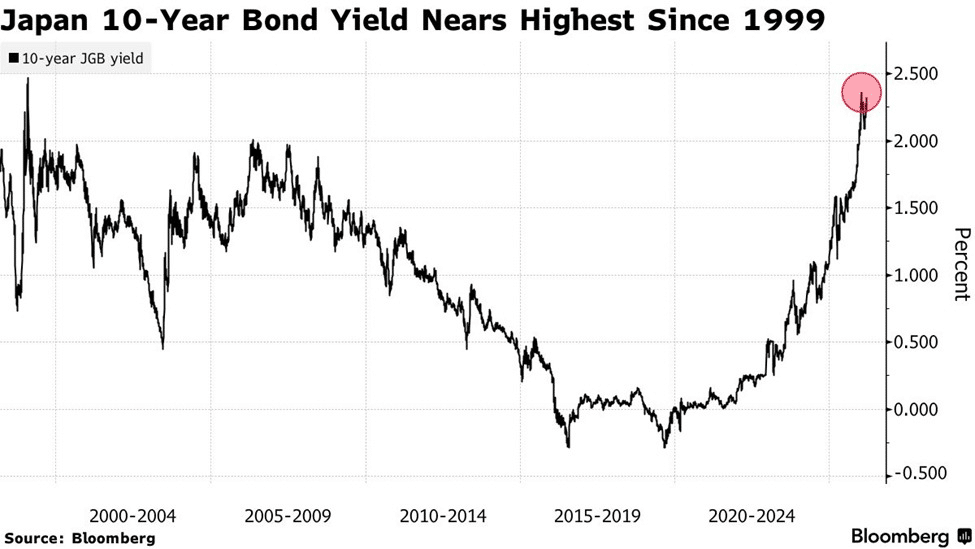
Source: Bloomberg

So naturally, the question becomes, how do crypto investors position themselves around this?

From a technical lens, USD/JPY is approaching the 160 level, reflecting sustained yen weakness against the U.S. dollar. Historically, this level has acted as a trigger point for intervention. The mechanism is critical: to support the yen, Japanese authorities intervene by selling U.S. Treasuries to buy their domestic currency.

Why does this matter? Japan is the largest foreign holder of U.S. Treasuries, with roughly $1.1 trillion in holdings. If Japan starts selling, it signals money moving out of U.S. assets and back into yen. That shift reduces demand for the dollar, putting downward pressure on it.

Historically, a weaker dollar has supported liquidity and driven capital into crypto. So the question is, with the crypto market still capped amid ongoing geopolitical uncertainty, could this weakening dollar setup be creating a longer-term bullish opportunity?

Recession fears push investors to rethink crypto exposure

The focus isn’t on oil. Instead, it’s on the U.S. bond market, where the real action is unfolding.

For context, the latest FOMC meeting kept interest rates steady, signaling that rate cuts are unlikely anytime soon. That move pushed the U.S. Dollar Index (DXY) above 100 and sent the 10-year Treasury yield up nearly 4%, back to levels last seen in July 2025.

Crypto markets reacted immediately, dropping 5.5% for the week, underscoring the familiar inverse relationship with the dollar. Yet, smart money appears unconcerned about a sustained trend, treating this as a short-term shock rather than a structural shift.
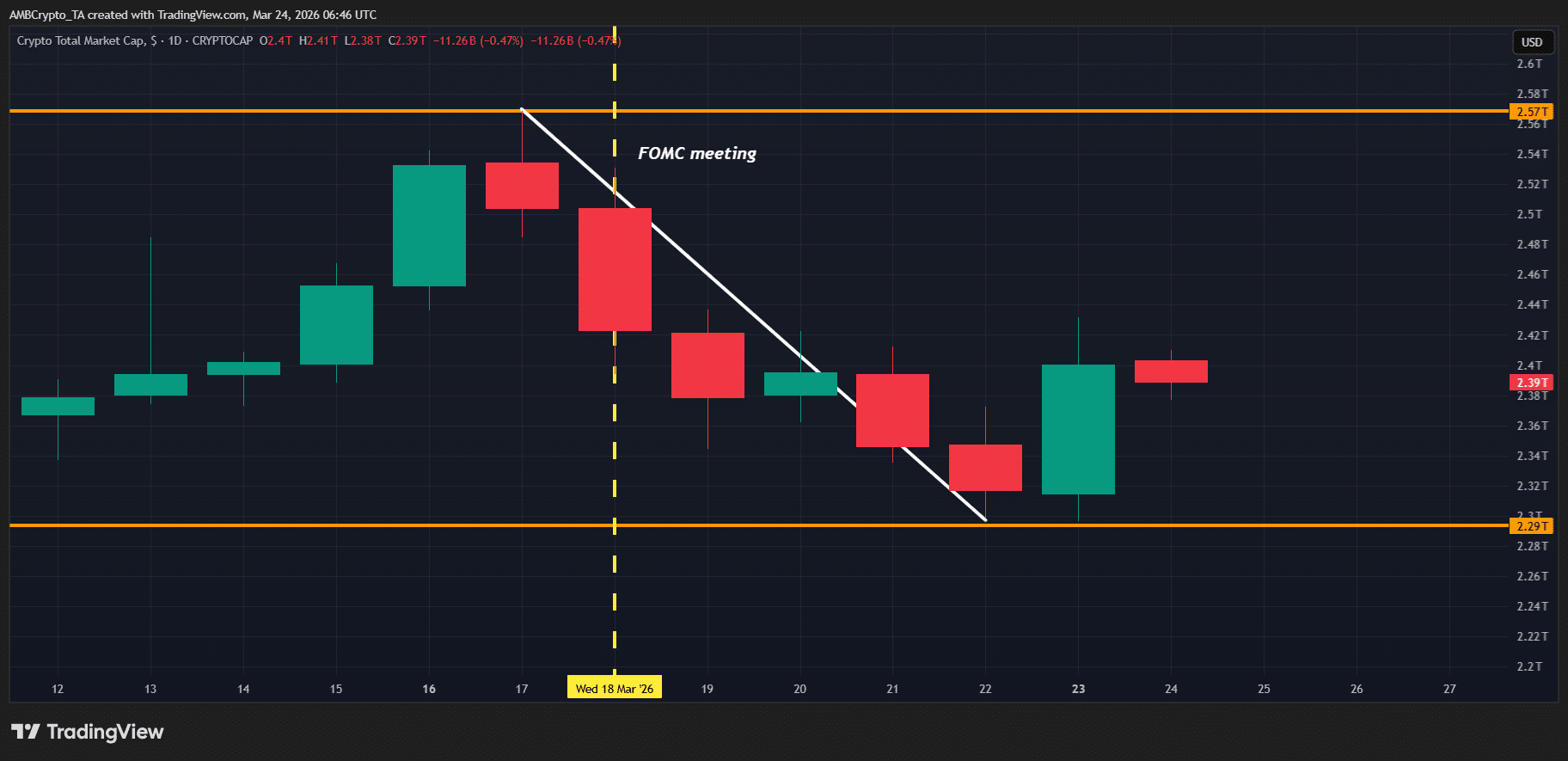
Source: TradingView (TOTAL/USD)

Goldman Sachs, for instance, has raised the U.S. recession probability to 30%, a 5 percentage point increase from prior estimates. The drivers include rising oil prices, tighter financial conditions, and ongoing Middle East tensions.

The implications are clear: slower GDP growth (1.25%-1.75% in H2) and rising unemployment (4.6%) put pressure on the economy, while the door remains open for rate cuts later this year. Notably, Japan is already showing similar stress, reflecting how these pressures are playing out across Asian markets.

Taken together, these shifts could reroute global capital flows, weigh on the U.S. dollar over time, and create potential opportunities for crypto. This suggests that much of the current volatility in risk assets is likely a short-term reaction rather than a long-term trend.


Final Summary

  • Rising yields, yen interventions, and weaker U.S. dollar conditions could create long-term opportunities for crypto.
  • The recent FOMC triggered a crypto drawdown, but smart money views it as a temporary shock rather than a lasting trend.


Preguntas relacionadas

QHow could Japan's rising 10-year government bond yield (2.30%) potentially create a global crypto opportunity?

AJapan's rising bond yield reflects inflationary pressures from high energy imports. To support the weakening yen, Japanese authorities may sell U.S. Treasuries (as the largest foreign holder), reducing dollar demand. Historically, a weaker dollar drives liquidity into crypto, creating a potential long-term bullish opportunity.

QWhat is the significance of USD/JPY approaching the 160 level mentioned in the article?

AThe 160 level for USD/JPY historically acts as a trigger point for intervention by Japanese authorities. To support the yen, they would sell U.S. Treasuries and buy yen, which could weaken the U.S. dollar and potentially drive capital into crypto assets.

QHow did the recent FOMC meeting impact crypto markets according to the article?

AThe FOMC kept rates steady, signaling no imminent cuts, which pushed the U.S. Dollar Index (DXY) above 100 and raised the 10-year Treasury yield. Crypto markets dropped 5.5% for the week, showing an inverse relationship with the dollar, but smart money views this as a short-term shock rather than a structural shift.

QWhy does Goldman Sachs' increased U.S. recession probability (to 30%) matter for crypto investors?

AGoldman Sachs raised the recession probability due to rising oil prices, tighter financial conditions, and Middle East tensions. This suggests potential slower GDP growth and rising unemployment, which could lead to future rate cuts, a weaker dollar, and rerouted global capital flows that may benefit crypto as an alternative asset.

QWhat key factors does the article suggest could drive long-term crypto opportunities despite short-term volatility?

AThe article highlights rising bond yields (especially in Japan), potential yen intervention leading to U.S. Treasury sales, a subsequently weaker U.S. dollar, and macroeconomic shifts like recession fears and possible future rate cuts as factors that could create long-term crypto opportunities, with current volatility seen as temporary.

Lecturas Relacionadas

A 'Overlooked' Market Event: Joint US-Japan-South Korea Intervention, Rare US Treasury Involvement, and Bessent's Quiet 'Market Rescue'?

Summary: The United States, Japan, and South Korea executed their largest coordinated foreign exchange intervention in nearly 30 years. The action targeted depreciation pressure on the Japanese yen and South Korean won. This move is seen as a significant effort by the US to stabilize the financial markets of its key allies and prevent the spillover of risks. Key details: * Japan reportedly intervened on July 30 using approximately 8.45 trillion yen (about $52.8 billion). South Korean authorities also intervened that day, selling dollars to support the won. * Notably, the US Treasury Department intervened directly in yen markets for the first time in roughly 30 years. The New York Fed, reportedly acting on behalf of the Treasury, sold euros to buy yen via Goldman Sachs and Morgan Stanley on July 31. Analysts view the use of the euro-yen pair as a way to alleviate yen pressure without adding selling pressure to the US dollar. * Prior to the action, the New York Fed conducted "rate checks" on both USD/JPY and EUR/JPY, a newer signaling tool that falls between verbal and physical intervention. The intervention is interpreted as going beyond traditional currency stabilization. Analysts, such as Michael Hartnett of Bank of America, suggest it resembles a "Price Keeping Operation" for the AI era. The core US objectives are perceived to be: 1. Preventing rapid yen depreciation from triggering a sharp rise in Japanese government bond yields. 2. Containing financial stress from spreading across Asian markets like South Korea and Japan. 3. Reducing the risk of disorderly capital flows impacting the US bond market. This coordinated action underscores the importance of Japan and South Korea as critical partners in the US semiconductor and AI supply chain. Stabilizing their financial markets is seen as vital to mitigating risks to the broader tech industry and the US market itself. The intervention coincides with market pressures, including the KOSDAQ index hitting a low since October 2022. While seen as a move to control volatility, some analysts caution it may not fundamentally reverse existing market trends.

marsbitHace 2 min(s)

A 'Overlooked' Market Event: Joint US-Japan-South Korea Intervention, Rare US Treasury Involvement, and Bessent's Quiet 'Market Rescue'?

marsbitHace 2 min(s)

Will the Federal Reserve Definitely Raise Interest Rates in September? How Will Cryptocurrencies and US Stocks Bear the Pressure?

In early August 2024, market expectations for a September Federal Reserve rate hike surged dramatically, from below 50% to over 80%, driven by renewed inflation concerns. This shift followed a contentious July FOMC meeting where a 9-3 vote to hold rates revealed a growing hawkish faction advocating for an immediate hike, citing prolonged above-target inflation. The key catalyst is escalating conflict near the Strait of Hormuz, which has pushed oil prices up approximately 20% in July, threatening to reignite inflation. The next critical data point is the July CPI report on August 12th; a hot reading could solidify hike expectations. For crypto assets, particularly Bitcoin, this represents near-term pressure. Bitcoin continues to exhibit high-beta, risk-on characteristics, making it sensitive to tightening liquidity and higher opportunity costs. However, historical precedent suggests that if a hike is perceived as the cycle's end rather than its start, the negative impact may be brief, with markets quickly pivoting to anticipate future rate cuts. U.S. stocks, especially crypto-linked equities like Coinbase and high-valuation tech stocks, face amplified volatility. Higher rates increase discount rates in valuation models, pressuring growth stocks. This coincides with a pivotal tech earnings season where investor focus has shifted from massive AI capital expenditures to demonstrable revenue and cash flow generation. Companies with negative cash flows and weak growth narratives could see severe pressure if a September hike materializes, as financing costs would rise. Key indicators to watch include oil prices, upcoming inflation data, and Fed commentary at events like the Jackson Hole symposium.

Odaily星球日报Hace 2 min(s)

Will the Federal Reserve Definitely Raise Interest Rates in September? How Will Cryptocurrencies and US Stocks Bear the Pressure?

Odaily星球日报Hace 2 min(s)

From South Korea to the United States: Blue-Collar Jobs Are Becoming Increasingly Popular, Thanks to AI

AI is reshaping the labor market's value proposition. The traditional four-year college degree is losing its appeal as a guaranteed career path, while skilled blue-collar trades like electricians, welders, and plumbers are experiencing historic demand and wage premiums. This shift is driven by dual pressures: AI's displacement of certain white-collar roles and a booming need for physical infrastructure and data center construction. Data confirms the trend. In the U.S., vocational school revenue surged, and a significant portion of recent layoffs are AI-related. Surveys show a majority of Gen Z adults plan to pursue blue-collar work, citing better job security against AI automation. Vocational education interest has exploded recently. Experts cite a psychological shift as younger generations seek tangible, AI-resistant careers and avoid high student debt. In many cases, salaries for skilled trades now match or exceed those requiring a bachelor's degree. In South Korea, semiconductor vocational high schools boast near-total employment, with graduates securing high-paying roles at companies like Samsung. The shortage is structural, exacerbated by a retiring baby boomer workforce and massive infrastructure projects. Companies like JPMorgan Chase, Meta, and Lowe's are investing heavily in training programs. However, overcoming historical stigma and a "perception gap" around trade careers remains a key challenge to closing the talent gap.

marsbitHace 1 hora(s)

From South Korea to the United States: Blue-Collar Jobs Are Becoming Increasingly Popular, Thanks to AI

marsbitHace 1 hora(s)

Trading

Spot
活动图片




