How Do 99% of Non-Profit Web3 Projects Survive?

marsbitPublicado a 2026-01-09Actualizado a 2026-01-09

Resumen

99% of Web3 projects lack cash flow and survive by relying on token sales and external funding rather than actual revenue. These projects often prioritize early token generation events (TGE) and aggressive fundraising over product development, leading to inflated valuations unsupported by real economic activity. The core issue is the "runway period"—the time a project can operate without revenue. Without sustainable income, projects eventually exhaust their resources and fail. Even marketing efforts become short-term fixes that can't compensate for a non-viable product. A comparison with the top 1% of profitable Web3 projects—which maintain reasonable price-to-earnings (P/E) ratios—highlights the unsustainable valuations of the remaining 99%. The system incentivizes founders to exit early via token unlocks and sales, regardless of project success, while investors bear the losses. This creates a distorted cycle where financial engineering outweighs genuine value creation.

Original Author: Ryan Yoon, Tiger Research

Original Compilation: Saoirse, Foresight News

99% of Web3 projects have no cash income, yet many companies still invest huge amounts of money in marketing and events every month. This article will delve into the survival rules of these projects and the truth behind "burning money".

Core Points

  • 99% of Web3 projects lack cash flow, and their cost expenditures rely on tokens and external funds, not product sales.
  • Premature listing (token issuance) leads to a surge in marketing expenditures, which in turn weakens the competitiveness of the core product.
  • The reasonable price-to-earnings ratio (P/E) of the top 1% of projects proves that the remaining projects lack actual value support.
  • Early token generation events (TGE) allow founders to "exit and cash out" regardless of the project's success or failure, creating a distorted market cycle.
  • The "survival" of 99% of projects essentially stems from a system defect built on investor losses rather than corporate profits.

Prerequisite for Survival: Verified Revenue Ability

"The prerequisite for survival is having verified revenue ability"—this is the most core warning in the current Web3 field. As the market matures, investors no longer blindly chase vague "visions". If a project cannot attract real users and actual sales, token holders will quickly sell and leave.

The key issue is the "fund turnover period", which is the time a project can maintain operations in a non-profit state. Even without sales, costs such as wages and server fees still need to be paid monthly, and teams without income have almost no legal channels to maintain operating funds.

Financing costs without income:
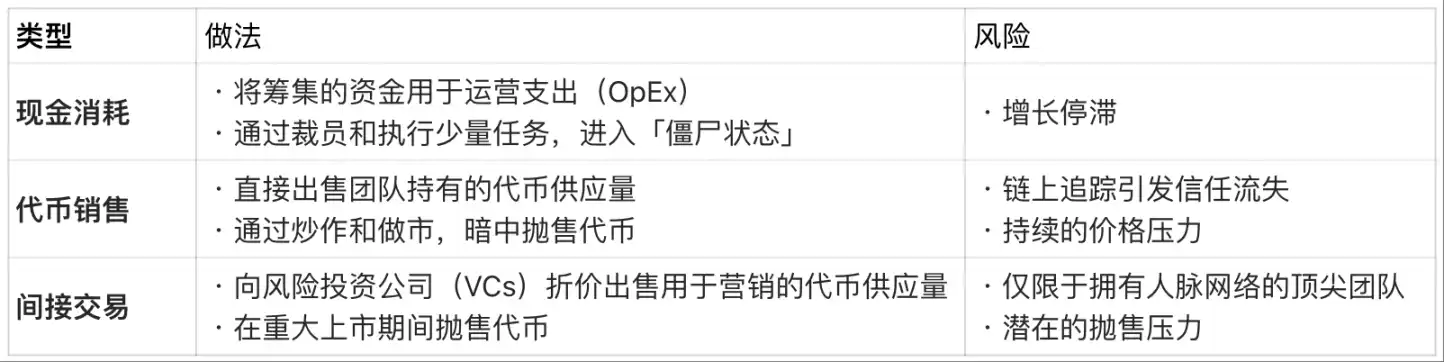
However, this "survival by tokens and external funds" model is only a stopgap measure. There is a clear upper limit to assets and token supply. Eventually, projects that exhaust all funding sources either cease operations or quietly exit the market.
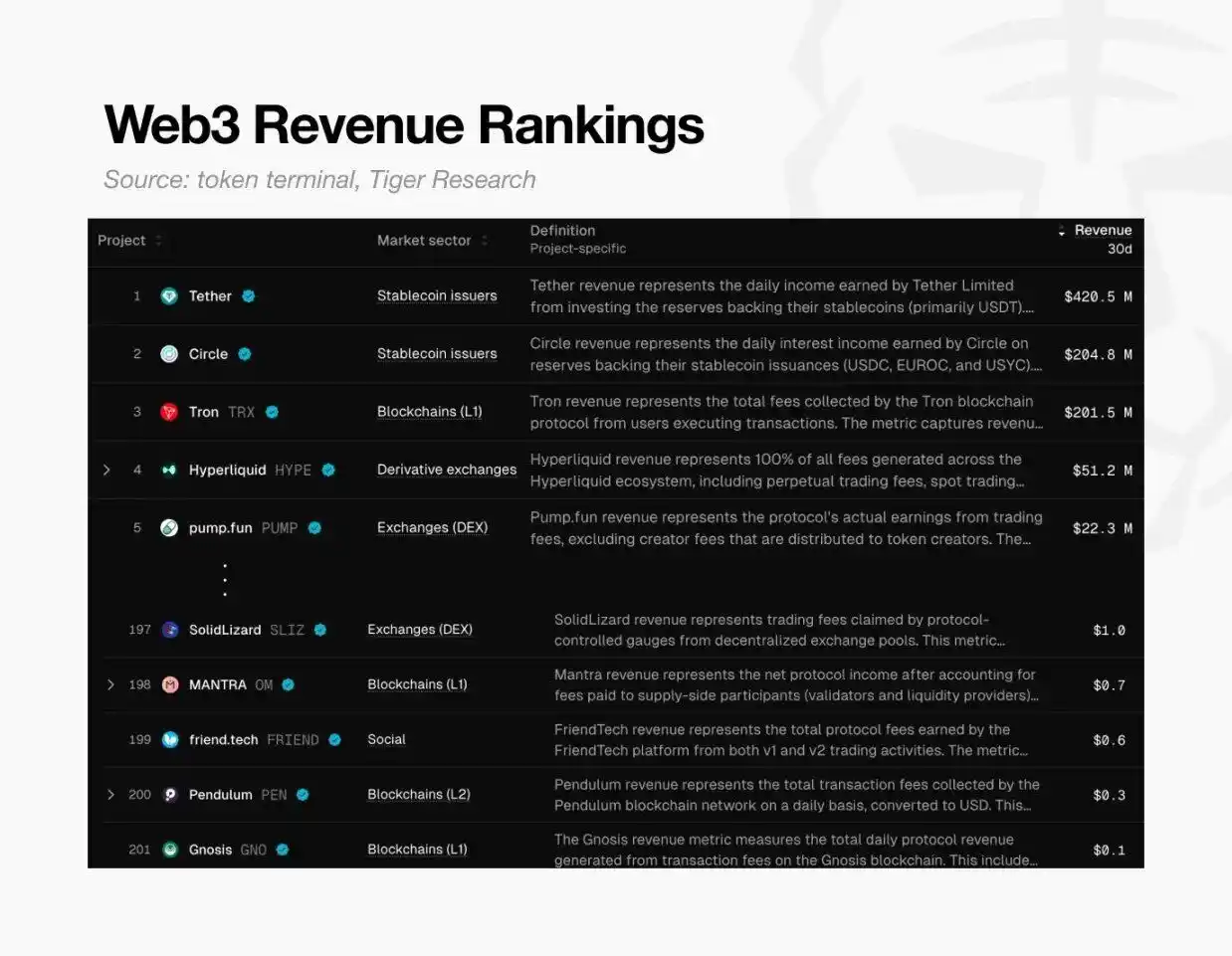
Web3 Revenue Ranking Table, Source: token terminal and Tiger Research

This crisis is universal. According to Token Terminal data, globally, only about 200 Web3 projects have achieved an income of $0.10 in the past 30 days.

This means that 99% of projects do not even have the ability to pay their own basic costs. In short, almost all cryptocurrency projects have failed to verify the feasibility of their business models and are gradually declining.

High Valuation Trap

This crisis was largely predetermined. Most Web3 projects completed their listing (token issuance) based solely on "vision", without even launching an actual product. This is in stark contrast to traditional enterprises—traditional enterprises must first prove their growth potential before an initial public offering (IPO); in the Web3 field, teams instead have to prove the rationality of their high valuation after listing (token generation event TGE).

But token holders will not wait indefinitely. As new projects emerge daily, if a project fails to meet expectations, holders will quickly sell and leave. This puts pressure on the token price, thereby threatening the project's survival. Therefore, most projects invest more funds in short-term hype rather than long-term product development. Obviously, if the product itself lacks competitiveness, even the most intensive marketing will eventually fail.

At this point, the project falls into a "dilemma trap":

  • If only focus on product development: It takes a lot of time, and during this period, market attention will gradually fade, and the fund turnover period will continue to shorten;
  • If only focus on short-term hype: The project becomes empty and lacks actual value support.

Both paths ultimately lead to failure—the project cannot prove the rationality of its initial high valuation and eventually collapses.

See the Truth of 99% of Projects Through the Top 1%

However, 1% of top projects have proven the feasibility of the Web3 model with huge revenues.

We can judge the value of major profitable projects such as Hyperliquid and Pump.fun through their price-to-earnings ratio (PER). The price-to-earnings ratio is calculated as "market capitalization ÷ annual income", and this indicator can reflect whether the project valuation is reasonable relative to actual income.

Price-to-earnings ratio comparison: Top Web3 projects (2025):
Note: Hyperliquid's sales are annualized estimates based on performance since June 2025.

The data shows that the price-to-earnings ratio of profitable projects ranges from 1x to 17x. Compared with the average price-to-earnings ratio of the S&P 500 index of about 31x, these top Web3 projects are either "undervalued relative to sales" or "have excellent cash flow conditions".

The fact that top projects with actual returns can maintain a reasonable price-to-earnings ratio makes the valuation of the remaining 99% of projects untenable—it directly proves that the high valuation of most projects in the market lacks a basis in actual value.

Can This Distorted Cycle Be Broken?

Why can projects with no sales still maintain valuations of billions of dollars? For many founders, product quality is only a secondary factor—Web3's distorted structure makes "quick exit and cash out" much easier than "building a real enterprise".

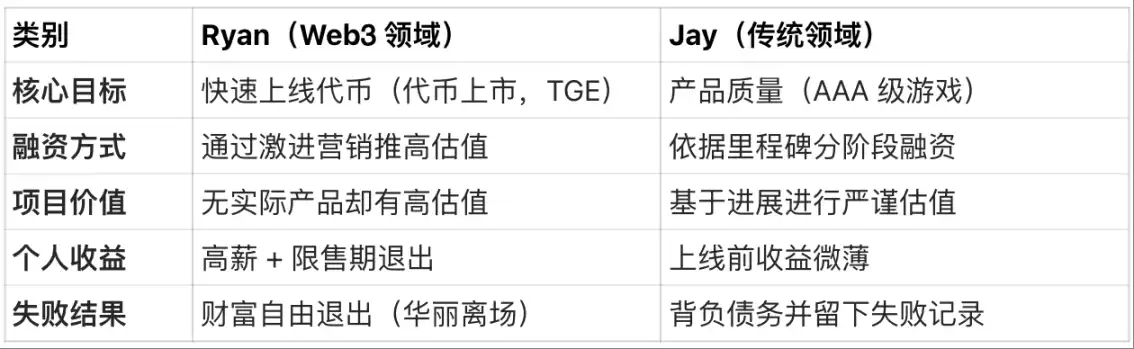
The cases of Ryan and Jay can explain this well: both launched AAA-level game projects, but the final outcomes were completely different.

Founder differences: Web3 vs. traditional model comparison

Ryan: Chose TGE, abandoned deep development

He chose a path centered on "profit": obtaining early funds by selling NFTs before the game was launched; then, while the product was still in a rough development stage, he held a token generation event (TGE) based solely on an aggressive roadmap and completed the listing on a medium-sized exchange.

After listing, he maintained the token price through hype, buying time for himself. Although the game was eventually launched late, the product quality was extremely poor, and holders sold and left. Ryan finally resigned on the grounds of "taking responsibility", but he was the real winner of this game—

On the surface, he pretended to focus on work, but in reality, he received a high salary while making huge profits by selling unlocked tokens. Regardless of the project's final success or failure, he quickly accumulated wealth and exited the market.

In contrast, Jay: Followed the traditional path, focused on the product itself

He prioritized product quality over short-term hype. But the AAA-level game development takes years, during which his funds were gradually exhausted, and he fell into a "fund turnover crisis".

In the traditional model, founders have to wait until the product is launched and sales are achieved before they can get considerable returns. Although Jay raised funds through multiple rounds of financing, he eventually shut down the company before the game was developed due to lack of funds. Unlike Ryan, Jay not only did not get any profit, but also was burdened with huge debts and left a record of failure.

Who is the Real Winner?

Neither case produced a successful product, but the winner is clear: Ryan accumulated wealth by utilizing Web3's distorted valuation system, while Jay lost everything in the process of trying to build a quality product.

This is the cruel reality of the current Web3 market: using excessive valuation to exit early is much easier than building a sustainable business model; and ultimately, the cost of this "failure" is all borne by investors.

Back to the initial question: "How do 99% of non-profit Web3 projects survive?"

This cruel reality is the most honest answer to that question.

Preguntas relacionadas

QAccording to the article, what is the main reason 99% of Web3 projects can survive without cash flow?

AThey rely on token sales and external funding rather than product revenue to cover their costs.

QWhat is the 'two-way trap' that unprofitable Web3 projects face after their Token Generation Event (TGE)?

AIf they focus only on product development, they lose market attention and their runaway period shortens. If they focus only on short-term hype, the project becomes hollow with no real value.

QHow does the Price-to-Earnings Ratio (P/E) of the top 1% of profitable Web3 projects reveal the truth about the other 99%?

AThe reasonable P/E ratios of the profitable top 1% prove that the high valuations of the other 99% of projects lack a foundation in real value.

QWhat key incentive does the article suggest drives founders to conduct an early TGE, even if their product is not ready?

AThe distorted structure of Web3 allows founders to achieve a 'quick exit and cash out' by selling their unlocked tokens for massive profits, regardless of the project's ultimate success or failure.

QIn the comparison of the two founders, Ryan and Jay, who was the 'winner' and what does this reveal about the current Web3 market?

ARyan was the winner because he accumulated wealth by exploiting the Web3 system, while Jay lost everything trying to build a quality product. This reveals that it is easier to exit using inflated valuations than to build a sustainable business, with the cost of failure borne by investors.

Lecturas Relacionadas

Analyzing the Impact of AI on Economic Growth and Productivity

**Title: Analyzing AI's Impact on Economic Growth and Productivity** This article examines three contrasting views on AI's influence on economic growth and productivity. **The Optimistic View** posits that AI, especially through automating R&D ("recursive self-improvement"), could dramatically accelerate growth, even triggering a technological "singularity" with explosive, potentially infinite, economic expansion. **The Moderate/Mainstream View** acknowledges AI's productivity benefits but emphasizes significant real-world constraints that could limit its impact. These include: limited cost savings per task, structural ceilings on which jobs and industries are "exposed" to AI, adoption bottlenecks (e.g., compute, energy, regulatory hurdles), and the "weak link" effect where non-automatable tasks cap overall gains. Consequently, the realized AI dividend may be far lower than optimistic projections, with estimates typically ranging from 0.1% to 1.3% annual productivity growth. **The Pessimistic View** stems from two strands. The first aligns with the moderate view but applies extremely conservative assumptions about task exposure and efficiency gains, yielding minimal projected impact. The second introduces a demand-side critique: if AI primarily replaces rather than augments labor, it could depress labor's share of income, weaken consumer demand, and create a "demand trap" that ultimately stifles growth, unless offset by redistribution policies. **The authors' assessment** is nuanced: * **Short-term (1-2 years):** AI will support growth primarily through investment spending, not significant productivity gains. * **Medium-term (3-5 years):** Three potential paths emerge based on AI demand and bottleneck severity: 1. **"Optimistic Path":** High demand, few bottlenecks. Rapid productivity gains but risk of major job displacement and social conflict without redistribution. 2. **"Moderate Path" (most likely):** High demand but significant, surmountable bottlenecks. Leads to moderate productivity gains, financial market volatility (K-shaped returns), and sectoral job losses. 3. **"Pessimistic Path":** Low demand or severe bottlenecks. Minimal productivity and growth impact, triggering financial market corrections but allowing a smoother societal transition with less labor disruption. * **Long-term:** AI holds potential for a major productivity revolution and prosperity. The conclusion stresses that no path is smooth. Technologically "optimistic" outcomes could be socially detrimental, while "pessimistic" technological diffusion might be more socially stable. Policymakers must monitor developments and prepare balanced responses to manage economic, financial, and social sustainability.

marsbitHace 5 min(s)

Analyzing the Impact of AI on Economic Growth and Productivity

marsbitHace 5 min(s)

The New Cold War is a Tech Stock War

The New Cold War is a Tech Stock War The article argues that the contemporary geopolitical and economic rivalry between the US and China represents a "New Cold War," but one fundamentally fought through technology and financial markets, not physical barriers or conventional trade. Historically, US dominance was secured through financial systems. The Soviet Union, reliant on the rigid "Transferable Ruble," was ultimately undermined by its dependency on the US dollar for oil trade. Later, Japan's semiconductor challenge was countered not just by tariffs (e.g., Plaza Accord, 301 investigations) but by binding it to US Treasury bonds. China presents a more complex, "embedded" challenger. While it holds vast dollar reserves and US debt like Japan, its industrial base is stronger and more diversified than the Soviet Union's. Surviving the initial 2018 trade war phase, the conflict has evolved into a "tech-financial war." The core battlefield is now the stock market. US tech stocks (AI, semiconductors) are treated as sovereign assets, buoyed by bipartisan national will. China is pushing to strengthen its own financial markets to convert industrial strength into financial power and fund its tech ambitions. Companies like ChangXin (semiconductors), Moonshot AI, and DJI compete not just for market share but as financial proxies for their respective systems. The new paradigm is moving from globally efficient monopolies (Apple, Google) towards companies that achieve monopolistic profits within their respective geopolitical spheres. This competition over "pricing power" and financial valuation in segmented markets defines the current era, making the stock market the primary arena for this tech-centric struggle.

marsbitHace 14 min(s)

The New Cold War is a Tech Stock War

marsbitHace 14 min(s)

RWA Weekly: Ten European Financial Institutions Establish Tokenized Asset Cooperative; Ondo Launches New Execution Network Ondo Network

RWA Weekly: European Banks Form Tokenized Asset Cooperative; Ondo Launches New Execution Network Ondo Network Covering July 24-31, 2026, the RWA sector saw a steady on-chain total value locked (TVL) of $36.8 billion, with holder count hitting a record high. However, stablecoin transfer volumes fell sharply (~30%), indicating low on-chain settlement demand. Key regulatory moves include South Korea advancing stablecoin legislation and a push to scrap crypto taxes, Kenya lowering capital requirements for stablecoin issuers, and Zimbabwe approving seven projects for its crypto sandbox. In project developments, BIS-led Project Agorá successfully tested cross-border payments with tokenized funds across six currencies. Ten major European financial institutions formed the RL1 blockchain cooperative to build tokenized asset infrastructure. Other notable updates: Aviva launched a tokenized dollar liquidity fund on XRPL, POSCO International tokenized commercial invoices on Injective, and a Brazilian farmer used tokenized cattle as collateral for a loan. Additional progress includes BNY Mellon migrating its core transfer agent operations to blockchain, Securitize gaining SEC investment advisor registration, and Tether’s compliant stablecoin USA₮ launching on Celo. Ondo Finance introduced Ondo Network, a new execution layer focused on speed and privacy, moving away from its initial chain plans. An analysis highlights that despite the growing scale of on-chain RWAs (~$32B), approximately 90% remain underutilized in DeFi, pointing to a critical challenge in unlocking liquidity and fostering real-world application beyond mere issuance.

marsbitHace 15 min(s)

RWA Weekly: Ten European Financial Institutions Establish Tokenized Asset Cooperative; Ondo Launches New Execution Network Ondo Network

marsbitHace 15 min(s)

South Korean Stock Market Sees Sharp Rebound After Forceful De-leveraging, SK Hynix Rises 30%

On July 31, South Korean stocks staged a historic rebound. The benchmark KOSPI index surged 18.27%, with chipmaker SK Hynix hitting a 30% gain limit. This followed a brutal, near-40% decline in the KOSPI over the previous month, driven largely by a deleveraging spiral involving leveraged ETFs. Analysts attributed the sharp sell-off to structural liquidity issues rather than deteriorating corporate fundamentals. The rally was triggered by a confluence of positive catalysts. Firstly, strong earnings from U.S. cloud giants Microsoft and Amazon alleviated fears of an "AI bubble burst," boosting global tech sentiment. Secondly, SK Group Chairman Chey Tae-won made a rare personal purchase of SK Hynix shares, seen as a strong vote of confidence. Thirdly, the South Korean government announced a 20 trillion won ($139 billion) AI investment fund. In response to the market turmoil, South Korean regulators are tightening controls on leveraged ETFs, admitting oversight shortcomings. Measures include raising minimum cash保证金 requirements for散户 investors and suspending new product launches. While the rebound signals eased liquidity pressure, analysts note deep structural issues remain. The market's future stability is seen as dependent on global tech capital expenditure trends and memory chip price cycles, with some viewing the surge as a technical correction rather than a definitive trend reversal.

marsbitHace 35 min(s)

South Korean Stock Market Sees Sharp Rebound After Forceful De-leveraging, SK Hynix Rises 30%

marsbitHace 35 min(s)

Trading

Spot
活动图片