How AI-Forged Group Photos Became a New Gray Market Tool Targeting Changpeng Zhao?

比推Publicado a 2026-02-05Actualizado a 2026-02-05

Resumen

The founder of Binance, Changpeng Zhao (CZ), recently exposed a fake photo circulating on X platform that depicted him alongside a user claiming to be a "long-term supporter of BNB." CZ identified multiple inconsistencies in the image, including an unfamiliar blue-purple shirt, a non-existent event backdrop, and mismatched resolution between the figures, indicating digital manipulation. The original image was in fact a photoshopped version of a legitimate photo of CZ with Aster CEO Leonard. Notably, the account sharing the fake photo, which has over 863,000 followers, had already blocked CZ. On February 4, CZ publicly dissected the image’s flaws and pointed out that the account had an inconsistent history—initially posting non-crypto content before abruptly shifting to focus on BNB-related activities. He suggested this was not a simple prank but potentially a targeted influence operation. CZ confirmed he did not know the account holder and had previously blocked the user, a decision he now considers justified. He also addressed a fabricated "legal letter" that had been circulated and expressed concern that some media outlets had reported on obviously manipulated or AI-generated content without verification. He warned that failure to identify such forgeries could lead to significant consequences.

Author: Nicky, Foresight News

Original Title: Changpeng Zhao Targeted by Gray Market Operations


Binance founder Changpeng Zhao (CZ) recently encountered "trouble" again.

In a photo on the X platform, CZ stands in front of an event backdrop alongside a user who claims to be a "long-term supporter of BNB." However, CZ quickly noticed something unusual—he never owned that blue-purple shirt, the backdrop does not exist, and the resolution of the characters is inconsistent, clearly indicating splicing and editing. Additionally, another photoshopped image was originally a group photo of CZ and Aster CEO Leonard.

What’s even more intriguing is that this account, with 863,000 followers, had already blocked CZ.
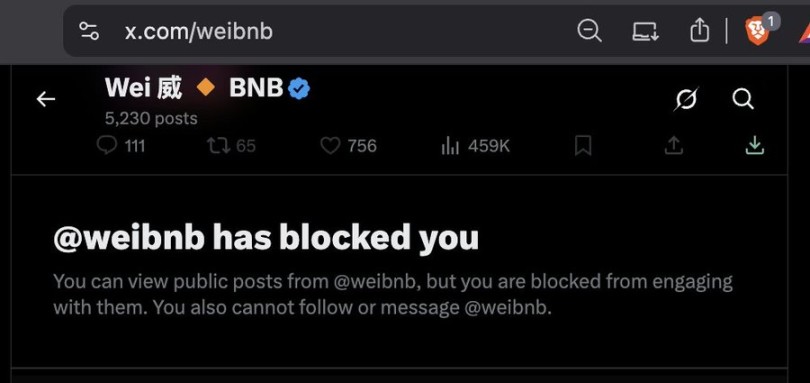
On February 4, CZ publicly dissected the details of the image and pointed out that the account's historical trajectory shows obvious discontinuities: early content had almost nothing to do with cryptocurrency, but later shifted to focus on BNB activities, with an unnatural transition in identity. In his view, such long-standing accounts built on forged materials are not just pranks but more like premeditated image manipulation.

CZ stated that he does not know the account holder and does not remember when he blocked them, but it now seems like the right move. Regarding the previously circulated so-called "lawyer's letter," he initially thought the forgery was too obvious to require clarification, but he noticed some media outlets still reposted and reported on the images. He warned that if even obvious PS or AI-generated content cannot be discerned, one may ultimately pay the price for it.

Meanwhile, some bloggers in the Chinese community have also discovered that a large number of accounts in the English-speaking region, with names or nicknames containing Chinese characters and "


Original link:https://www.bitpush.news/articles/7609077

Preguntas relacionadas

QWhat was the main issue that Binance founder Changpeng Zhao (CZ) recently encountered on social media?

ACZ encountered a fake AI-generated photo of himself posing with a user claiming to be a long-term BNB supporter, which he identified as fraudulent due to inconsistencies like an unfamiliar shirt and non-existent background.

QHow did CZ identify the image as fake?

ACZ noted that he never owned the blue-purple shirt in the image, the background board did not exist, there were resolution inconsistencies between the subjects, and the image was clearly spliced from an original photo with Aster CEO Leonard.

QWhat suspicious behavior did CZ observe about the account that posted the fake image?

AThe account, which had 863,000 followers, had previously blocked CZ, and its content history showed a sudden shift from non-crypto-related posts to focusing on BNB activities without a logical transition.

QWhat did CZ warn about regarding such fake content?

ACZ warned that if people cannot distinguish obvious PS or AI-generated content, they may end up paying a price for it, emphasizing the risks of falling for manipulated imagery.

QWhat was the original title of the article discussing this incident?

AThe original title of the article was '被灰产盯上的赵长鹏', which translates to 'Changpeng Zhao Targeted by Gray Industry'.

Lecturas Relacionadas

Bitcoin Withdrawals Continue: 8 Years of Storage in a Coldcard Cold Wallet Ended in Zero

Coldcard Hardware Wallet Hacked: Losses Mount Due to Vulnerable Seed Generation A critical vulnerability in Coldcard hardware wallets has led to a continued wave of fund thefts. According to Galaxy Research, the total stolen has reached 1,367.05 BTC (approx. $88.6 million) from 4,585 addresses, a significant increase from the initial 594.5 BTC reported on July 30, 2026. Most of the stolen funds remain on the attackers' addresses. The issue is not with the current firmware, which Coinkite has updated, but with seed phrases generated on vulnerable devices between March 2021 and the release of fixed firmware versions. Due to a programmer error, devices switched from using a hardware random number generator to the software-based Yasmarang generator, which was initialized with publicly accessible data like the chip's serial number. This made the seed phrases predictable through offline brute-force attacks, meaning wallets remain at risk until funds are moved to a new wallet generated with the patched firmware. Affected devices include Mk2/Mk3 with firmware 4.0.1–4.1.9 (and up to 5.0.3), Mk4/Mk5 up to version 5.6.0, and Q models up to 1.5.0Q. The only exceptions are seeds created with a high-entropy method like at least 50 independent dice rolls or a strong unique BIP-39 passphrase. All other owners must generate a new seed on the fixed firmware and transfer their assets. A case highlighting the human impact involves a 39-year-old long-term investor who lost 2 BTC (approx. $130,000) in minutes. He had accumulated the Bitcoin over eight years through physical labor, viewing it as a financial lifeline and a retirement plan in a country suffering from hyperinflation. His story underscores that even conservative "buy and hold in cold storage" strategies can be compromised by such underlying technical flaws. From a technical perspective, this incident echoes historical failures where weak random number generators undermined cryptographic security, challenging the assumption that offline storage is automatically foolproof.

cryptonews.ruHace 22 min(s)

Bitcoin Withdrawals Continue: 8 Years of Storage in a Coldcard Cold Wallet Ended in Zero

cryptonews.ruHace 22 min(s)

Trading

Spot
活动图片




