How a single copy-paste mistake cost a user $50M in USDt

cointelegraphPublicado a 2025-12-20Actualizado a 2025-12-20

Resumen

A user lost nearly $50 million in USDt in an address poisoning scam after mistakenly copying a malicious look-alike address from their transaction history. The scam works by attackers sending small transactions to a victim's wallet using addresses that closely resemble those of the victim's trusted contacts. In this case, the victim first sent a small test transaction to the correct address but then copied a fraudulent, similar-looking address for the full $50 million transfer. Onchain investigators noted the addresses shared the same first three and last four characters, a subtle similarity that can deceive even experienced users. The stolen funds were subsequently swapped for Ether and partially laundered through Tornado Cash. This incident highlights how such attacks exploit human error rather than technical vulnerabilities. The loss occurred amid a broader surge in crypto hacks, which reached $3.4 billion in losses in 2025.

A single transaction error led to one of the largest onchain losses seen this year, after a user mistakenly sent nearly $50 million in USDt to a scam address in a classic address poisoning attack.

According to onchain investigator Web3 Antivirus, the victim lost 49,999,950 USDt (USDT) after copying a malicious wallet address from their transaction history.

Address poisoning scams rely on look-alike wallet addresses being inserted into a victim’s transaction history via small transfers. When victims later copy an address from their transaction history, they may unknowingly select the scammer’s lookalike address instead of the intended recipient.

Onchain data shows the victim initially sent a small test transaction to the correct address. Minutes later, however, the full $50 million transfer was sent to the poisoned address.
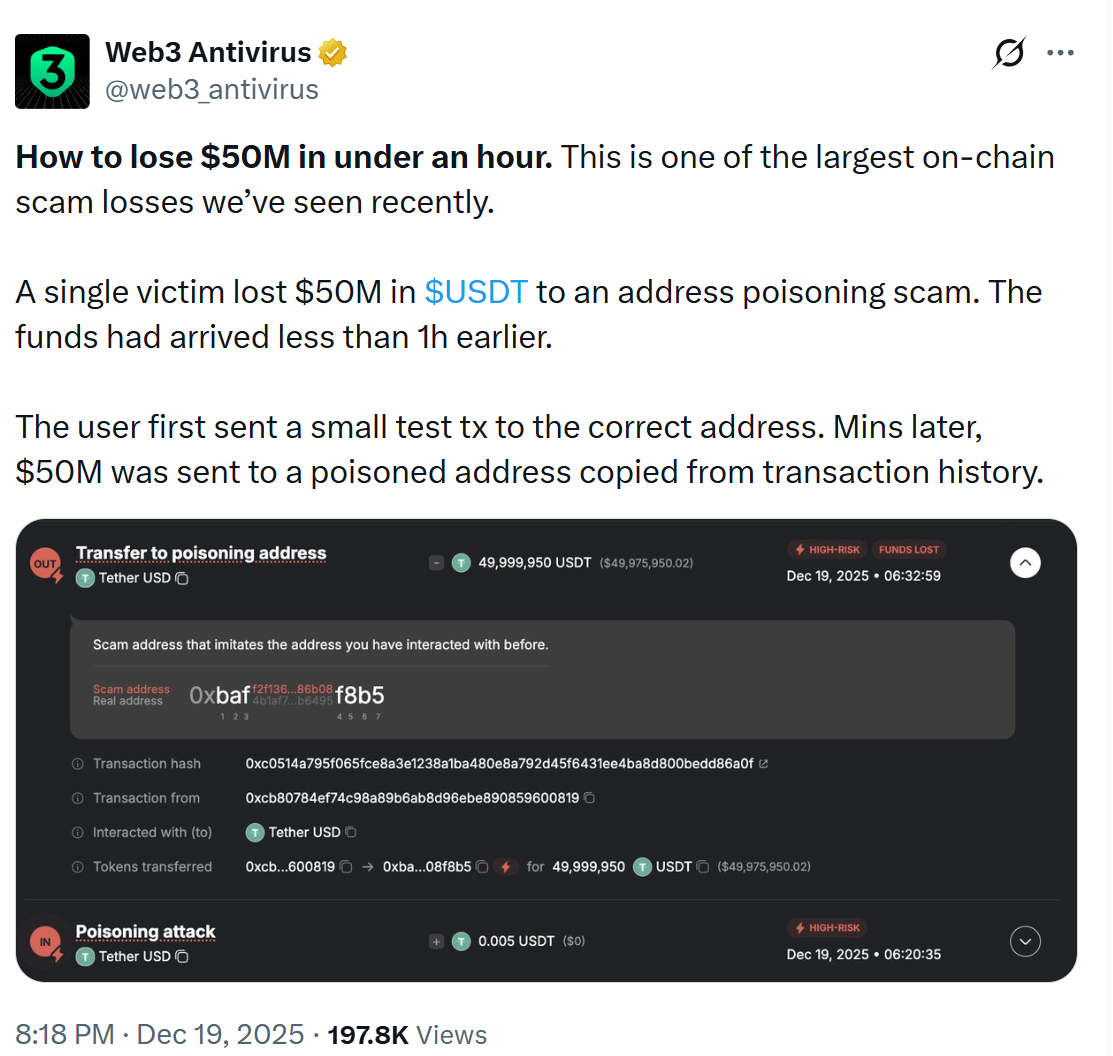
User falls victim to address poisoning scam. Source: Web3 Antivirus

Related: Attacker takes over multisig minutes after creation, drains up to $40M slowly

Subtle address similarity enough to fool experienced users

Security researcher Cos, founder of SlowMist, noted the similarity between the addresses was subtle but enough to deceive even experienced users. “You can see the first 3 characters and last 4 characters are the same,” he wrote.

The victim’s wallet had been active for roughly two years and was primarily used for USDt transfers, according to onchain analysis. Shortly before the loss, the funds were withdrawn from Binance, suggesting the wallet was being actively managed at the time of the incident.

“This is the brutal reality of address poisoning, an attack that doesn’t rely on breaking systems, but on exploiting human habits,” another onchain analyst wrote.

The attacker has since swapped the stolen USDt for Ether (ETH), splitting it into multiple wallets, and partially moved it into Tornado Cash.

Related: Binance denies reports of delayed action over funds linked to Upbit hack

Crypto hacks hit $3.4 billion in 2025

As Cointelegraph reported, crypto-related hacks resulted in $3.4 billion in losses in 2025, marking the highest annual total since 2022. The surge was largely driven by a handful of massive breaches targeting major crypto entities rather than a broad rise in average attack size.

Just three incidents accounted for 69% of total losses this year, led by the $1.4 billion hack of crypto exchange Bybit, which alone made up nearly half of all stolen funds.

Magazine: 2026 is the year of pragmatic privacy in crypto — Canton, Zcash and more

Criptos en tendencia

Preguntas relacionadas

QWhat is an address poisoning scam and how did it lead to a $50 million loss?

AAn address poisoning scam is a type of attack where a scammer sends a small transaction to a victim's wallet using a look-alike address. The victim, when later copying an address from their transaction history, may accidentally select the scammer's fraudulent address instead of the legitimate one. In this case, the user mistakenly sent $50 million in USDt to the poisoned address.

QWhat detail did the security researcher from SlowMist point out about the fraudulent address?

AThe security researcher, Cos from SlowMist, noted that the similarity between the legitimate and the fraudulent address was very subtle. He pointed out that the first 3 characters and the last 4 characters of the two addresses were identical, which was enough to deceive even experienced users.

QWhat did the attacker do with the stolen USDt funds after the scam was successful?

AAfter successfully stealing the USDt, the attacker swapped the funds for Ether (ETH). They then split the ETH into multiple wallets and partially moved it into the privacy-focused mixing service, Tornado Cash.

QHow much was lost to crypto hacks in 2025 according to the article, and what was a major contributing factor?

AAccording to the article, crypto-related hacks resulted in $3.4 billion in losses in 2025. The surge was largely driven by a handful of massive breaches targeting major crypto entities, with just three incidents accounting for 69% of the total losses.

QWhat preliminary step did the victim take before sending the full $50 million, and why was it ineffective in preventing the loss?

AThe victim initially sent a small test transaction to the correct address. However, this was ineffective because the scammer's look-alike address was already in their transaction history from a previous, small 'poisoning' transfer. When the victim went to copy the address for the large transfer, they mistakenly selected the fraudulent one.

Lecturas Relacionadas

Agent Race Ends, Super Workbench Takes Over

The era of fragmented AI agents is ending. Over the past month, China's tech giants—Tencent, Alibaba, and ByteDance—have simultaneously shifted strategy: instead of launching new, standalone AI agents, they are consolidating their various agent projects into unified "super workbenches." Tencent integrated its QClaw teams into WorkBuddy, a strategic product hailed as a potential third flagship after QQ and WeChat. Alibaba is merging its QoderWork, Wukong, and MuleRun agents into a new "Qianwen Office" platform under DingTalk's leadership. ByteDance rebranded its TRAE SOLO coding agent to TRAE Work, signaling a broader focus on workflow collaboration. This convergence marks a pivotal industry consensus. The initial exploration phase, where companies rapidly built numerous overlapping agents for different scenarios, proved costly and inefficient. With open-source tools eroding technical barriers, competition has shifted from agent creation to resource consolidation and cost control. Historically, platform wars are won not by creating more products, but by simplifying them—as seen with browsers unifying web access and super-apps consolidating services. Now, the "super workbench" aims to become the unified AI entry point for work. This reflects a deeper market realization: the primary audience for AI is no longer just programmers (a market in the tens of millions) but all knowledge workers (a market of billions). The real opportunity lies in augmenting everyday tasks—managing emails, documents, data, and meetings—across the entire workday. The core battleground is becoming control over the primary AI entry point that employees use daily. Tencent's WorkBuddy leverages WeChat and Tencent Docs; Alibaba's Qianwen Office taps into DingTalk's organizational data; ByteDance's TRAE Work integrates with Feishu's workflows. Whoever owns this "super workbench" gains strategic control over orchestrating enterprise data and APIs. This shift is redefining enterprise software. Traditional SaaS applications, valued for their user interfaces, will recede into the background. Their core functionalities will be exposed as standardized "Skills" or APIs for the super workbench's agents to invoke. Software value will shift from selling user seats to charging based on API calls and outcomes delivered. The evolution of agents is moving through clear stages: first as novel standalone products, then as consolidated primary work entry points, and finally as pervasive, invisible capabilities embedded into the digital fabric. The recent moves by major tech firms signal the transition from the first stage into the second, accelerating toward the third. In the end, the most successful agent technology may become invisible—like electricity or the HTTP protocol—a fundamental, unnamed infrastructure powering work itself.

marsbitHace 8 min(s)

Agent Race Ends, Super Workbench Takes Over

marsbitHace 8 min(s)

Michael Saylor: 110 Reasons to Oppose BIP-110

Michael Saylor presents 110 arguments against Bitcoin Improvement Proposal (BIP) 110, a soft fork aimed at restricting certain non-monetary data storage uses (like inscriptions) on the Bitcoin blockchain. He acknowledges the proponents' valid concerns—such as node costs, fee pressure, and preserving Bitcoin's monetary focus—but fundamentally disagrees with the proposed solution. Saylor argues that BIP 110 represents a dangerous precedent of using consensus rules to enforce value judgments on transaction validity, moving away from Bitcoin's core principles of neutrality and permissionless innovation. His key objections are organized into eleven categories: 1) It violates neutrality and hard consensus by banning currently valid transactions. 2) It fails to meet the high burden of proof required for a consensus change, lacking concrete data on the alleged crisis. 3) Its seven bundled technical restrictions are overly broad, targeting generic script functionalities and blocking future upgrade paths. 4) It sacrifices compatibility and future optionality by closing off designed upgrade hooks. 5) Its temporary rules add significant complexity (grandfathering, expiry states) without sufficient justification. 6) The economic and security impacts, particularly on miner revenue and fee markets, are uncertain and unmodeled. 7) Superior, market-based tools (fee markets, relay/mining policies) already exist to manage blockchain load. 8) It stifles innovation by creating a chilling effect for developers. 9) Its modified activation mechanism (55% threshold, forced signaling) is aggressive and risks network splits. 10) The precedent it sets—using consensus to suppress disliked but legal uses—is more dangerous than the problem it aims to solve. 11) A better path exists: improving measurements, refining resource-based policies, and allowing market forces to work. Saylor concludes that Bitcoin's strength lies in its neutral rules, open markets, and hard consensus. Changing these foundational elements to target specific use cases is an unnecessary and risky "iatrogenic" intervention. He advocates for guarding Bitcoin's neutrality rather than acting as its redeemer.

marsbitHace 23 min(s)

Michael Saylor: 110 Reasons to Oppose BIP-110

marsbitHace 23 min(s)

Trading

Spot

Artículos destacados

Cómo comprar O

¡Bienvenido a HTX.com! Hemos hecho que comprar O1 exchange (O) sea simple y conveniente. Sigue nuestra guía paso a paso para iniciar tu viaje de criptos.Paso 1: crea tu cuenta HTXUtiliza tu correo electrónico o número de teléfono para registrarte y obtener una cuenta gratuita en HTX. Experimenta un proceso de registro sin complicaciones y desbloquea todas las funciones.Obtener mi cuentaPaso 2: ve a Comprar cripto y elige tu método de pagoTarjeta de crédito/débito: usa tu Visa o Mastercard para comprar O1 exchange (O) al instante.Saldo: utiliza fondos del saldo de tu cuenta HTX para tradear sin problemas.Terceros: hemos agregado métodos de pago populares como Google Pay y Apple Pay para mejorar la comodidad.P2P: tradear directamente con otros usuarios en HTX.Over-the-Counter (OTC): ofrecemos servicios personalizados y tipos de cambio competitivos para los traders.Paso 3: guarda tu O1 exchange (O)Después de comprar tu O1 exchange (O), guárdalo en tu cuenta HTX. Alternativamente, puedes enviarlo a otro lugar mediante transferencia blockchain o utilizarlo para tradear otras criptomonedas.Paso 4: tradear O1 exchange (O)Tradear fácilmente con O1 exchange (O) en HTX's mercado spot. Simplemente accede a tu cuenta, selecciona tu par de trading, ejecuta tus trades y monitorea en tiempo real. Ofrecemos una experiencia fácil de usar tanto para principiantes como para traders experimentados.

128 Vistas totalesPublicado en 2026.06.19Actualizado en 2026.06.29

Cómo comprar O

Cómo comprar PROS

¡Bienvenido a HTX.com! Hemos hecho que comprar Pharos (PROS) sea simple y conveniente. Sigue nuestra guía paso a paso para iniciar tu viaje de criptos.Paso 1: crea tu cuenta HTXUtiliza tu correo electrónico o número de teléfono para registrarte y obtener una cuenta gratuita en HTX. Experimenta un proceso de registro sin complicaciones y desbloquea todas las funciones.Obtener mi cuentaPaso 2: ve a Comprar cripto y elige tu método de pagoTarjeta de crédito/débito: usa tu Visa o Mastercard para comprar Pharos (PROS) al instante.Saldo: utiliza fondos del saldo de tu cuenta HTX para tradear sin problemas.Terceros: hemos agregado métodos de pago populares como Google Pay y Apple Pay para mejorar la comodidad.P2P: tradear directamente con otros usuarios en HTX.Over-the-Counter (OTC): ofrecemos servicios personalizados y tipos de cambio competitivos para los traders.Paso 3: guarda tu Pharos (PROS)Después de comprar tu Pharos (PROS), guárdalo en tu cuenta HTX. Alternativamente, puedes enviarlo a otro lugar mediante transferencia blockchain o utilizarlo para tradear otras criptomonedas.Paso 4: tradear Pharos (PROS)Tradear fácilmente con Pharos (PROS) en HTX's mercado spot. Simplemente accede a tu cuenta, selecciona tu par de trading, ejecuta tus trades y monitorea en tiempo real. Ofrecemos una experiencia fácil de usar tanto para principiantes como para traders experimentados.

146 Vistas totalesPublicado en 2026.06.22Actualizado en 2026.06.29

Cómo comprar PROS

Qué es VERONA

I. Introducción al Proyecto VERONA es una blockchain construida para todos, en todas partes a través de la abstracción de cadenas. Utilizando su capa de Abstracción Generalizada, VERONA se distingue por integrar funcionalidades complejas de blockchain, como cuentas, firmas e interoperabilidad, directamente a nivel de protocolo. Este enfoque permite interactuar con aplicaciones de blockchain sin necesidad de entender las tecnologías subyacentes.1) Información Básica Nombre: VERONA (VERONA)III. Enlaces Relacionados Enlace al sitio web oficial: https://xion.burnt.com/ Libro Blanco: https://xion.burnt.com/whitepaper.pdf Exploradores: https://explorer.burnt.com/ Redes Sociales: https://x.com/burnt_xion Nota: La introducción del proyecto proviene de los materiales publicados o proporcionados por el equipo oficial del proyecto, que es solo para referencia y no constituye asesoramiento de inversión. HTX no se hace responsable de ninguna pérdida directa o indirecta resultante.

171 Vistas totalesPublicado en 2026.06.22Actualizado en 2026.06.22

Qué es VERONA

Discusiones

Bienvenido a la comunidad de HTX. Aquí puedes mantenerte informado sobre los últimos desarrollos de la plataforma y acceder a análisis profesionales del mercado. A continuación se presentan las opiniones de los usuarios sobre el precio de A (A).

活动图片











