Housing Price "Shorting Tool" Emerges as Polymarket Launches Real Estate Prediction Market

marsbitPublicado a 2026-01-06Actualizado a 2026-01-06

Resumen

Polymarket, a prediction market platform, has partnered with real estate data provider Parcl to launch a new prediction market for US housing prices. The collaboration will utilize Parcl’s daily housing price indices as a verifiable and transparent data source to settle market outcomes on Polymarket. Users can trade on whether prices in specific high-liquidity U.S. cities—such as New York, Miami, and San Francisco—will rise or fall over monthly, quarterly, or annual periods. All trading is done using USDC on the Polygon blockchain. This initiative effectively creates a “shorting tool” for real estate, allowing participants to hedge against or speculate on local housing market downturns without needing to buy or sell physical property. The move introduces a liquid, crypto-native trading layer for real estate price expectations—a market traditionally known for its illiquidity and high transaction costs. The launch has positively impacted Parcl’s native token PRCL, which saw a price increase of over 150% following the announcement.

Author | Asher(@Asher_ 0210)

The credibility of "everything is predictable" continues to rise.

On the evening of January 5th, the on-chain real estate platform Parcl announced a collaboration with the prediction market Polymarket, aiming to introduce Parcl's daily housing price index into Polymarket's new real estate prediction market. Following this news, Parcl's token PRCL saw a short-term surge of over 150%, currently retracting slightly to $0.042, with a market cap of $19 million.
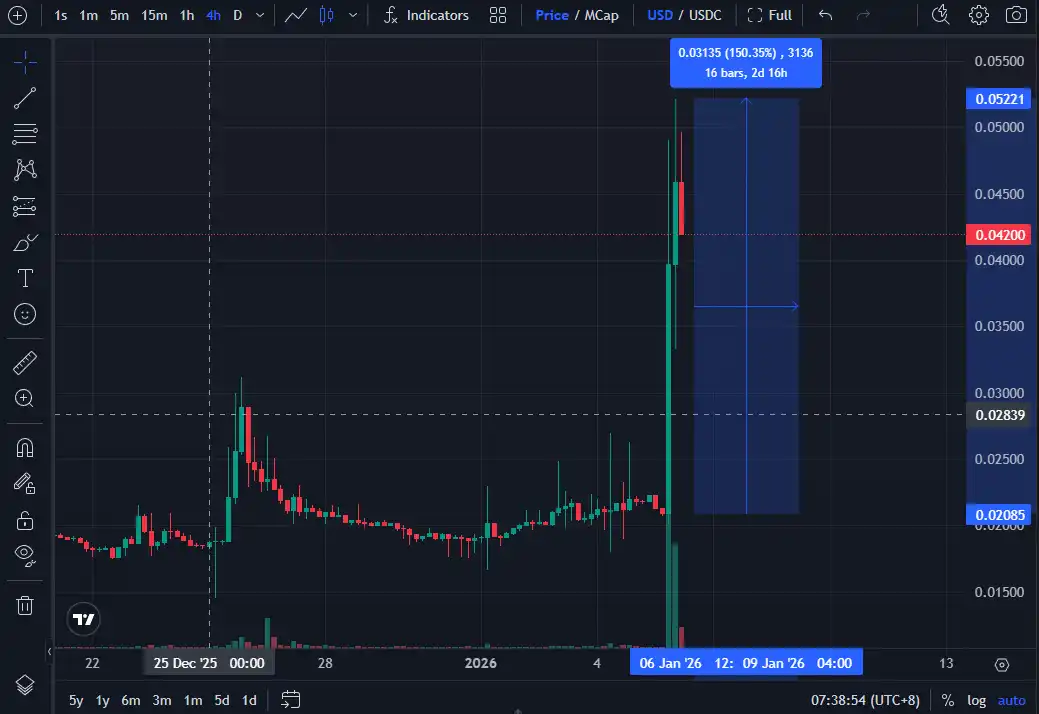
PRCL Price Chart

Operational Details of Polymarket's Real Estate Prediction Market Section

Collaboration Details:

  • Parcl provides daily housing price indices as an independent, transparent reference data for market settlement;
  • Polymarket is responsible for listing and operating the markets, where users can trade using USDC on the Polygon chain;
  • Market settlements are based on Parcl's publicly verifiable index, avoiding the delays (typically monthly) and subjectivity of traditional real estate data.

Market Types:

  • Predicting whether housing prices will rise/fall within a month, quarter, or year;
  • Threshold markets: e.g., whether housing prices exceed a specific level;
  • Each market is linked to Parcl's dedicated settlement page, displaying final values, historical data, and index calculation methods.

Coverage:

  • Initially starting with high-liquidity U.S. cities, such as New York, Miami, San Francisco, Austin, etc.;
  • Subsequently expanding to more cities and market types based on user demand.

Example Display:

Currently, this section has only listed 7 monthly real estate prediction events, with low liquidity. The event with the highest trading volume, "U.S. Los Angeles Housing Agent Price on February 1st," has only $3,700.
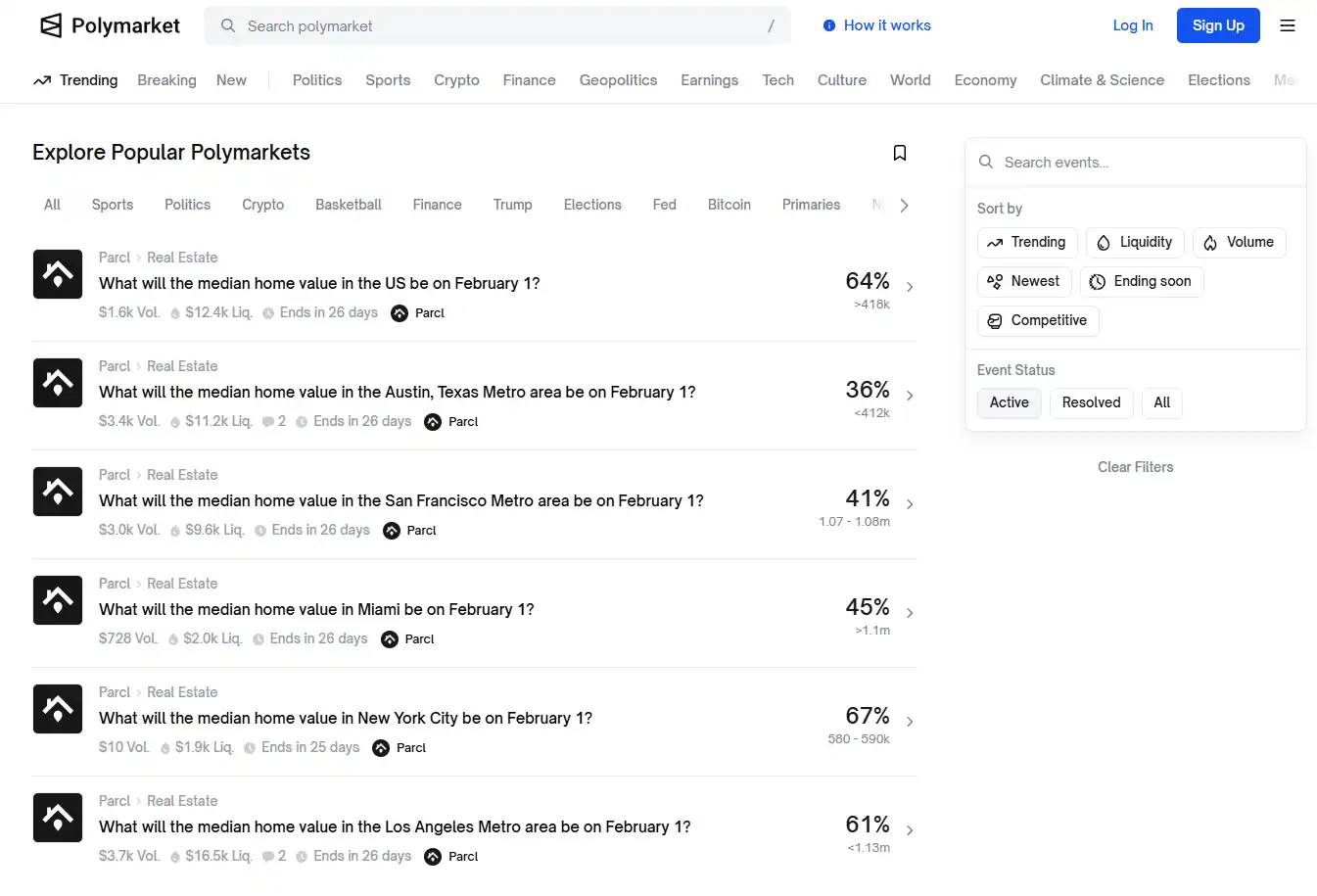
Polymarket's New Real Estate Prediction Market Section

In traditional real estate markets, whether bullish or bearish, such expectations are difficult to express directly, let alone form continuous market signals. Polymarket's introduction essentially separates "judgments on housing prices" from asset transactions. As long as there is a clear settlement standard, expectations themselves can be priced independently.

The Real Estate Market Finally Sees a "Shorting Tool"

An easily overlooked fact is that the potential demand for real estate-related markets does not only come from native speculators.

In the traditional financial system, "falling housing prices" are almost a risk that cannot be directly hedged. Whether holding property or having asset structures and income sources highly dependent on a city's real estate cycle, the practical response is often to continue holding or directly sell physical assets—high transaction costs, long cycles, and a lack of flexible intermediate options. As KOL 0xMarioNawfal (@RoundtableSpace) stated: "This is far more than just betting; it's about bringing liquidity to one of the world's most illiquid markets. Imagine housing prices are at historic highs, and you expect a crash but can't sell your house—now you can hedge and short the market."

The introduction of prediction markets abstracts the decline in housing prices into a tradable risk judgment. When housing prices are high and market expectations begin to weaken, the trend of real estate prices itself can be priced separately without having to dispose of underlying assets for risk management.

Through Polymarket, the downside risk of real estate prices is abstracted into a tradable judgment rather than requiring the disposal of physical assets. From this perspective, Polymarket's real estate prediction market is closer to a simplified macro hedging mechanism than a mere speculative game around rises and falls. It does not change the liquidity structure of real estate assets themselves but provides a tradable layer that can reflect expectations in real-time for a long-term illiquid market.

Polymarket CMO Matthew Modabber stated: "Prediction markets are best suited for events with clear, verifiable data. Parcl's daily housing price index provides us with a transparent, consistent settlement foundation. Real estate should become a first-class category in prediction markets."

The collaboration between Polymarket and Parcl also introduces traditional real estate price signals into the crypto system: Originally low-frequency, closed, and high-barrier assets are broken down into settleable, verifiable, and tradable index results, resembling stock indices or crypto derivatives. This may be a more practical and demand-aligned implementation path in the RWA narrative.


Preguntas relacionadas

QWhat is the main purpose of the collaboration between Parcl and Polymarket?

AThe collaboration aims to introduce Parcl's daily housing price indices into Polymarket's new real estate prediction markets, providing an independent and transparent reference for market settlements.

QHow does the real estate prediction market on Polymarket function in terms of settlement?

AMarket settlements are based on Parcl's publicly verifiable index data, which avoids the delays (typically monthly) and subjectivity of traditional real estate data.

QWhat types of markets are available in Polymarket's real estate prediction section?

AThe markets include predicting whether housing prices will rise or fall within monthly, quarterly, or annual periods, as well as threshold-based markets, such as whether prices will exceed specific levels.

QWhy is the introduction of real estate prediction markets significant for risk management?

AIt allows users to hedge against or speculate on housing price declines without needing to dispose of physical assets, providing a tool to directly trade and price the risk of falling real estate values.

QWhich US cities are initially covered in Polymarket's real estate prediction markets?

AThe initial coverage includes high-liquidity US cities such as New York, Miami, San Francisco, and Austin, with plans to expand to more cities based on user demand.

Lecturas Relacionadas

Agent Race Ends, Super Workbench Takes Over

The era of fragmented AI agents is ending. Over the past month, China's tech giants—Tencent, Alibaba, and ByteDance—have simultaneously shifted strategy: instead of launching new, standalone AI agents, they are consolidating their various agent projects into unified "super workbenches." Tencent integrated its QClaw teams into WorkBuddy, a strategic product hailed as a potential third flagship after QQ and WeChat. Alibaba is merging its QoderWork, Wukong, and MuleRun agents into a new "Qianwen Office" platform under DingTalk's leadership. ByteDance rebranded its TRAE SOLO coding agent to TRAE Work, signaling a broader focus on workflow collaboration. This convergence marks a pivotal industry consensus. The initial exploration phase, where companies rapidly built numerous overlapping agents for different scenarios, proved costly and inefficient. With open-source tools eroding technical barriers, competition has shifted from agent creation to resource consolidation and cost control. Historically, platform wars are won not by creating more products, but by simplifying them—as seen with browsers unifying web access and super-apps consolidating services. Now, the "super workbench" aims to become the unified AI entry point for work. This reflects a deeper market realization: the primary audience for AI is no longer just programmers (a market in the tens of millions) but all knowledge workers (a market of billions). The real opportunity lies in augmenting everyday tasks—managing emails, documents, data, and meetings—across the entire workday. The core battleground is becoming control over the primary AI entry point that employees use daily. Tencent's WorkBuddy leverages WeChat and Tencent Docs; Alibaba's Qianwen Office taps into DingTalk's organizational data; ByteDance's TRAE Work integrates with Feishu's workflows. Whoever owns this "super workbench" gains strategic control over orchestrating enterprise data and APIs. This shift is redefining enterprise software. Traditional SaaS applications, valued for their user interfaces, will recede into the background. Their core functionalities will be exposed as standardized "Skills" or APIs for the super workbench's agents to invoke. Software value will shift from selling user seats to charging based on API calls and outcomes delivered. The evolution of agents is moving through clear stages: first as novel standalone products, then as consolidated primary work entry points, and finally as pervasive, invisible capabilities embedded into the digital fabric. The recent moves by major tech firms signal the transition from the first stage into the second, accelerating toward the third. In the end, the most successful agent technology may become invisible—like electricity or the HTTP protocol—a fundamental, unnamed infrastructure powering work itself.

marsbitHace 18 min(s)

Agent Race Ends, Super Workbench Takes Over

marsbitHace 18 min(s)

Michael Saylor: 110 Reasons to Oppose BIP-110

Michael Saylor presents 110 arguments against Bitcoin Improvement Proposal (BIP) 110, a soft fork aimed at restricting certain non-monetary data storage uses (like inscriptions) on the Bitcoin blockchain. He acknowledges the proponents' valid concerns—such as node costs, fee pressure, and preserving Bitcoin's monetary focus—but fundamentally disagrees with the proposed solution. Saylor argues that BIP 110 represents a dangerous precedent of using consensus rules to enforce value judgments on transaction validity, moving away from Bitcoin's core principles of neutrality and permissionless innovation. His key objections are organized into eleven categories: 1) It violates neutrality and hard consensus by banning currently valid transactions. 2) It fails to meet the high burden of proof required for a consensus change, lacking concrete data on the alleged crisis. 3) Its seven bundled technical restrictions are overly broad, targeting generic script functionalities and blocking future upgrade paths. 4) It sacrifices compatibility and future optionality by closing off designed upgrade hooks. 5) Its temporary rules add significant complexity (grandfathering, expiry states) without sufficient justification. 6) The economic and security impacts, particularly on miner revenue and fee markets, are uncertain and unmodeled. 7) Superior, market-based tools (fee markets, relay/mining policies) already exist to manage blockchain load. 8) It stifles innovation by creating a chilling effect for developers. 9) Its modified activation mechanism (55% threshold, forced signaling) is aggressive and risks network splits. 10) The precedent it sets—using consensus to suppress disliked but legal uses—is more dangerous than the problem it aims to solve. 11) A better path exists: improving measurements, refining resource-based policies, and allowing market forces to work. Saylor concludes that Bitcoin's strength lies in its neutral rules, open markets, and hard consensus. Changing these foundational elements to target specific use cases is an unnecessary and risky "iatrogenic" intervention. He advocates for guarding Bitcoin's neutrality rather than acting as its redeemer.

marsbitHace 33 min(s)

Michael Saylor: 110 Reasons to Oppose BIP-110

marsbitHace 33 min(s)

Trading

Spot
活动图片

