Hotstuff Launches 24/7 Spot Trading for Tokenized Equities, ETFs and Crypto Assets, Targeting the $147 Trillion Global Equity Market

TheNewsCryptoPublicado a 2026-05-13Actualizado a 2026-05-13

Resumen

Hotstuff Labs, the core contributor to the Hotstuff Layer 1 blockchain, has launched 24/7 spot trading for tokenized U.S. equities and ETFs, expanding into the $147 trillion global equity market. This follows the platform surpassing $1 billion in derivative trading volume within 90 days of its mainnet launch. The new offering, powered by xStocks, provides 1:1 asset-backed tokens that are redeemable for cash value. It aims to overcome barriers like poor liquidity and limited access by enabling round-the-clock trading, utilizing hybrid RFQ liquidity, and offering instant listings for over 100 assets initially. The integration positions Hotstuff as a key venue for on-chain real-world assets, building on strong user demand where RWA volume recently outpaced crypto volume by 3x.

DeFi Layer 1 Hotstuff Expands Beyond Crypto Perps Into Real-World Asset Spot Trading After Surpassing $1 Billion in Derivative Trading Volumes

Hotstuff Labs, the core contributor to Hotstuff L1, today announced the launch of 24/7 spot markets for tokenised equities, ETFs, and crypto assets on Hotstuff, marking a major expansion from crypto and RWA perpetuals into the $147 trillion global equity market.
Powered byxStocks, the integration enables users to buy, sell, hold, and transfer tokenised US stocks and ETFs 24/7. Tokenised Equities on Hotstuff allow users worldwide to gain on-chain exposure to US Equities and ETFs, with each asset being backed 1:1 by the underlying and redeemable for equivalent cash value.

HotstuffCrosses $1 Billion in Trading Volume Three Months After Mainnet

Since its mainnet launch on February 6, 2026, Hotstuff has grown into one of the top 25 DeFi platforms globally and a top 10 DeFi platform for RWA futures trading, recording over $1 billion in total trading volume across crypto and RWA perpetual pairs in its first 90 days. More than 3,000 active traders are on the platform around the clock.

The platform’s nine-week points program has distributed a cumulative 5.9 million points, with the program set to conclude in Q3 2026 ahead of a token generation event (TGE) anticipated in Q4 2026.

Why Tokenised Stocks? Unlocking Access to a $147T Market Opportunity

Despite the global equity market dwarfing the crypto market by a ratio of roughly 54:1 ($147 trillion vs $2.7 trillion), fewer than 1% of on-chain traders currently interact with tokenized equities, held back by poor liquidity, inaccessibility, and fragmented infrastructure.

Hotstuff’s tokenized spot markets directly address these barriers:

  • 1:1 asset backing – every tokenised stock and ETF is fully backed by real shares held at regulated custodians via Alpaca’s Instant Tokenisation Network.
  • 24/7 trading – Markets on Hotstuff never close, removing the restriction of traditional exchange hours.
  • Hybrid RFQ liquidity – tight spreads across asset classes by tapping deep off-chain liquidity alongside native order books, eliminating the day-one liquidity bootstrap problem, starting with Bebop as the first RFQ partner.
  • Instant listings – stocks become tradable the moment they are tokenised.

The initial launch covers 100+ US stocks and ETFs, with Korean, Chinese and additional global equity markets to be added in a phased rollout.

xStocks Integration Brings Institutional-Grade Infrastructure to DeFi Users

Hotstuff’s tokenised stocks and ETFs offering is powered byxStocks, a leading real-world asset tokenisation protocol. The seamless integration unifies on-chain and off-chain liquidity, enabling lightning-fast RWA listings and positioning Hotstuff as one of the most liquid and accessible venues for tokenized equities in the DeFi ecosystem today.

The launch builds on strong momentum: during Hotstuff’s recent RWA Trading Competition, RWA volume surpassed crypto volume by nearly 3x, a clear signal of growing institutional and retail appetite for on-chain real-world assets.

What Industry Leaders Are Saying

“Bringing real-world assets like stocks or commodities on-chain goes beyond turning the underlying asset into a token”, says CEO of Bebop Katia Banina, “It’s also bringing the price discovery of the most liquid world venues into the DeFi ecosystem. Hotstuff understands that universal access to financial assets shouldn’t come at a cost of poor execution. That’s why it tapped into Bebop’s on-chain RFQ to ensure excellent pricing quality for the platform users”.

About Hotstuff Labs

Hotstuff Labs is the core contributor to Hotstuff L1, a purpose-built DeFi Layer 1 building the financial OS for global retail users: a vertically integrated platform where users worldwide can trade global assets and derivatives, access tokenised market exposure, earn yield, borrow against their portfolio, and move money 24/7/365 from a single account. Powered by DracoBFT consensus, Hotstuff turns validators into financial service providers that can coordinate off-chain liquidity, fiat and stablecoin orchestration, FX swaps, card issuance, and other API-based financial services.

Website: hotstuff.trade (Invite-only access)


Disclaimer: Tokenized Equities on Hotstuff are not offered, sold, or solicited to U.S. persons or in any jurisdiction where such activity is prohibited. Availability of xStocks on Hotstuff is subject to applicable legal, regulatory, jurisdictional, and platform restrictions. xStocks are tokenized representations of specific U.S. equities and ETFs that provide onchain price exposure to the underlying assets. They are not the same as direct ownership of the underlying securities and do not represent shareholder rights, voting rights, or bank-deposit-like protection. Nothing in this announcement constitutes investment advice, an offer to sell, or a solicitation to buy, sell, borrow, or trade any security, token, or financial instrument.


Media Contact

  • Hotstuff Labs,
  • press@hotstufflabs.com

Disclaimer: TheNewsCrypto does not endorse any content on this page. The content depicted in this Press Release does not represent any investment advice. TheNewsCrypto recommends our readers to make decisions based on their own research. TheNewsCrypto is not accountable for any damage or loss related to content, products, or services stated in this Press Release.


TagsHotstuff LabsPress Release

Preguntas relacionadas

QWhat is the main new offering announced by Hotstuff Labs, and which market does it target?

AHotstuff Labs announced the launch of 24/7 spot markets for tokenized equities, ETFs, and crypto assets. This expansion targets the $147 trillion global equity market.

QWhat are the key features of Hotstuff's tokenized spot markets that aim to solve existing problems?

AKey features include: 1:1 asset backing via regulated custodians, 24/7 trading availability, hybrid RFQ liquidity for tight spreads, and instant listings for new tokenized stocks.

QWhich protocol powers Hotstuff's new tokenized stocks and ETFs offering, and what does it enable?

AThe offering is powered by xStocks. This integration unifies on-chain and off-chain liquidity, enabling fast RWA listings and positioning Hotstuff as a highly liquid venue for tokenized equities in DeFi.

QWhat milestone did Hotstuff recently achieve in terms of trading volume, and what does it signal about user interest?

AHotstuff surpassed $1 billion in total derivative trading volume within 90 days of its mainnet launch. Furthermore, during a recent trading competition, RWA volume surpassed crypto volume by nearly 3x, signaling strong institutional and retail appetite for on-chain real-world assets.

QWhat are the upcoming plans for Hotstuff regarding its tokenized equities offerings and its native token?

AThe initial launch covers 100+ US stocks and ETFs, with plans to add Korean, Chinese, and other global equity markets in phases. Its points program will conclude in Q3 2026 ahead of a Token Generation Event (TGE) anticipated in Q4 2026.

Lecturas Relacionadas

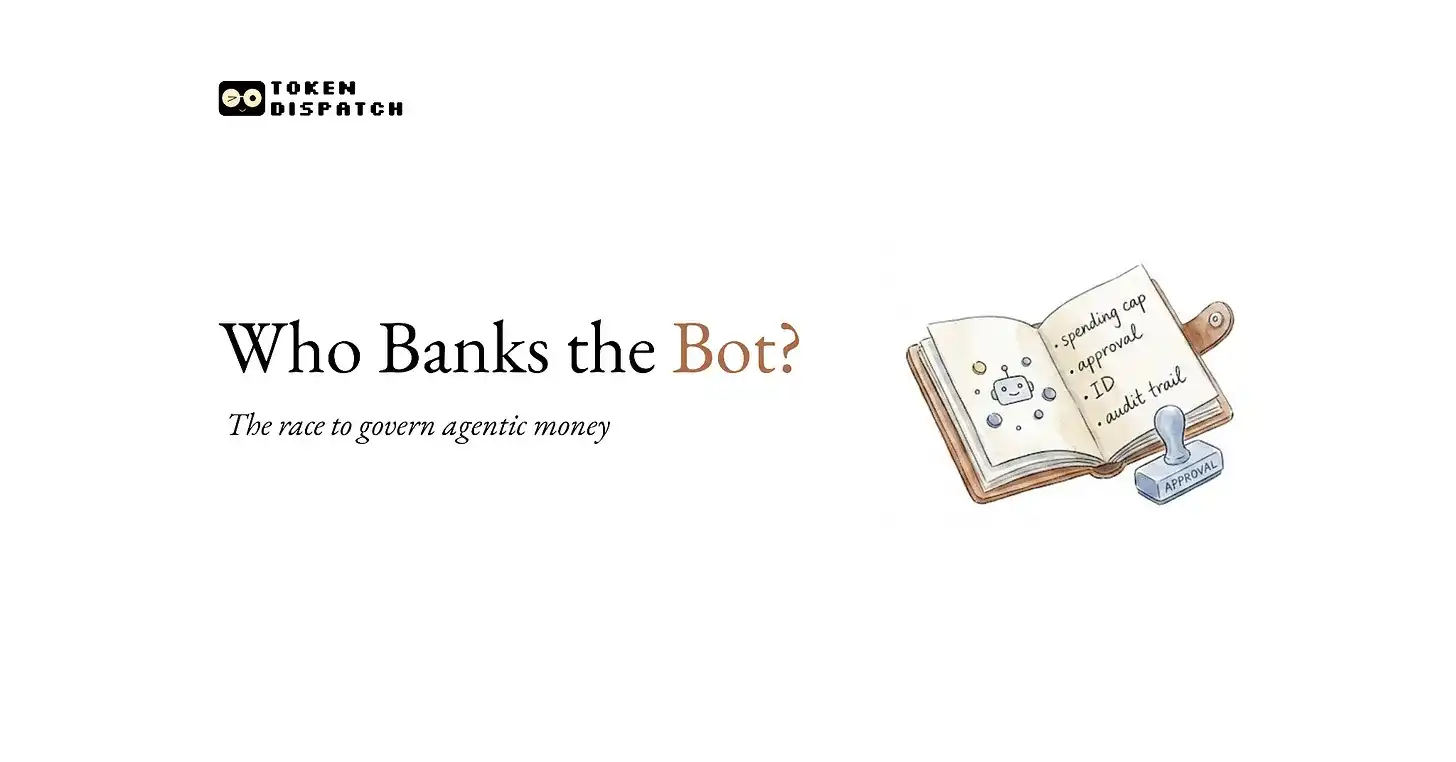
Who Funds the Agents?

**Summary: Who Funds AI Agents?** OpenAI recently shut down a feature allowing AI agents to shop for users, highlighting the challenge of creating a secure and regulated environment for agent-driven transactions. While payment infrastructure exists, a crucial governance layer—defining spending limits, fraud detection, tax handling, and return policies—is largely missing. The potential is enormous: AI agents already processed $73M across 176M transactions last year, with McKinsey forecasting this could grow to $3-5T in global consumer commerce by 2030. The core competition isn't just about processing payments, which can be very cheap (especially with crypto-based settlement), but about controlling the rules that govern agent spending. Key players like Stripe and Coinbase are racing to dominate this governance layer. Stripe's acquisition of wallet provider Privy allows it to set spending policies, identity checks, and human-in-the-loop approvals directly at the wallet level. Similarly, Coinbase's stack, including its x402 protocol and AgentKit, embeds governance rules. This vertical integration across settlement, wallet, and governance layers is becoming the dominant strategy. Control over the governance layer is where significant future value lies. If agents handle trillions in transactions, even a small fee for managing compliance, fraud prevention, and policy enforcement could generate billions in annual revenue. The companies that successfully integrate across the payment stack will capture value from idle agent balances, transaction fees, and governance services, positioning themselves as the foundational banks of the AI agent economy.

marsbitHace 18 min(s)

Who Funds the Agents?

marsbitHace 18 min(s)

A Nation Blocks Chips, a Giant Buys a Nuclear Power Plant: Why It's Time to Seriously Consider DeAI

**Title: Great Powers Blockade Chips, Giants Buy Nuclear Plants: Why It's Time to Seriously Consider DeAI** In May 2026, the US closed loopholes for Chinese firms to acquire advanced NVIDIA chips via overseas subsidiaries. That same month, Kenya halted a $1B geothermal data center project involving Microsoft, fearing its immense energy consumption. Meanwhile, Huawei announced mass production of its Ascend AI chip. These disparate events underscore a new reality: the competition for computing power ("compute") has escalated beyond the tech industry, becoming a geopolitical and infrastructural battleground. A new era of oligopoly is forming, with control over the AI stack—from GPU chips (NVIDIA) and cloud platforms (AWS, Azure, Google Cloud) to foundational models (OpenAI, Anthropic)—concentrating in a few Western "AI Octopus" corporations. This centralization creates systemic risks: pricing power and platform lock-in for users, infrastructure fragility, and a widening "compute divide" that threatens to marginalize nations without independent AI capacity. An "AI Iron Curtain" is deepening through export controls. In response, some nations like Saudi Arabia and the UAE are investing heavily to buy compute power, aiming to transition from oil to AI economies. The EU seeks to triple its compute capacity by 2030 to reduce dependency. However, the spending gap is vast, with four US tech giants alone planning ~$750B in AI capex for 2026. The race is increasingly constrained by energy, with AI tasks consuming up to 1000x more power than web searches, pushing firms to even acquire nuclear plants. This landscape is fueling interest in Decentralized AI (DeAI). It proposes a third way: using open protocols to coordinate a global network of idle GPUs, independent developers, and data centers, creating an AI infrastructure without a single controlling entity. Leveraging blockchain and cryptographic verification, DeAI aims to break market concentration, disperse energy demands, reduce geopolitical dependencies, and enhance transparency. While still nascent in performance and stability, DeAI's core promise is not immediate superiority but providing a crucial alternative architecture to resist monopoly, censorship, and centralized power. As specialized AI hardware costs fall and open-source models flourish, the window to build this foundation is open. The very existence of such competition serves as a vital check against the inevitable abuse of concentrated power.

marsbitHace 1 hora(s)

A Nation Blocks Chips, a Giant Buys a Nuclear Power Plant: Why It's Time to Seriously Consider DeAI

marsbitHace 1 hora(s)

Trading

Spot
Futuros

Artículos destacados

Cómo comprar LAYER

¡Bienvenido a HTX.com! Hemos hecho que comprar Solayer (LAYER) sea simple y conveniente. Sigue nuestra guía paso a paso para iniciar tu viaje de criptos.Paso 1: crea tu cuenta HTXUtiliza tu correo electrónico o número de teléfono para registrarte y obtener una cuenta gratuita en HTX. Experimenta un proceso de registro sin complicaciones y desbloquea todas las funciones.Obtener mi cuentaPaso 2: ve a Comprar cripto y elige tu método de pagoTarjeta de crédito/débito: usa tu Visa o Mastercard para comprar Solayer (LAYER) al instante.Saldo: utiliza fondos del saldo de tu cuenta HTX para tradear sin problemas.Terceros: hemos agregado métodos de pago populares como Google Pay y Apple Pay para mejorar la comodidad.P2P: tradear directamente con otros usuarios en HTX.Over-the-Counter (OTC): ofrecemos servicios personalizados y tipos de cambio competitivos para los traders.Paso 3: guarda tu Solayer (LAYER)Después de comprar tu Solayer (LAYER), guárdalo en tu cuenta HTX. Alternativamente, puedes enviarlo a otro lugar mediante transferencia blockchain o utilizarlo para tradear otras criptomonedas.Paso 4: tradear Solayer (LAYER)Tradear fácilmente con Solayer (LAYER) en HTX's mercado spot. Simplemente accede a tu cuenta, selecciona tu par de trading, ejecuta tus trades y monitorea en tiempo real. Ofrecemos una experiencia fácil de usar tanto para principiantes como para traders experimentados.

272 Vistas totalesPublicado en 2025.02.11Actualizado en 2026.06.02

Cómo comprar LAYER

Discusiones

Bienvenido a la comunidad de HTX. Aquí puedes mantenerte informado sobre los últimos desarrollos de la plataforma y acceder a análisis profesionales del mercado. A continuación se presentan las opiniones de los usuarios sobre el precio de LAYER (LAYER).

活动图片