Hot Track, New Interaction Opportunities: Three Prediction Markets Backed by YZi Labs

Odaily星球日报Publicado a 2025-12-23Actualizado a 2025-12-23

Resumen

Prediction markets are a hot topic in the crypto community, with significant activity on BNB Chain. According to Dune data, three platforms dominate: Opinion leads with 75% market share and $125M in daily volume, followed by PancakeSwap's Probable at 14.5% ($24M), and predict.fun, founded by dingaling, at 10.5% ($17M). All three are backed by YZi Labs. **Opinion**, a Binance Labs MVB alum, raised a $5M seed round. It runs a points program with weekly rewards. A special Christmas/New Year event offers 100k points for activities like daily trading, high volume, and using Binance Wallet. **predict.fun**, founded by NFT influencer dingaling, allows users to earn yield on capital locked in predictions. It airdropped initial points to active BNB Chain users. Its first weekly points event concludes soon, with a second starting immediately after. **Probable**, incubated by PancakeSwap, focuses on a zero-fee, fully on-chain experience using UMA's Oracle for dispute resolution. It supports predictions on various events and allows deposits in any token, auto-swapped to USDT. A points system based on trading volume is imminent and is already tracking user activity.

Original | Odaily Planet Daily (@OdailyChina)

Author | Asher (@Asher_ 0210)
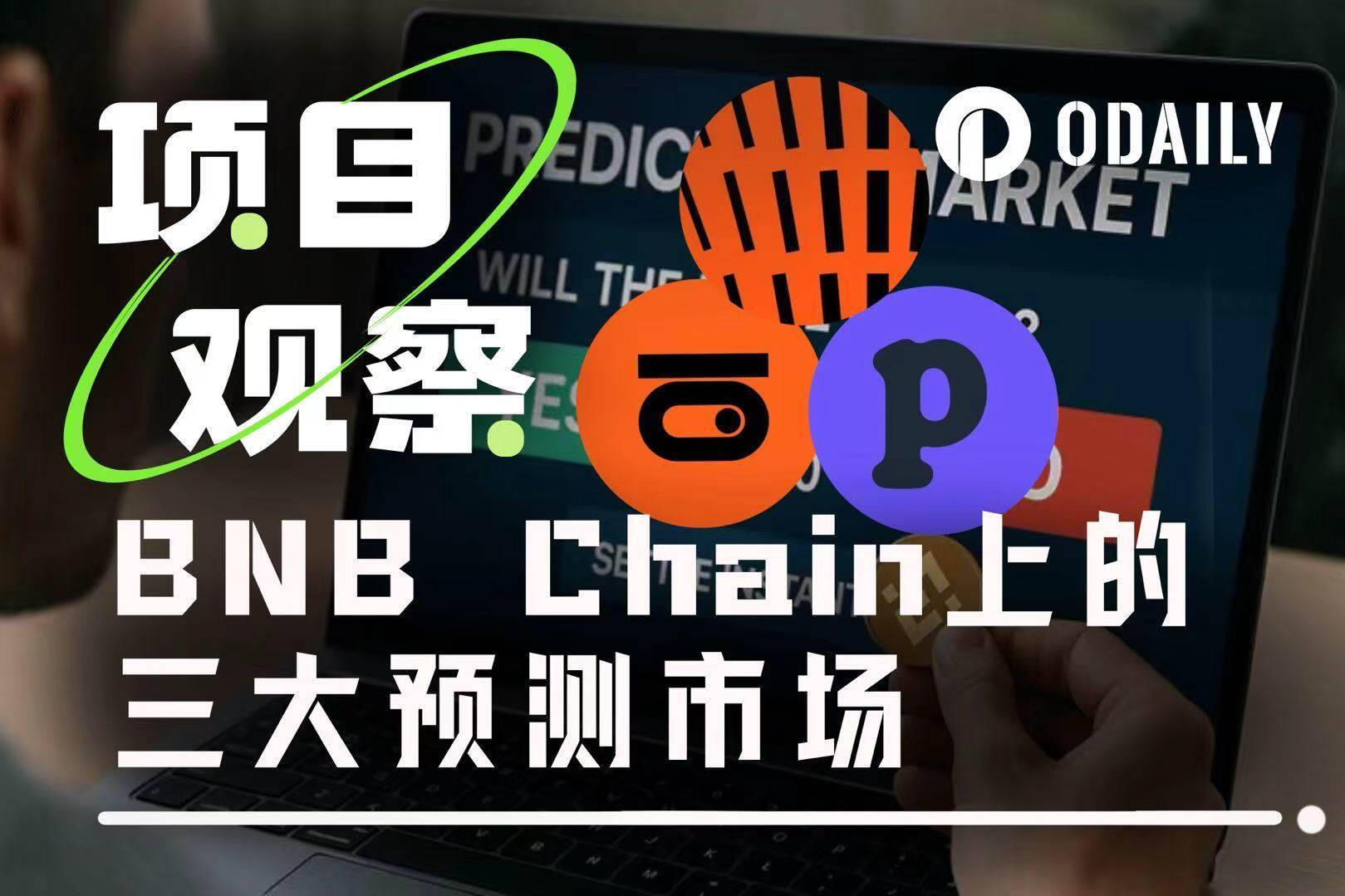
Prediction markets are a topic of extremely high discussion in the community recently. Besides Polymarket and Kalshi, the prediction market within the BNB Chain ecosystem has also been growing and strengthening. According to Dune data, looking at the trading volume of the three major prediction market platforms on BNB Chain from yesterday, Opinion currently leads far ahead of the others with a market share of 75% and a trading volume of $125 million yesterday; followed by Probable, backed by the PancakeSwap team, with a market share of 14.5% and a trading volume of $24 million yesterday; predict.fun, founded by dingaling, ranks third with a market share of 10.5% and a trading volume of $17 million yesterday.
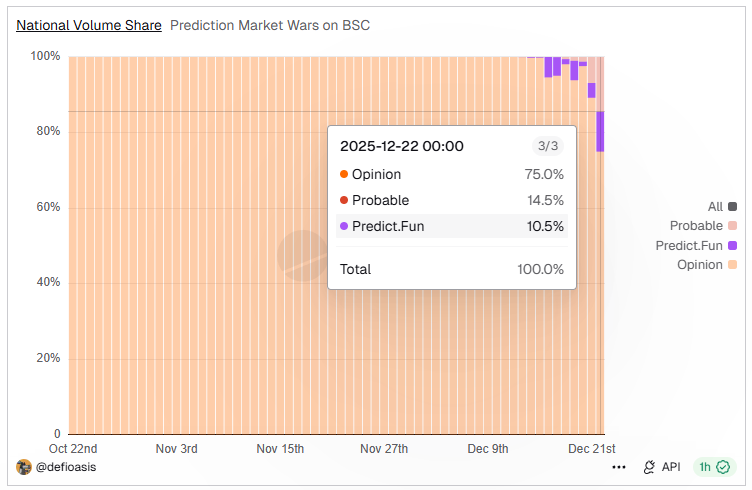
BNB Chain Ecosystem Prediction Market Share (December 22)
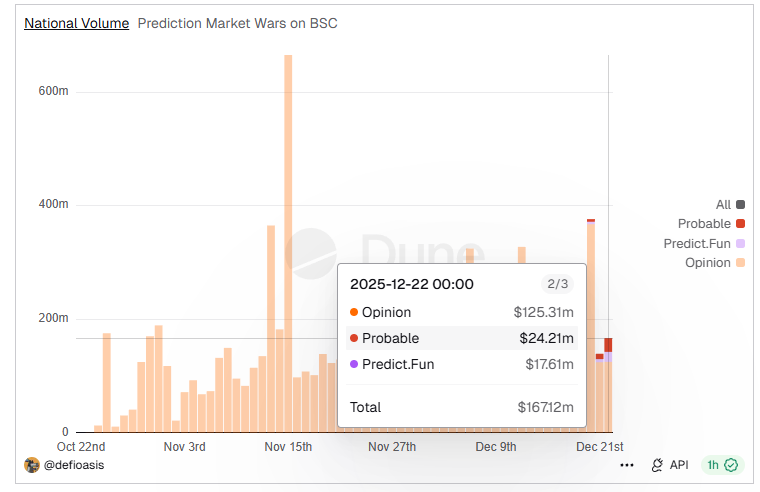
BNB Chain Ecosystem Prediction Market Trading Volume (December 22)

Next, Odaily Planet Daily will take you to understand the three prediction market platforms on BNB Chain that have received investment from YZi Labs: Opinion, predict.fun, and Probable.

Opinion: The Leader in BNB Chain's Prediction Market Ecosystem, Launched Christmas & New Year Points Activity Yesterday
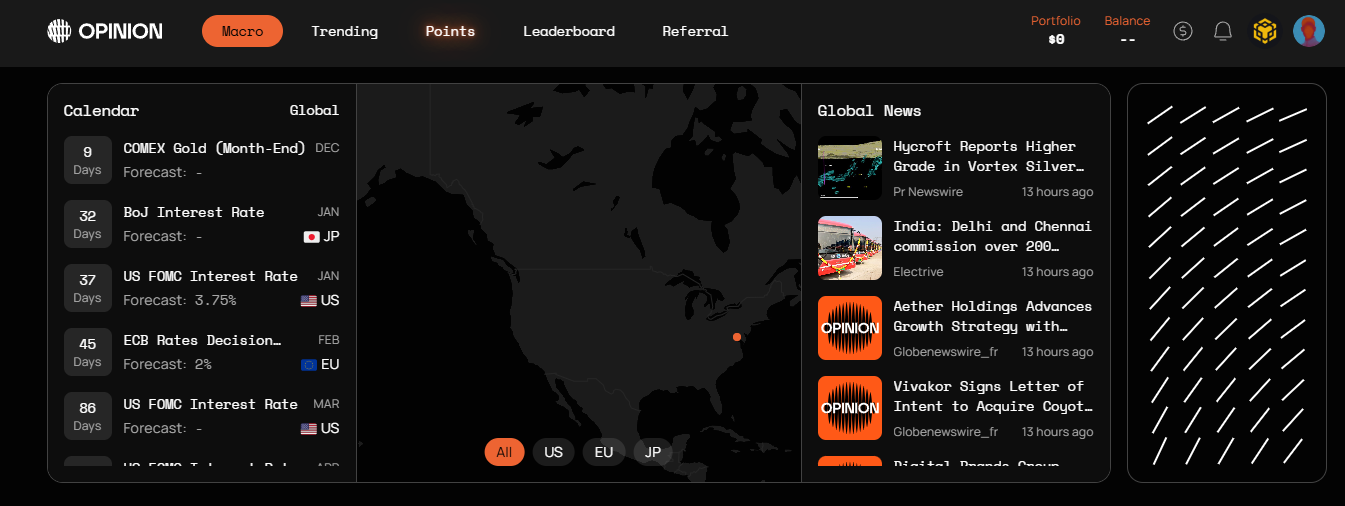
Opinion is the first prediction market platform on the BNB Chain ecosystem. According to ROOTDATA data, Opinion announced the completion of a $5 million seed round financing on March 18 this year. This round was led by YZi Labs, with participation from echo, Animoca Ventures, Manifold, Amber Group, and others. Additionally, Opinion was one of the 4 best-performing projects in the previous Binance Labs MVB program.

Points Rules

Opinion points are allocated on a weekly basis, with a total of 100,000 points rewarded per week. The rules are as follows:

1. Trading volume requirement: ≥ $200 per week (and a single order ≥ $10) to be counted for points.

2. Holding time: The larger the position and the longer the holding time → the higher the points.

3. Liquidity orders (limit orders): Limit order amount ≥ $10 to count for points; the longer the order is placed and the closer the price is to the best bid/ask → the more points; limit orders have 0 fees and add points weight, making them the most stable way to earn points (market orders charge about 2% fees).

4. Trading volume and fees: The higher the transaction volume and the more fees contributed, the more points earned.

Christmas & New Year Points Activity

Yesterday (December 22), Opinion announced on platform X the launch of the Christmas & New Year points activity. Specific details are as follows:

  • Activity reward: A total of 100,000 points;
  • Activity period: From December 22 to January 5, 2026, lasting two weeks;
  • Ways to earn points: Daily Warriors, 20,000 points total (trade > 3 times daily, and meet the requirement for > 10 days); Volume Kings: 20,000 points total (daily trading volume > $2,000, and meet the requirement for > 10 days); Binance Wallet Elite: 10,000 points total (accumulated trading volume during the activity > $2,000); Diamond Hands: 20,000 points total; Mystery Finale: 30,000 points total.

Additionally, some notes on the ways to earn points:

  • Diamond Hands reward: Allocated based on the time-weighted open positions of all users during the activity period, data comes from regular platform snapshots;
  • Daily Warriors and Volume Kings rewards: Wallets that meet the corresponding daily trading threshold for at least 10 days during the activity period will share the respective rewards;
  • Binance Wallet Elite reward: Users who complete a cumulative trading volume > $2,000 during the activity period via Binance Wallet will share the reward. This reward requires using a keyless address or a newly imported wallet; old wallets already registered with OPINION are not eligible.

predict.fun: Founder is NFT field renowned figure dingaling, First Week Points Activity Ends Tonight at 10 PM
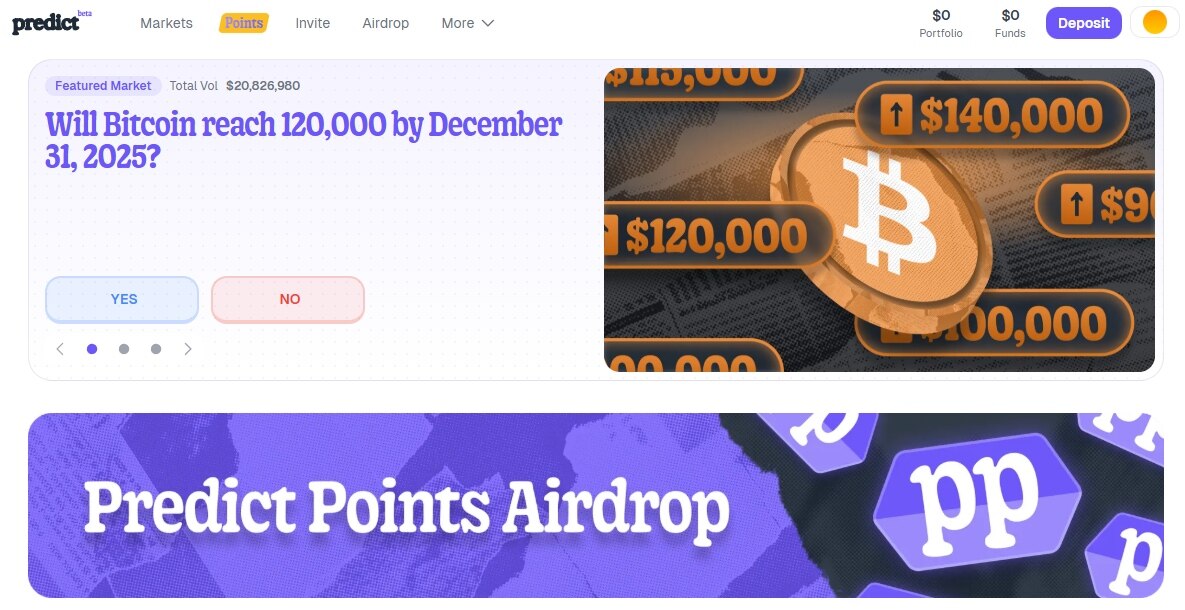
predict.fun is a prediction market platform launched on BNB Chain, founded by the previously well-known figure in the NFT field, dingaling. Unlike traditional prediction markets like Polymarket and Kalshi, predict.fun has implemented a key innovation: funds used by users to participate in predictions are no longer idle but can simultaneously generate additional returns during the prediction period.

On December 17, predict.fun's founder dingaling announced on platform X that the platform is officially open and has airdropped initial points to Meme traders on BNB Chain, Aster participants, and active users of various prediction markets. (For more interaction tutorials, read: Step-by-Step Guide to Participating in CZ-Supported predict.fun)

Today, predict.fun officially announced on platform X that the first week points activity will end at 10 PM Beijing time tonight. Prediction points rewards and other additional airdrop rewards will be credited to users' personal accounts in 3 days, and the leaderboard will also be updated. Additionally, the second week points activity will start immediately after the first week activity ends.

Probable: Prediction Market Incubated by PancakeSwap, Points System Coming Soon
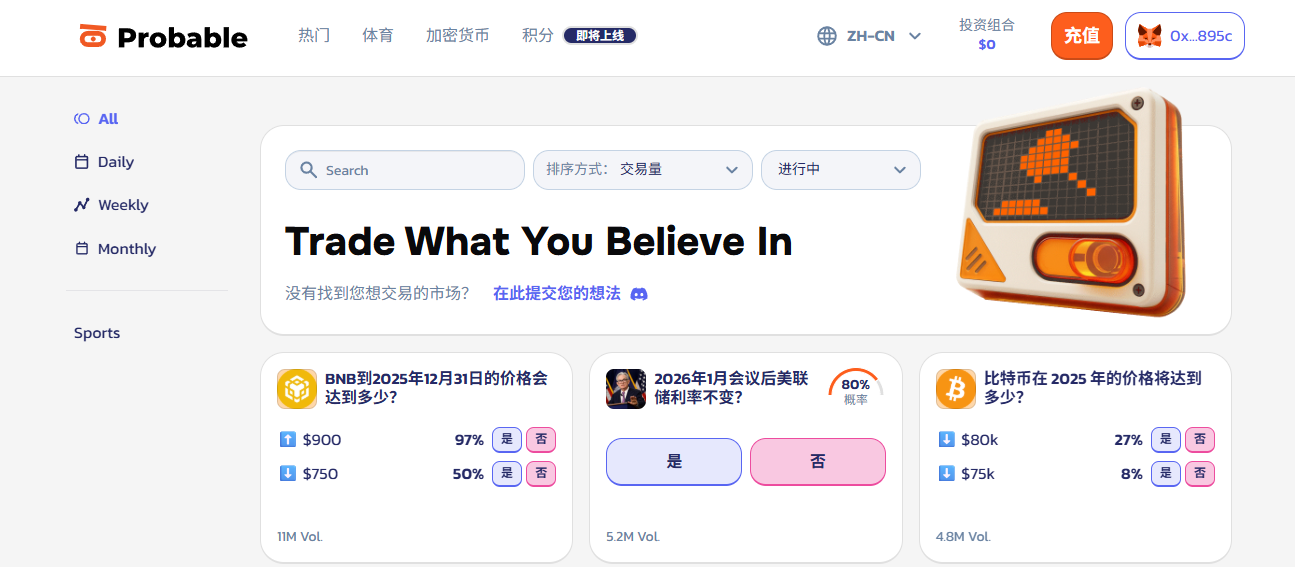
On December 16, PancakeSwap announced the launch of Probable, a fully on-chain prediction market platform incubated by them (platform language supports switching to Simplified Chinese). This project is jointly supported by PancakeSwap and YZi Labs and will be exclusively deployed on BNB Chain. PancakeSwap stated that Probable is an independent project, and its team will advance product development and ecosystem expansion with the support of PancakeSwap and YZi Labs.

According to the introduction, Probable is positioned as a user-centric on-chain prediction platform, featuring zero fees, fully on-chain settlement, and a simplified user experience. Initially, the platform will not charge prediction fees. Relying on BNB Chain's low-cost and high-performance infrastructure, it supports users to predict cryptocurrency trends, global events, sports events, and some regional characteristic markets.

At the mechanism level, Probable uses UMA's Optimistic Oracle as an event adjudication tool, achieving result confirmation through a dispute-based verification method to enhance the transparency and censorship resistance of the prediction market. Additionally, users can top up with any token, and the system will automatically exchange it for USDT on BNB Chain for participation in predictions, lowering the operational barrier.

Currently, Probable's points system has not yet been launched. According to official information, a new points system is coming soon. Points will be calculated based on users' trading volume, and the backend has already started counting and accumulating users' current trading volume.


Preguntas relacionadas

QWhich three prediction market platforms on BNB Chain are highlighted in the article as being backed by YZi Labs?

AThe three prediction market platforms on BNB Chain backed by YZi Labs are Opinion, predict.fun, and Probable.

QAccording to the Dune data from December 22nd, which BNB Chain prediction market had the highest trading volume and what was its market share?

AAccording to the Dune data from December 22nd, Opinion had the highest trading volume of $125 million, capturing a 75% market share.

QWhat is a key innovative feature of predict.fun that differentiates it from traditional prediction markets like Polymarket?

AA key innovative feature of predict.fun is that the funds users use to participate in predictions are not idle; they can simultaneously generate additional yield during the prediction period.

QWhat is the total amount of the seed round funding that Opinion completed, and who was the lead investor?

AOpinion completed a $5 million seed round funding, which was led by YZi Labs.

QWhat are two main technical features that Probable, incubated by PancakeSwap, promotes for its users?

AProbable promotes two main features: zero trading fees and a fully on-chain settlement process.

Lecturas Relacionadas

WeChat Agent Issues a 'Heroic Summons,' Half of the Internet Responds

WeChat AI Agent is on the horizon. The WeChat Open Platform has issued a guide for developers, offering them ways to integrate into the WeChat AI ecosystem. This will enable mini-programs to be discovered and invoked by the AI. Meituan has already announced its integration, allowing users to access services like food delivery through WeChat AI. Other platforms like Ctrip and Tongcheng have followed suit. Furthermore, WeChat is collaborating with major smartphone manufacturers to enable their native AI assistants to perform actions within WeChat, such as initiating calls or sending messages, through a controlled protocol called Agent-to-Agent (A2A). Reports indicate the WeChat AI Agent will be accessible by swiping right on the main interface. It aims to understand user intent within the rich context of chats, groups, and past interactions, then automatically call upon relevant mini-programs to complete tasks like ordering coffee or booking restaurants. This positions it as a potential "super app" with direct access to WeChat's vast ecosystem of services, social connections, and payment systems. Technically, this is a complex endeavor. It requires advanced natural language understanding, a "world model" to predict interactions within mini-programs (UI-Oceanus), multi-model orchestration for cost efficiency, and careful coordination with millions of third-party service providers. Tencent's development follows a "Co-Design" approach, where product teams and the Hunyuan model team collaborate closely, allowing capabilities honed in other AI products (like Yuanbao for chat, ima for search, WorkBuddy for office tasks) to be transferred to the WeChat Agent. Tencent is strategically opting for the A2A protocol over GUI-based automation (which it has blocked in the past), maintaining control over its ecosystem. To manage the immense scale and cost of serving 1.4 billion monthly active users, Tencent is deepening its ties with DeepSeek, known for its cost-effective training, to secure a low-cost inference backbone. The ultimate goal is to solve practical, everyday problems for users within the WeChat ecosystem, moving beyond technical benchmarks to deliver real utility, which Tencent sees as the key to winning in the long-term AI game.

marsbitHace 3 min(s)

WeChat Agent Issues a 'Heroic Summons,' Half of the Internet Responds

marsbitHace 3 min(s)

Humanity Loses $31 Million in Attack, Token Price Plummets 90% Due to a Single Private Key

On June 9th, the digital identity project Humanity Protocol suffered a major security breach resulting in over $31 million in losses. According to on-chain analyst Specter, hundreds of wallets holding the project's H token were drained. The attack was confirmed by founder Terence Kwok to be caused by the compromise of a foundation member's private key. As a precaution, users are advised to avoid interacting with Humanity's cross-chain bridge or liquidity pools. The incident caused the H token price to crash over 90%, from around $0.70 to a low of $0.052, wiping its market cap from $2 billion to approximately $35.7 million. The attacker allegedly minted 100 million new H tokens and is selling them for BNB. This breach adds to existing controversies surrounding Humanity Protocol. Founded in 2024, it aimed to verify human users via palm-print biometrics and zero-knowledge proofs. However, a leaked conversation in 2025 revealed that only about 1 million of its 9 million claimed Human IDs had completed biometric verification, suggesting 88% might be bots. Furthermore, the project has faced allegations of being a repackaged product from a Chinese access control vendor, raising privacy and authenticity concerns. Founder Terence Kwok's previous venture, Tink Labs, a hotel smartphone startup that raised $170 million, failed and entered bankruptcy in 2020 after burning through its funding. The current attack highlights the persistent critical issue of private key management in crypto. Unlike smart contract exploits, a private key compromise bypasses all on-chain security mechanisms. With no user compensation plan announced yet, this $31 million breach may be a final blow to the project's credibility, already weakened by previous controversies and a heavily depreciated token.

marsbitHace 38 min(s)

Humanity Loses $31 Million in Attack, Token Price Plummets 90% Due to a Single Private Key

marsbitHace 38 min(s)

MicroStrategy Will Not Die in This Downturn: Reflexivity, STRC Anchoring Back to Par, and the Self-Rescue Logic of "Sell Stock, Not Bitcoin"

This article analyzes the recent sharp decline in Bitcoin and MicroStrategy (MSTR), framing it as a targeted "reflexivity" attack. The trigger was MSTR using its cash reserves to buy back convertible notes, raising market concerns about a liquidity crisis. The playbook follows George Soros's principle: market expectations can shape reality. Fears that MSTR might be forced to sell BTC caused panic selling, lowering BTC's price and worsening MSTR's financial ratios, thus reinforcing the negative narrative. The author argues that MSTR's Structured Convertible (STRC), while falling in price, is a floating-rate security that will eventually return to par value (100). The price drop reflects the market demanding a higher yield due to perceived risk, but as a floating-rate instrument, its coupon can adjust, naturally pulling the price back to par over time. This is crucial for MSTR's continued ability to raise funds. The core thesis is that MSTR's best move to counter the attack is to **issue new equity (sell shares)**, not sell its Bitcoin holdings. While selling BTC would solve the immediate cash crunch, it would destroy the company's core investment thesis and premium. It would dilute the BTC per share, likely erase the market premium over its net asset value (mNAV > 1), and worsen its debt-to-asset ratio. Issuing shares while mNAV is high (e.g., 1.25x) allows MSTR to raise cash for reserves without harming shareholder value or the "perpetual accumulation" narrative. It improves the debt ratio and reassures STRC holders, breaking the negative reflexivity cycle. In conclusion, while MSTR could survive this episode even by selling BTC, doing so would fundamentally alter its investment proposition and weaken it for future cycles. The optimal, value-preserving strategy is to sell equity to rebuild reserves and maintain the long-term growth flywheel.

marsbitHace 39 min(s)

MicroStrategy Will Not Die in This Downturn: Reflexivity, STRC Anchoring Back to Par, and the Self-Rescue Logic of "Sell Stock, Not Bitcoin"

marsbitHace 39 min(s)

Humanity Loses $31 Million, a Private Key Causes Token Price to Plunge 90%

On June 9th, the digital identity project Humanity Protocol suffered a major security breach resulting in over $31 million stolen from hundreds of wallets holding its H token. The attack was caused by the compromise of a private key belonging to a foundation member, leading the team to advise users against interacting with its bridge or liquidity pools. Following the incident, the price of the H token plummeted by over 90%, from around $0.70 to a low of $0.052, wiping out a significant portion of its market capitalization. The attacker allegedly minted 100 million new H tokens and began selling them for BNB. Humanity Protocol, founded in 2024, aimed to verify human users through palm-print biometrics and zero-knowledge proofs on Polygon CDK. Despite raising $50 million across two funding rounds and achieving a unicorn valuation, the project faced prior controversies. Shortly after its June 2025 token launch, reports emerged that only about 1 million of its 9 million registered IDs had completed biometric verification, suggesting 88% might be bots. Furthermore, allegations surfaced that the project might be a rebranded "shell" of a Chinese access control company, raising concerns about data privacy and authenticity. The project's founder, Terence Kwok, has a controversial business history. His previous venture, Tink Labs, burned through $170 million in funding before collapsing in 2020. The breach highlights the persistent critical risk of private key management in crypto. With no user compensation plan detailed in the initial response, the incident deals a severe blow to trust in a project already struggling with credibility issues.

Foresight NewsHace 1 hora(s)

Humanity Loses $31 Million, a Private Key Causes Token Price to Plunge 90%

Foresight NewsHace 1 hora(s)

Trading

Spot
Futuros

Artículos destacados

Cómo comprar HOT

¡Bienvenido a HTX.com! Hemos hecho que comprar Holo (HOT) sea simple y conveniente. Sigue nuestra guía paso a paso para iniciar tu viaje de criptos.Paso 1: crea tu cuenta HTXUtiliza tu correo electrónico o número de teléfono para registrarte y obtener una cuenta gratuita en HTX. Experimenta un proceso de registro sin complicaciones y desbloquea todas las funciones.Obtener mi cuentaPaso 2: ve a Comprar cripto y elige tu método de pagoTarjeta de crédito/débito: usa tu Visa o Mastercard para comprar Holo (HOT) al instante.Saldo: utiliza fondos del saldo de tu cuenta HTX para tradear sin problemas.Terceros: hemos agregado métodos de pago populares como Google Pay y Apple Pay para mejorar la comodidad.P2P: tradear directamente con otros usuarios en HTX.Over-the-Counter (OTC): ofrecemos servicios personalizados y tipos de cambio competitivos para los traders.Paso 3: guarda tu Holo (HOT)Después de comprar tu Holo (HOT), guárdalo en tu cuenta HTX. Alternativamente, puedes enviarlo a otro lugar mediante transferencia blockchain o utilizarlo para tradear otras criptomonedas.Paso 4: tradear Holo (HOT)Tradear fácilmente con Holo (HOT) en HTX's mercado spot. Simplemente accede a tu cuenta, selecciona tu par de trading, ejecuta tus trades y monitorea en tiempo real. Ofrecemos una experiencia fácil de usar tanto para principiantes como para traders experimentados.

93 Vistas totalesPublicado en 2024.12.11Actualizado en 2026.06.02

Cómo comprar HOT

Qué es HOLO

Entendiendo HOLO: El Futuro de las Aplicaciones Descentralizadas Introducción a HOLO, $holo En el paisaje en rápida evolución de las criptomonedas y las tecnologías descentralizadas, HOLO, también conocido como Holo, ha emergido como un jugador notable. Este proyecto innovador facilita el desarrollo de aplicaciones descentralizadas (DApps) a través de su arquitectura subyacente conocida como Holochain. Con la visión de crear un puente entre el internet centralizado que conocemos hoy y el ecosistema descentralizado del futuro, HOLO tiene como objetivo hacer que las DApps sean accesibles para el usuario cotidiano sin los obstáculos de instalaciones complejas y habilidades técnicas. ¿Qué es HOLO, $holo? En su núcleo, HOLO es una plataforma distribuida diseñada para alojar DApps construidas sobre Holochain. A diferencia de las plataformas de blockchain tradicionales, Holochain adopta un enfoque único al permitir que cada aplicación funcione bajo su propio conjunto de reglas. El mandato de HOLO es conectar estas aplicaciones Holochain (hApps) con los usuarios a través de tecnologías web familiares. El objetivo principal de HOLO es democratizar el acceso y uso de las DApps al permitir que los usuarios accedan a estas aplicaciones directamente a través de navegadores web estándar. Esta accesibilidad es clave para reducir la fricción para los usuarios promedio de internet, permitiéndoles utilizar aplicaciones de próxima generación sin necesidad de navegar por las complejidades a menudo asociadas con las criptomonedas y el uso de DApps. Creador de HOLO, $holo HOLO surge de la visión de sus creadores, Arthur Brock y Eric Harris-Braun. Ambos son desarrolladores experimentados y codificadores de contratos, y comenzaron el proyecto en diciembre de 2016 como parte del Proyecto MetaCurrency. Esta iniciativa se centró inicialmente en desarrollar herramientas y tecnologías destinadas a fomentar una economía de igual a igual. Sus antecedentes en codificación y emprendimientos los posicionaron de manera única para abordar los desafíos del desarrollo y alojamiento de aplicaciones descentralizadas. Inversores de HOLO, $holo Si bien los detalles específicos sobre inversores individuales en HOLO no están fácilmente disponibles, es evidente que el proyecto ha recibido un respaldo y atención significativos de la comunidad de criptomonedas en general. Su enfoque innovador para alojar aplicaciones descentralizadas, junto con una comunidad de apoyo, ha alimentado el interés y la inversión en el proyecto. ¿Cómo funciona HOLO, $holo? HOLO opera creando un extenso ecosistema en el que los anfitriones contribuyen con almacenamiento y poder de procesamiento para las DApps basadas en Holochain. Al convertir sus dispositivos o incluso hardware dedicado como HoloPorts en nodos de alojamiento, los individuos pueden monetizar efectivamente los recursos no utilizados de sus computadoras. Los componentes funcionales clave de HOLO incluyen: Proveedor de Aplicaciones: Estas entidades compran créditos de alojamiento de HOLO, que se mantienen en una cuenta de reserva. Este mecanismo permite a los desarrolladores de DApp asegurar los recursos necesarios para ejecutar sus aplicaciones. Anfitrión: Individuos u organizaciones que eligen alojar DApps generan registros de servicio firmados a medida que responden a las solicitudes de los usuarios. Este proceso asegura que todas las interacciones en la red sean rastreadas y autenticadas. Prueba de Servicio: Un elemento crucial de la integridad operativa de HOLO, los anfitriones envían facturas a los proveedores de aplicaciones, que luego validan el servicio proporcionado. Tras la validación, los anfitriones reciben compensación en forma de créditos de alojamiento. HoloFuel: Sirviendo como el token nativo de la red Holo, HoloFuel está diseñado para microtransacciones. Este token facilita el extenso rendimiento de transacciones necesario para que la plataforma soporte miles de millones de transacciones simultáneas sin problemas. La sinergia combinada de estos componentes asegura un entorno de alojamiento robusto y descentralizado, impulsando la utilidad y el alcance de las aplicaciones Holochain. Cronología de HOLO, $holo El viaje de HOLO ha estado marcado por varios hitos desde su inicio: Diciembre de 2016: La creación de HOLO por Arthur Brock y Eric Harris-Braun como parte del Proyecto MetaCurrency. 2018: La emisión de un token ERC20, conocido como HoloToken (HOT), que sirvió como un “IOU” que es canjeable por HoloFuel al lanzamiento del proyecto. Desarrollo Continuo: Avances continuos, pruebas y optimización de la red Holo y HoloFuel, asegurando que el proyecto permanezca a la vanguardia de la tecnología de alojamiento de aplicaciones descentralizadas. Características Únicas de HOLO, $holo HOLO se destaca en el abarrotado campo de las criptomonedas y plataformas descentralizadas debido a sus características distintivas y el marco innovador en el que opera: Alojamiento de Igual a Igual: HOLO abre la puerta para que cualquiera se convierta en anfitrión de DApps simplemente utilizando sus computadoras. Esta democratización del alojamiento es similar a cómo plataformas como Airbnb interrumpieron la industria hotelera tradicional al empoderar a los individuos para participar en la economía. Marco Holochain: Central a las innovaciones de HOLO está el marco Holochain en sí. Posicionado como una tecnología de próxima generación, Holochain cuenta con escalabilidad sin igual, velocidades de transacción rápidas, eficiencia energética excepcional y rentabilidad en comparación con las tecnologías de blockchain convencionales. HoloFuel para Microtransacciones: HoloFuel está meticulosamente diseñado para acomodar microtransacciones, permitiendo que la red Holo gestione de manera eficiente miles de millones de transacciones simultáneamente. Esta capacidad es fundamental para la adopción generalizada, permitiendo a los desarrolladores crear aplicaciones que sean económicamente viables a gran escala. Conclusión HOLO representa un avance significativo en el panorama de las aplicaciones descentralizadas y la tecnología blockchain. Con su infraestructura robusta, enfoque amigable para el usuario y el innovador marco Holochain, HOLO está preparado para desempeñar un papel crucial en el futuro de la web. Si mejorará las experiencias cotidianas de internet o redefinirá cómo los desarrolladores y usuarios interactúan con las aplicaciones digitales sigue siendo una incógnita, pero su progreso hasta ahora vale la pena seguirlo a medida que el mundo continúa avanzando hacia una economía digital descentralizada. A medida que el proyecto evoluciona, sus desarrollos continuos y el compromiso de la comunidad serán componentes cruciales de su éxito, estableciendo potencialmente a HOLO como una plataforma principal para aplicaciones descentralizadas. Con el creciente interés en torno a las tecnologías descentralizadas, la importancia e impacto de proyectos como HOLO solo aumentarán en los años venideros.

93 Vistas totalesPublicado en 2024.12.26Actualizado en 2024.12.26

Qué es HOLO

Discusiones

Bienvenido a la comunidad de HTX. Aquí puedes mantenerte informado sobre los últimos desarrollos de la plataforma y acceder a análisis profesionales del mercado. A continuación se presentan las opiniones de los usuarios sobre el precio de HOT (HOT).

活动图片