Hoskinson Says Failed Wyoming Clinic Refocused Him On Cardano And Midnight

bitcoinistPublicado a 2026-05-28Actualizado a 2026-05-28

Resumen

Charles Hoskinson, founder of Cardano, announced the closure of a family-backed medical clinic in Gillette, Wyoming, citing unsustainable financial losses. The clinic, which served approximately 22,000 patients, was losing about $1.7 million per month due to structural issues in the U.S. healthcare system and insufficient local support. Hoskinson framed the shutdown as a strategic refocusing of his time and resources. He stated that his primary daily priorities are now driving adoption for Cardano's privacy-focused sidechain, Midnight, and returning Cardano to the top tier of cryptocurrencies. He emphasized that these are areas where he has direct expertise and agency, unlike the healthcare venture which he described as a costly diversion.

Charles Hoskinson said the closure of his family-backed Wyoming medical clinic has reinforced where his attention now belongs: Cardano, Midnight and the crypto ventures where he believes he has the most direct agency.

In a May 27 livestream, the Cardano founder gave an detailed account of why the Gillette, Wyoming clinic is being shut down, framing the decision as the result of structural losses, weak local support, difficult healthcare economics and a business model he said could not survive without subsidy or a private-equity-style operating approach.

Hoskinson said the project began in 2021 as a family effort involving his father and brother, both physicians, and was intended to build a “center of excellence” in an underserved rural market. The clinic eventually served about 22,000 patients, which he said amounted to roughly two-thirds of the town. But the economics moved in the wrong direction.

According to Hoskinson, the facility initially lost about $4 million per month before cost reductions brought losses down to roughly $1.7 million per month. He said even that reduced burn rate remained untenable, especially because reimbursements for primary care and mental health often failed to cover the clinic’s cost per appointment.

Related Reading: Hoskinson Reaffirms Cardano Focus After IO Treasury Proposals Pass

“The American health care system is broken,” Hoskinson said. “This was never a business. It was basically a charity.” He added that the clinic had become “an indispensable component of the public health of that county,” but said local and state stakeholders were unwilling to provide the kind of support needed to keep it operating.

Why This Matters For Cardano And Midnight

The most relevant part for crypto markets and Cardano observers came when Hoskinson connected the clinic’s failure to his own allocation of time. He said his strongest focus is no longer on running fee-for-service clinical operations, but on areas where he has expertise and influence.

“Every day I wake up, I say, ‘How do I get Midnight adopted? And how do I get Cardano back into the top 10, back into the top five?’” Hoskinson said. “These are the things that I’m primarily interested in. And these are the things that I have core expertise in and agency over changing.”

That line gives the livestream a different significance from a local business postmortem. Hoskinson has often operated across a wide portfolio of ventures, including blockchain, ranching, healthcare, regenerative medicine and policy interests. In this video, he described the clinic as a costly diversion that ultimately could not be reconciled with his main professional priorities.

He did not present the closure as a bankruptcy or liquidity problem. Hoskinson said he has “well more than enough money” to settle bills and close accounts, and that the facility will remain vacant for a time while conversations continue with other healthcare systems that may be able to use the building.

The explanation also included a broader critique of US healthcare incentives. Hoskinson argued that clinics in primary care are structurally disadvantaged by insurance reimbursements, Medicare and Medicaid rates, hospital billing advantages and a system that rewards procedures, cancer treatment and pharmaceuticals far more than routine care. He said the clinic faced a choice between dramatically increasing patient volume, relying more heavily on mid-level providers and reducing specialist capacity, or shutting down.

“We could have built it as a steel warehouse with crude fixtures. It would still lose money,” he said. “That’s just the reality of the matter. It had nothing to do with the capex. It had to do with the opex.”

For Cardano, the livestream is notable less for any specific roadmap update than for the signal it sends about Hoskinson’s bandwidth. He described Midnight adoption and Cardano’s return to the upper tier of crypto market rankings as daily priorities, while making clear that running a rural clinic is not a venture he expects to revisit soon.

At press time, ADA traded at $0.23.
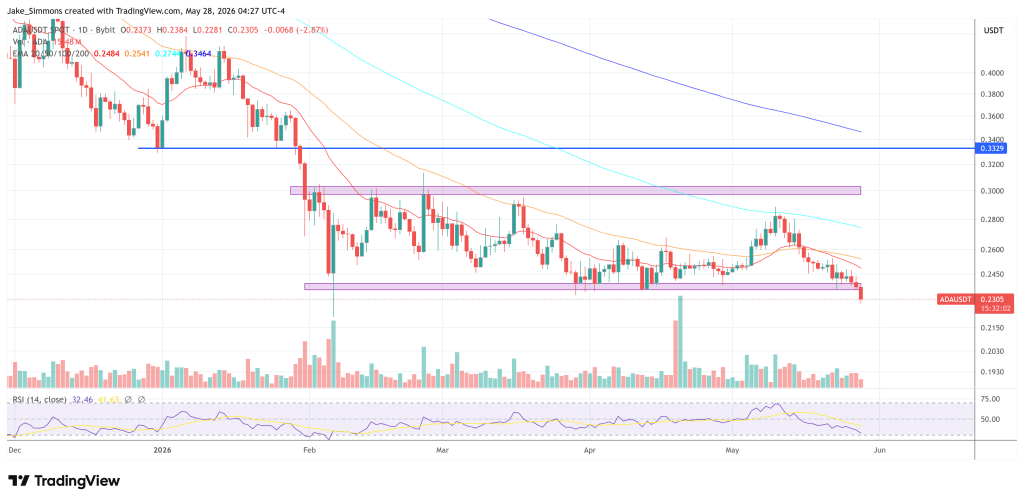
ADA drops below key support, 1-day chart | Source: ADAUSDT on TradingView.com

Preguntas relacionadas

QWhat is the primary reason Charles Hoskinson cited for closing the Wyoming medical clinic?

AHoskinson cited structural financial losses, weak local support, difficult healthcare economics, and an unsustainable business model that relied on subsidies or a private-equity-style approach.

QAccording to Hoskinson, what are his main daily professional priorities now?

AHis main daily priorities are focusing on getting Midnight adopted and getting Cardano back into the top 10, and ultimately the top 5, of the crypto market rankings.

QHow did Hoskinson characterize the clinic's role and its financial nature?

AHe characterized the clinic as an indispensable component of public health for the county, but stated it was never a true business and was essentially operating as a charity due to its financial losses.

QWhat broader issue in the US healthcare system did Hoskinson criticize in relation to the clinic's failure?

AHe criticized a system that structurally disadvantages primary care clinics through low insurance reimbursements, Medicare/Medicaid rates, and hospital billing advantages, while disproportionately rewarding procedures, cancer treatment, and pharmaceuticals over routine care.

QWhat does the clinic's closure signal for Hoskinson's involvement with Cardano?

AIt signals a refocusing of his time and bandwidth away from non-core ventures like healthcare and towards his crypto expertise, specifically on driving adoption for Midnight and improving Cardano's market position.

Lecturas Relacionadas

Bloomberg Uncovered: How Do China's Wealthy Circumvent the Annual $50,000 Limit to Transfer Assets?

**Summary: How Wealthy Chinese Circumvent $50,000 Annual Foreign Exchange Limits** Despite China's strict capital controls, including an annual $50,000 per person foreign exchange quota, an estimated $150 billion in funds still leaves the country annually via various gray and underground channels. This report outlines the evolution of China's "capital wall" and the methods used to bypass it. **The Evolving Capital Controls:** * **Foundation (1994):** The system of "current account convertibility with strict capital account controls" was established. * **Quota Set (2007):** The $50,000 individual annual forex purchase limit was formalized. * **Crackdown Begins (2015-2017):** Following market volatility, enforcement tightened. Banks were required to scrutinize transactions, and channels like using UnionPay cards for Hong Kong insurance premiums or buying overseas property were blocked. * **Digital & Legal Upgrades (2024-2026):** Enhanced algorithms now flag suspicious patterns (e.g., "smurfing"). The Common Reporting Standard (CRS) provides Chinese tax authorities with data on citizens' offshore accounts. Unlicensed cross-border brokers have been targeted. **Five Primary Methods for Moving Capital:** 1. **Underground Banking / "Hawala" (Duiqiao):** The largest-scale method. No money crosses borders. Clients pay RMB to a domestic account; an overseas associate deposits equivalent foreign currency into the client's offshore account. Risks include high fees, account freezes, and legal penalties. 2. **"Smurfing" or "Ant Moving":** Using multiple individuals' $50,000 quotas to pool funds for one offshore recipient. Increasingly detected by anti-money laundering algorithms. 3. **Trade Invoice Manipulation:** Businesses over-invoice imports or under-invoice exports via offshore shell companies, creating a pretext to transfer excess funds abroad under the guise of trade. 4. **Channel Migration:** After a crackdown on internet brokers, funds flow toward more compliant but costly channels like major banks' cross-border wealth management services or Qualified Domestic Institutional Investor (QDII) quotas. 5. **Structural Arrangements:** High-net-worth individuals use complex, high-cost legal structures involving offshore trusts, insurance, and investment migration programs to transfer asset ownership. **Regulatory Response: Focusing on People, Not Just Money** The current strategy extends oversight from enterprises to **individual residents**. Tools like CRS allow retroactive visibility into offshore assets. Cryptocurrencies, once seen as a potential loophole, are now actively monitored and prosecuted as an illegal channel. The underlying driver remains: with significant wealth concentrated among millions of affluent households seeking diversification amid domestic economic shifts, the incentive to move assets offshore persists despite regulatory barriers.

marsbitHace 20 min(s)

Bloomberg Uncovered: How Do China's Wealthy Circumvent the Annual $50,000 Limit to Transfer Assets?

marsbitHace 20 min(s)

Ethereum's Ballmer Moment: As Everyone Is Bearish, the Circulating Supply Is Disappearing

"Ethereum's Ballmer Moment: Circulation Shrinks Amid Bearish Sentiment" Amid widespread bearish sentiment, with prominent figures like Bankless founder David Hoffman selling ETH and young developers flocking to Solana, some argue Ethereum is entering its "Ballmer era"—akin to Microsoft's perceived stagnation under Steve Ballmer. While surface-level criticisms about slow protocol development, cautious leadership, and competitive pressure are valid, underlying fundamentals tell a different story. Approximately 30% of ETH is staked, major holders like BitMine are accumulating, and spot ETFs continue to absorb supply. Regulatory clarity, including the SEC/CFTC's March ruling on staking rewards and the potential passage of the CLARITY Act, is transforming crypto from a regulatory threat into a legitimized framework. This institutionalization, alongside a shrinking circulating supply (with net issuance around 0.23% annually), creates significant buy-side pressure independent of fee-based value capture. The broader crypto total addressable market is expanding through regulated stablecoins, tokenized assets, and institutional adoption. While public chains face competition from permissioned alternatives, the winning model appears to be permissioned assets settling on public chains like Ethereum and Solana. The author advocates a non-maximalist, barbell strategy: holding ETH for its institutional role and supply squeeze, SOL for consumer/throughput trends, BTC as a macro hedge, and a basket of next-gen L1s. Key bullish drivers for ETH include rapid circulation shrinkage, potential Q2 staked ETF approvals, regulatory tailwinds solidifying its role as a default settlement layer, and the optionality of an eventual "Satya moment" leadership shift. Despite bearish consensus, the current setup—where crypto is "not hot" and regulatory groundwork is being laid—presents a compelling investment opportunity. The crypto cycle's focus may have shifted to AI, but blockchain infrastructure is gaining a legal and institutional foothold precisely while attention is elsewhere.

marsbitHace 21 min(s)

Ethereum's Ballmer Moment: As Everyone Is Bearish, the Circulating Supply Is Disappearing

marsbitHace 21 min(s)

Claude Code Introduces Dynamic Workflows: Enabling AI to Form Teams and Collaborate

Claude Code introduces dynamic workflows, enabling AI to coordinate teams of specialized agents for complex tasks. This transforms Claude from a code assistant into a programmable workbench. Workflows address key limitations of single-agent systems: agentic laziness (premature task completion), self-preferential bias (favoring own outputs), and goal drift (losing sight of original objectives). The system allows Claude to dynamically create execution frameworks using JavaScript. It can split tasks, dispatch parallel agents for isolated work (e.g., in separate worktrees), implement adversarial validation, run tournaments, and synthesize results. This multi-agent approach is valuable for tasks requiring deep research, factual verification, code migration, root cause analysis, large-scale triage, and qualitative sorting. Key patterns include: classify-and-route, fan-out-and-synthesize, adversarial verification, generate-and-filter, tournaments, and loop-until-done. While token usage is higher, workflows excel where tasks resemble programming—needing problem decomposition, isolated context, hypothesis testing, and handling many details. They extend Claude Code's utility beyond technical work to areas like business plan review, resume screening, and naming brainstorm. The feature is not a universal solution but points to a future where AI tool competitiveness depends on organizing reliable, reusable, and auditable execution flows for complex goals.

marsbitHace 1 hora(s)

Claude Code Introduces Dynamic Workflows: Enabling AI to Form Teams and Collaborate

marsbitHace 1 hora(s)

Trading

Spot
Futuros

Artículos destacados

Cómo comprar ADA

¡Bienvenido a HTX.com! Hemos hecho que comprar Cardano (ADA) sea simple y conveniente. Sigue nuestra guía paso a paso para iniciar tu viaje de criptos.Paso 1: crea tu cuenta HTXUtiliza tu correo electrónico o número de teléfono para registrarte y obtener una cuenta gratuita en HTX. Experimenta un proceso de registro sin complicaciones y desbloquea todas las funciones.Obtener mi cuentaPaso 2: ve a Comprar cripto y elige tu método de pagoTarjeta de crédito/débito: usa tu Visa o Mastercard para comprar Cardano (ADA) al instante.Saldo: utiliza fondos del saldo de tu cuenta HTX para tradear sin problemas.Terceros: hemos agregado métodos de pago populares como Google Pay y Apple Pay para mejorar la comodidad.P2P: tradear directamente con otros usuarios en HTX.Over-the-Counter (OTC): ofrecemos servicios personalizados y tipos de cambio competitivos para los traders.Paso 3: guarda tu Cardano (ADA)Después de comprar tu Cardano (ADA), guárdalo en tu cuenta HTX. Alternativamente, puedes enviarlo a otro lugar mediante transferencia blockchain o utilizarlo para tradear otras criptomonedas.Paso 4: tradear Cardano (ADA)Tradear fácilmente con Cardano (ADA) en HTX's mercado spot. Simplemente accede a tu cuenta, selecciona tu par de trading, ejecuta tus trades y monitorea en tiempo real. Ofrecemos una experiencia fácil de usar tanto para principiantes como para traders experimentados.

1.5k Vistas totalesPublicado en 2024.12.10Actualizado en 2026.06.02

Cómo comprar ADA

Discusiones

Bienvenido a la comunidad de HTX. Aquí puedes mantenerte informado sobre los últimos desarrollos de la plataforma y acceder a análisis profesionales del mercado. A continuación se presentan las opiniones de los usuarios sobre el precio de ADA (ADA).

活动图片