Hoskinson Blasts Ripple CEO Garlinghouse In Fresh Public Rant

bitcoinistPublicado a 2026-01-19Actualizado a 2026-01-19

Resumen

Cardano founder Charles Hoskinson criticized Ripple CEO Brad Garlinghouse in a video on January 18, 2026, for supporting the US Clarity Act, which Hoskinson argues would expand the SEC's authority and harm the crypto industry. He claimed the bill, with 137 amendments, would treat all new projects as securities by default, forcing them to seek regulatory relief. Hoskinson called this worse than the current regulatory uncertainty, accusing Garlinghouse and others of compromising too easily. He warned that passing a flawed bill would make meaningful change nearly impossible, citing the long-standing Securities Exchange Act of 1933. Hoskinson also expressed concerns about the industry moving toward custodial wallets, KYC, and reversible transactions, which he believes betray crypto's original revolutionary ethos. At the time of reporting, XRP was trading at $1.95.

Cardano founder Charles Hoskinson took aim at Ripple CEO Brad Garlinghouse in a January 18, 2026 video, criticizing what he framed as an industry push to accept the US Clarity Act on terms that would expand the Securities and Exchange Commission’s authority over new projects.

Speaking on Jan 18, Hoskinson used a wide-ranging monologue on market fatigue, industry morale, and the mission behind Cardano and Midnight to zero in on a regulatory flashpoint: a bill he described as swollen by “137 amendments” and tilted toward the SEC. In his telling, the proposal would force crypto projects to “go beg and plead” for relief, with “all new projects” treated as securities by default.

Why Hoskinson Blasted Ripple CEO Garlinghouse

Hoskinson argued that the outcome would be a strategic own-goal, worse, in his view, than the policy uncertainty the industry has been trying to escape. “How is that any better than what Scary Gary [Gensler] gave us under Biden?” he said, referring to the SEC’s enforcement action against the crypto industry under former US President Joe Biden, before extending the critique to lobbying and political dealmaking more broadly.

Hoskinson’s sharpest remarks came when he cited unnamed industry figures he suggested are urging compromise, then called out Garlinghouse directly. “Still got people like Brad [Garlinghouse] saying well it’s not perfect but we just got to get something,” he said. “You know, it’s better than no clarity. Hand it to the same people who sued us. Hand it to the same people who put us out of business, who subpoenaed us, who put us in jail. That’s better. That’s what we fought for.”

He then framed the decision as effectively irreversible once legislated, invoking the long life of US securities law to argue that a flawed framework would calcify. “And tell me, how do we change it? Like we changed the Securities Exchange Act of 1933,” Hoskinson said. “93 years later, have we been able to change it? No. You pass it, you own it forever. Sorry, Brad. It’s not better than chaos. Take the chaos and fight for what’s right. Fight for integrity.”

While the Garlinghouse jab was the most explicit, Hoskinson placed it inside a larger narrative: that crypto’s purpose is being reduced to a lobbying-driven contest for acceptable market access rather than an attempt to redesign how value and identity are handled online.

He argued that the industry is at risk of normalizing a world of “custodial wallet” defaults, pervasive KYC, and reversible transactions, outcomes he associated with legacy power structures rather than the original “revolution” ethos.

“I didn’t sign up to hand the revolution to 15 banks,” he said, describing a future where transactions can be “frozen at a whim.” Hoskinson linked those concerns to a broader critique of technological surveillance and what he called the loss of individual “agency,” suggesting the industry’s incentive structure is pulling leaders toward comfort and access rather than confrontation.

The remarks landed amid a separate thread in his talk: a rebuke of what he called “toxic learned hopelessness” in crypto discourse. Hoskinson said he had stopped using X/Twitter, still broadcasting, but not reading or engaging—arguing that constant outrage and demands for instant announcements distort how long negotiations and product development actually work.

At press time, XRP traded at $1.95.
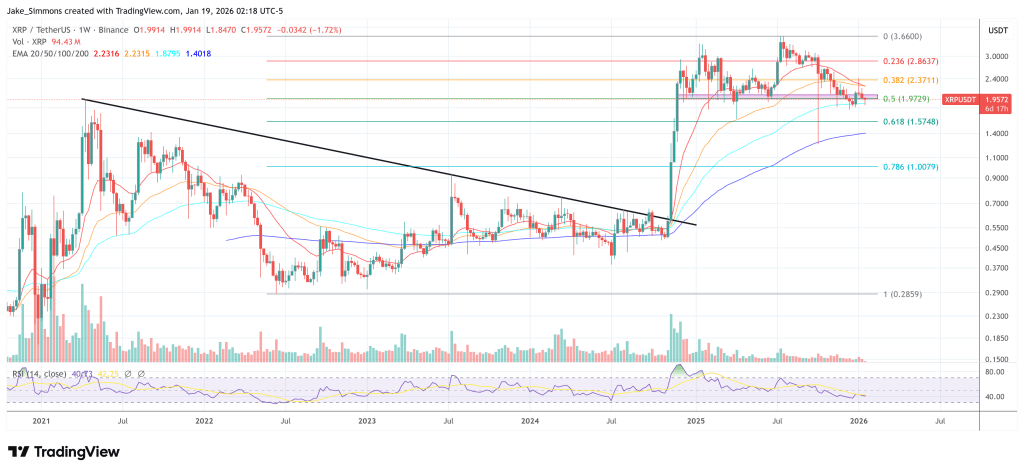
XRP falls into the red support zone again, 1-week chart | Source: XRPUSDT on TradingView.com

Preguntas relacionadas

QWhat was the main criticism Charles Hoskinson directed at Brad Garlinghouse in his January 18, 2026 video?

AHoskinson criticized Garlinghouse for advocating to accept the US Clarity Act despite its flaws, arguing that compromising with a bill that expands SEC authority and treats all new projects as securities by default is worse than regulatory chaos.

QAccording to Hoskinson, what negative outcomes would the proposed regulatory framework lead to for the crypto industry?

AHoskinson argued it would force crypto projects to beg for relief, treat all new projects as securities by default, normalize custodial wallets, pervasive KYC, and reversible transactions, ultimately handing control to traditional banks and allowing transactions to be frozen at a whim.

QWhy does Hoskinson believe that passing a flawed regulatory framework would be effectively irreversible?

AHe invoked the long life of US securities law, specifically referencing the Securities Exchange Act of 1933 which hasn't been changed in over 93 years, arguing that once such a framework is passed, the industry would be stuck with it forever.

QBeyond criticizing Garlinghouse, what broader concern did Hoskinson express about the crypto industry's direction?

AHe expressed concern that the industry's purpose is being reduced to a lobbying-driven contest for acceptable market access rather than a revolution to redesign how value and identity are handled online, and that leaders are being pulled toward comfort and access rather than confrontation.

QWhat did Hoskinson say about his own engagement with social media platform X/Twitter?

AHoskinson stated that he had stopped using X/Twitter in terms of reading or engaging with content, though he still broadcasts, due to what he called 'toxic learned hopelessness' and the distortion that constant outrage and demands for instant announcements create.

Lecturas Relacionadas

Xiaohongshu's Second Great Voyage, This Time Sailing Towards AI

Xiaohongshu's Second Voyage: Navigating Towards AI Since ChatGPT's emergence, Xiaohongshu's founder Mao Wenchao has been acutely aware of AI's potential threat, recognizing that the life advice people seek from chatbots overlaps directly with his platform's core business. Founded in 2013 as a PDF shopping guide for Chinese tourists, Xiaohongshu evolved into a massive community where millions share authentic, personal experiences—from product reviews to travel tips. This vast repository of "I've tried this" human judgment became its most valuable asset. However, the rise of AI, which delivers instant answers, challenges the very need for users to sift through numerous personal notes. Fearing its treasure trove of lived experience could become mere training data for others, Xiaohongshu is proactively adapting. In 2026, it established a dedicated AI division (Dots), launched RED Skill to turn user experiences into usable AI tools, and acquired the AI search product "Diandian." Its investments now extend to AI firms like MiniMax and hardware startups, moving upstream to address needs before they even become search queries. The platform's commercialization strategy is also evolving. With a newly acquired payment license and tools like the AIPS model to track consumer decision journeys, Xiaohongshu aims to seamlessly integrate recommendations with transactions, embedding commerce within AI-generated answers. Yet, a critical tension remains. While building smarter machines to organize and leverage its human experiences, Xiaohongshu must prevent AI from drowning out the authentic, flawed, and trustworthy "I've tried this" voices that built its community. Its core challenge is to harness AI's power without letting the map—the machine's perfect, synthesized answer—replace the territory of genuine human experience. This balance between technological advancement and preserving human trust defines its current journey and its future.

marsbitHace 1 min(s)

Xiaohongshu's Second Great Voyage, This Time Sailing Towards AI

marsbitHace 1 min(s)

SharpLink CEO: How to Understand Ethereum Developers Just Exceeded 1 Million?

SharpLink CEO reflects on the milestone of Ethereum surpassing 1 million historical developers, emphasizing that this figure represents the largest pool of technical talent ever assembled around an open, permissionless blockchain network. While approximately 232,000 developers remain active, the key question for the crypto industry is not which chain is fastest, but where the best builders choose to build long-term. Ethereum's advantage lies in a decade-long accumulation of infrastructure, standards, tools, liquidity, and a cohesive culture, making it the default operating system for programmable finance. This developer base is tackling complex challenges: the Glamsterdam upgrade aims to enhance scalability while preserving core principles; synchronous composability seeks to unify Rollup ecosystems; and significant efforts are underway for post-quantum security. Ethereum's deeper network effects stem from composability and shared standards (like the EVM and Solidity), creating a flywheel of more developers, tools, and liquidity. Three reinforcing strengths cement Ethereum's lead: credible neutrality (secured by ~900k validators), a modular architecture with interconnected Rollups, and a culture that attracts top researchers. The ecosystem is consolidating as the trusted coordination layer for internet-native finance, favored by large institutions valuing security and liquidity. The future of Ethereum is being built by this global community of founders and architects.

链捕手Hace 16 min(s)

SharpLink CEO: How to Understand Ethereum Developers Just Exceeded 1 Million?

链捕手Hace 16 min(s)

A Clod of Chinese Soil Chokes Two Japanese Giants

"Chinese Soil Chokes Japanese Giants" The production of a key electronic specialty gas, tungsten hexafluoride (WF6), vital for manufacturing AI chips, was halted by two leading Japanese producers—Kanto Denka and Central Glass. Their shutdown was not due to a technological failure but a sudden, critical shortage of a raw material they had long taken for granted: ultra-high-purity (6N-grade) tungsten powder, which is almost entirely sourced from China. Following a quiet Chinese export announcement in January 2026, tungsten powder shipments to Japan dropped to zero for months. Despite frantic efforts, Japanese companies found no viable alternative; imported powder was three times more expensive and lacked the required purity. Their existing stockpiles were exhausted by mid-2026. WF6 is essential for depositing tungsten into the microscopic contact holes of High Bandwidth Memory (HBM) chips, which are crucial for advanced processors like those from Nvidia. While Japanese firms had mastered producing ultra-pure WF6 gas, their entire supply chain relied on China's 6N tungsten powder—a dependency now revealed as a fatal vulnerability. China's dominance in this "soil" results from decades of painstaking R&D by companies like Xiamen Tungsten and China Tungsten & Hightech. They overcame immense technical hurdles, such as separating chemically similar molybdenum from tungsten, to achieve mass production of the world's purest tungsten powder. With their primary suppliers gone, Kanto Denka and Central Glass announced a permanent halt to WF6 production starting July 1, 2026. This immediately created a supply crisis for major semiconductor manufacturers like Samsung and SK Hynix, forcing them to urgently seek and certify new Chinese suppliers for WF6 itself. The reversal marks a dramatic shift: China has moved from exporting low-value raw materials to controlling the high-purity foundation of a critical global tech supply chain, upending a long-established industrial hierarchy.

marsbitHace 47 min(s)

A Clod of Chinese Soil Chokes Two Japanese Giants

marsbitHace 47 min(s)

Trading

Spot
Futuros
活动图片