Hook Narrative Recreates Wealth Opportunities, How to Seize the Next One?

marsbitPublicado a 2026-05-09Actualizado a 2026-05-09

Resumen

The V4 Hook narrative is creating new wealth opportunities in the crypto space, as seen with projects like SATO, uPEG, and Slonks. These projects, built on Uniswap V4's customizable "hook" feature, have rapidly gained significant value and mainstream attention. SATO demonstrated new economic models, uPEG bridged DeFi and NFT communities with a compelling backstory, and Slonks introduced an innovative "AI-misinterpreted art" concept and tokenomics. To identify the next potential opportunity, key figures to follow include Uniswap founders, core developers like saucepoint, and influential figures like OpenSea's Adam Hollander. Essential resources are HookRank.io for discovering new hooks, the Uniswap Foundation's weekly Builder Updates, DEX screeners for on-chain activity, and NFT marketplace trending pages. The narrative's next phase may involve short-term "bug-fix" forks of successful projects like SATO, medium-term development of composable "meta-hooks" that combine multiple functions, and long-term growth centered on Unichain. Future hooks could expand into audio generation, prediction markets, or time-based mechanics, pushing the boundaries of what's possible within a liquidity pool.

If people in your group chats aren't discussing $SATO, $uPEG, and Slonks yet, you might need to find some new groups.

When Slonks launched, its mint price was less than 0.004 ETH, equivalent to under 70 RMB. Six days later, its floor price rose to 0.123 ETH, a 60x increase. uPEG, priced at $982 per unit, went from 0 to a market cap of $34.44 million in two weeks. When SATO's market cap dropped below $3 million, someone directly bought the bottom through the on-chain bonding curve, opening a position of 260,000 SATO in one go. Its market cap later surged to $40 million, resulting in a floating profit of $360,000.

These are not your typical memecoin wealth narratives. They all point to the same sector: Uniswap V4 Hook. In just two and a half weeks, these three projects dragged the entire V4 hook sector from being an "internal toy for DeFi geeks" into the mainstream spotlight. Related reading: "Bull Market Bets on New Coins, Could the 'Hook' Concept Be the Sector to Start the Bull Run?"

For retail investors who didn't get in early on $SATO, $uPEG, and Slonks, how can we seize the next potential wealth opportunity? Before discussing that, we need to briefly review how the V4 Hook narrative caught fire.

How Did the V4 Hook Narrative Catch Fire?

Before V3, Uniswap was a money exchange counter. You swap ETH for USDC, the price follows x*y=k, done. After V4, the "hook" was embedded into the swap lifecycle, allowing anyone to insert their own code at the moment before or after a swap, or when adding liquidity.

In fact, Uniswap v4 was launched as early as January 30th of last year. But it wasn't until the recent emergence of projects like $SATO, $uPEG, and Slonks that hooks sparked widespread discussion among the retail player community.

SATO was the first among these three to gain traction, launching around mid-April, roughly a week before uPEG. But it didn't have KOLs to ignite it, nor heavyweights like Adam Hollander endorsing it. Its spread was closer to the degen circles. Keywords like "pure on-chain", "fair launch", "no team allocation", and "contract runs itself" directly attracted V4 geeks and bonding curve veterans.

The real explosion point for the V4 Hook narrative was Unipeg (UPEG). The name "Unipeg" was born with a strong commemorative meaning for Uniswap, giving it inherent narrative and attention from the start.

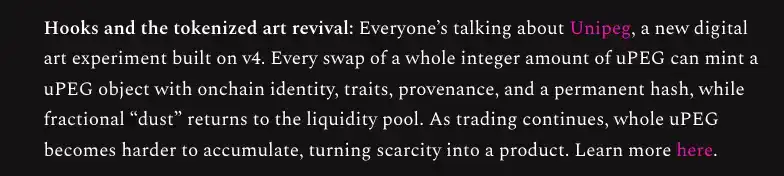
In 2019, Hayden Adams posted a blog titled "Uniswap Birthday Blog—V0", where he recalled that when naming the Uniswap protocol, he originally wanted to call it "Unipeg", a combination of Unicorn and Pegasus. But Vitalik took a look and said, "Unipeg? That sounds more like Uniswap." So Hayden settled on Uniswap.
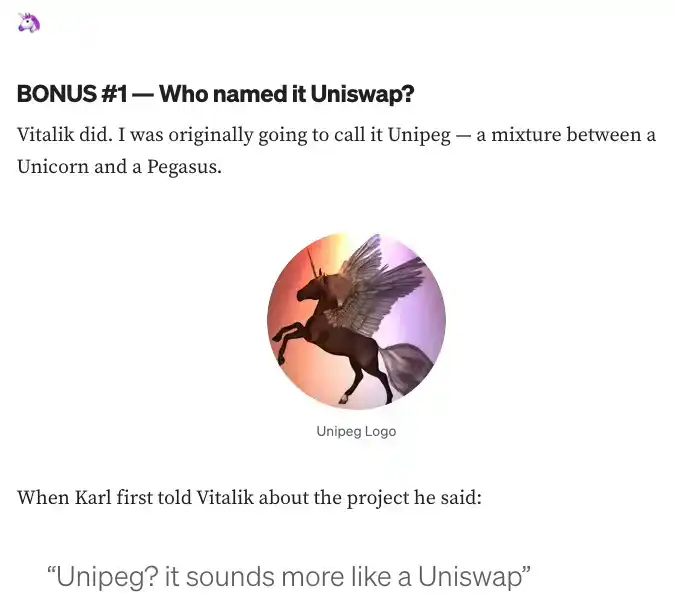
"Uniswap" replaced "Unipeg" and became the name of the $70 billion DeFi blue-chip.

Eight years later, in April 2026, an anonymous developer (Twitter handle @unipegv4, rumored to be related to the 0xHadrian blog) picked up this discarded name and gave it new meaning: Uni + JPEG = uPEG. The NFT circle has long jokingly called pictures "JPEGs". Since this thing was born in a Uniswap pool, it's Uniswap's JPEG.

This story itself is viral material. It perfectly merges four narratives into one name: Hayden's personal anecdote, Vitalik's offhand remark, NFT circle lingo, and V4's new mechanism.

The "uPEG" story is easy to tell and spread. It attracted OpenSea CMO Adam Hollander, who tweeted on April 25th: "Interested in this concept, buying a little to try it out."
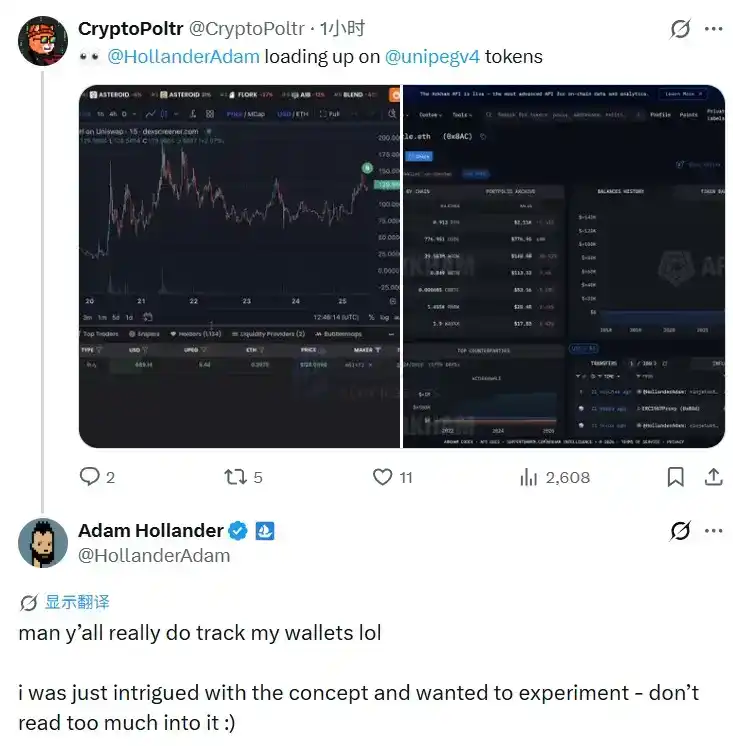
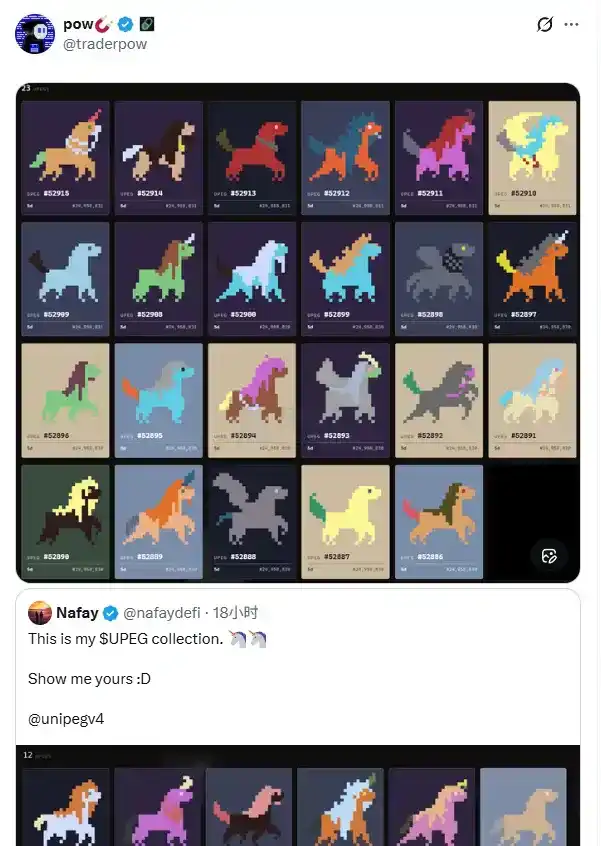
That night, "uPEG" tripled in price. Then Uniswap team member niko followed up, and Ouroboros co-founder Nafay and meme coin KOL pow also posted their uPEG holdings on X. In two weeks, uPEG went from 0 to a $34.44 million market cap, with a unit price of $982. Related reading: "Market Cap Breaks $23 Million, Hitting New Highs, What's the Magic of the New Picture Gem Unipeg?"
Following uPEG, "Slonks" launched on May 1st.

Developer Hirsch did something that sounds counterintuitive: he directly embedded an AI image generation model (only 214KB, about the size of a low-resolution phone wallpaper) into an Ethereum smart contract. This model's task was to replicate 10,000 CryptoPunks.

But a 214KB model can't remember 10,000 faces. With 576 pixels per image, the model would misdraw about 24 pixels on average, roughly a 4% distortion rate. Only 32 out of 10,000 were perfectly replicated; the rest were all "warped punks."
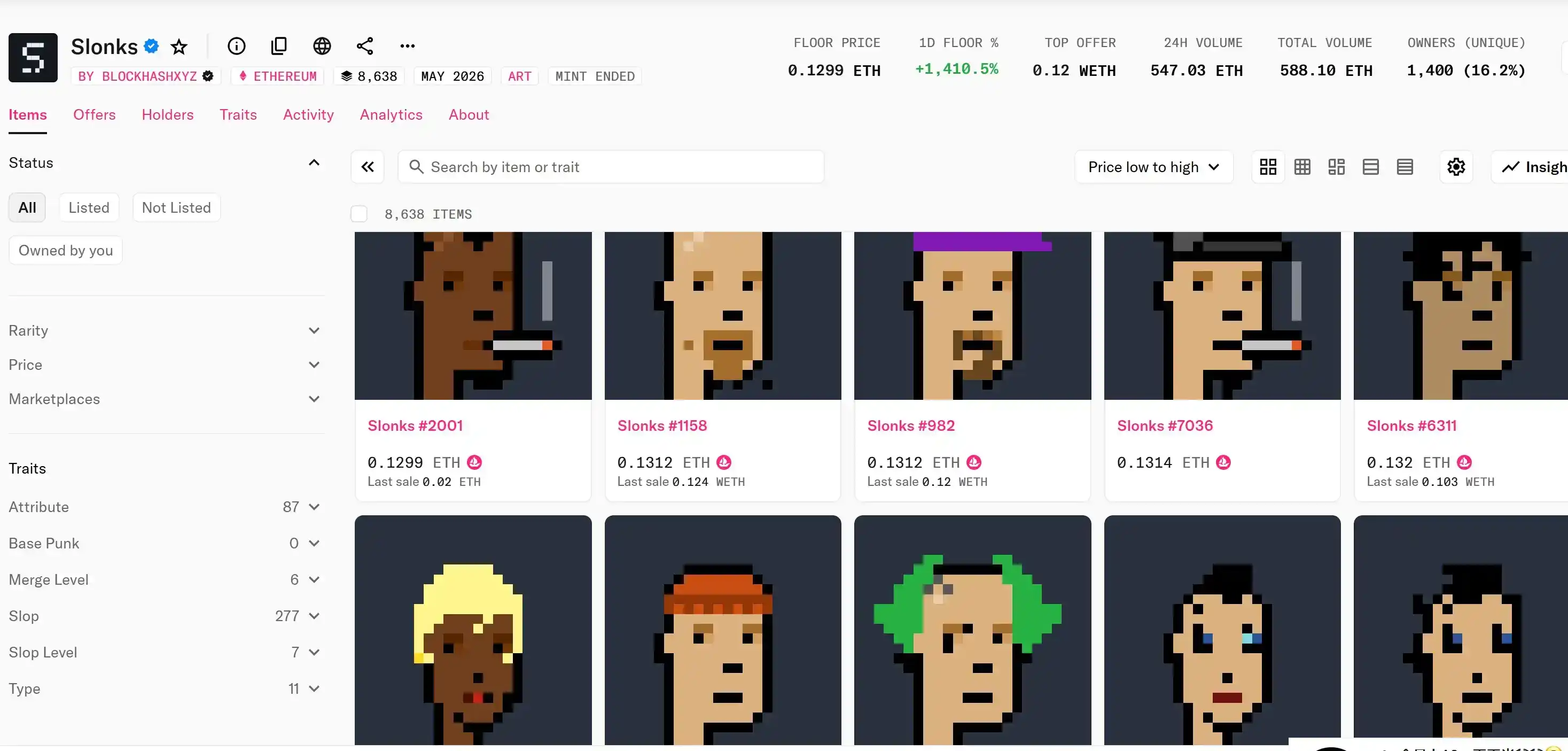
Hirsch called these misdrawn pixels "slop." Then he tweeted the project's philosophy: "The slop is not a bug. It is the medium."

The entire economic model is built on "the more mistakes, the more valuable." Two Slonks of the same level can be merged, burning one to upgrade another; the new image's slop only increases. Any Slonk can be sent to the void to mint the future $SLOP token (not officially launched yet) at a 1:1 ratio based on its slop count. Every action is completed through a V4 hook, verifiable on-chain.

Slonks wasn't an immediate hit. In its first few days, it was almost ignored under the spotlight of uPEG's $30 million market cap. The floor price hovered around 0.005 ETH, with little discussion on OpenSea. It wasn't until NFT circle veterans like 798 took to X, one after another, turning "misdrawing is art" into a shareable meme, coupled with further smart money moves on-chain, subsequent promotion by KOLs and media, and OpenSea's homepage trending section distributing traffic for it, that Slonks saw a 60x increase in 5 days.

But the significance of SATO lies in its foundational proof that "V4 hooks can create new economic models." This was the prerequisite for the emergence of uPEG and Slonks later.

uPEG's significance was translating the DeFi concept of V4 hooks for the NFT community. Retail investors suddenly realized hooks weren't just toys for DeFi geeks; they could create things they also wanted to buy.

Slonks built upon the attention dividend created by uPEG, crafting an even stronger story hook and an interesting economic model, further propelling the V4 Hook narrative.

What to Focus on to Seize the Next Opportunity?

For the foreign V4 Hook inner circle, our editors mainly recommend following these users:

1. Hayden Adams (@haydenzadams), Founder of Uniswap. Importance goes without saying.

2. saucepoint (@saucepoint), The "hook godfather" of the Uniswap Foundation, author of v4-template. Almost all hook projects start from his template code.

3. Uniswap official (@Uniswap) and Uniswap Foundation (@UniswapFND). The weekly Builder Update (Wednesday or Thursday) is the most important official signal source for the sector.

4. niko (@niko_eth), Member of Uniswap Labs team. You could say he was a key baton in the first wave of KOL relays for uPEG.

5. horsefacts (@horsefacts_eth), One of the earliest V4 hook builders, a technical bellwether.

6. Adam Hollander (@AdamHollander), CMO of OpenSea. His deeper background is as an early ecosystem driver for Hashmasks and Pudgy Penguins, a key translator bridging this wave from DeFi to NFT circles.

7. Project official accounts: uPEG official (@unipegv4), Unimon official (@unimonapp), Slonks official account, SATO official (@Satothedog). See who they follow and interact with; it often helps unearth the next hook project that hasn't been highlighted yet.

Besides that, we can also pay attention to some websites related to V4 hooks and Uniswap:

1. HookRank.io is currently the cleanest V4 hook explorer, with 1300+ hooks listed, sorted by TVL/Volume/Fees, featuring "New" and "Trending" tags. This is the first stop to see hooks that have seen rising data but haven't been mentioned on Twitter yet.

2. HookAtlas.com is a directory of hook projects with descriptions, suitable for mapping.

3. Uniswap Foundation Builder Update is published on the blog . The Foundation releases one every Wednesday or Thursday. Any core user following the Uniswap ecosystem won't miss the hottest narratives.
4. Unichain Infinite Hackathon competition. Award-winning projects are almost always seeds; we can focus on core projects on Unichain.

5. Dune Uniswap V4 Tracker. Shows total hook count, TVL distribution, chain volume distribution.

6. Dexscreener needs little introduction, a commonly used charting site for trading, useful for monitoring newly created V4 pairs, an early signal source for projects not yet ignited by KOLs. For example, when uPEG's holder addresses jumped from 200 to 4000+ within 24 hours, that slope itself was a signal.

7. OpenSea + Magic Eden Trending lists. Slonks appeared on OpenSea Trending the day after launch, something ordinary NFT projects need weeks of marketing to achieve. Meanwhile, on May 8th, Slonks's daily trading volume of 575 ETH surpassed CryptoPunks' 129 ETH. Any new project's daily volume exceeding CryptoPunks' during the same period is a sector-level signal.

8. The awesome-uniswap-hooks GitHub project. All experimental hook projects are registered here, suitable for discovering early-stage projects with "interesting designs" that don't yet have tokens.

The Next Stage of the V4 Hook Narrative

Here's our (irresponsible) speculation. If the V4 Hook narrative doesn't immediately fizzle out, it will likely progress along three lines in order of time: short-term is SATO's bug fix plays, medium-term is hook composability, and long-term is Unichain becoming the center of the entire sector.

First, the short-term SATO bug fix plays, which you can see discussed in various group chats today.

The reason SATO spawned a "fix play" like sat1 lies in its hook contract. Any V4 hook that wants to replace Uniswap's standard pricing must maintain its own ledger of "how much money is in the pool" to calculate its own curve formula. But Uniswap's PoolManager also maintains a ledger of the real balance. Two ledgers exist simultaneously, requiring synchronization with each swap. If the sync logic isn't written rigorously, the two numbers will drift apart. In hook engineering circles, this is called dual-state drift.

Drift creates arbitrage opportunities. At some point, the hook internally thinks 1 SATO should be worth X ETH, but the pool's actual reserves show Y ETH. Whoever spots this difference first gets to exploit it. Those two addresses with $360k floating profit weren't buying market sentiment; they were buying an accounting loophole in the contract.

sat1 packages itself as "one curve, single state," using only one ledger, no drift. The engineering fix is reasonable, but narratively, it's calculated—it tells retail "SATO has a bug, I'm the correct version," aiming to capture legitimacy.

This playbook isn't new to V4. Bitcoin ecosystem had ORDI, SATS, 1000SATS; ERC-404 era had Pandora, DN404, ERC-404 V2; pump.fun era had BankrFun, ClankerFun. Every later entrant claimed to "fix the previous one's problems."

The essence of a bugfix play isn't technical repair; it's narrative usurpation. It doesn't even need to actually fix anything; it just needs the consensus on Twitter that "the original has a bug," and liquidity will shift from the original to the new one.

V4 hooks have lowered the cost of this script to an unprecedented level. Hooks are open-source; fork one, change three lines of code, and deploy. Every successful hook project comes with its own fork generator. SATO/sat1 is the first template pair; uPEG2, Slinks will follow—it's inevitable.

In the medium term, we can look forward to hook composability.

Currently in V4, a pool can only have one hook attached. But people are already working on "meta-hooks," where one hook internally calls multiple sub-hooks, enabling combined behaviors.

Once this works, it means uPEG's image generation + Slonks's NFT-token conversion + SATO's bonding curve could all exist simultaneously in the same pool. One swap could trigger image generation, rewrite the pricing curve, and mint an NFT all at once.

Possible directions are numerous: swap triggers music or audio generation (replace SVG with MIDI; audio spreads more easily than images); swap as identity or reputation system (each swap updates soul-bound points); prediction market hook (treat swap as a betting action, Polymarket model running within LPs); time-based hook (lower sell tax the longer you hold); cross-collection fusion gameplay (use hooks to fuse Pudgy Penguin and Azuki into new forms, most feasible between CC0 projects).


Preguntas relacionadas

QWhat are $SATO, $uPEG, and Slonks, and why have they recently gained attention in the cryptocurrency community?

A$SATO, $uPEG, and Slonks are projects built on the Uniswap V4 Hook infrastructure. They have gained significant attention because they leveraged the new V4 Hook mechanism to create novel economic models and narratives, resulting in dramatic price increases and bringing the previously niche 'DeFi geek' Hook concept into the mainstream crypto discussion.

QHow did the $uPEG project's name and backstory contribute to its viral growth?

AThe $uPEG project's name and backstory were crucial to its viral growth. The name 'Unipeg' was Uniswap founder Hayden Adams's original, unused name for the protocol, based on 'Unicorn' and 'Pegasus.' The project revived this name with a new meaning: Uni + JPEG (a common slang for NFTs). This story combined a piece of crypto folklore, Vitalik's anecdote, NFT culture, and the new V4 mechanism into a highly shareable and compelling narrative, attracting key influencers like Adam Hollander.

QWhat are some key Twitter accounts recommended for tracking the V4 Hook narrative and finding early-stage projects?

AKey Twitter accounts include: Hayden Adams (Uniswap founder), saucepoint (hook 'godfather'), Uniswap and Uniswap Foundation (official updates), niko (Uniswap Labs team member), horsefacts (early builder), Adam Hollander (OpenSea CMO), and the official accounts of successful projects like @unipegv4, @unimonapp, @Satothedog, and Slonks. Following who they interact with can reveal new projects.

QWhat tools and websites can be used to discover and analyze emerging V4 Hook projects?

ARecommended tools include: HookRank.io (a V4 hook explorer ranked by TVL/Volume), HookAtlas.com (a project directory), the Uniswap Foundation Builder Update blog, the Unichain Infinite Hackathon, Dune's Uniswap V4 Tracker dashboard, Dexscreener (for new trading pairs), OpenSea/Magic Eden Trending pages (for NFT-based hooks), and the awesome-uniswap-hooks GitHub repository for early-stage experimental projects.

QAccording to the article, what is the likely short-term and medium-term development path for the V4 Hook narrative?

AIn the short term, the narrative is likely to see 'bug fix' forks like sat1 for SATO, where new projects claim to fix flaws in original successful projects to capture their liquidity and narrative. In the medium term, the focus will shift to the composability of hooks, where 'meta-hooks' could combine functionalities (like image generation, bonding curves, and NFT minting) into a single pool, enabling more complex and interactive DeFi/NFT applications.

Lecturas Relacionadas

Near Returns to the AI Stage: Transformation into a Public Chain Due to 'Payroll Difficulties,' Agent and Privacy Emerge as New Growth Narratives

NEAR Returns to AI Origins: From Payroll Struggles to Blockchain, Now Focusing on AI Agents and Privacy NEAR Protocol's journey began not with grand blockchain ambitions, but from a practical hurdle: its AI startup founders, including Transformer paper co-author Illia Polosukhin, couldn't efficiently pay international developers in 2017. This led them to pivot and build a high-performance, scalable blockchain. After years navigating various crypto narratives like sharding and cross-chain interoperability, NEAR is now leveraging its AI roots to re-enter the AI arena. A key driver is its "NEAR Intents" layer, which abstracts complex cross-chain transactions. Users simply state their goal (e.g., swap BTC for ETH), and a solver network finds the optimal route. This system has processed over $20B in cross-chain volume, generating significant fee revenue. A major growth area is private transactions via "Confidential Intents/Swaps," which hide trade details until settlement to protect against MEV and front-running. Remarkably, private swaps recently accounted for over 40% of NEAR's transaction volume, highlighting strong demand but also potential regulatory scrutiny. With its AI-founder pedigree, NEAR is positioning itself at the intersection of blockchain, AI agents, and privacy, aiming to become infrastructure for the emerging agent economy while navigating the challenges of its rapid adoption.

marsbitHace 51 min(s)

Near Returns to the AI Stage: Transformation into a Public Chain Due to 'Payroll Difficulties,' Agent and Privacy Emerge as New Growth Narratives

marsbitHace 51 min(s)

From Ethereum to AI's 'CROPS': What Exactly is This Set of 'Slow Variables' That Vitalik Repeatedly Emphasizes?

In recent discussions, Vitalik Buterin has frequently emphasized the concept of "CROPS," a framework defining core values for Ethereum's development. CROPS stands for Censorship Resistance, Capture Resistance, Open Source, Privacy, and Security. Initially outlined in the Ethereum Foundation's "EF Mandate," it represents a commitment to user sovereignty, ensuring that the network resists external control, remains open, protects privacy, and prioritizes security. The relevance of CROPS extends beyond Ethereum's foundational principles, becoming crucial in the context of AI integration. As AI agents begin handling wallet operations and automated transactions, the risk increases that users may cede control over their digital assets, privacy, and intentions to centralized AI service providers. A "CROPS AI" would therefore emphasize local execution where possible, privacy-preserving remote model calls (e.g., using zero-knowledge proofs), and transparent, verifiable processes to maintain user agency. Vitalik highlights a significant convergence between "CROPS Ethereum access layer" and "CROPS AI." Both address the same fundamental challenge: how users can access powerful services—be it blockchain data via RPCs or AI models—without exposing sensitive information or relinquishing ultimate control. This intersection points toward a future digital entry point that is more private, secure, and user-controlled. Ultimately, CROPS is not merely an abstract ideal but a practical guidepost. It steers development—from protocol resilience and wallet design to AI agent safety—towards a future where users retain self-sovereignty even as digital systems grow more complex and powerful. In an era of accelerating AI adoption, these "slow variables" of censorship resistance, openness, privacy, and security may define Ethereum's enduring value.

marsbitHace 1 hora(s)

From Ethereum to AI's 'CROPS': What Exactly is This Set of 'Slow Variables' That Vitalik Repeatedly Emphasizes?

marsbitHace 1 hora(s)

Silicon Valley 'Startup Guru' Steve Hoffman: Web3 + AI Could Be a Trap

Silicon Valley investor and "Godfather of Startups" Steve Hoffman warns that combining Web3 with AI is likely a trap, not a promising venture. In an interview, Hoffman argues that while AI is a foundational technology touching all industries, Web3 adds complexity, friction, and regulatory risk without solving mainstream consumer or business needs. He advises founders to focus on deep, specialized applications where startups can out-iterate giants, rather than on generic features easily replicated by large tech companies. Hoffman observes that Silicon Valley will lead foundational AI research, while China excels at rapid, large-scale application and commercialization, particularly in robotics. He stresses that AI-driven autonomous agents capable of collaborative, multi-step tasks are 2-4 years away, which will cause significant job displacement. The solution is not to slow AI but to redesign business models around human-AI collaboration and reform social systems like education and retraining. For startups, Hoffman recommends focusing on vertical, expertise-heavy domains to build defensibility. He sees major opportunities in AI fraud detection and cybersecurity. Key founder mindsets include systemic thinking over feature-focus, relentless customer centricity, building adaptive teams, and deeply understanding AI's capabilities and limits. Hoffman is also leading a non-profit initiative to establish university centers aimed at training future leaders in responsible, human-value-aligned AI innovation.

marsbitHace 2 hora(s)

Silicon Valley 'Startup Guru' Steve Hoffman: Web3 + AI Could Be a Trap

marsbitHace 2 hora(s)

Token Inefficient, Economy Tokenless

The article "Tokens Aren't Economical, Economics Aren't Tokenized" analyzes a pivotal shift in the AI industry from a technology-driven narrative to one dominated by capital efficiency. It highlights two concurrent trends: a severe capital shortage due to the exorbitant and recurring costs of compute (e.g., OpenAI's high burn rate) and a wave of corporate spin-offs where major tech companies are separating their AI units (like Kuaishou's Kling and Baidu's Kunlunxin). The core argument is that AI's "anti-internet" business model, where user growth increases costs rather than profits, has created a disconnect between high valuations and actual cash flow. Spin-offs address this by allowing AI assets to be valued independently. Within a parent company, they are seen as cost centers, but as standalone entities, they are priced based on their growth potential and scarcity in the primary market, leading to massive valuation premiums (e.g., Kling's estimated value tripling post-spin-off). The industry is at an inflection point, moving from "model worship" to "value realization." The competition is evolving from a pure compute (GPU) race to a broader focus on systemic efficiency and full-stack engineering (involving CPUs and orchestration) to achieve viable commercialization. The year 2026 is framed as a critical moment where the industry must definitively answer how to economically translate AI capability into tangible business value, reshaping the sector's future power structure.

marsbitHace 2 hora(s)

Token Inefficient, Economy Tokenless

marsbitHace 2 hora(s)

Trading

Spot
Futuros

Artículos destacados

Cómo comprar ONE

¡Bienvenido a HTX.com! Hemos hecho que comprar Harmony (ONE) sea simple y conveniente. Sigue nuestra guía paso a paso para iniciar tu viaje de criptos.Paso 1: crea tu cuenta HTXUtiliza tu correo electrónico o número de teléfono para registrarte y obtener una cuenta gratuita en HTX. Experimenta un proceso de registro sin complicaciones y desbloquea todas las funciones.Obtener mi cuentaPaso 2: ve a Comprar cripto y elige tu método de pagoTarjeta de crédito/débito: usa tu Visa o Mastercard para comprar Harmony (ONE) al instante.Saldo: utiliza fondos del saldo de tu cuenta HTX para tradear sin problemas.Terceros: hemos agregado métodos de pago populares como Google Pay y Apple Pay para mejorar la comodidad.P2P: tradear directamente con otros usuarios en HTX.Over-the-Counter (OTC): ofrecemos servicios personalizados y tipos de cambio competitivos para los traders.Paso 3: guarda tu Harmony (ONE)Después de comprar tu Harmony (ONE), guárdalo en tu cuenta HTX. Alternativamente, puedes enviarlo a otro lugar mediante transferencia blockchain o utilizarlo para tradear otras criptomonedas.Paso 4: tradear Harmony (ONE)Tradear fácilmente con Harmony (ONE) en HTX's mercado spot. Simplemente accede a tu cuenta, selecciona tu par de trading, ejecuta tus trades y monitorea en tiempo real. Ofrecemos una experiencia fácil de usar tanto para principiantes como para traders experimentados.

278 Vistas totalesPublicado en 2024.12.12Actualizado en 2026.06.02

Cómo comprar ONE

Discusiones

Bienvenido a la comunidad de HTX. Aquí puedes mantenerte informado sobre los últimos desarrollos de la plataforma y acceder a análisis profesionales del mercado. A continuación se presentan las opiniones de los usuarios sobre el precio de ONE (ONE).

活动图片