Hong Kong Unveils New Rules To Allow Crypto Margin Financing And Perpetual Contracts

bitcoinistPublicado a 2026-02-12Actualizado a 2026-02-12

Resumen

Hong Kong's Securities and Futures Commission (SFC) has introduced new rules allowing licensed virtual asset brokers to offer crypto margin financing and perpetual contracts to professional investors. Under the ASPIRe roadmap's Pillar P, eligible clients with strong credit and sufficient collateral can use Bitcoin and Ether as collateral for margin trading. The move aims to enhance market liquidity, provide risk management tools, and strengthen Hong Kong's position as a global virtual asset hub. The SFC emphasized the need for robust risk controls, as these products carry distinct risks. Executive Director Eric Yip stated that these measures are part of a broader strategy to cultivate market depth and investor confidence through regulated innovation.

Hong Kong financial authorities have announced new rules to expand the scope of product offerings, allowing the integration of crypto margin financing and perpetual contracts into the local virtual assets market.

Hong Kong Approves Crypto Margin Financing, Perps

On Wednesday, Hong Kong’s Securities and Futures Commission (SFC) unveiled a framework for licensed corporations that provide virtual asset dealing services (VA brokers) to offer virtual asset financing.

According to the SFC’s circular, the financial watchdog will permit VA brokers to extend credit to margin clients with strong credit profiles and sufficient securities collateral, under Pillar P of its Access, Safeguards, Products, Infrastructure and Relationships (ASPIRe) roadmap.

This will allow eligible margin clients to “increase their participation in VA trading, which can enhance the liquidity of Hong Kong’s VA market. At the same time, this can also facilitate the development of VA financing in a risk-controlled environment.”

Under the new guidance, only the two leading cryptocurrencies, Bitcoin (BTC) and Ether (ETH), will be eligible as VA collateral. The regulator also released a high-level framework for licensed virtual asset trading platforms to offer crypto perpetual contracts to professional investors.

“Under the ASPIRe roadmap, Pillar P reflects the SFC’s commitment to expanding the scope of product offerings, including Perps. This initiative aims to deepen market liquidity, broaden risk management tools for investors, and further strengthen Hong Kong’s position as a leading global virtual asset hub,” the watchdog affirmed.

The SFC emphasized that the introduction of Perps will bring new opportunities to the market, but noted that it also carries “a range of risks that are distinct from those associated with traditional futures or spot trading of virtual assets.”

Therefore, the framework requires platform operators to have robust management measures and transparent processes governing valuation, margining, collateralization, and liquidation management.

Hong Kong Digital Landscape In ‘Defining Stage’

Speaking at Consensus Hong Kong 2026 on Wednesday, Eric Yip, SFC’s Executive Director of Intermediaries, shared his views on the watchdog’s regulatory enhancements for the next phase of Hong Kong’s crypto assets ecosystem.

Yip affirmed that Hong Kong’s crypto asset development has entered a “defining stage, shaped by the SFC’s ASPIRe roadmap that outlines a future-proof regulatory framework aimed at deepening market quality, resilience, and global competitiveness.”

He emphasized this year’s focus on liquidity, “cultivating market depth, strengthening price discovery, and building investor confidence through a strategic blend of expanded access and responsible product innovation.”

As the executive explained, the SFC is expanding the city’s crypto product suite under Pillar P while maintaining regulatory guardrails aligned with traditional financial market standards.

Notably, Yip highlighted the SFC’s greenlight of crypto margin financing, which will be anchored to the existing securities margin financing framework. He noted that it will provide clarification on the use of crypto assets as collateral, “enabling responsible leverage that supports liquidity without undermining financial stability.”

In addition, he also outlined the new high-level framework for leveraged perpetual contracts for professional investors, which sets out a principles-based model.

Discussing how to bridge innovation and regulatory clarity, he pointed to the upcoming Digital Asset Accelerator to be set up under Pillar Re, which will serve as a structured communication channel between the regulatory agency and industry innovators.

He concluded that “liquidity does not emerge organically; it must be cultivated through openness, strong governance, and a purposeful regulatory design. Through targeted access reforms, product expansion, and structured innovation support, Hong Kong is well-positioned to become a leading global digital assets centre where liquidity thrives on a foundation of integrity, resilience, and international cooperation.”
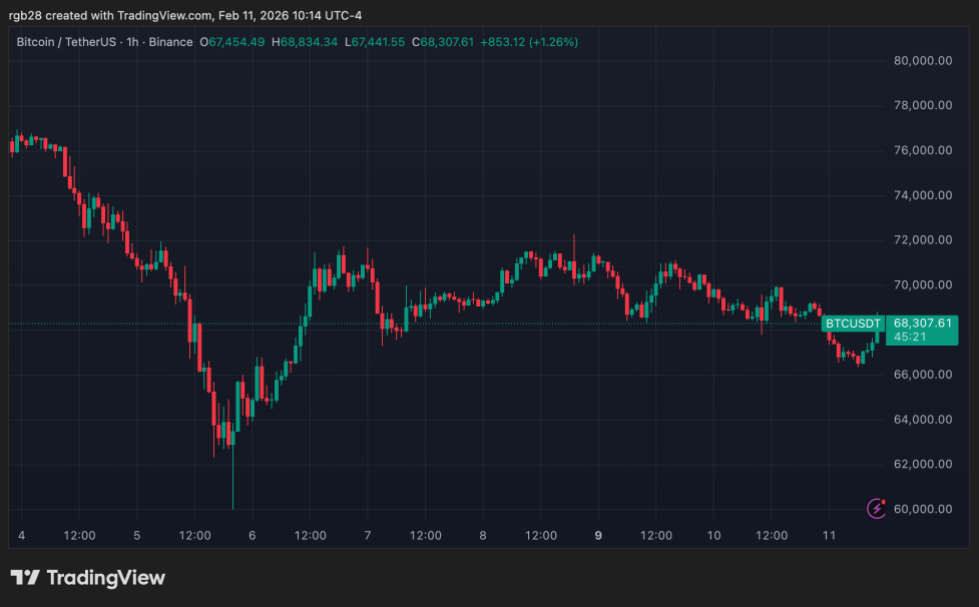
Bitcoin trades at $68,307 in the one-week chart. Source: BTCUSDT on TradingView


Preguntas relacionadas

QWhat new financial products has Hong Kong's SFC approved for the virtual assets market?

AHong Kong's SFC has approved crypto margin financing and perpetual contracts for professional investors.

QWhich two specific cryptocurrencies are eligible to be used as collateral under the new margin financing rules?

AOnly Bitcoin (BTC) and Ether (ETH) are eligible as virtual asset collateral under the new guidance.

QWhat is the name of the SFC's roadmap that outlines this new regulatory framework?

AThe regulatory framework is part of the SFC's ASPIRe (Access, Safeguards, Products, Infrastructure and Relationships) roadmap.

QAccording to the SFC executive, what stage has Hong Kong's crypto asset development entered?

AAccording to Eric Yip, Hong Kong's crypto asset development has entered a 'defining stage'.

QWhat is the primary goal of introducing these new products like margin financing and perpetual contracts?

AThe primary goals are to enhance market liquidity, broaden risk management tools for investors, and strengthen Hong Kong's position as a leading global virtual asset hub.

Lecturas Relacionadas

How to Do Research Well: Deliberately Practice the Real Skills That Matter

No one truly teaches you how to do research. You're often given a desk, a pre-selected problem, and vague instructions to "create something new." Consequently, many people reverse-engineer the job based on visible outputs—papers, posts, announcements—learning only how to *appear* like a researcher rather than how to *become* one. True research capability is built from stacking small, trainable skills, nearly all of which can be developed through deliberate practice. **Pick Your Own Problem:** Most researchers absorb problems from advisors or trends, lacking the underlying reasoning. Choosing a problem you genuinely care about, as John Schulman advises, leads to original work. Develop "taste" like a muscle: predict experiment outcomes, guess paper results from methods, and track which findings remain important over time. **Upgrade Your Inputs:** Relying on shared reading lists (arXiv hot lists, filtered group chats) leads to unoriginal conclusions. Undervalued old literature often holds crucial insights (e.g., MoE, LSTM, backpropagation). Richard Sutton's "The Bitter Lesson" or Claude Shannon's 1952 talk on creative thinking are more predictive than lengthy modern surveys. Breadth matters as much as depth: draw from neuroscience, mechanism design, hardware knowledge, and honest statistics. Read papers directly, especially appendices and limitations sections. **Write Everything Down:** As Paul Graham noted, writing exposes flaws in seemingly mature ideas. Writing is the cheapest defense against self-deception. Following Feynman's principle, Darwin programmatically wrote down facts contradicting his theory to combat memory bias. Maintain a detailed log of hypotheses, setups, predictions, results, and updated understandings. Reviewing past logs fosters essential humility.

marsbitHace 2 hora(s)

How to Do Research Well: Deliberately Practice the Real Skills That Matter

marsbitHace 2 hora(s)

Following US Ban on Fable 5, Zhipu AI's Stock Soars 47%

On June 15th, shares of Zhipu AI surged dramatically on the Hong Kong stock market, peaking at a 47.6% gain before closing 32.82% higher. This sharp increase was directly triggered by two recent industry events. On June 12th, Anthropic announced it was suspending global access to its latest flagship models, Claude Fable 5 and Claude Mythos 5, to comply with a U.S. government export control order. The next day, Zhipu AI announced it would open access to its latest open-source flagship model, GLM-5.2, under the permissive MIT license. The Anthropic incident highlighted a critical issue beyond raw model capability: the risk of sudden, unpredictable loss of access to advanced AI models, especially for developers and enterprises deeply integrated with them. This has shifted industry and market focus toward factors like stability, sustainable access, and controllability. Zhipu's move, promoting "frontier intelligence for all," positions its openly available model as a reliable and accessible alternative. The GLM-5.2 model emphasizes "Long Horizon Task" capabilities with a 1M context window, targeting complex, multi-step coding and engineering workflows where maintaining context is crucial. Analysts note this event exposes the risk of dependency on closed-source models subject to single jurisdictional controls, potentially accelerating a shift toward domestic base models and localized deployments. The market's reaction signals a new valuation dimension in AI: providers who can offer stable, long-term, and sustainably accessible AI capabilities are gaining strategic importance.

marsbitHace 2 hora(s)

Following US Ban on Fable 5, Zhipu AI's Stock Soars 47%

marsbitHace 2 hora(s)

Trading

Spot
Futuros
活动图片