Hong Kong Professionals Association Urges Regulators To Ease Crypto Reporting Rules

bitcoinistPublicado a 2026-01-20Actualizado a 2026-01-20

Resumen

Hong Kong Securities & Futures Professionals Association (HKSFPA) has urged regulators to ease certain aspects of the OECD’s Crypto Asset Reporting Framework (CARF) and related amendments to Hong Kong’s Common Reporting Standard (CRS). While generally supportive, the association raised concerns about record-keeping obligations for dissolved entities and uncapped penalties for minor technical errors. It proposed appointing third-party custodians for dissolved firms and introducing penalty caps for unintentional errors. The group also recommended a simplified registration process for crypto service providers with no annual filings. Hong Kong is among 76 jurisdictions committed to implementing CARF by 2028 as part of its broader strategy to become a global crypto hub.

A Hong Kong industry group has urged the city’s regulators to ease aspects of the Organisation for Economic Co-operation and Development’s (OECD) crypto reporting rules ahead of its implementation.

Association Pushes To Soften CARF Requirements

On Monday, the Hong Kong Securities & Futures Professionals Association (HKSFPA) released a response to the implementation of the OECD’s Crypto Asset Reporting Framework (CARF) and the related amendments made to Hong Kong’s Common Reporting Standard (CRS).

In their official response, the association shared its concerns about certain elements of the CARF and CRS amendments, warning that they could create operational and liability risks for market participants.

Notably, the HKSFPA affirmed that it mostly supports the proposals, but urged regulators to ease the record-keeping requirements for dissolved entities. “We generally agree with the six-year retention period to align with existing inland revenue and CRS standards,” they explained, “but we have concerns regarding the obligations placed on individuals post-dissolution.”

The industry group argued that holding directors or principal officers personally liable for record-keeping after dissolution poses significant practical challenges, noting that former officers of dissolved companies may lack the resources, infrastructure, and legal standing to maintain sensitive personal data of former clients.

As a result, they suggested the government “allow for the appointment of a designated third-party custodian (such as a liquidator or a licensed corporate service provider) to fulfill this obligation, rather than placing indefinite personal liability and logistical burden on former individual officers.”

Moreover, the association also cautioned that the proposed uncapped per-account penalties for minor technical errors. They asserted that this could lead to “disproportionately astronomical fines for systemic software errors affecting thousands of accounts where there was no intent to defraud.”

To solve this, they proposed a “reasonable cap” on total penalties for unintentional administrative errors or first-time offenses to ensure that the per-account calculation “is reserved for cases of willful negligence or intentional evasion.”

Additionally, the group suggested a “lite” registration or a simplified annual declaration process for Reporting Crypto-Asset Service Providers (RCASPs) that anticipate filing Nil Returns, to reduce administrative costs while still satisfying the Inland Revenue Department’s oversight requirements.

Hong Kong’s Crypto Hub Efforts

Notably, Hong Kong is among the 76 markets committed to implementing the upcoming crypto reporting framework, which is the OECD’s new global standard for exchanging tax information on crypto assets.

The CARF is designed to prevent tax evasion by bringing crypto users across borders under global tax transparency rules, similar to the OECD’s existing CRS for traditional finance. Hong Kong will be among the 27 jurisdictions that will begin their first cross-border exchanges of crypto reporting data in 2028.

Over the past few years, Hong Kong financial authorities have been actively working to develop a comprehensive framework that supports the expansion of the digital assets industry, part of its strategy to become a leading crypto hub in the world.

As reported by Bitcoinist, the city is exploring rules to allow insurance companies to invest in cryptocurrencies and the infrastructure sector. The Hong Kong Insurance Authority recently proposed a framework that could channel insurance capital into cryptocurrencies and stablecoins.

Moreover, the Hong Kong Monetary Authority (HKMA) is expected to grant the first batch of stablecoin issuer licenses in the first few months of the year. The HKMA enacted the Stablecoins Ordinance in August, which directs any individual or entity seeking to issue a stablecoin in Hong Kong, or any Hong Kong Dollar-pegged token, to obtain a license from the regulator.

Multiple companies have applied for the license, with over 30 applications filed in 2025, including logistics technology firm Reitar Logtech and the overseas arm of Chinese mainland financial technology giant Ant Group.
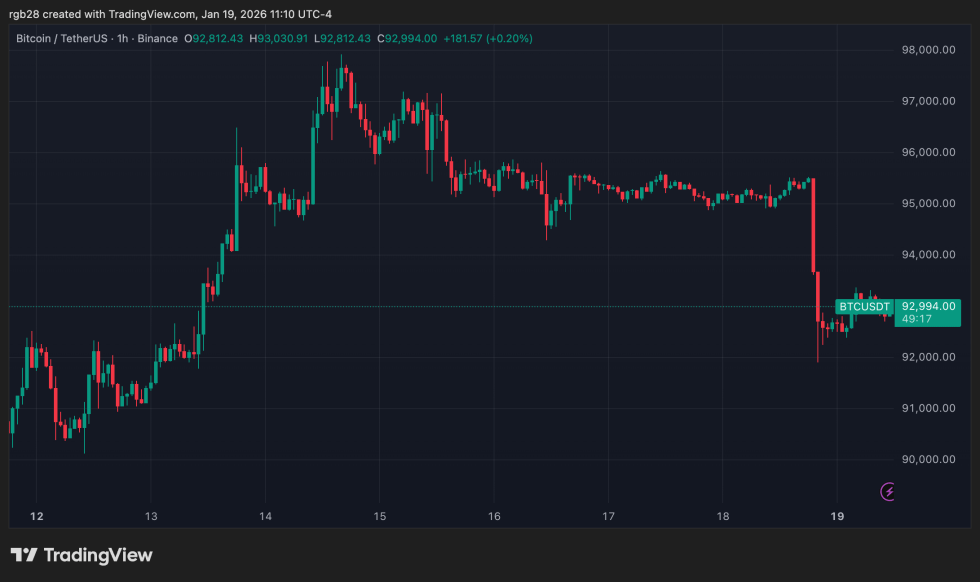
Bitcoin (BTC) trades at $92,994 in the one-week chart. Source: BTCUSDT on TradingView


Preguntas relacionadas

QWhat is the main concern raised by the Hong Kong Securities & Futures Professionals Association (HKSFPA) regarding the OECD's Crypto Asset Reporting Framework (CARF)?

AThe HKSFPA is concerned that certain elements of CARF and related CRS amendments could create operational and liability risks for market participants, particularly regarding record-keeping requirements for dissolved entities and uncapped penalties for minor technical errors.

QWhat specific suggestion did the HKSFPA make to address the record-keeping burden on dissolved entities?

AThe association suggested allowing the appointment of a designated third-party custodian (such as a liquidator or licensed corporate service provider) to fulfill record-keeping obligations instead of placing indefinite personal liability on former individual officers.

QHow did the HKSFPA propose to handle penalties for unintentional administrative errors in crypto reporting?

AThey proposed implementing a reasonable cap on total penalties for unintentional administrative errors or first-time offenses, reserving per-account penalty calculations for cases of willful negligence or intentional evasion.

QWhen will Hong Kong begin its first cross-border exchanges of crypto reporting data under CARF?

AHong Kong will begin its first cross-border exchanges of crypto reporting data in 2028, as one of the 27 jurisdictions committed to implementing the framework.

QWhat recent regulatory development in Hong Kong involves stablecoin issuance?

AThe Hong Kong Monetary Authority (HKMA) enacted the Stablecoins Ordinance in August, requiring any individual or entity seeking to issue a stablecoin in Hong Kong to obtain a license, with the first batch of licenses expected to be granted in early 2025.

Lecturas Relacionadas

Will the Next Crypto Bull Run Start with On-Chain Trading of SpaceX?

This article presents a scenario-based forecast for the crypto industry from 2026 to 2029, arguing that the next major cycle will be driven not by technological narratives but by legal access to real-world assets. The author predicts that by mid-2026, pre-IPO perpetual contracts for top private companies like SpaceX, OpenAI, and Anthropic on platforms like Hyperliquid will become the primary gateway for accessing quality assets, as most crypto-native tokens fail to capture real value. The much-hyped AI x Crypto intersection largely fails except for prediction markets, which thrive on betting on AI model supremacy. By 2027, public blockchain foundations are forced to choose between catering to retail speculation or building compliant infrastructure for institutions, with many opting for the latter. Growth in stablecoins and tokenized private credit/equity hits a "triple ceiling" due to regulatory and political uncertainty rather than market demand. The pivotal shift is forecast for 2028. A major liquidation event in pre-IPO perpetuals exposes the structural flaw of synthetic markets lacking a real underlying asset anchor. In response, regulatory changes finally allow the public solicitation of private securities resales to verified accredited investors. This creates a legitimate secondary market for real company equity, which then becomes the core asset class of the new bull market, relegating synthetic perps to a niche role. By 2029, the industry becomes "boring" but foundational. Tokens without claims on real cash flows or assets cease trading. Stablecoin growth is steady but politically capped. Crypto infrastructure fades from view as it gets absorbed into traditional finance backends. The article's central thesis is that the key bottleneck for crypto's next phase is legal and regulatory channels for real asset ownership, not technology.

marsbitHace 21 min(s)

Will the Next Crypto Bull Run Start with On-Chain Trading of SpaceX?

marsbitHace 21 min(s)

The Value Distribution of Stablecoins

**Summary: The Value Distribution of Stablecoins** The article argues that stablecoins are evolving from mere trading tools into broader channels for dollar access. It divides the stablecoin ecosystem into four layers to analyze how value is distributed: 1. **Issuance Layer:** Mints stablecoins, holds reserve assets, and captures the spread between reserve yield and user costs (e.g., Tether, Circle). This layer currently earns the largest profit margin. 2. **Infrastructure Layer:** Connects stablecoins to the traditional financial system, handling fiat on/off-ramps, banking integration, compliance (KYC/AML), and asset management (e.g., Bridge, BVNK). This is the "unglamorous" but critical work, building the essential bridges between crypto and real-world finance. 3. **Acquiring/Distribution Layer:** Integrates stablecoins into merchant systems, manages payment flows, and provides enterprise financial software (e.g., Stripe, Coinbase). They act as the access point for businesses. 4. **Application Layer:** The end-users and businesses that ultimately use stablecoins for payments, settlements, or as a store of value. They benefit from convenience but have little pricing power. The core thesis is that while the issuance layer currently dominates profits, the often-overlooked **infrastructure layer holds significant long-term potential**. The real challenge and barrier to mass adoption is not the on-chain transfer of stablecoins (which is simple), but the complex "last mile" integration into existing business workflows, banking systems, and regulatory frameworks across different countries. Companies in this layer are currently in a "land grab" phase, investing heavily to build networks, secure bank partnerships, and establish compliance pathways. While their position is currently pressured by the profitable issuers above and distribution platforms below, the article suggests that if stablecoins become a default financial rail for businesses, the infrastructure providers who have done the hard work of integration will ultimately gain strong pricing power and become entrenched, essential players.

marsbitHace 7 hora(s)

The Value Distribution of Stablecoins

marsbitHace 7 hora(s)

The Value Distribution of Stablecoins

The Value Distribution of Stablecoins The article argues that stablecoins are evolving from a mere trading tool into a broad "dollar channel." It analyzes the industry's value chain through four layers: 1. **Issuance Layer (e.g., Tether, Circle):** The top layer that mints stablecoins, holds reserve assets, and captures the thickest interest rate spread. 2. **Infrastructure Layer (e.g., Bridge, BVNK):** Connects stablecoins to the traditional financial system, handling critical but complex "dirty work" like fiat on/off-ramps, banking integration, compliance (KYC/AML), and cross-border settlement. 3. **Acquiring/Distribution Layer (e.g., Stripe, Coinbase):** Embeds stablecoins into merchant systems, manages payment flows, and integrates with enterprise software. 4. **Application Layer:** End-users and businesses that ultimately use stablecoins for payments, settlement, or storing value. The author posits that while the issuance layer currently captures the most profit, the most overlooked and potentially critical layer is infrastructure. The core challenge for stablecoin adoption isn't the on-chain transfer (which is simple), but bridging the gap between blockchain and the real-world financial system. This involves solving practical problems for businesses: fiat conversion, reconciliation, tax handling, and user onboarding. Infrastructure companies are currently in a difficult "land-grab" phase—building networks, securing banking relationships, and achieving compliance country-by-country. They face pressure from both the profitable issuance layer above and distribution platforms below. However, the author suggests this layer is building a crucial moat. Once stablecoins become a default business rail, the infrastructure players who have done the hard work of integration may gain significant, durable value and pricing power.

链捕手Hace 7 hora(s)

The Value Distribution of Stablecoins

链捕手Hace 7 hora(s)

Trading

Spot
Futuros
活动图片




