Hong Kong Issues Licenses, Stablecoin Landscape Shifts: Who is Reshaping the Next Generation Financial Map?

marsbitPublicado a 2026-04-14Actualizado a 2026-04-14

Resumen

Hong Kong's financial landscape has entered a new phase with the issuance of the first stablecoin licenses by the Hong Kong Monetary Authority (HKMA) on April 10, 2026. Anchor Fintech and HSBC were granted the initial approvals, marking the completion of a regulatory framework that spans legislation, review, and licensing. This move signals a strategic shift in the role of stablecoins—from being auxiliary tools in crypto trading to integral components in cross-border payments, tokenized asset transactions, and programmable finance. With only 2 licenses issued from 36 applications, HKMA has adopted a highly selective, quality-over-quantity approach. The licensing process underscores Hong Kong’s ambition to position itself as a leader in digital finance infrastructure, combining banking credibility, payment networks, and blockchain capabilities. Compared to the EU’s MiCA framework and the UK’s upcoming crypto regulations, Hong Kong has gained a first-mover advantage in institutionalizing stablecoins. The city has already laid the foundation with initiatives like tokenized green bonds, e-HKD trials, and the Project Ensemble Sandbox. Globally, dollar-backed stablecoins still dominate over 90% of the market. Hong Kong’s strategy is not to directly challenge the dollar’s dominance but to create a regulated, scalable path for non-dollar stablecoins. It also complements mainland China’s digital yuan system, forming a two-tiered structure: onshore digital RMB for domestic use, and ...

This article is selected from "Fudan Financial Review"
Authors: Gao Huasheng, Deputy Party Branch Secretary, Vice Dean, Professor and Doctoral Supervisor of Finance at Fudan International School of Finance, long-term researcher of crypto assets, author of the series "Stablecoins: The Future of Digital Finance"; Xu Bo, Postdoctoral Researcher at Fudan International School of Finance

On April 10, 2026, the Hong Kong Monetary Authority (HKMA) officially issued the first batch of stablecoin issuer licenses to Anchor Financial Technology Co., Ltd. and The Hongkong and Shanghai Banking Corporation Limited.

With this, Hong Kong has essentially completed the institutional closed loop of "legislation-review-licensing" for fiat-backed stablecoins and has taken the lead in advancing stablecoin regulation to the implementation and business preparation stage.

The importance of this event lies not only in Hong Kong issuing the first batch of licenses, but also in the fact that the functional positioning of stablecoins in Hong Kong is changing. They are no longer just auxiliary tools in crypto asset trading but are explicitly embedded in real-world financial activities such as cross-border payments, local payments, tokenized asset trading, and programmable finance. In other words, Hong Kong's push for stablecoins is not about creating new speculative narratives, but rather an attempt to shape them into part of the digital financial infrastructure.

Judging from the composition of the first batch of licensees, this institutional signal is particularly clear. Anchor Financial Technology was jointly established by Standard Chartered Bank (Hong Kong), Hong Kong Telecom, and Animoca Brands, while HSBC became the other first-batch licensed institution. This combination indicates that Hong Kong's first batch of stablecoins is not a simple legitimization of "crypto-native projects," but rather resembles an institutional integration of bank credit, payment gateways, and on-chain capabilities.

More notably, the HKMA received applications from 36 institutions before the first application deadline, ultimately issuing licenses to only 2 institutions, resulting in a first-batch approval rate of only about 5.6%, and explicitly stated that the number of licenses will remain "very limited" in the future. This shows that Hong Kong is not taking a lenient, expansionary route, but rather one of high-threshold, selective access.

The reason why Hong Kong's licensing is noteworthy also lies in the fact that its "first-mover advantage" is not just a slogan. On May 21, 2025, the Hong Kong Legislative Council passed the Stablecoin Bill; on May 30, the Ordinance was gazetted; on August 1, the Stablecoin Ordinance officially came into effect; and by April 10, 2026, the first batch of licenses were officially issued. Hong Kong has completed the entire chain of "legislation-review-licensing".

In comparison, although the stablecoin-related provisions in the EU's MiCA have been applicable since June 30, 2024, the overall framework will not be fully applicable until December 30, 2024; the UK FCA's new cryptoasset business application window is not set to open until September 30, 2026, with the new rules expected to take effect on October 25, 2027. At least in terms of the pace of regulatory implementation, Hong Kong has already taken the lead among major international financial centers.

More importantly, Hong Kong doesn't just have licenses; it also has use cases. The Hong Kong government completed the issuance of its first HK$800 million tokenized green bond as early as February 2023, and issued another approximately HK$6 billion digital green bond in February 2024, covering currencies including HKD, RMB, USD, and EUR. Meanwhile, the e-HKD Phase 1 has attracted participation from 16 institutions, covering 6 types of application scenarios; the Project Ensemble Sandbox has also been initiated and is gradually entering a new stage supporting real-value transactions. In other words, this licensing round in Hong Kong is not about starting a story from scratch, but is built upon a set of already somewhat formed on-chain financial experiments and infrastructure.

Of course, the importance of Hong Kong's licensing should not be simplistically interpreted as it being about to immediately rewrite the global stablecoin landscape. The total market capitalization of the global stablecoin market has now reached $317 billion, an increase of over 50% since the beginning of 2025; but structurally, over 90% of fiat-backed stablecoins are still pegged to the US dollar, with USDT and USDC together accounting for about 93% of the total market value.

This means that on-chain finance has not fundamentally rewritten the global monetary power structure thus far, but has, to a considerable extent, continued the dominant position of US dollar credit, US dollar assets, and US dollar liquidity. Hong Kong's breakthrough here lies more in pioneering a more institutionalized, verifiable, and implementable development path for non-USD stablecoins in the short term rather than directly challenging the dollar.

Viewed within the broader context of China's digital finance, the true significance of Hong Kong's licensing may not lie in whether the mainland immediately replicates a set of RMB stablecoin regulations, but rather in how it further highlights a more layered arrangement: within the territory, using the digital yuan to safeguard the legal tender, retail payments, and regulatory bottom line; outside the territory, using Hong Kong as an offshore regulatory testing ground to explore the application boundaries of compliant stablecoins in cross-border payments, on-chain settlement, and tokenized asset trading.

The digital yuan leans more towards official leadership and domestic institutional construction, while Hong Kong's licensed stablecoins are closer to offshore markets, international payments, and on-chain trading scenarios. The two are not necessarily a substitute relationship but are more likely to form a pattern of layered advancement and mutual complementarity.

However, necessary restraint should be maintained. An institutional closed loop does not equal a market closed loop, and the first license issuance does not mean the competitive landscape is set. Whether HKD stablecoins can truly succeed still depends on whether they can form strong enough network effects, payment demand, and scenario stickiness. Especially given the clear first-mover advantage already established by USD stablecoins, whether the Hong Kong model can evolve from a "high-quality example" to a "system with scaled influence" still requires time to test.

Overall, the issuance of Hong Kong's first batch of stablecoin licenses is indeed an important node in the evolution of global stablecoin regulation. What is truly worth paying attention to is not how much market success Hong Kong has already achieved, but that it has率先 provided an institutional sample that can be observed, tested, and iterated upon.

By issuing only 2 licenses from 36 applications, Hong Kong has not taken a step of indiscriminate expansion, but rather conducted a high-threshold screening for the next generation of digital financial infrastructure. Whether this path can succeed in the future does not depend on how many licenses are issued, but on whether institutional credit, real-world scenarios, payment networks, and on-chain asset circulation can be truly integrated into a system.


Preguntas relacionadas

QWhat is the significance of Hong Kong issuing the first stablecoin licenses to Anchorpoint Fintech and HSBC?

AThe issuance of the first stablecoin licenses by the HKMA marks the completion of Hong Kong's regulatory framework for stablecoins, transitioning them from speculative tools to integral parts of digital financial infrastructure for cross-border payments, tokenized asset trading, and programmable finance. It represents a high-threshold, selective approach to integrating banking credibility, payment gateways, and on-chain capabilities.

QHow does Hong Kong's approach to stablecoin regulation compare to the EU's MiCA and the UK's timeline?

AHong Kong has established a first-mover advantage by completing its 'legislation-review-licensing' process faster. Its Stablecoin Ordinance took effect on August 1, 2025, with licenses issued by April 2026. In contrast, the EU's MiCA stablecoin rules began in June 2024 but the full framework applies from December 2024, and the UK's new crypto asset application window opens in September 2026, with rules taking effect in October 2027.

QWhat is the current global market structure of fiat-backed stablecoins, and what challenge does Hong Kong face?

AOver 90% of the global fiat-backed stablecoin market, with a total市值 of $317 billion, is pegged to the US dollar, with USDT and USDC comprising about 93%. Hong Kong's challenge is not to immediately challenge the dollar's dominance but to pioneer an institutionalized, verifiable development path for non-USD stablecoins and build sufficient network effects and adoption to scale its model.

QWhat role does Hong Kong's stablecoin initiative play within China's broader digital finance strategy?

AIt creates a layered strategy: mainland China uses the digital yuan (e-CNY) to safeguard legal tender status and retail payments domestically, while Hong Kong serves as an offshore testing ground for compliant stablecoins in cross-border payments, on-chain settlement, and tokenized asset transactions. The two are complementary, not substitutive, forming a tiered advancement.

QWhat existing infrastructure and trials in Hong Kong support the new stablecoin ecosystem?

AHong Kong has already conducted trials such as the issuance of HK$8 billion in tokenized green bonds in February 2023 and a ~HK$60 billion digital green bond in February 2024. The e-HKD pilot involves 16 institutions across 6 application scenarios, and the Project Ensemble Sandbox has progressed to supporting real-value transactions, providing a foundational ecosystem for licensed stablecoins.

Lecturas Relacionadas

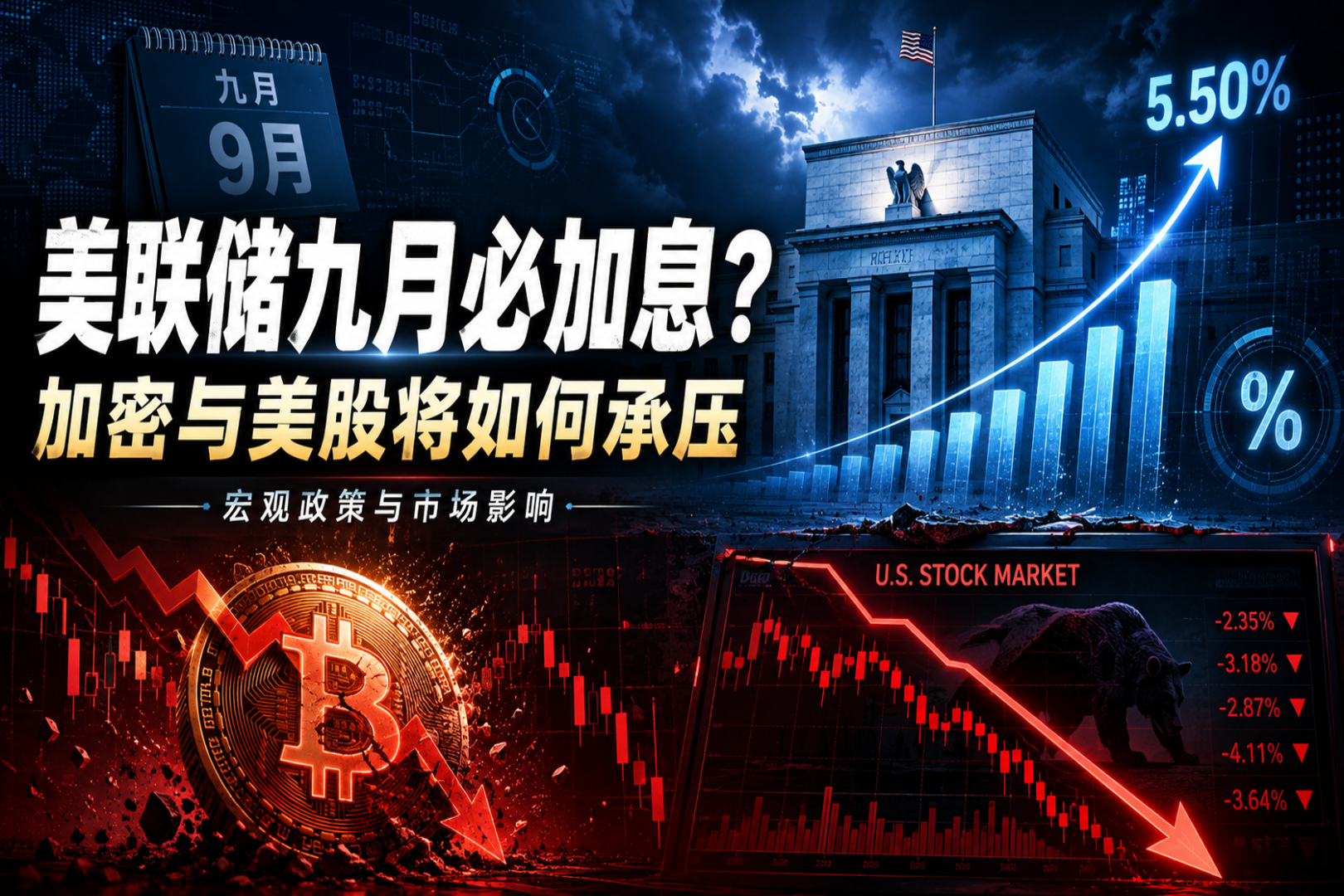
Will the Fed Definitely Raise Interest Rates in September? How Will Crypto and U.S. Stocks Withstand the Pressure?

The market's expectation for a September Fed rate hike surged dramatically in early August, jumping from under 50% to over 80% within a week. This shift followed a contentious July FOMC meeting, where a 9-3 vote to hold rates revealed growing dissent from hawkish members advocating for an immediate hike to combat persistent inflation. The primary catalyst for this repricing is rising oil prices, driven by renewed geopolitical tensions around the Strait of Hormuz, which threaten global supply. Energy costs directly influence inflation metrics, making the upcoming July CPI report (due August 12th) a critical data point. If it shows inflation reaccelerating, the probability of a September hike will solidify. For Bitcoin and crypto assets, this is typically bearish news. Bitcoin continues to behave as a high-beta, liquidity-sensitive risk asset. A rate hike raises the opportunity cost of holding non-yielding assets and could drive capital toward money markets, pressuring crypto prices in the short term. However, historical patterns suggest that if a hike is perceived as the end of a tightening cycle rather than the start, any negative price impact may be brief. U.S. stocks, particularly crypto-linked equities like Coinbase and growth-oriented tech stocks, are also vulnerable. Higher rates increase discount rates in valuation models, putting pressure on high-multiple companies. This coincides with a pivotal tech earnings season where investor focus has shifted from massive AI capital expenditure to tangible revenue and cash flow generation. Companies with negative cash flow and weak growth narratives could face heightened volatility if borrowing costs rise in September. In summary, a September Fed hike has evolved into a mainstream market scenario. Key factors to watch are oil prices, the July CPI report, and Fed communications, which will determine the final decision and its impact on volatile crypto and equity markets.

marsbitHace 3 min(s)

Will the Fed Definitely Raise Interest Rates in September? How Will Crypto and U.S. Stocks Withstand the Pressure?

marsbitHace 3 min(s)

A 'Overlooked' Market Event: Joint US-Japan-South Korea Intervention, Rare US Treasury Involvement, and Bessent's Quiet 'Market Rescue'?

Summary: The United States, Japan, and South Korea executed their largest coordinated foreign exchange intervention in nearly 30 years. The action targeted depreciation pressure on the Japanese yen and South Korean won. This move is seen as a significant effort by the US to stabilize the financial markets of its key allies and prevent the spillover of risks. Key details: * Japan reportedly intervened on July 30 using approximately 8.45 trillion yen (about $52.8 billion). South Korean authorities also intervened that day, selling dollars to support the won. * Notably, the US Treasury Department intervened directly in yen markets for the first time in roughly 30 years. The New York Fed, reportedly acting on behalf of the Treasury, sold euros to buy yen via Goldman Sachs and Morgan Stanley on July 31. Analysts view the use of the euro-yen pair as a way to alleviate yen pressure without adding selling pressure to the US dollar. * Prior to the action, the New York Fed conducted "rate checks" on both USD/JPY and EUR/JPY, a newer signaling tool that falls between verbal and physical intervention. The intervention is interpreted as going beyond traditional currency stabilization. Analysts, such as Michael Hartnett of Bank of America, suggest it resembles a "Price Keeping Operation" for the AI era. The core US objectives are perceived to be: 1. Preventing rapid yen depreciation from triggering a sharp rise in Japanese government bond yields. 2. Containing financial stress from spreading across Asian markets like South Korea and Japan. 3. Reducing the risk of disorderly capital flows impacting the US bond market. This coordinated action underscores the importance of Japan and South Korea as critical partners in the US semiconductor and AI supply chain. Stabilizing their financial markets is seen as vital to mitigating risks to the broader tech industry and the US market itself. The intervention coincides with market pressures, including the KOSDAQ index hitting a low since October 2022. While seen as a move to control volatility, some analysts caution it may not fundamentally reverse existing market trends.

marsbitHace 7 min(s)

A 'Overlooked' Market Event: Joint US-Japan-South Korea Intervention, Rare US Treasury Involvement, and Bessent's Quiet 'Market Rescue'?

marsbitHace 7 min(s)

Will the Federal Reserve Definitely Raise Interest Rates in September? How Will Cryptocurrencies and US Stocks Bear the Pressure?

In early August 2024, market expectations for a September Federal Reserve rate hike surged dramatically, from below 50% to over 80%, driven by renewed inflation concerns. This shift followed a contentious July FOMC meeting where a 9-3 vote to hold rates revealed a growing hawkish faction advocating for an immediate hike, citing prolonged above-target inflation. The key catalyst is escalating conflict near the Strait of Hormuz, which has pushed oil prices up approximately 20% in July, threatening to reignite inflation. The next critical data point is the July CPI report on August 12th; a hot reading could solidify hike expectations. For crypto assets, particularly Bitcoin, this represents near-term pressure. Bitcoin continues to exhibit high-beta, risk-on characteristics, making it sensitive to tightening liquidity and higher opportunity costs. However, historical precedent suggests that if a hike is perceived as the cycle's end rather than its start, the negative impact may be brief, with markets quickly pivoting to anticipate future rate cuts. U.S. stocks, especially crypto-linked equities like Coinbase and high-valuation tech stocks, face amplified volatility. Higher rates increase discount rates in valuation models, pressuring growth stocks. This coincides with a pivotal tech earnings season where investor focus has shifted from massive AI capital expenditures to demonstrable revenue and cash flow generation. Companies with negative cash flows and weak growth narratives could see severe pressure if a September hike materializes, as financing costs would rise. Key indicators to watch include oil prices, upcoming inflation data, and Fed commentary at events like the Jackson Hole symposium.

Odaily星球日报Hace 7 min(s)

Will the Federal Reserve Definitely Raise Interest Rates in September? How Will Cryptocurrencies and US Stocks Bear the Pressure?

Odaily星球日报Hace 7 min(s)

Trading

Spot
活动图片