Hong Kong Aims to Act as Global Connector Between Crypto and Traditional Finance

TheNewsCryptoPublicado a 2026-02-02Actualizado a 2026-02-02

Resumen

Hong Kong lawmaker Johnny Ng emphasizes that the city is positioning itself as a global connector between cryptocurrency and traditional finance, rather than competing directly with other nations. He argues that crypto is not a zero-sum game and should function as an interconnected global system. Hong Kong’s advantages include its common law system, English-language courts, and free capital flow, which help build a regulated and trusted crypto environment. The city also leverages the Greater Bay Area, collaborating with hubs like Shenzhen and Macau to combine fundraising and regulatory expertise with technological innovation. Recent efforts include inviting global crypto firms, such as Coinbase, to establish operations in Hong Kong and introducing clearer custody and OTC trading rules to better integrate crypto with institutional and corporate finance.

Johnny Ng, a Hong Kong lawmaker and a strong supporter of Web3 and digital assets, says that Hong Kong is not trying to “Beat” other countries in crypto; instead, it can act as a global connector between crypto markets and traditional finance across the U.S., Europe, and China.

Ng says that crypto should not be treated as the Zero sum game, meaning Crypto doesn’t belong to one country and is global, which works best when it is connected. He also stated that Hong Kong’s goal is to link East and West, Crypto startups and traditional banks, and innovation and regulations.

Why Hong Kong has a strong advantage

According to him, Hong Kong already has the strong advantages of a common law system that the global investors could understand and the English language court, trusted by the international businesses, with a free movement of money in and out of the city. This helps Hong Kong to build a crypto market that is regulated, safer, and accepted by the global financial institutions.

A key part of Hong Kong’s strategy involves the Greater Bay Area, which connects cities and Chinese hubs such as Shenzhen and Macau. Ng explained that Hong Kong helps to raise money and handle rules, whereas these main cities turn ideas into real products, which makes the region powerful.

Inviting the global crypto firms
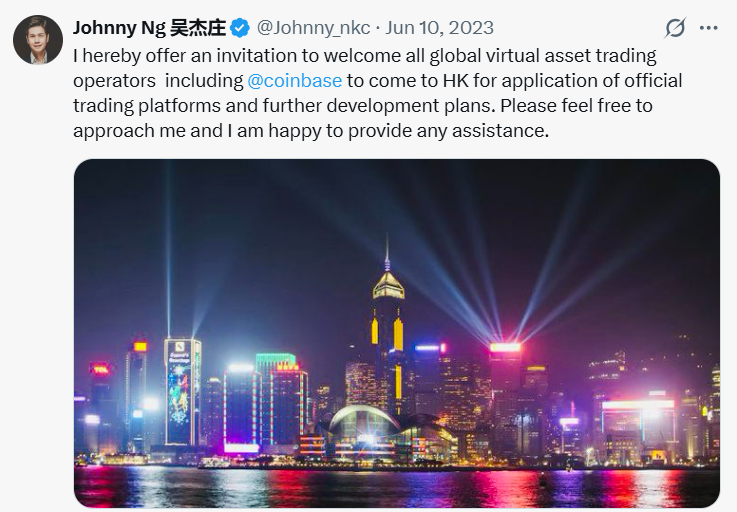
Ng pointed out that Vitalik Buterin spent a lot of time in Hong Kong during Ethereum’s early stages, which shows that the region has long supported blockchain innovations. In 2023, during the period of strict enforcement by the U.S. regulations, he invited the major crypto companies like Coinbase to operate in Hong Kong.

In 2026, Hong Kong plans to introduce clearer custody rules and regulate OTC crypto trading with larger trading limits for professional investors. Ng says that the next phase is about the infrastructure, and these steps aim to make crypto work smoothly with real businesses and large investors.

Highlighted Crypto News:

XRP Slides Below $1.60 Amid Broader Crypto Market Pullback

TagsBlockchainCryptoHongKong

Preguntas relacionadas

QWhat role does Hong Kong aim to play in the global crypto market according to Johnny Ng?

AHong Kong aims to act as a global connector between crypto markets and traditional finance, linking East and West, crypto startups and traditional banks, and innovation and regulations.

QWhat advantages does Hong Kong have in building a regulated crypto market?

AHong Kong has a common law system, English language courts trusted by international businesses, and free movement of money, which help build a regulated, safer crypto market accepted by global financial institutions.

QHow does the Greater Bay Area contribute to Hong Kong's crypto strategy?

AThe Greater Bay Area connects cities like Shenzhen and Macau, where Hong Kong handles fundraising and regulations while these cities turn ideas into real products, making the region powerful.

QWhat did Johnny Ng do in 2023 regarding global crypto companies?

AIn 2023, during strict U.S. regulations, Johnny Ng invited major crypto companies like Coinbase to operate in Hong Kong.

QWhat regulatory steps is Hong Kong planning for 2026 to support crypto integration?

AIn 2026, Hong Kong plans to introduce clearer custody rules and regulate OTC crypto trading with larger limits for professional investors to make crypto work smoothly with real businesses and large investors.

Lecturas Relacionadas

BIT Research: Liquidity is Disappearing, Will Bitcoin Replay the Bottoming Pattern of 2022?

The crypto market is currently in an adjustment phase driven by policy expectations and liquidity shifts. Despite a brief rebound fueled by geopolitical easing and SpaceX's strong IPO performance, unexpectedly hawkish signals from new Fed Chair Kevin Warsh have removed anticipated easing support. Concurrently, stablecoin liquidity is shrinking, with insufficient new capital inflows, pushing the market into a typically quiet summer period. Pricing lacks catalysts for a sustained rally. Daily trading volume has significantly contracted, stablecoin growth has slowed markedly, and the supportive effect of Strategy's (formerly MicroStrategy) STRC preferred stock-financed Bitcoin purchases is fading. Amid policy uncertainty, seasonal weakness, and liquidity contraction, Bitcoin faces near-term downward pressure. Warsh's hawkish pivot and refusal to provide a clear policy outlook have increased risk premiums, historically unfavorable for Bitcoin. Technically, the trend remains bearish below $73,700, with $62,446 as critical support. A break below could accelerate declines, though a prolonged consolidation phase, similar to 2022's bottoming process, is possible. Liquidity is a core constraint. Current daily volume is around $500 billion, roughly 25% of the peak during the July-Oct 2025 rally. The 12-month growth rates for USDT and USDC have fallen to ~20%, with 6-month growth near zero, indicating weak new inflows. Bitcoin ETF and Strategy-driven inflows have also weakened, with a 30-day rolling net outflow. With inflation at 4.2% above the Fed's target, combined hawkish policy, seasonal factors, and liquidity shortages challenge Bitcoin's ability to hold above $60,000. However, this adjustment phase may be forming a cyclical low this summer, potentially setting the stage for the next bull cycle.

marsbitHace 28 min(s)

BIT Research: Liquidity is Disappearing, Will Bitcoin Replay the Bottoming Pattern of 2022?

marsbitHace 28 min(s)

Who Makes the Best Use of Claude Code? The Answer Might Not Be Programmers

Claude Code Usage Report Summary (Based on ~400k sessions) Core Finding: In agentic programming with Claude Code, a clear division of labor has emerged: humans primarily decide *what* to build (planning decisions), while Claude decides *how* to build it (execution decisions). Key Insights: 1. **Effectiveness is not limited to programmers.** In code-generation tasks, success rates for users in non-technical fields (law, finance, management, research) are nearing those of software engineers. What matters most is the user's domain expertise and understanding of the problem to be solved. 2. **Domain expertise drives success and efficiency.** Sessions where users exhibited "expert" proficiency in the task's domain saw verified success rates double compared to "novice" sessions. Experts also delegated more work per instruction, with Claude executing more actions and producing more output. 3. **AI is amplifying, not replacing, domain knowledge.** Claude Code lowers the *implementation* barrier, not the *judgment* barrier. The value of knowing the "what" and "why" is increasing relative to just knowing the "how" to code. 4. **Usage is evolving.** Over a 7-month period (Oct '25 - Apr '26), the share of sessions for debugging halved, while use for software operations, data analysis, and non-code writing roughly doubled. The estimated economic value of typical tasks increased by ~25%. Conclusion: The data suggests coding agents are making programming background less critical for completing technical tasks. However, they reward and amplify deep domain understanding. The ability to successfully direct an AI agent stems more from mastery of a specific field than from coding skill itself. The primary gains come from being competent in a domain; deep specialization adds only marginal additional advantage. This may signal a shift where software creation becomes integrated into various professions.

marsbitHace 1 hora(s)

Who Makes the Best Use of Claude Code? The Answer Might Not Be Programmers

marsbitHace 1 hora(s)

Trading

Spot
Futuros
活动图片