Here’s what happened in crypto today: $414M ETF outflows, “Mined in America” bill & more

ambcryptoPublicado a 2026-03-31Actualizado a 2026-03-31

Resumen

Amid heightened US-Iran tensions, the crypto market faced significant pressure, with altcoins hit particularly hard—40% were at or near all-time lows, a more severe state than the previous cycle. Bitcoin spot ETFs saw $414 million in outflows, breaking a four-week inflow streak, as rising oil prices and inflation fears dampened investor sentiment. Meanwhile, US Senators proposed the "Mined in America" bill to promote domestic cryptocurrency mining and establish a Strategic Bitcoin Reserve. Additionally, the Speaker of Iran’s Parliament offered trading advice, suggesting that pre-market news often acts as a "reverse indicator." Both crypto and stock markets reacted sharply to geopolitical developments, with BTC briefly rallying before declining again.

As tensions between the United States and Iran remained high, the altcoin market was approaching cycle extremes, with 40% of altcoins at or near all-time lows, according to a CryptoQuant research report. The total valuation of the crypto market was down 45% from its peak of $4.27 trillion, reached in October 2025.

The report laid out how current conditions are slightly more severe compared to the previous cycle, where only 38% of altcoins fell to or around their all-time lows. The figure was already at 40% this time, and the long-term downtrend of Bitcoin was still in place.

Here’s a full breakdown of top headlines that shaped crypto in the past 48 hours.

ETF flows respond to US-Iran tensions
Source: SoSoValue

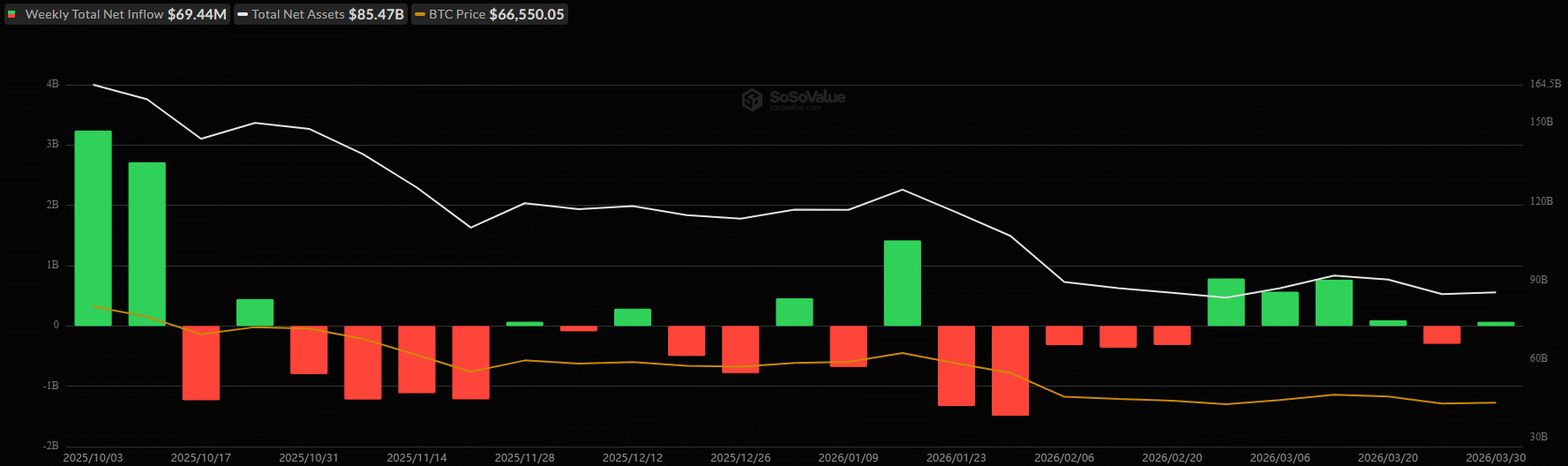
Starting in the final week of February, the Bitcoin spot ETF flows were positive and racked up a 4-week streak of inflows. This streak measured $2.218 billion, but the week ending on Friday, the 27th of March, brought $414 million in outflows.

Even before the inflow streak broke, the inflows massively slowed down in the third week of March, with just $95.18 million in inflows.

This was due to the rising oil prices, inflation worries, and it was becoming increasingly clear that the conflict would not see a quick resolution.

Farside Investors’ data showed that Bitcoin ETFs saw positive flows on Monday, the 30th of March, as BTC fell to the swing low at $65.6k.

U.S. Senators propose “Mined in America” bill

Introduced by Senators Bill Cassidy and Cynthia Lummis, the “Mined in America” act seeks to expand U.S.-based cryptocurrency mining. It also codifies a Strategic Bitcoin Reserve, as was the earlier executive push.


Source: Senator Bill Cassidy

The legislation allows facilities to qualify as “Mined in America” if they meet certain criteria through a voluntary certification program. The aim is to move away from mining hardware linked to foreign adversaries.

The previous executive actions outlined the Strategic Bitcoin Reserve idea, but this legislation seeks to embed it into law. This could strengthen U.S. leadership in digital assets.

Iran’s Speaker of the Parliament’s trading advice

In a post on X on the 29th of March, Mohammad Ghalibaf, Iran’s Speaker of the Parliament, said,

Pre-market news is a ‘reverse indicator’ and if they ‘dump’ the market, then “go long.”
Source: The Kobeissi Letter

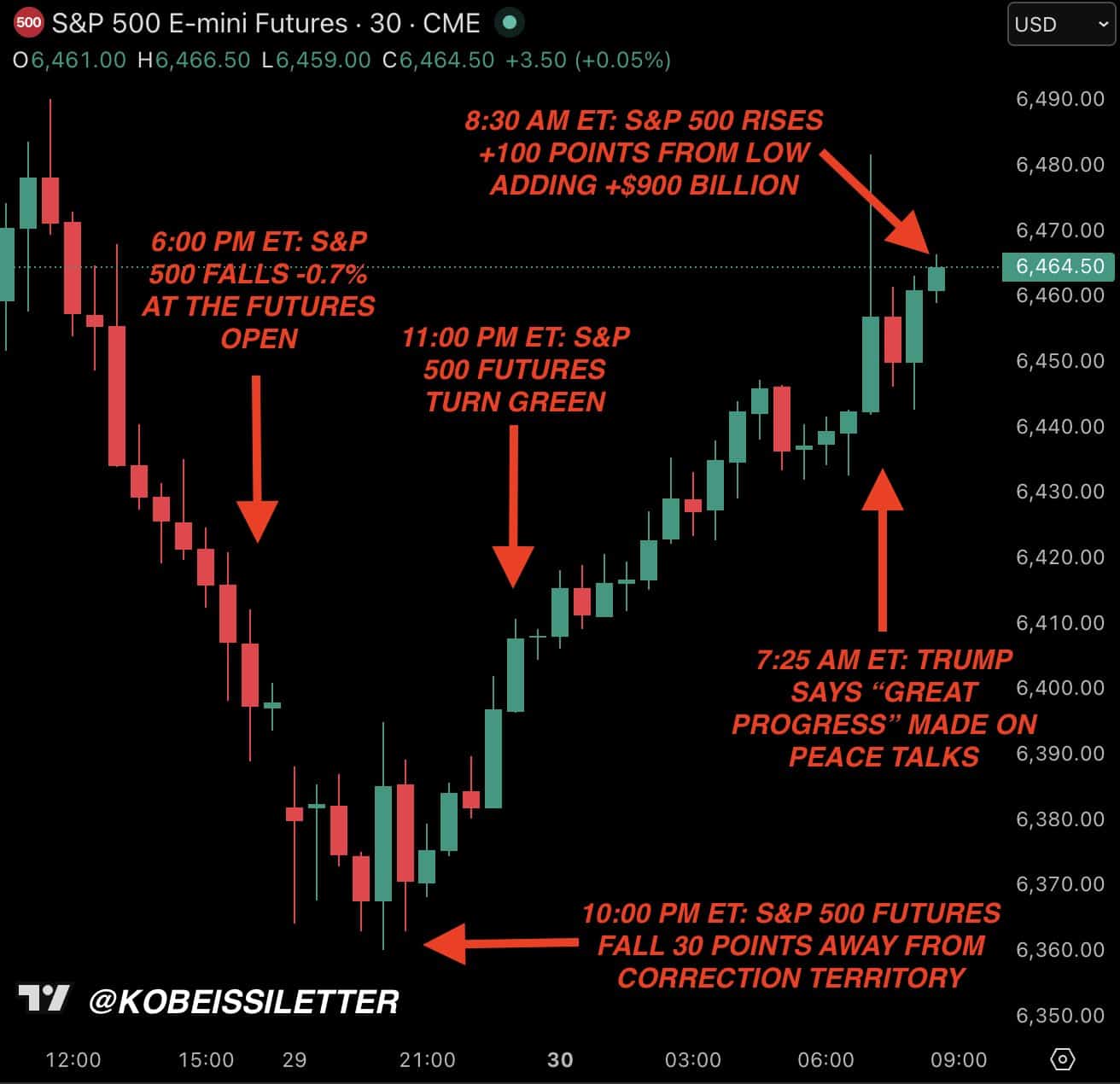
On the 30th of March, before the market opened, President Trump announced that “great progress” was being made in Iran peace talks. The S&P 500 rallied off the news but was quick to slump and was 1.3% down from the local high on the 30th of March.

Crypto was also affected by the stock markets, with BTC rallying 3.2% from recent lows before slumping lower at press time.

No matter which way you slice it, peace talks blossoming before Monday’s market opens and fading away days later is an interesting pattern.


Final Summary

  • The US-Iran tensions saw Bitcoin investors take profits earlier in March, and selling pressure has ramped up over the previous week.
  • The bill pushing toward domestic Bitcoin mining hardware also sought to establish a Strategic Bitcoin Reserve.


Preguntas relacionadas

QWhat percentage of altcoins were at or near all-time lows according to the CryptoQuant report, and how does this compare to the previous cycle?

AAccording to the CryptoQuant report, 40% of altcoins were at or near all-time lows. This is slightly more severe than the previous cycle, where only 38% of altcoins fell to or around their all-time lows.

QWhat was the total amount of outflows for Bitcoin spot ETFs in the week ending March 27th, and what broke the previous 4-week inflow streak?

AThe total outflows for Bitcoin spot ETFs in the week ending March 27th were $414 million. This broke the previous 4-week streak of inflows, which had reached a total of $2.218 billion.

QWhat is the main goal of the 'Mined in America' bill proposed by Senators Cassidy and Lummis?

AThe main goal of the 'Mined in America' bill is to expand U.S.-based cryptocurrency mining and codify a Strategic Bitcoin Reserve. It establishes a voluntary certification program for facilities that meet certain criteria, aiming to move away from mining hardware linked to foreign adversaries and strengthen U.S. leadership in digital assets.

QWhat trading advice did Iran's Speaker of the Parliament, Mohammad Ghalibaf, give in his post on X?

AIn his post on X, Mohammad Ghalibaf advised that pre-market news is a 'reverse indicator.' He suggested that if they 'dump' the market, then traders should 'go long.'

QHow did the announcement of progress in Iran peace talks by President Trump on March 30th affect the financial markets?

APresident Trump's announcement of 'great progress' in Iran peace talks on March 30th initially caused the S&P 500 to rally. However, it quickly slumped and was down 1.3% from its local high later that day. Similarly, Bitcoin rallied 3.2% from recent lows but then slumped lower again.

Lecturas Relacionadas

Within Strategy's Framework, STRC's Dividend Yield Remains at 12% as Share Price Stays Below Par Value

Michael Saylor, Executive Chairman of Strategy (MSTR), confirmed that the dividend rate for its STRC perpetual preferred shares will remain at 12.00% through August 2026. The rate has increased from 9% at its July 2025 launch to the current high via a "ratchet" mechanism, which permanently raises the rate by 0.5% whenever the share price falls below $95. This mechanism is intended to push the price back toward its $100 par value and support Strategy's "at-the-market" (ATM) program for issuing new shares to fund Bitcoin purchases. However, the mechanism has not worked as intended. STRC shares closed at $89.46 on July 31, remaining about 10-11% below par value despite the record-high dividend. Competition from rival Strive's higher-yielding SATA securities has pressured demand. The persistent discount has forced Strategy to suspend new STRC issuances via its ATM program, limiting this funding channel for Bitcoin acquisitions. STRC's struggles reflect Bitcoin's own volatility, as the preferred shares historically move in tandem. Analysts have warned the ratchet structure carries long-term, one-way risk. A law firm is investigating Strategy's ability to maintain dividend payments if Bitcoin's price stays low. Retail investors own roughly 83% of outstanding STRC shares, a group seen as prone to panic selling during downturns. In response, Strategy has established financial reserves, including a liquidity cushion covering about 26 months of dividend/interest obligations, and a $2 billion share buyback program alongside a Bitcoin monetization framework, though the company emphasized it is not obligated to sell any Bitcoin.

cryptonews.ruHace 26 min(s)

Within Strategy's Framework, STRC's Dividend Yield Remains at 12% as Share Price Stays Below Par Value

cryptonews.ruHace 26 min(s)

Analyst: Bitcoin's Price Will Drop to $60k in August, Then Rebound to $70k

Financial analyst Andrey Poroshin has provided a new forecast for Bitcoin's price dynamics in August. Poroshin, an analyst at the Bitbanker exchange, expects the cryptocurrency market to experience a downturn this month, with prices retesting the $60,000 level due to a lack of supportive macroeconomic catalysts. He noted that the recent US Federal Reserve decision to hold interest rates did not significantly impact the market, while inflation remains above the 2% target. Poroshin stated that Bitcoin is ending July under pressure from moderate volatility and a lack of new macroeconomic stimuli, leading to continued market caution. According to his base scenario, Bitcoin will drop to a range of $60,000 to $62,000 before recovering to $70,000. He pointed out that even $70,000 remains below the cost of mining in the US, which has prompted some miners to shift towards AI data center operations. Poroshin cited the winding down of BitMEX's operations as a potential catalyst for a price rebound, suggesting the exit of weaker players often coincides with market reversals and reduced short-term selling pressure. He believes Bitcoin is currently less susceptible to geopolitical shocks, such as the Iran-US conflict, and does not expect significant market changes in August related to the pending CLARITY Act. Looking ahead, Poroshin forecasts that September will bring more active price fluctuations driven by potential Fed rate decisions and possible discussions or approval of the CLARITY Act.

cryptonews.ruHace 26 min(s)

Analyst: Bitcoin's Price Will Drop to $60k in August, Then Rebound to $70k

cryptonews.ruHace 26 min(s)

Trading

Spot
活动图片