HashKey CaaS and Lingchu Intelligence Form Strategic Partnership to Jointly Build AI Autonomous Payment Infrastructure

marsbitPublicado a 2026-01-29Actualizado a 2026-01-29

Resumen

HashKey CaaS and Lingchu Intelligence have entered into a strategic partnership to jointly develop AI autonomous payment infrastructure. The collaboration will focus on data tokenization for robots and the implementation of the HP2 (HashKey Payment Protocol) autonomous payment network, aiming to integrate AI with the digital financial system and build key infrastructure for the embodied intelligence economy. As part of the agreement, Lingchu will deploy 10 dual-arm robots integrated with HashKey CaaS’s HP2 payment protocol, designed for Web3 and AI agents. These robots will gain controlled payment permissions, enabling them to act as autonomous agents to conduct on-chain transactions—such as purchasing services, accessing data interfaces, and earning on-chain income through task execution. Each autonomous transaction will be recorded as an auditable on-chain financial record, transforming the robots from mere smart devices into independent participants in the digital economy. Additionally, HashKey CaaS will tokenize the operational data generated by Lingchu’s robots, turning them into tradable digital assets with monetary value. HashKey’s CEO of On-Chain Business Group, Li Chen, stated that this partnership marks the first application of the HP2 protocol in embodied AI, supporting the integration of robots into the digital financial ecosystem. Wang Qibin, CEO of Lingchu Intelligence, emphasized that the collaboration will help accelerate the transition from R&D to an ecosy...

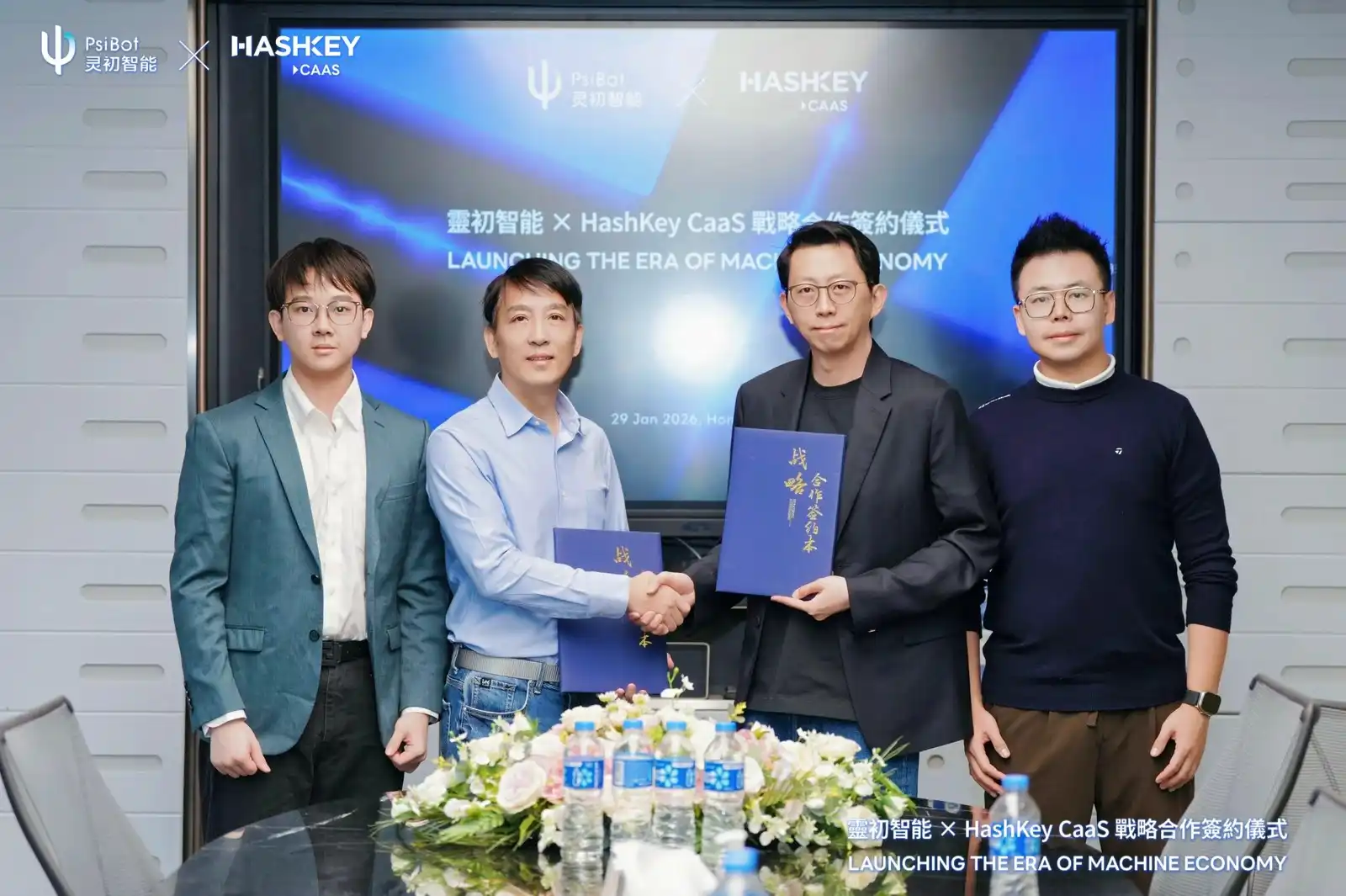
HashKey CaaS has announced a strategic partnership with Lingchu Intelligence, a robotics company focused on the field of embodied AI. The two parties will engage in in-depth collaboration around robot data tokenization and the HP2 (HashKey Payment Protocol) autonomous payment network, promoting the integration of AI and the digital financial system, and jointly building the key infrastructure for the embodied intelligent economy.

As part of this collaboration, Lingchu Intelligence will deploy 10 dual-arm robots and integrate them with HashKey CaaS's HP2 payment protocol, which is specifically designed for Web3 and AI Agents. Through HP2, the robots will gain controlled payment permissions, enabling them to perform on-chain interactions as "autonomous agents," including autonomously purchasing services, calling data interfaces, and earning on-chain revenue by executing tasks. Throughout this process, every autonomous transaction generated by the robots will be fully recorded as auditable on-chain financial credentials, transforming the robots from traditional "intelligent devices" into genuine "digital economic entities" capable of independently participating in economic activities.

Simultaneously, HashKey CaaS will convert the operational data generated by Lingchu Intelligence's robots during actual operation into tradable tokenized digital assets, endowing "robot data" with asset attributes and transactional value.

Li Chen, CEO of HashKey On-Chain Business Group, stated: "This collaboration marks the first application of the HP2 protocol in the field of embodied AI. HashKey CaaS's on-chain new financial infrastructure will support robots and AI in truly integrating into the digital financial system, achieving autonomous on-chain data transactions and value circulation, and laying the foundation for embodied intelligence to participate in the real economy."

Wang Qibin, CEO of Lingchu Intelligence, stated: "The widespread application of embodied intelligence relies on the confirmation of data value and an automated value exchange system. Through the partnership with HashKey, Lingchu Intelligence will accelerate its transition from technological research and development to ecosystem development oriented towards the machine economy."

In the future, the two parties will continue to explore more applications of embodied intelligence in scenarios such as payment and autonomous services, accelerate the implementation of related technologies and models, and promote the shift of the AI economy from conceptual validation to large-scale practice.


Preguntas relacionadas

QWhat is the strategic partnership between HashKey CaaS and Lingchu AI about?

AThe strategic partnership between HashKey CaaS and Lingchu AI focuses on robot data tokenization and the HP2 (HashKey Payment Protocol) autonomous payment network. They aim to integrate AI with the digital financial system and build key infrastructure for the embodied intelligent economy.

QHow many robots will Lingchu AI deploy as part of this collaboration?

ALingchu AI will deploy 10 dual-arm robots as part of this collaboration.

QWhat is the HP2 payment protocol designed for?

AThe HP2 payment protocol is designed for Web3 and AI Agents, enabling robots to have controlled payment permissions, act as autonomous agents for on-chain interactions, purchase services, call data interfaces, and earn on-chain income through task execution.

QHow will HashKey CaaS utilize the operational data from Lingchu AI's robots?

AHashKey CaaS will convert the operational data generated by Lingchu AI's robots into tokenized digital assets, giving the data asset attributes and transactional value.

QWhat did HashKey's On-Chain Business Group CEO, Li Chen, say about this partnership?

ALi Chen stated that this partnership is the first application of the HP2 protocol in the embodied intelligence field. HashKey CaaS's on-chain financial infrastructure will support robots and AI in integrating into the digital financial system, enabling autonomous on-chain data settlement and value transfer, laying the foundation for embodied intelligence to participate in the real economy.

Lecturas Relacionadas

TechFlow Intelligence Bureau: KelpDAO Attack Causes Nearly $300 Million Loss, Triggers Aave Withdrawal Wave, RAVE Crashes 95% in a Single Day

China's AI firm DeepSeek is seeking external funding for the first time, with a valuation exceeding $10 billion, signaling intensifying competition and high R&D costs in the domestic large model sector. Meanwhile, OpenAI CEO Sam Altman faces scrutiny over potential conflicts of interest between his personal investments and OpenAI’s business ahead of a possible IPO. In Web3, KelpDAO suffered a $294 million attack due to forged cross-chain messages on LayerZero, leading to massive withdrawals from Aave and a resulting 18% drop in AAVE tokens. Separately, RAVE cryptocurrency collapsed by 95% in a single day amid suspected insider manipulation. Geopolitically, Iran is now demanding Bitcoin payments for transit through the Strait of Hormuz, reflecting both internal governmental discord and the growing adoption of crypto in tense regions. In semiconductors, Nvidia CEO Jensen Huang showed rare public frustration over questions regarding chip sales to China, while the industry faces renewed price hikes. Tesla continues expanding its Robotaxi service, and a Chinese humanoid robot outperformed humans in a half-marathon, marking a milestone in robotics. Despite Middle East tensions and market uncertainties, U.S. stocks continue to rise, prompting discussions about market optimism versus risk blindness. Overall, today’s developments highlight systemic vulnerabilities—in tech, finance, and geopolitics—while also showcasing innovation in crises.

marsbitHace 5 hora(s)

TechFlow Intelligence Bureau: KelpDAO Attack Causes Nearly $300 Million Loss, Triggers Aave Withdrawal Wave, RAVE Crashes 95% in a Single Day

marsbitHace 5 hora(s)

Trading

Spot
Futuros
活动图片