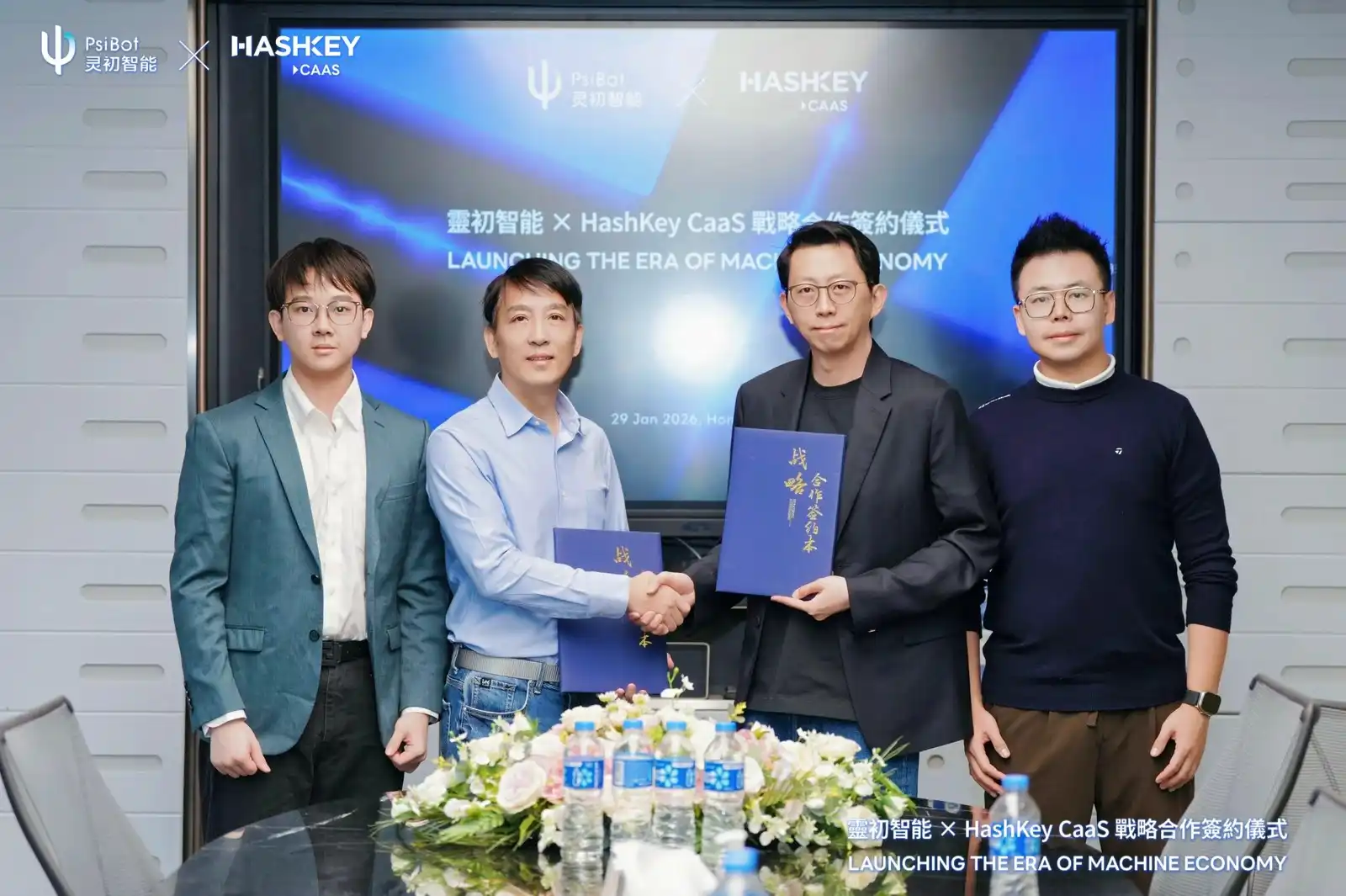
HashKey CaaS and Lingchu Intelligence Form Strategic Partnership to Jointly Build AI Autonomous Payment Infrastructure

marsbitPublicado a 2026-01-29Actualizado a 2026-01-29

Resumen

HashKey CaaS and Lingchu Intelligence have entered into a strategic partnership to jointly develop AI autonomous payment infrastructure. The collaboration will focus on data tokenization for robots and the implementation of the HP2 (HashKey Payment Protocol) autonomous payment network, aiming to integrate AI with the digital financial system and build key infrastructure for the embodied intelligence economy. As part of the agreement, Lingchu will deploy 10 dual-arm robots integrated with HashKey CaaS’s HP2 payment protocol, designed for Web3 and AI agents. These robots will gain controlled payment permissions, enabling them to act as autonomous agents to conduct on-chain transactions—such as purchasing services, accessing data interfaces, and earning on-chain income through task execution. Each autonomous transaction will be recorded as an auditable on-chain financial record, transforming the robots from mere smart devices into independent participants in the digital economy. Additionally, HashKey CaaS will tokenize the operational data generated by Lingchu’s robots, turning them into tradable digital assets with monetary value. HashKey’s CEO of On-Chain Business Group, Li Chen, stated that this partnership marks the first application of the HP2 protocol in embodied AI, supporting the integration of robots into the digital financial ecosystem. Wang Qibin, CEO of Lingchu Intelligence, emphasized that the collaboration will help accelerate the transition from R&D to an ecosy...

HashKey CaaS has announced a strategic partnership with Lingchu Intelligence, a robotics company focused on the field of embodied AI. The two parties will engage in in-depth collaboration around robot data tokenization and the HP2 (HashKey Payment Protocol) autonomous payment network, promoting the integration of AI and the digital financial system, and jointly building the key infrastructure for the embodied intelligent economy.

As part of this collaboration, Lingchu Intelligence will deploy 10 dual-arm robots and integrate them with HashKey CaaS's HP2 payment protocol, which is specifically designed for Web3 and AI Agents. Through HP2, the robots will gain controlled payment permissions, enabling them to perform on-chain interactions as "autonomous agents," including autonomously purchasing services, calling data interfaces, and earning on-chain revenue by executing tasks. Throughout this process, every autonomous transaction generated by the robots will be fully recorded as auditable on-chain financial credentials, transforming the robots from traditional "intelligent devices" into genuine "digital economic entities" capable of independently participating in economic activities.

Simultaneously, HashKey CaaS will convert the operational data generated by Lingchu Intelligence's robots during actual operation into tradable tokenized digital assets, endowing "robot data" with asset attributes and transactional value.

Li Chen, CEO of HashKey On-Chain Business Group, stated: "This collaboration marks the first application of the HP2 protocol in the field of embodied AI. HashKey CaaS's on-chain new financial infrastructure will support robots and AI in truly integrating into the digital financial system, achieving autonomous on-chain data transactions and value circulation, and laying the foundation for embodied intelligence to participate in the real economy."

Wang Qibin, CEO of Lingchu Intelligence, stated: "The widespread application of embodied intelligence relies on the confirmation of data value and an automated value exchange system. Through the partnership with HashKey, Lingchu Intelligence will accelerate its transition from technological research and development to ecosystem development oriented towards the machine economy."

In the future, the two parties will continue to explore more applications of embodied intelligence in scenarios such as payment and autonomous services, accelerate the implementation of related technologies and models, and promote the shift of the AI economy from conceptual validation to large-scale practice.


Preguntas relacionadas

QWhat is the strategic partnership between HashKey CaaS and Lingchu AI about?

AThe strategic partnership between HashKey CaaS and Lingchu AI focuses on robot data tokenization and the HP2 (HashKey Payment Protocol) autonomous payment network. They aim to integrate AI with the digital financial system and build key infrastructure for the embodied intelligent economy.

QHow many robots will Lingchu AI deploy as part of this collaboration?

ALingchu AI will deploy 10 dual-arm robots as part of this collaboration.

QWhat is the HP2 payment protocol designed for?

AThe HP2 payment protocol is designed for Web3 and AI Agents, enabling robots to have controlled payment permissions, act as autonomous agents for on-chain interactions, purchase services, call data interfaces, and earn on-chain income through task execution.

QHow will HashKey CaaS utilize the operational data from Lingchu AI's robots?

AHashKey CaaS will convert the operational data generated by Lingchu AI's robots into tokenized digital assets, giving the data asset attributes and transactional value.

QWhat did HashKey's On-Chain Business Group CEO, Li Chen, say about this partnership?

ALi Chen stated that this partnership is the first application of the HP2 protocol in the embodied intelligence field. HashKey CaaS's on-chain financial infrastructure will support robots and AI in integrating into the digital financial system, enabling autonomous on-chain data settlement and value transfer, laying the foundation for embodied intelligence to participate in the real economy.

Lecturas Relacionadas

Dalio Warns: AI Boom Shows Signs of a Bubble, Day of Reckoning Will Be the Time of Burst

Ray Dalio, founder of Bridgewater Associates, warns that the current artificial intelligence investment boom shows classic signs of a bubble, which he expects will eventually burst. In a Bloomberg Television interview, he noted that great technological revolutions often lead to capital inflows that create bubbles, making it difficult for investors and companies to calibrate their spending accurately—either overspending to capture market share or underspending and losing their competitive position. This caution comes amid significant rallies in AI-related assets, particularly chipmakers, driven by soaring demand for data centers and high-bandwidth chips, raising debates about overheating valuations. In contrast, Nvidia CEO Jensen Huang recently asserted that investors embracing the AI wave would see "crazy" returns and dismissed concerns over return on investment for data center spending as outdated. Dalio, however, focuses on the risks in the profit realization phase. He argues that bubbles tend to show signs of破裂 when markets transition from investment to the need for tangible returns, describing the burst as a process of converting paper wealth into cash. While acknowledging AI's intrinsic value, he expressed concern over the future profitability of some AI companies, suggesting the market is repeating a familiar pattern. The 76-year-old billionaire, who fully exited Bridgewater in 2025, has a net worth estimated at $21.5 billion according to the Bloomberg Billionaires Index.

marsbitHace 22 min(s)

Dalio Warns: AI Boom Shows Signs of a Bubble, Day of Reckoning Will Be the Time of Burst

marsbitHace 22 min(s)

Privacy Coin Crisis of Confidence! ZEC Plunges Over 56% in a Single Day

Zcash (ZEC), a leading privacy-focused cryptocurrency, experienced a severe crash on June 5th, plummeting over 56% in a single day and erasing nearly two months of gains. The flash crash was triggered by the disclosure of a critical zero-knowledge proof vulnerability within Zcash's Orchard privacy pool, which had existed since the pool's launch in May 2022. The flaw theoretically allowed an attacker to forge unlimited ZEC undetectably due to the pool's privacy features. The vulnerability was discovered on May 29th by independent security researcher Taylor Hornby during a proactive audit commissioned by Shielded Labs, utilizing AI-assisted analysis. The Zcash development team responded swiftly, implementing an emergency soft fork to disable Orchard transactions on June 2nd and executing a permanent hard fork fix (NU6.2) on June 3rd. Despite the technical fix, a major crisis of confidence emerged. The core issue is that Orchard's privacy design makes it cryptographically impossible to prove whether the vulnerability was exploited over the past four years, casting permanent doubt on the historical supply integrity of ZEC. While Shielded Labs argues exploitation was unlikely, the inability to provide definitive proof has severely damaged market trust. This sentiment was exacerbated when BitMEX co-founder Arthur Hayes, a prominent ZEC supporter, announced he was selling his entire position. He stated that privacy assets require "perfect security" rather than "probable safety." The combined effect of the disclosure and Hayes's exit ignited widespread panic selling, leading to massive liquidations and significant price decline. Analysts note the event highlights a fundamental tension within privacy coins: the conflict between verifiable supply and cryptographic privacy.

链捕手Hace 25 min(s)

Privacy Coin Crisis of Confidence! ZEC Plunges Over 56% in a Single Day

链捕手Hace 25 min(s)

Trading

Spot
Futuros
活动图片




