Hash Global Founder: Why I Also Choose to Liquidate All My ETH Holdings?

marsbitPublicado a 2026-05-28Actualizado a 2026-05-28

Resumen

Hash Global founder explains his decision to sell all ETH holdings, despite recognizing the potential regulatory clarity from the US CLARITY Act as a positive development. He argues against the narrative that such clarity would automatically grant ETH a "monetary premium" comparable to Bitcoin or gold. The core of his critique is that market valuation for ETH remains tied to fundamental network metrics—like mainnet revenue, DeFi activity, staking yield, and competition—rather than a pure store-of-value narrative. He contends that legal classification solves compliance issues for institutions but does not inherently create the deep, historical consensus required for monetary status. Furthermore, Ethereum's complexity and role as a multi-functional infrastructure asset (gas, collateral, settlement layer) work against the simple narrative needed for such a premium. Looking forward, he suggests that the rise of DeFi and tokenized real-world assets (RWA) will mean ETH is not the only yield-bearing asset; tokenized gold, treasuries, and others will also offer programmable yield. Thus, ETH's "yielding" advantage diminishes. He believes monetary premium will likely remain with Bitcoin, physical gold, and potentially tokenized gold, while ETH's value is more accurately framed as a crucial infrastructure asset. Ultimately, he views CLARITY's benefit as reducing a "regulatory discount" on ETH, not unlocking trillions in monetary re-rating. ETH's long-term value is significant but ste...

Author: HashGlobal KK Hash Global Founder

Compiled by: Jiahuan, ChainCatcher

The author has liquidated all held ETH positions. This article was published on May 24th.
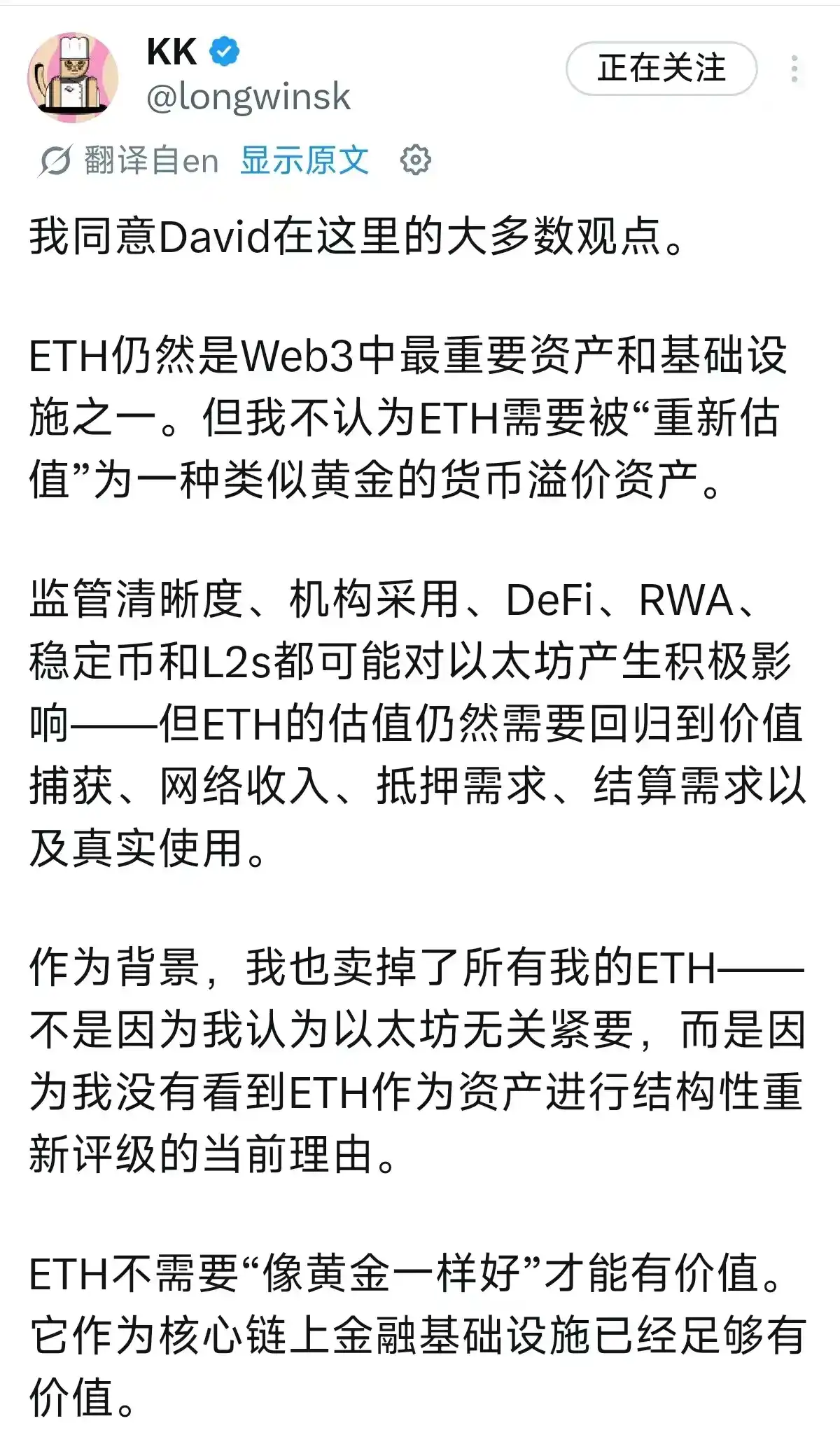
Recently I read an article with the viewpoint that if the US CLARITY Act passes, Ethereum will become the biggest winner.

Its core argument is that ETH could become the only asset under the US regulatory framework that possesses both "decentralized digital commodity" and "programmable smart contract platform" attributes. Therefore, ETH's valuation framework should shift from network revenue logic to a monetary premium logic similar to BTC, gold, or even sovereign reserve assets.

I find this viewpoint enlightening, but the conclusion may be somewhat overextended.

This is not to say I am bearish on ETH or deny the benefits of CLARITY.

On the contrary, regulatory clarity is undoubtedly a significant positive for ETH. It will reduce compliance concerns for institutional allocation to ETH and help further develop ETFs, custody services, staking, institutional DeFi, RWA, and on-chain settlement businesses.

However, regulatory clarity is not equivalent to a monetary premium.

CLARITY may resolve ETH's "regulatory discount," but it will not automatically open up valuation space related to gold, real estate, or global reserve assets.

These are two distinctly different matters and should be analyzed separately.

1. The Market Hasn't Bought Into This Logic Yet

If the market truly viewed ETH as "programmable gold" or a "yield-bearing monetary asset," its valuation should be much closer to BTC's.

But that is not the case.

When evaluating ETH, the market still focuses on specific metrics:

  • Ethereum mainnet revenue;
  • DeFi activity levels;
  • Whether stablecoins and RWAs settle primarily within the Ethereum ecosystem;
  • Value flow from L2 to L1;
  • ETH staking yields;
  • Fund inflows into ETH ETFs;
  • Competition from ecosystems like Solana, BNB Chain, and Base.

These are essentially valuation logics for network assets, platform assets, and ecosystem assets.

BTC is different. It has no cash flow, no application ecosystem, and no discussion of network revenue. Its logic is simple: 21 million supply cap, non-sovereign, censorship-resistant, digital gold. People may not agree with this narrative, but it is simple, clear, and easy to propagate.

ETH's narrative is far more complex. ETH serves as gas fees, a staking asset, DeFi collateral, an L2 settlement asset, and infrastructure for institutional on-chain finance. While multiple functions are an advantage, monetary premiums typically require an extremely simple narrative.

Complexity benefits ecosystem development but does not necessarily contribute to forming a monetary premium like gold and BTC.

2. Legal Classification is Just the Entry Ticket

The original article makes a critical leap: because ETH may be legally recognized as a decentralized digital commodity, it should enter the valuation framework of top-tier monetary premium assets.

I believe this inference is problematic.

Legal classification solves the question: Can institutions hold it compliantly? Can they trade it compliantly? Can they provide compliant custody? Can they develop related products compliantly?

Monetary premium solves the question: Is the global market willing to hold it as a long-term store of wealth?

These are two different questions.

Gold possesses a monetary premium not because any single law classifies it as such, but because millennia of historical consensus, physical scarcity, central bank reserve demand, and geopolitical safe-haven attributes have collectively formed a massive consensus.

BTC possesses a monetary premium not because it can execute smart contracts, but because it is simple enough, pure enough, and sufficiently resembles "digital gold."

For ETH to gain a monetary premium, regulatory classification alone is insufficient. It must also prove that global capital is willing to hold ETH as a long-term store of value, not just as a significant on-chain financial infrastructure asset.

There remains a significant gap between these two states.

3. DeFi Will Weaken ETH's "Sole Yield-Bearing" Narrative

The original article emphasizes an advantage of ETH: ETH can generate yield through staking, whereas BTC and gold cannot.

While this holds some truth today, the situation may change in the coming years.

With the development of DeFi and RWAs, many assets will be tokenized in the future. Gold, treasuries, money market funds, real estate funds, income rights, commodities, and stock ETFs can all enter the on-chain financial system as tokens.

Once these assets are on-chain, they will also gain new capabilities:

  • Can be used as collateral;
  • Can be borrowed/lent;
  • Can be used for market making;
  • Can be combined into structured yield products;
  • Can be integrated with DeFi protocols;
  • Can form closed-loop on-chain capital flows with stablecoins.

Therefore, in the future, ETH will not be the only asset that "generates yield."

Tokenized gold integrated with DeFi can also generate on-chain yield. Tokenized treasuries and money market funds inherently possess underlying yields. Tokenized real estate funds and other RWAs can also generate cash flow.

By then, the question will no longer be "ETH can generate yield, gold cannot."

The real questions will become: Which is better collateral? Which has lower volatility? Which has clearer yield sources? Which has higher regulatory acceptance? Which is more suitable for institutional balance sheets? Which is easier for global capital to hold long-term?

From this perspective, ETH may have no advantage compared to tokenized gold, tokenized treasuries, or tokenized money market funds.

ETH's staking yield comes from network security mechanisms, not traditional risk-free returns. It carries protocol risk, validator risk, slashing risk, liquid staking protocol risk, regulatory risk, and price volatility risk.

For institutions, ETH staking is certainly a valuable feature, but it should not be directly equated with "superior to gold."

4. Monetary Premium Belongs to BTC, Gold, and Tokenized Gold

I am more inclined to believe that in the future, monetary premiums will primarily belong to BTC, gold, and potentially tokenized gold.

BTC's positioning is clear: digital gold.

Gold's positioning is also clear: the most important non-sovereign store of value in the traditional world.

If tokenized gold develops, the situation could become very attractive. It would inherit gold's historical credibility while gaining on-chain liquidity, composability, and collateral capability. In this scenario, gold's monetary premium wouldn't necessarily flow to ETH; on the contrary, it might be further strengthened by tokenized gold itself.

This isn't necessarily bad for ETH. These tokenized assets also require on-chain infrastructure and could be issued, traded, and collateralized on Ethereum or Ethereum L2s.

However, this means ETH is more of an infrastructure asset, not the ultimate monetary premium asset.

Infrastructure is certainly valuable. But infrastructure valuations typically revert to usage metrics, revenue, network effects, and value capture, not direct analogies to gold's total market cap, real estate's monetary premium, or the global reserve asset pool.

5. Ethereum's Value Capture Problem Remains Unresolved

The original article posits that CLARITY will widen the gap between ETH and other smart contract platforms, with other L1s potentially entering a second-tier valuation, while ETH remains in the first tier.

This judgment also requires cautious treatment.

The real world will not choose a blockchain based solely on US regulatory classification.

Different countries, assets, and institutions will choose underlying networks based on multiple factors:

  • Cost;
  • Performance;
  • Compliance interfaces;
  • KYC/AML requirements;
  • Local regulatory attitudes;
  • Ecosystem resources;
  • Liquidity;
  • Relationships with asset issuers and service providers;
  • Need for a permissioned environment.

Many RWA, stablecoin, and payment scenarios may not necessarily choose the Ethereum mainnet. They might opt for L2s, app-chains, consortium chains, or other L1s that better align with local regulations and business needs.

More importantly, even if significant activity occurs within the Ethereum ecosystem, it does not guarantee that ETH will capture value proportionally.

As we have seen in recent years, while L2s expand the Ethereum ecosystem, they also pose a question: once L2s scale, how much value truly flows back to ETH?

If large transaction volumes occur on L2s with continuously decreasing fees, and the application layer and L2s themselves capture more user value, while the ETH mainnet only handles final settlement and security, then ETH's value capture capability remains to be proven.

One cannot assume that Ethereum ecosystem growth automatically translates into proportional ETH value appreciation.

This is why I believe ETH's valuation must revert to concrete questions about network revenue, settlement demand, collateral demand, staking yield, and ecosystem value flow.

6. Using Ethereum ≠ Buying ETH

Another distinction is needed: institutions entering on-chain finance does not mean they will allocate ETH as a core asset.

Institutions might:

  • Use the Ethereum network;
  • Use Ethereum L2s;
  • Issue tokenized funds;
  • Use stablecoins for settlement;
  • Use on-chain custody and compliant transfer tools;
  • Use DeFi or permissioned DeFi;
  • Indirectly access on-chain finance through service providers.

None of these require them to purchase large amounts of ETH.

Just as companies heavily using cloud services do not necessarily buy the cloud service company's stock, institutions using blockchain infrastructure do not necessarily need to hold the underlying token long-term.

For ETH to transition from a "used network" to a "long-term held asset," a clear value capture mechanism is needed.

If this mechanism remains unclear, the market will continue to evaluate ETH based on revenue, fees, staking yield, and ecosystem growth.

7. Grand Narratives Can't Support Valuation Anymore

In the last cycle, the market was willing to assign valuations based on grand narratives.

"World computer," "Internet of Value," "Global settlement layer," "Decentralized financial cornerstone" – these narratives were very powerful. Ethereum was undoubtedly the most important representative.

But the market has changed.

Investors are increasingly asking: Where is the revenue? Where are the users? Where is the value capture? Where is the real demand? Where is the regulatory path? Where is the closed-loop business logic?

As we have repeatedly emphasized in recent years, Web3 cannot just stay at the vision stage; it must ultimately return to fundamental value and basic business logic.

Can it make money? Can it provide a better user experience? Can it create real economic value? If these questions cannot be answered, even the grandest narratives will struggle to sustain valuation long-term.

The same applies to ETH.

While it is certainly one of the most important Web3 infrastructures, for higher valuation, the market may need to see:

  • Resurgence of DeFi growth;
  • Recovery of mainnet revenue;
  • Clearer value flow from L2 to L1;
  • Real settlement demand for stablecoins and RWAs within the Ethereum ecosystem;
  • Sustained growth in ETH collateral demand;
  • Institutions not just using Ethereum, but genuinely needing to hold ETH.

None of these can be automatically achieved by a single piece of legislation.

8. CLARITY's Real Significance is Fixing the Regulatory Discount

Therefore, I tend to view CLARITY's impact on ETH as reducing the regulatory discount, not unlocking a multi-trillion dollar monetary premium revaluation potential.

ETH did face regulatory uncertainty in the past. If US regulators more clearly recognize ETH's commodity attribute, that would be a significant positive.

However, this would shift ETH from a "network asset with regulatory tail risk" to a "network asset with clearer regulation."

This is already significant.

But it does not mean ETH will automatically become a substitute for gold, BTC, or global reserve assets.

If the market continues to evaluate ETH based on network revenue, staking yield, L2 value flow, DeFi activity, RWA settlement volume, and institutional usage, then ETH's valuation will remain constrained by fundamentals.

This isn't necessarily bad. Excellent infrastructure assets deserve high value. But they are not equivalent to monetary premium assets.

9. My Stance on ETH

I still believe ETH is one of the most important assets in the digital asset industry.

Its long-term value stems from several aspects: First, it is the most important open smart contract network.

Second, it is a key settlement layer for DeFi, stablecoins, RWAs, and on-chain finance.

Third, from a regulatory perspective, it is one of the most defensible decentralized infrastructures.

Fourth, it has accumulated long-term developer, application, asset, and institutional recognition.

Fifth, as Web3 enters large-scale commercial applications, it may become an extremely important underlying trust and settlement asset.

However, these values are more akin to infrastructure value, network value, ecosystem value, and collateral value.

It may enjoy some scarcity premium, regulatory clarity premium, and network effect premium, but not necessarily the pure monetary premium enjoyed by BTC or gold.

ETH has significant long-term value, but its valuation framework should not be incorrectly substituted.

10. CLARITY Benefits ETH, But Don't Treat ETH Like Gold

My core judgment on this matter is straightforward:

CLARITY benefits ETH, but this does not mean ETH should be valued like gold.

Regulatory clarity is a positive, but it is not equivalent to a monetary premium.

ETH is an extremely important on-chain financial infrastructure asset, but it may not become the ultimate store of wealth for the world.

In the future, those truly enjoying monetary premiums will likely still primarily be BTC, gold, and potentially tokenized gold and other high-credit store-of-value assets. ETH is more likely to serve as the core infrastructure for these assets to be on-chain, circulated, collateralized, settled, and composed.

This position is already important enough; there's no need to force-fit ETH into a "superior to gold" narrative.

A more robust valuation framework for ETH might be: regulatory clarity drives discount repair; institutional entry drives demand increase; DeFi, RWA, stablecoin, and L2 ecosystems determine network usage; network revenue, collateral demand, and value flow determine long-term valuation; monetary premium can be an optimistic scenario but should not be the base assumption.

These are my main reservations regarding the ETH revaluation argument.

The Web3 industry often extrapolates real positives into huge valuation stories. While imagination is valuable, returning to fundamental questions is more critical.

What problem does this asset actually solve? Who will hold it long-term? What are the returns and risks of holding it? Where does its value truly come from? If the ecosystem develops, will value really accumulate to this token?

If these questions cannot be clearly answered, regulatory classification alone will struggle to support a genuine valuation leap.


Preguntas relacionadas

QWhat is the author's main argument regarding the impact of the CLARITY Act on ETH's valuation?

AThe author argues that while the CLARITY Act is undoubtedly a positive regulatory development for ETH, it should be viewed primarily as reducing the 'regulatory discount' on ETH rather than unlocking a 'monetary premium' valuation comparable to gold or Bitcoin. The Act will ease institutional compliance and adoption but does not automatically elevate ETH into the valuation framework of a global reserve or monetary asset.

QAccording to the author, why does ETH currently lack a 'monetary premium' like Bitcoin?

AThe author states that ETH lacks a monetary premium because its narrative is complex—it functions as gas, a staking asset, DeFi collateral, and infrastructure. In contrast, Bitcoin's value proposition is simple and pure: a fixed supply, non-sovereign, censorship-resistant 'digital gold.' Monetary premiums typically require simple, easily communicable narratives.

QHow does the author believe DeFi and RWA development will affect ETH's 'yield-bearing' narrative?

AThe author believes that as DeFi and Real-World Assets (RWA) develop, many assets like tokenized gold, treasuries, and real estate will also become yield-bearing on-chain through their use as collateral, in lending, and in structured products. Therefore, ETH will not be the only 'yield-bearing' asset, and its staking yield, which carries protocol and volatility risks, may not hold a distinct advantage over traditional yield-bearing assets in the eyes of institutions.

QWhat key distinction does the author make between 'using Ethereum' and 'buying ETH'?

AThe author distinguishes that institutions may use the Ethereum network, its L2s, or issue tokenized assets on it without needing to hold significant amounts of ETH as a core asset on their balance sheets. Just as using cloud services doesn't require buying the cloud provider's stock, using blockchain infrastructure does not necessitate holding the underlying token. For ETH's valuation to rise, a clear mechanism for value capture is needed.

QWhat does the author identify as the primary driver for ETH's long-term valuation, as opposed to a monetary premium?

AThe author identifies that ETH's long-term valuation should be driven by fundamentals such as network revenue, staking yields, demand for ETH as collateral, value flow from L2s to L1, DeFi activity, and real settlement demand for stablecoins and RWAs within its ecosystem. Its value is that of a critical infrastructure, network, and ecosystem asset, not primarily a monetary store-of-value asset.

Lecturas Relacionadas

Conversation with VanEck CEO: Memory Chip Stocks Are a Bubble, Bitcoin Will Stay but Token Ecosystems Will Disappear

In this podcast, VanEck CEO Jan van Eck discusses his investment outlook centered on three key long-term ("10-year macro") themes: AI-driven compute demand, India's economic rise, and excessive government debt in developed nations. Regarding AI and semiconductors, van Eck believes Nvidia has transformed into a foundational "host" for AI infrastructure, possessing deep moats in software, scale, and power efficiency, making it a core holding. However, he views the recent surge in memory chip stocks as a bubble driven by temporary supply-demand imbalances and pricing power, lacking Nvidia's competitive durability. On asset management, he emphasizes that while ETFs are scale-driven tools, the decisions on which ETFs to own and how to allocate remain highly active. He expresses greatest concern over fixed-income market illiquidity and the risk of a loss of confidence in government debt sustainability. Van Eck is bullish on gold's long-term role as a global monetary alternative and highlights the dramatic policy-driven growth in nuclear energy investment. He is strongly positive on India due to its demographic trends and pro-business reforms. Discussing crypto, he labels 2026 the "year of the corporate-controlled chain," where traditional finance adopts blockchain's best features (like 24/7 operation and programmability) but retains control. He predicts a permanent "crypto winter" for many projects, with only Bitcoin, stablecoins, and the core blockchain concept surviving long-term. He sees the U.S. stablecoin bill as marginally impactful, enabling tech firms to compete with, but not replace, banks. Finally, he views the upcoming SpaceX IPO as a significant, positive liquidity event for markets and advises investors to maintain a long-term, macro perspective when making asset allocation decisions.

marsbitHace 9 min(s)

Conversation with VanEck CEO: Memory Chip Stocks Are a Bubble, Bitcoin Will Stay but Token Ecosystems Will Disappear

marsbitHace 9 min(s)

In the Era of Agent Users, Where Does Crypto Value Flow?

Title: Who Makes Money from Agents? The rise of AI Agents as potential blockchain users raises a crucial question: if they become the next billion users, who will capture the value? Traditional crypto value capture theories—like "fat protocols" (where value accrues to the base layer) and "fat applications" (where value accrues to user-facing apps)—assume human users who value UX, brand, and convenience. Agents, however, operate differently: they interact via APIs, have no brand loyalty, and can switch services with near-zero cost. This shift could disrupt existing value flows. Applications might become "headless," offering their routing and infrastructure as APIs to Agents. Alternatively, Agents might bypass intermediaries entirely, allowing protocols to regain value capture ("fat protocols" reborn). A more extreme scenario is that Agents, being purely rational and cost-sensitive, could commoditize the entire stack, compressing margins toward marginal cost and turning crypto into a low-margin utility. However, Agents may not just amplify existing activities; they could enable entirely new ones—like continuous, sub-penny portfolio rebalancing, machine-to-machine commerce, and new market types only viable at automated speeds. This expands the economic pie rather than just redistributing it. Ultimately, the key question for builders is: what will make an Agent return to your service instead of a cheaper alternative? The answer may not be UX but factors like liquidity, latency, settlement guarantees, or a yet-unnamed business model. As humans and Agents will coexist as users, value capture may split: "fat apps" for human-facing services, and a new, evolving model for the Agent-dominated layer.

marsbitHace 39 min(s)

In the Era of Agent Users, Where Does Crypto Value Flow?

marsbitHace 39 min(s)

Base MCP, The Next Step for x402

Base has officially launched Base MCP, allowing users to connect their Base Account to AI Agents to perform actions like swaps, transfers, portfolio tracking, and transaction history queries through conversational commands. This move aligns with Base's strategic focus on AI, driven by the broader competition in the emerging Agent-to-Agent payment sector. The evolution of Agent payments has accelerated. In late 2024, the primary method involved insecure browser automation. By 2025, solutions like Coinbase's x402 (providing crypto wallets for Agents), Google's AP2, and Visa's token-based system emerged. x402 has since processed 176 million transactions totaling over $70 million, with a median value between $0.01 and $0.10. Stablecoins, particularly USDC, dominate these settlements due to their negligible transaction costs compared to traditional payment fees, which are prohibitive for micro-payments. Coinbase faces competition from Stripe, which has built a comparable infrastructure for Agent payments with its Tempo blockchain, Privy wallets, Bridge routing (acquired for $1.1B), and the recently launched MPP protocol. Both companies are now competing at the application layer. The core reason AI is central to Base's strategy is to expand the scenarios for Agent payments, ensuring more transactions occur on its network. By securing a dominant position and scale advantage in this nascent field, Coinbase aims to capture the future commercial potential of Agent-driven payments. The launch of Base MCP is thus a strategic step in this larger ambition.

marsbitHace 45 min(s)

Base MCP, The Next Step for x402

marsbitHace 45 min(s)

Reframing Ethereum's Valuation: Why the Fee Model is Wrong, and the 'Treasury Logic' is the Future?

"Rethinking Ethereum's Value: The 'Vault Logic' Framework" Traditional valuation models incorrectly treat Ethereum as a company, valuing ETH based on transaction fees ("revenue"). This is flawed. Fees are network friction; a successful network aims to reduce them to zero. Ethereum's average fee has dropped from over $50 in 2021 to around $0.20 today, while transaction volume has tripled. Instead, view Ethereum as a digital vault securing ~$250 billion in on-chain assets (stablecoins, RWAs, L2 bridged funds, wBTC, etc.). Post-merge, Ethereum's security is directly purchased with its own asset: ETH. To attack the network, an attacker must acquire and control staked ETH. Therefore, the vault's security level is intrinsically tied to ETH's market value. Currently, the value of all staked ETH is only ~$72B, protecting ~$250B in assets—a dangerous imbalance. For robust security, the staked ETH securing the network should be valued significantly *higher* than the total value it protects. Applying a conservative security multiplier suggests ETH's fair value should be closer to ~$6,900 (vs. ~$2,070 currently). As on-chain asset value grows into the trillions, ETH's price must rise proportionally to maintain this security budget. Comparisons to free infrastructure like Linux or low-margin utilities like the DTCC are misguided. Their security is provided externally (community, law, banks). Ethereum's security is internal and must be purchased in the open market using ETH. ETH is not the clearinghouse; it is the collateral backing it. The model is not a short-term price predictor but a structural framework. The economic force for ETH appreciation grows monotonically with the adoption of Ethereum for settling value. The narrative that high fees are good is backwards; low fees enable more activity, which increases the value needing protection, thus demanding a more valuable ETH.

marsbitHace 51 min(s)

Reframing Ethereum's Valuation: Why the Fee Model is Wrong, and the 'Treasury Logic' is the Future?

marsbitHace 51 min(s)

Justin Sun’s Interview with Hurun Report: A New Order and Certainty for Value Flow in the Era of Transformation

In an interview with *Hurun Report*, Justin Sun, founder of TRON, discussed the evolution of the Web3 industry as it moves from initial exploration to large-scale adoption. He emphasized that the core value of blockchain lies in building an open and inclusive internet of value, enabling anyone globally to transfer and use funds efficiently and at low cost, regardless of location or access to banking. Sun highlighted that projects with lasting impact are those built on genuine demand and real-world usage. He pointed to the stablecoin payment ecosystem as the most mature and scalable application currently, noting that TRON has rapidly become one of the world's largest stablecoin networks. The circulation of USDT on TRON has surpassed $86.3 billion, driven by actual use cases such as cross-border transfers and daily payments, demonstrating strong network effects. Regarding strategy, Sun outlined a methodology combining data-driven iteration, rapid execution, and user-centric focus. He cited the decision to partner with Tether to launch TRC-20 USDT as a key strategic move, based on an assessment of market trends and long-term potential, which has become a significant growth engine for the TRON ecosystem. On globalization, Sun stressed the importance of local compliance and cultural adaptation, noting that success in different markets depends on deep understanding and local partnerships. He also addressed the convergence of AI and blockchain, describing it as a transformative direction where blockchain provides decentralized infrastructure for AI, while AI enhances the intelligence and user experience of blockchain systems. For industry participants and young entrepreneurs, Sun advised continuous learning and adaptability in a fast-changing environment, focusing on building irreplaceable core strengths rather than spreading resources too thinly. Through infrastructure development, global strategy, and technological foresight, TRON aims to advance the practical implementation and evolution of the value internet.

marsbitHace 1 hora(s)

Justin Sun’s Interview with Hurun Report: A New Order and Certainty for Value Flow in the Era of Transformation

marsbitHace 1 hora(s)

Trading

Spot
Futuros

Artículos destacados

Qué es ETH 2.0

ETH 2.0: Una Nueva Era para Ethereum Introducción ETH 2.0, conocido ampliamente como Ethereum 2.0, marca una actualización monumental para la blockchain de Ethereum. Esta transición no es solo una mejora superficial; busca mejorar fundamentalmente la escalabilidad, seguridad y sostenibilidad de la red. Con un cambio del mecanismo de consenso intensivo en energía Prueba de Trabajo (PoW) a una Prueba de Participación (PoS) más eficiente, ETH 2.0 promete un enfoque transformador para el ecosistema blockchain. ¿Qué es ETH 2.0? ETH 2.0 es un conjunto de actualizaciones interconectadas y distintivas centradas en optimizar las capacidades y el rendimiento de Ethereum. La reestructuración está diseñada para abordar desafíos críticos que el mecanismo actual de Ethereum ha enfrentado, particularmente en lo que respecta a la velocidad de transacción y la congestión de la red. Objetivos de ETH 2.0 Los objetivos principales de ETH 2.0 giran en torno a mejorar tres aspectos clave: Escalabilidad: Con el objetivo de aumentar significativamente el número de transacciones que la red puede manejar por segundo, ETH 2.0 busca superar la limitación actual de aproximadamente 15 transacciones por segundo, potencialmente alcanzando miles. Seguridad: Las medidas de seguridad mejoradas son fundamentales para ETH 2.0, particularmente a través de una mejor resistencia contra ciberataques y la preservación del ethos descentralizado de Ethereum. Sostenibilidad: El nuevo mecanismo PoS está diseñado no solo para mejorar la eficiencia, sino también para reducir drásticamente el consumo de energía, alineando el marco operativo de Ethereum con consideraciones ambientales. ¿Quién es el Creador de ETH 2.0? La creación de ETH 2.0 se puede atribuir a la Fundación Ethereum. Esta organización sin fines de lucro, que desempeña un papel crucial en el apoyo al desarrollo de Ethereum, es liderada por el notable cofundador Vitalik Buterin. Su visión de un Ethereum más escalable y sostenible ha sido la fuerza motriz detrás de esta actualización, involucrando contribuciones de una comunidad global de desarrolladores y entusiastas dedicados a mejorar el protocolo. ¿Quiénes son los Inversores de ETH 2.0? Si bien los detalles sobre los inversores de ETH 2.0 no se han hecho públicos, se sabe que la Fundación Ethereum recibe apoyo de varias organizaciones e individuos en el ámbito de blockchain y tecnología. Estos socios incluyen firmas de capital de riesgo, compañías tecnológicas y organizaciones filantrópicas que comparten un interés mutuo en apoyar el desarrollo de tecnologías descentralizadas e infraestructura blockchain. ¿Cómo Funciona ETH 2.0? ETH 2.0 se distingue por introducir una serie de características clave que lo diferencian de su predecesor. Prueba de Participación (PoS) La transición a un mecanismo de consenso PoS es uno de los cambios más destacados de ETH 2.0. A diferencia de PoW, que se basa en la minería intensiva en energía para la verificación de transacciones, PoS permite a los usuarios validar transacciones y crear nuevos bloques de acuerdo con la cantidad de ETH que apuestan en la red. Esto conduce a una mayor eficiencia energética, reduciendo el consumo en aproximadamente un 99.95%, convirtiendo a Ethereum 2.0 en una alternativa considerablemente más verde. Cadenas Shard Las cadenas shard son otra innovación crítica de ETH 2.0. Estas cadenas más pequeñas operan en paralelo con la cadena principal de Ethereum, lo que permite que múltiples transacciones sean procesadas simultáneamente. Este enfoque mejora la capacidad general de la red, abordando las preocupaciones de escalabilidad que han afectado a Ethereum. Cadena Beacon En el núcleo de ETH 2.0 se encuentra la Cadena Beacon, que coordina la red y gestiona el protocolo PoS. Funciona como un organizador de cierta manera: supervisa a los validadores, asegura que los shards permanezcan conectados a la red y monitorea la salud general del ecosistema blockchain. Cronología de ETH 2.0 El viaje de ETH 2.0 ha estado marcado por varios hitos clave que trazan la evolución de esta importante actualización: Diciembre 2020: El lanzamiento de la Cadena Beacon marcó la introducción de PoS, preparándose para la migración hacia ETH 2.0. Septiembre 2022: La finalización de “La Fusión” representa un momento crucial en el que la red Ethereum se trasladó exitosamente de un marco PoW a uno PoS, anunciando una nueva era para Ethereum. 2023: El lanzamiento esperado de cadenas shard tiene como objetivo mejorar aún más la escalabilidad de la red Ethereum, consolidando a ETH 2.0 como una plataforma robusta para aplicaciones y servicios descentralizados. Características Clave y Beneficios Escalabilidad Mejorada Una de las ventajas más significativas de ETH 2.0 es su escalabilidad mejorada. La combinación de PoS y cadenas shard permite que la red expanda su capacidad, permitiendo acomodar un volumen mucho mayor de transacciones en comparación con el sistema heredado. Eficiencia Energética La implementación de PoS representa un gran paso hacia la eficiencia energética en la tecnología blockchain. Al reducir drásticamente el consumo de energía, ETH 2.0 no solo disminuye los costos operativos, sino que también se alinea más estrechamente con los objetivos de sostenibilidad global. Seguridad Mejorada Los mecanismos actualizados de ETH 2.0 contribuyen a mejorar la seguridad en toda la red. El despliegue de PoS, junto con las medidas de control innovadoras establecidas a través de cadenas shard y la Cadena Beacon, asegura un mayor grado de protección contra posibles amenazas. Costos Más Bajos para los Usuarios A medida que la escalabilidad mejora, los efectos sobre los costos de transacción también serán evidentes. Se espera que una mayor capacidad y una menor congestión se traduzcan en tarifas más bajas para los usuarios, haciendo que Ethereum sea más accesible para transacciones cotidianas. Conclusión ETH 2.0 marca una evolución significativa en el ecosistema blockchain de Ethereum. A medida que aborda problemas fundamentales como la escalabilidad, el consumo de energía, la eficiencia en las transacciones y la seguridad general, la importancia de esta actualización no puede ser subestimada. La transición a la Prueba de Participación, la introducción de cadenas shard y el trabajo fundamental de la Cadena Beacon son indicativos de un futuro donde Ethereum puede satisfacer las crecientes demandas del mercado descentralizado. En una industria impulsada por la innovación y el progreso, ETH 2.0 se erige como un testimonio de las capacidades de la tecnología blockchain para allanar el camino hacia una economía digital más sostenible y eficiente.

166 Vistas totalesPublicado en 2024.04.04Actualizado en 2024.12.03

Qué es ETH 2.0

Qué es ETH 3.0

ETH3.0 y $eth 3.0: Un Examen Profundo del Futuro de Ethereum Introducción En el paisaje en rápida evolución de las criptomonedas y la tecnología blockchain, ETH3.0, a menudo denotado como $eth 3.0, ha surgido como un tema de considerable interés y especulación. El término abarca dos conceptos principales que merecen aclaración: Ethereum 3.0: Esto representa una posible actualización futura destinada a aumentar las capacidades de la blockchain existente de Ethereum, enfocándose particularmente en mejorar la escalabilidad y el rendimiento. ETH3.0 Meme Token: Este proyecto de criptomoneda distinto busca aprovechar la blockchain de Ethereum para crear un ecosistema centrado en memes, promoviendo la participación dentro de la comunidad de criptomonedas. Comprender estos aspectos de ETH3.0 es esencial no solo para los entusiastas de las criptomonedas, sino también para aquellos que observan tendencias tecnológicas más amplias en el espacio digital. ¿Qué es ETH3.0? Ethereum 3.0 Ethereum 3.0 se presenta como una actualización propuesta para la red de Ethereum ya establecida, que ha sido la columna vertebral de muchas aplicaciones descentralizadas (dApps) y contratos inteligentes desde su inicio. Las mejoras previstas se concentran principalmente en la escalabilidad, integrando tecnologías avanzadas como sharding y pruebas de conocimiento cero (zk-proofs). Estas innovaciones tecnológicas tienen como objetivo facilitar un número sin precedentes de transacciones por segundo (TPS), potencialmente alcanzando millones, abordando así una de las limitaciones más significativas que enfrenta la tecnología blockchain actual. La mejora no es meramente técnica, sino también estratégica; está destinada a preparar la red de Ethereum para su adopción generalizada y utilidad en un futuro marcado por una mayor demanda de soluciones descentralizadas. ETH3.0 Meme Token En contraste con Ethereum 3.0, el ETH3.0 Meme Token se aventura en un ámbito más ligero y juguetón al combinar la cultura de memes de internet con la dinámica de las criptomonedas. Este proyecto permite a los usuarios comprar, vender e intercambiar memes en la blockchain de Ethereum, proporcionando una plataforma que fomenta la participación comunitaria a través de la creatividad y los intereses compartidos. El ETH3.0 Meme Token tiene como objetivo demostrar cómo la tecnología blockchain puede intersectarse con la cultura digital, creando casos de uso que son tanto entretenidos como financieramente viables. ¿Quién es el Creador de ETH3.0? Ethereum 3.0 La iniciativa hacia Ethereum 3.0 es impulsada principalmente por un consorcio de desarrolladores e investigadores dentro de la comunidad de Ethereum, incluyendo notablemente a Justin Drake. Conocido por sus ideas y contribuciones a la evolución de Ethereum, Drake ha sido una figura prominente en las discusiones sobre la transición de Ethereum a una nueva capa de consenso, denominada “Beam Chain.” Este enfoque colaborativo para el desarrollo significa que Ethereum 3.0 no es el producto de un creador singular, sino más bien una manifestación de ingenio colectivo centrado en avanzar la tecnología blockchain. ETH3.0 Meme Token Los detalles sobre el creador del ETH3.0 Meme Token son actualmente inidentificables. La naturaleza de los tokens de memes a menudo conduce a una estructura más descentralizada y dirigida por la comunidad, lo que podría explicar la falta de atribución específica. Esto se alinea con la ética de la comunidad cripto más amplia, donde la innovación a menudo surge de esfuerzos colaborativos en lugar de individuales. ¿Quiénes son los Inversores de ETH3.0? Ethereum 3.0 El apoyo a Ethereum 3.0 proviene principalmente de la Fundación Ethereum junto con una entusiasta comunidad de desarrolladores e inversores. Esta asociación fundamental proporciona un grado significativo de legitimidad y mejora la perspectiva de una implementación exitosa, ya que aprovecha la confianza y credibilidad construidas a lo largo de años de operaciones en la red. En el clima cambiando rápidamente de las criptomonedas, el apoyo de la comunidad juega un papel crucial en impulsar el desarrollo y la adopción, posicionando a Ethereum 3.0 como un contendiente serio para futuros avances en blockchain. ETH3.0 Meme Token Si bien las fuentes actualmente disponibles no proporcionan información explícita sobre las fundaciones o organizaciones de inversión que respaldan el ETH3.0 Meme Token, es indicativo del modelo de financiamiento típico para tokens de memes, que a menudo depende del apoyo de base y la participación comunitaria. Los inversores en tales proyectos suelen consistir en individuos motivados por el potencial de innovación impulsada por la comunidad y el espíritu de cooperación que se encuentra dentro de la comunidad cripto. ¿Cómo Funciona ETH3.0? Ethereum 3.0 Las características distintivas de Ethereum 3.0 radican en su implementación propuesta de sharding y tecnología zk-proof. Sharding es un método de particionamiento de la blockchain en piezas más pequeñas y manejables o “shards,” que pueden procesar transacciones de manera concurrente en lugar de secuencial. Esta descentralización del procesamiento ayuda a prevenir la congestión y asegura que la red permanezca receptiva incluso bajo una carga pesada. La tecnología de prueba de conocimiento cero (zk-proof) contribuye con otra capa de sofisticación al permitir la validación de transacciones sin revelar los datos subyacentes involucrados. Este aspecto no solo mejora la privacidad, sino que también aumenta la eficiencia general de la red. También se habla de incorporar una Máquina Virtual de Ethereum de conocimiento cero (zkEVM) en esta actualización, amplificando aún más las capacidades y utilidad de la red. ETH3.0 Meme Token El ETH3.0 Meme Token se distingue al capitalizar la popularidad de la cultura de memes. Establece un mercado para que los usuarios participen en el comercio de memes, no solo por entretenimiento sino también por el posible beneficio económico. Al integrar características como staking, provisión de liquidez y mecanismos de gobernanza, el proyecto fomenta un entorno que incentiva la interacción y participación de la comunidad. Al ofrecer una mezcla única de entretenimiento y oportunidad económica, el ETH3.0 Meme Token tiene como objetivo atraer a una audiencia diversa, que abarca desde entusiastas de las criptomonedas hasta conocedores casuales de memes. Línea de Tiempo de ETH3.0 Ethereum 3.0 11 de noviembre de 2024: Justin Drake insinúa la próxima actualización de ETH 3.0, centrada en mejoras de escalabilidad. Este anuncio significa el comienzo de las discusiones formales sobre la futura arquitectura de Ethereum. 12 de noviembre de 2024: Se espera que la propuesta anticipada para Ethereum 3.0 se desvele en Devcon en Bangkok, preparando el escenario para una mayor retroalimentación de la comunidad y posibles próximos pasos en el desarrollo. ETH3.0 Meme Token 21 de marzo de 2024: El ETH3.0 Meme Token se lista oficialmente en CoinMarketCap, marcando su incursión en el dominio público de las criptomonedas y mejorando la visibilidad de su ecosistema basado en memes. Puntos Clave En conclusión, Ethereum 3.0 representa una evolución significativa dentro de la red de Ethereum, enfocándose en superar las limitaciones en términos de escalabilidad y rendimiento a través de tecnologías avanzadas. Sus actualizaciones propuestas reflejan un enfoque proactivo hacia las demandas y la usabilidad futura. Por otro lado, el ETH3.0 Meme Token encapsula la esencia de la cultura impulsada por la comunidad en el espacio de las criptomonedas, aprovechando la cultura de memes para crear plataformas atractivas que fomentan la creatividad y participación del usuario. Comprender los distintos propósitos y funcionalidades de ETH3.0 y $eth 3.0 es fundamental para cualquiera interesado en los desarrollos en curso dentro del espacio cripto. Con ambas iniciativas abriendo caminos únicos, subrayan colectivamente la naturaleza dinámica y multifacética de la innovación en blockchain.

178 Vistas totalesPublicado en 2024.04.04Actualizado en 2024.12.03

Qué es ETH 3.0

Cómo comprar ETH

¡Bienvenido a HTX.com! Hemos hecho que comprar Ethereum (ETH) sea simple y conveniente. Sigue nuestra guía paso a paso para iniciar tu viaje de criptos.Paso 1: crea tu cuenta HTXUtiliza tu correo electrónico o número de teléfono para registrarte y obtener una cuenta gratuita en HTX. Experimenta un proceso de registro sin complicaciones y desbloquea todas las funciones.Obtener mi cuentaPaso 2: ve a Comprar cripto y elige tu método de pagoTarjeta de crédito/débito: usa tu Visa o Mastercard para comprar Ethereum (ETH) al instante.Saldo: utiliza fondos del saldo de tu cuenta HTX para tradear sin problemas.Terceros: hemos agregado métodos de pago populares como Google Pay y Apple Pay para mejorar la comodidad.P2P: tradear directamente con otros usuarios en HTX.Over-the-Counter (OTC): ofrecemos servicios personalizados y tipos de cambio competitivos para los traders.Paso 3: guarda tu Ethereum (ETH)Después de comprar tu Ethereum (ETH), guárdalo en tu cuenta HTX. Alternativamente, puedes enviarlo a otro lugar mediante transferencia blockchain o utilizarlo para tradear otras criptomonedas.Paso 4: tradear Ethereum (ETH)Tradear fácilmente con Ethereum (ETH) en HTX's mercado spot. Simplemente accede a tu cuenta, selecciona tu par de trading, ejecuta tus trades y monitorea en tiempo real. Ofrecemos una experiencia fácil de usar tanto para principiantes como para traders experimentados.

4.1k Vistas totalesPublicado en 2024.12.10Actualizado en 2025.03.21

Cómo comprar ETH

Discusiones

Bienvenido a la comunidad de HTX. Aquí puedes mantenerte informado sobre los últimos desarrollos de la plataforma y acceder a análisis profesionales del mercado. A continuación se presentan las opiniones de los usuarios sobre el precio de ETH (ETH).

活动图片