Hang Seng TECH Index Launches Largest Reform in History

marsbitPublicado a 2026-08-12Actualizado a 2026-08-12

Resumen

The Hang Seng Tech Index is undergoing its most significant reform since its launch in 2020. In a consultation paper, Hang Seng Indexes proposed major changes to enhance the index's market representation, reflecting the evolution of Hong Kong's tech sector. Key proposed revisions include completely removing industry classification restrictions, updating six key technology themes (e.g., Digital Platforms, AI, Advanced Hardware), and implementing a dual-track selection mechanism. This new mechanism will pick 40 constituents based on market capitalization and 10 based on revenue growth, expanding the total number of constituents from 30 to 50. The reform aims to address the index's historical concentration in large internet platforms like Tencent and Alibaba, which has caused it to miss gains from newer, high-growth tech areas such as AI and semiconductors. Many of these newer companies are smaller in market cap but show stronger revenue growth. The proposed changes would significantly increase exposure to themes like Advanced Hardware (from 5 to 15 simulated constituents) and AI (from 3 to 6). Simulated results show the reform would slightly reduce the index's concentration in its top ten holdings, diversify its thematic exposure, and incorporate faster-growing companies. The "revenue growth" subset of new constituents shows a median growth rate of 82%, far exceeding the current index's 13.8%. Final revisions are expected by late September, with changes taking effect in Dec...

The Hang Seng TECH Index is actively embracing hard technology.

On the evening of August 10, Hang Seng Indexes Company issued a consultation paper stating that the composition of Hong Kong's technology sector continues to expand, with faster-growing revenue companies often having smaller market capitalizations. To enhance the market representation of the Hang Seng TECH Index, they are seeking market opinions on the index revision proposal.

The key points of this reform include: fully removing industry restrictions; revising six technology themes; introducing a dual-track stock selection mechanism based on market capitalization and revenue growth; and expanding the number of constituent stocks from 30 to 50.

"The Hang Seng Index has been under significant pressure over the past six months, missing out on the gains brought by the global AI (Artificial Intelligence) surge," a source close to Hang Seng Indexes Company told Caijing. "This is just the first step of the reform, starting with the consultation paper. We will see how the market responds next."

According to simulation calculations by Hang Seng Indexes Company, among the 50 constituent stocks of the revised Hang Seng TECH Index, the number of stocks related to advanced hardware and artificial intelligence would increase from the current 5 and 3 to 15 and 6, respectively.

The results of this revision are expected to be announced by the end of September, with changes to the constituent stocks taking effect on the official index adjustment date in December. If the plan is ultimately approved, this would be the most significant and systematic structural reform of the Hang Seng TECH Index since its launch in 2020.

As of the end of June 2026, the global fund assets tracking this index have reached US$40.4 billion. Any changes to the constituent list and weights will trigger large-scale passive fund rebalancing, and its impact on Hong Kong's technology sector extends far beyond technical adjustments to index compilation.

1

Changes in Hong Kong's Tech Ecosystem

Looking back to July 2020, the Hang Seng TECH Index was officially launched, with the original intention of providing global investors with a tool to track the overall performance of Hong Kong-listed technology companies, selecting the 30 largest technology firms by market capitalization. Today, the Hang Seng TECH Index has grown into one of the most influential flagship indices in the Hong Kong stock market, with tracking assets increasing from an initial US$1.5 billion to US$40.4 billion, a nearly 26-fold increase.

Although the index's market status has grown, its representative capacity has not kept pace with the dramatic changes in Hong Kong's technology ecosystem. In the past, because the Hang Seng TECH Index has been highly concentrated in the Network and E-commerce themes since its inception, the weights of internet platform companies such as Tencent, Meituan, and Alibaba have long dominated. The index's fluctuations were largely tied to the outcomes of food delivery subsidy wars, e-commerce promotional season data, and even the approval rhythm of game licenses.

The scope of technology investment in Hong Kong continues to expand. Over the past few years, Hong Kong has welcomed a batch of companies in artificial intelligence, semiconductors, robotics, and specialized technology, with enterprises listed under the HKEX's new Chapter 18C rules also increasing. However, these companies generally have short listing histories and small market capitalizations, systematically excluded by the market capitalization threshold.

According to Hang Seng Indexes Company data, at the end of 2021, the Network theme had the highest share among Hong Kong tech stocks, accounting for 37.3%. By the first half of 2026, Network's share had dropped to 25.0%, surpassed by Intelligent Transformation at 32.1%.

Furthermore, within Hong Kong's technology sector, companies with stronger revenue growth tend to have smaller market capitalizations. Hang Seng Indexes Company data shows that the median revenue growth of current Hang Seng TECH Index constituents is significantly lower than that of smaller-cap, non-constituent companies.

Currently, the Hang Seng TECH Index has included two major AI listed companies, but this has not impacted the heavyweight stocks. The latest Hang Seng TECH Index changes effective on June 8 included MiniMax and Zhipu AI, with a combined weighting of less than 1%.

2

What Impact Will the Two Major Revision Proposals Have?

The revision proposals for the Hang Seng TECH Index involve structural adjustments around two dimensions.

The first is expanding the coverage of technology themes. Specific suggestions include: removing industry requirements, as technological innovation has integrated into all industries and is not limited by traditional sector classifications; revising six major technology themes to cover Digital Platforms & Solutions, Artificial Intelligence, Advanced Hardware, Robotics & Automation, Cloud, and Frontier Technology. Additionally, expanding the number of technology sub-themes under the six major themes from 16 to 24.
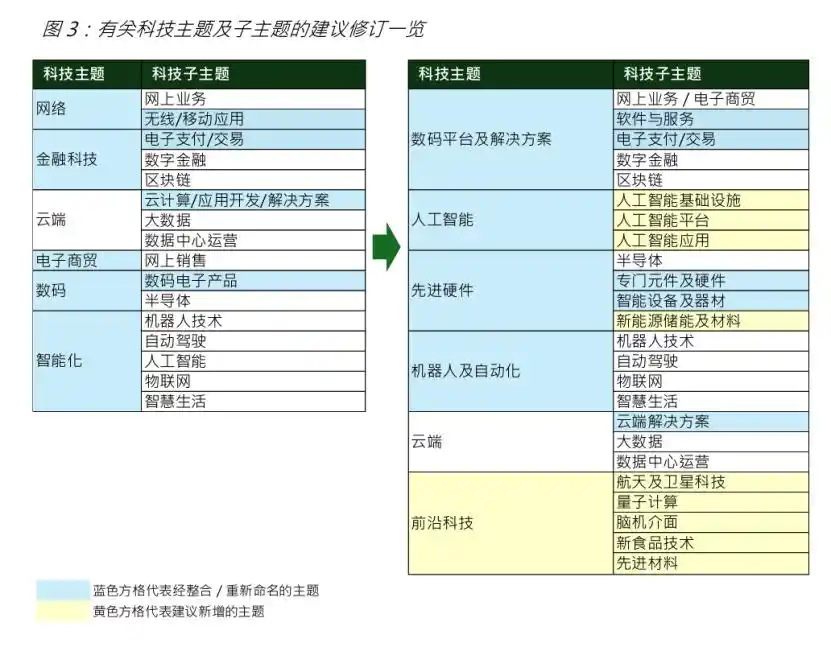
Source: Hang Seng Indexes Company website

The second is introducing a grouping selection mechanism. Hang Seng Indexes Company proposes that the stock selection scope for the Hang Seng TECH Index be limited to constituents of the Hang Seng Composite LargeCap & MidCap Index, while introducing a grouping selection mechanism. Selection will proceed via a dual-track system based on "Market Capitalization Group" and "Revenue Growth Group," and the number of constituent stocks will increase from 30 to 50. Specifically, the top 40 will be selected by market capitalization ranking, and the top 10 will be selected by revenue growth ranking.
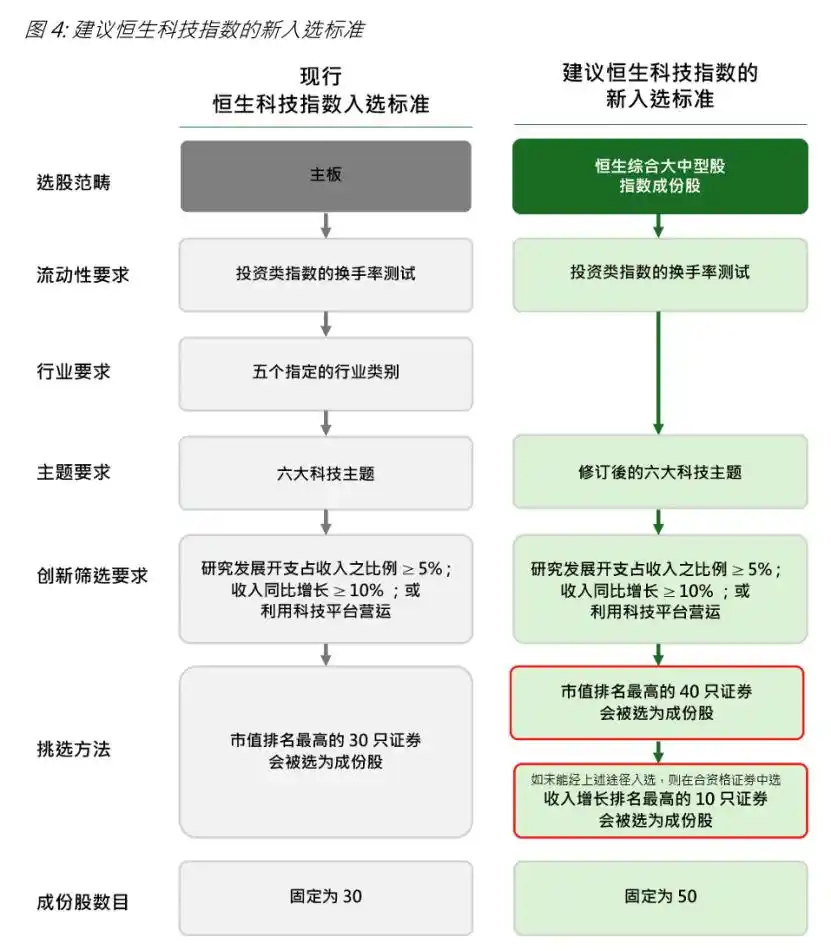
Source: Hang Seng Indexes Company website

According to simulation results released by Hang Seng Indexes Company, the revision will bring three major impacts on index characteristics.

First, index concentration will decrease slightly. Hang Seng Indexes Company simulation results show that the weight of the top ten constituents will drop from the current 70.6% to 66.3%, dispersing the index's exposure to leading companies somewhat.

Second, the distribution of technology themes will become more diverse. Under the new thematic framework, the number of constituents related to "Advanced Hardware" will increase from 5 to 15, and those related to "Artificial Intelligence" will increase from 3 to 6. Newly added themes like "Frontier Technology" will also gain inclusion space, significantly broadening the index's coverage of technology attributes.

Finally, the Revenue Growth Group will introduce high-growth targets. Simulation results show that the 10 new constituent stocks added via the "Revenue Growth Group" have a median revenue growth rate as high as 82%, higher than the 23.4% for those added via the "Market Capitalization Group," and far exceeding the 13.8% revenue growth rate of existing constituents.

This article is from the WeChat public account "Read One Insight" (ID: dushuyizhi007), author: Cheng Mengqi, editor: Guo Nan.


Criptos en tendencia

Preguntas relacionadas

QWhat are the main objectives of the proposed reforms to the Hang Seng TECH Index?

AThe main objectives are to enhance the index's market representation by adapting to the evolving Hong Kong tech ecosystem. Key changes include removing industry restrictions, revising the six tech themes, introducing a dual-track selection mechanism based on market cap and revenue growth, and expanding the number of constituent stocks from 30 to 50.

QHow does the proposed dual-track selection mechanism for the Hang Seng TECH Index work?

AThe dual-track selection mechanism involves selecting constituents based on two criteria: market capitalization and revenue growth. The top 40 stocks will be chosen by market cap ranking, and the top 10 stocks will be chosen by revenue growth ranking, resulting in a total of 50 constituent companies.

QWhat changes are expected in the thematic composition of the Hang Seng TECH Index based on the reform proposal?

AThe thematic composition will become more diversified. The number of constituents related to 'Advanced Hardware' is projected to increase from 5 to 15, and those related to 'Artificial Intelligence' from 3 to 6. New themes like 'Frontier Technology' will also gain representation.

QAccording to the article, how has the focus of Hong Kong's listed tech stocks shifted between 2021 and 2026?

AThe focus has shifted from internet-centric to intelligence-centric. In 2021, the 'Network' theme comprised 37.3% of listed tech stocks. By H1 2026, its share had fallen to 25.0%, while the 'Intelligent Implementation' theme had become the largest, accounting for 32.1%.

QWhat is the significance of the Hang Seng TECH Index's asset under management (AUM) growth mentioned in the article?

AThe article highlights that the global assets tracking the Hang Seng TECH Index have grown from $1.5 billion at launch to $40.4 billion as of June 2026. This 26-fold increase signifies the index's status as a major flagship index. Consequently, any changes to its constituents or weights will trigger significant passive fund reallocations, impacting the broader Hong Kong tech sector.

Lecturas Relacionadas

AI Boosting Efficiency and Cutting Costs Makes VC Increasingly Expensive

"AI for Cost Reduction Makes VC Funding More Expensive" Despite the "cost-reduction and efficiency" narrative of AI, venture capital (VC) investment in the AI sector is becoming increasingly costly. While AI tools lower the initial costs for many startups—with team sizes shrinking across funding stages—the market is polarizing. For top-tier AI teams, especially those from leading companies like Google and OpenAI, funding rounds are now larger and valuations are higher than ever at the seed and early stages. For example, new ventures by prominent researchers are securing billions in funding with valuations reaching tens of billions before having a mature product. This creates a "barbell" market: lightweight startups need less capital, while elite AI firms attract massive investments early on. This dynamic raises the cost for VCs to acquire and maintain meaningful ownership stakes. As valuations soar early, securing the same equity percentage requires significantly larger capital commitments. VCs must now invest more upfront and reserve substantial funds for follow-on rounds to avoid dilution, prompting large firms like Accel and a16z to raise massive new funds. Consequently, capital is concentrating intensely in a few perceived winners like OpenAI and Anthropic, widening the gap between large and small VC funds. While high valuations bake in future growth expectations, they also compress potential returns, demanding that portfolio companies achieve unprecedented scale. For major VCs, the core strategy is clear: secure early positions in potential winners and maintain the capital to keep investing as valuations rapidly escalate.

marsbitHace 19 min(s)

AI Boosting Efficiency and Cutting Costs Makes VC Increasingly Expensive

marsbitHace 19 min(s)

An Eight-Year Investment Takes a Sharp Turn: Why Did Ethereum Suddenly Abandon Poseidon?

On August 13, Ethereum researcher Justin Drake announced a significant shift in Ethereum's Layer-1 cryptographic roadmap: abandoning the SNARK-friendly hash function Poseidon in favor of traditional functions like SHA2 or BLAKE2. This decision ends eight years of research and investment, marking a major revision to the post-quantum security strategy. Poseidon, introduced in 2019, was highly efficient for zkRollups and zkVMs within SNARK circuits. However, its need for prolonged cryptanalysis and the pressing timeline for quantum resistance revealed limitations. Recent breakthroughs in SNARK design, specifically using binary fields, now enable traditional, battle-tested hash functions to perform as efficiently as Poseidon within SNARKs. Benchmarks show modern laptops can now verify over a million traditional hash calls per second. This change is partly driven by accelerated concerns over quantum computing threats. Reports warn that "Cryptographically Relevant Quantum Computers" could break current blockchain signatures like ECDSA by the early 2030s, risking trillions in assets. Ethereum's response focuses on hash-based post-quantum signature schemes, deemed more quantum-resistant than some lattice-based alternatives under pressure from AI cryptanalysis. Ethereum's updated post-quantum roadmap targets a production-ready "leanVM" for signature aggregation by 2027, with full deployment across consensus, execution, and data layers by 2028. The shift to mature hash functions like SHA2 reduces reliance on newer algorithms and aligns with the goal of using widely analyzed cryptographic primitives. Other major blockchains are also preparing. Solana's core teams have independently chosen the NIST-standardized Falcon signature scheme for its compact size. Starknet plans a phased migration, starting with replacing its Pedersen hash with BLAKE2. Ethereum's move signifies a strategic pivot towards proven security foundations for the quantum era.

marsbitHace 1 hora(s)

An Eight-Year Investment Takes a Sharp Turn: Why Did Ethereum Suddenly Abandon Poseidon?

marsbitHace 1 hora(s)

Programmers Worldwide Are Wasting Money on Anthropic! The Company Can't Stand It Anymore

Anthropic recently published guidelines to help developers using Claude Code reduce unnecessary token costs. The key recommendations include: 1) Clear (/clear) conversations after completing a task to avoid carrying irrelevant file reads and command outputs into the next task. 2) Set the model and reasoning effort level at the start of a session, as switching mid-session invalidates the prompt cache, requiring a full-price recalculation of the entire dialog history. 3) Attach files using @ references instead of typing paths manually to avoid extra tool calls and searches that bloat the context. 4) Add quiet flags to verbose commands (e.g., in CLAUDE.md) to minimize lengthy output in the dialog history. 5) Use /compact while the session cache is still warm (before breaks) to compress the dialog at one-tenth the cost. 6) Offload large-output tasks to a sub-agent, which runs in an isolated context and only returns conclusions, preventing intermediate outputs from polluting the main dialog. The article explains token pricing: input tokens (prefill) are processed in parallel, while output tokens (decode) are generated serially, making output tokens five times more expensive. Caching is crucial for savings—if a request's prefix (system prompt, CLAUDE.md, dialog history) matches the previous one byte-for-byte, reading it costs only 10% of the standard input price. However, cache invalidation occurs when changing models, effort levels, fast mode, compressing dialogs, after cache expiration, or when resuming old sessions. Dialog history also grows quadratically (O(n²)) as file contents and command outputs accumulate, increasing costs per round. Proactive context management—like isolating noisy tasks, using /rewind to trim unproductive turns, and task-based session clearing—is becoming an essential skill for cost-effective AI-assisted development.

marsbitHace 3 hora(s)

Programmers Worldwide Are Wasting Money on Anthropic! The Company Can't Stand It Anymore

marsbitHace 3 hora(s)

Pax Silica vs. WAICO: The US Wants to Prohibit Europe from Using Chinese Artificial Intelligence

The United States is preparing to demand that European and other partners abandon Chinese artificial intelligence initiatives, threatening exclusion from the American-led "Pax Silica" coalition, according to a leaked U.S. State Department document. This ultimatum forces signatories of the "AI Opportunity Statement" to choose between the Western technological ecosystem and alternative frameworks, with China not explicitly named but clearly targeted. Pax Silica is a U.S. strategy for AI and semiconductor hegemony, launched in late 2025. Its European presence expanded significantly in mid-2026. Concurrently, China, Russia, and 27 other nations established the World AI Cooperation Organization (WAICO) in July 2026 as an independent intergovernmental platform promoting AI governance based on UN principles. This situation creates a difficult choice, especially for European nations balancing strategic autonomy with dependence on U.S. tech and security. It also pressures Global South countries with pragmatic ties to both Washington and Beijing. The formation of competing blocks risks fragmenting the global tech landscape, forcing companies to split supply chains, increasing costs, and potentially leading to incompatible standards and protocols. The era of open globalization in AI may be ending, replaced by geopolitical confrontation where technological sovereignty trumps economic efficiency. The decisions made will shape the global digital economy for decades.

cryptonews.ruHace 5 hora(s)

Pax Silica vs. WAICO: The US Wants to Prohibit Europe from Using Chinese Artificial Intelligence

cryptonews.ruHace 5 hora(s)

Trading

Spot

Artículos destacados

Qué es ₿O₿

Bitcoin Bob ($₿o₿): Pionero en DeFi Centrado en Bitcoin a Través de la Innovación Híbrida de Capa 2 En una era donde la economía digital está evolucionando rápidamente, Bitcoin Bob ($₿o₿) surge como un proyecto revolucionario que busca mejorar la utilidad de Bitcoin en el sector de las finanzas descentralizadas (DeFi). Lanzado oficialmente en mayo de 2024, Bitcoin Bob, también conocido como Build on Bitcoin (BOB), representa una solución híbrida de blockchain de Capa 2 que combina la reconocida seguridad e inmutabilidad de Bitcoin con la programabilidad de Ethereum. Esta iniciativa busca llenar un vacío crucial en el ecosistema de Bitcoin al facilitar la integración de contratos inteligentes y aplicaciones descentralizadas, manteniendo al mismo tiempo los principios fundamentales de confianza y seguridad inherentes a Bitcoin. Con un respaldo significativo de destacados capitalistas de riesgo, Bitcoin Bob está posicionado para redefinir el papel de Bitcoin en el paisaje DeFi, convirtiéndolo en una piedra angular de las operaciones financieras descentralizadas a nivel global. ¿Qué es Bitcoin Bob, $₿o₿? En su esencia, Bitcoin Bob es una solución de blockchain híbrida diseñada para mejorar la funcionalidad de Bitcoin. El objetivo principal del proyecto es habilitar las finanzas descentralizadas en Bitcoin, facilitando transacciones rápidas y sin problemas mientras se asegura altos niveles de seguridad. Bitcoin Bob emplea tecnología avanzada, específicamente una arquitectura híbrida de capa 2 que combina los atributos de seguridad de Bitcoin con la programabilidad y flexibilidad de la Máquina Virtual de Ethereum (EVM). Este enfoque pragmático permite que el proyecto opere de manera efectiva sin comprometer los valores fundamentales de Bitcoin, convirtiéndolo en un paso monumental para cerrar la brecha entre los tenedores tradicionales de Bitcoin y el emergente ecosistema DeFi. Una de las características destacadas de Bitcoin Bob es su papel en proporcionar un entorno minimizado en confianza a través de mecanismos innovadores, como los rollups optimistas que inicialmente dependen de Ethereum, y que eventualmente transicionan a una integración completa con Bitcoin. Este sistema híbrido está diseñado para asegurar que la vasta liquidez presente en Bitcoin no solo se preserve, sino que también se utilice de manera efectiva en varios protocolos DeFi. ¿Quién es el Creador de Bitcoin Bob, $₿o₿? La fuerza creativa detrás de Bitcoin Bob es el cofundador y CEO Alexei Zamyatin, quien aporta una gran experiencia y conocimiento de su extensa trayectoria en el espacio de las criptomonedas. Zamyatin tiene un doctorado en Ciencias de la Computación y ha estado involucrado activamente en el desarrollo de Bitcoin desde 2015. Su profundo entendimiento de los ecosistemas de Bitcoin y Ethereum juega un papel crucial en la formación de la visión y los fundamentos tecnológicos de Bitcoin Bob. Junto a Zamyatin está el cofundador Dominik Harz, quien se desempeña como Director de Tecnología (CTO). Juntos, el dúo ha cultivado un equipo de individuos talentosos con una pasión compartida por empujar los límites de la tecnología blockchain, asegurando el estatus innovador de Bitcoin Bob en el mercado. ¿Quiénes son los Inversores de Bitcoin Bob, $₿o₿? Bitcoin Bob ha logrado obtener apoyo de una variedad de inversores prominentes y firmas de capital de riesgo que reconocen su potencial para transformar el paisaje de Bitcoin. En marzo de 2024, el proyecto completó una robusta ronda de financiamiento inicial de $10 millones, liderada por Castle Island Ventures, con la notable participación de firmas como Coinbase Ventures y Bankless Ventures. Poco después, en julio de 2024, Bitcoin Bob aseguró un adicional de $1.6 millones en financiamiento estratégico. Esta ronda fue co-liderada por Ledger Ventures y contó con ángeles de varias firmas prominentes como BlackRock, Aave y Curve. El fuerte respaldo financiero refleja un reconocimiento en toda la industria del enfoque innovador de Bitcoin Bob para desbloquear el potencial de Bitcoin en el espacio DeFi. Este financiamiento es crucial no solo para el desarrollo continuo del proyecto, sino también para establecer un incubador que fomente aplicaciones descentralizadas (dApps) nativas de Bitcoin, dirigidas específicamente a satisfacer las necesidades de una base de usuarios en crecimiento. ¿Cómo Funciona Bitcoin Bob, $₿o₿? La mecánica operativa de Bitcoin Bob se basa en su arquitectura de rollup híbrido, que está diseñada para combinar los beneficios de la seguridad de Bitcoin con la versatilidad de la EVM de Ethereum. El proyecto emplea un modelo de seguridad por fases que describe su interacción con usuarios y desarrolladores de la siguiente manera: Fase 1 – La fase inicial opera como un rollup optimista en Ethereum, donde las transacciones se procesan con una expectativa prometedora de validez, allanando el camino para futuros desarrollos en Bitcoin. Fase 2 – A medida que el proyecto transiciona, integrará la finalización de Bitcoin a través de Staking de Bitcoin, aprovechando la Red Babylon para mejorar la seguridad. Este mecanismo requiere que los validadores bloqueen Bitcoin, verificando así las transacciones de BOB, lo que no solo mejora la seguridad, sino que también crea perspectivas de rendimiento para los participantes. Fase 3 – La visión a futuro para Bitcoin Bob es integrarse completamente con Bitcoin, utilizando tecnologías innovadoras como BitVM y pruebas de conocimiento cero para facilitar la computación fuera de la cadena mientras se mantiene la integridad de seguridad de Bitcoin. Innovaciones clave como BitVM2, un protocolo de puente minimizado en confianza co-autorado por Zamyatin, son críticas para la funcionalidad del proyecto, permitiendo depósitos y retiros de Bitcoin sin necesidad de una extensa dependencia de la red. Esto permite que el ecosistema se conecte de manera eficiente con Ethereum y otras cadenas compatibles, creando un modelo de interacción fluido y efectivo para usuarios y desarrolladores. Cronología de Bitcoin Bob, $₿o₿ Entender la evolución de Bitcoin Bob implica rastrear sus hitos importantes: 2019: Alexei Zamyatin y Dominik Harz establecen una firma de investigación enfocada en soluciones blockchain, sentando las bases para futuros proyectos. Marzo 2024: Bitcoin Bob recauda exitosamente $10 millones en una ronda de financiamiento inicial, marcando su entrada en el competitivo paisaje de blockchain. 1 de mayo de 2024: Ocurre el lanzamiento oficial de la mainnet, mostrando las capacidades del proyecto con una adopción significativa de usuarios y valor total bloqueado (TVL). Julio 2024: El proyecto atrae un adicional de $1.6 millones en financiamiento estratégico para establecer su incubadora, destinada a fomentar innovaciones impulsadas por Bitcoin. Octubre 2024: Bitcoin Bob publica un “Documento de Visión”, detallando su diseño de capa 2 híbrida y estrategias a futuro. 2025: Se espera el lanzamiento de las características de la Fase 2, enfocándose en la finalización de Bitcoin y puentes BitVM destinados a mejorar la funcionalidad general. Conclusión: Redefiniendo el Papel de Bitcoin en las Finanzas Descentralizadas Bitcoin Bob ($₿o₿) no es solo otro proyecto de blockchain; representa un cambio de paradigma en la forma en que Bitcoin puede interactuar con aplicaciones financieras más amplias. Al combinar meticulosamente la seguridad de Bitcoin con la flexibilidad de Ethereum, Bitcoin Bob busca remodelar el paisaje DeFi, cerrando la brecha entre la moneda digital y las aplicaciones descentralizadas. Con un robusto marco tecnológico, un liderazgo fuerte y financiamiento estratégico, Bitcoin Bob está bien posicionado para establecerse como un jugador fundamental en el ecosistema de criptomonedas, desbloqueando nuevas dimensiones de liquidez y utilidad para Bitcoin. A medida que el proyecto continúa evolucionando y expandiéndose, promete inaugurar una nueva era de innovación, demostrando que el potencial de Bitcoin se extiende mucho más allá de ser un mero almacén de valor, sino más bien como una piedra angular del futuro paisaje financiero. A medida que el proyecto avanza a través de sus fases anticipadas, todas las miradas estarán puestas en Bitcoin Bob, particularmente en lo que respecta a su compromiso de incorporar principios descentralizados y asegurar que los usuarios puedan disfrutar de todos los beneficios de DeFi anclados en Bitcoin.

110 Vistas totalesPublicado en 2025.06.30Actualizado en 2025.06.30

Qué es ₿O₿

Cómo comprar O

¡Bienvenido a HTX.com! Hemos hecho que comprar O1 exchange (O) sea simple y conveniente. Sigue nuestra guía paso a paso para iniciar tu viaje de criptos.Paso 1: crea tu cuenta HTXUtiliza tu correo electrónico o número de teléfono para registrarte y obtener una cuenta gratuita en HTX. Experimenta un proceso de registro sin complicaciones y desbloquea todas las funciones.Obtener mi cuentaPaso 2: ve a Comprar cripto y elige tu método de pagoTarjeta de crédito/débito: usa tu Visa o Mastercard para comprar O1 exchange (O) al instante.Saldo: utiliza fondos del saldo de tu cuenta HTX para tradear sin problemas.Terceros: hemos agregado métodos de pago populares como Google Pay y Apple Pay para mejorar la comodidad.P2P: tradear directamente con otros usuarios en HTX.Over-the-Counter (OTC): ofrecemos servicios personalizados y tipos de cambio competitivos para los traders.Paso 3: guarda tu O1 exchange (O)Después de comprar tu O1 exchange (O), guárdalo en tu cuenta HTX. Alternativamente, puedes enviarlo a otro lugar mediante transferencia blockchain o utilizarlo para tradear otras criptomonedas.Paso 4: tradear O1 exchange (O)Tradear fácilmente con O1 exchange (O) en HTX's mercado spot. Simplemente accede a tu cuenta, selecciona tu par de trading, ejecuta tus trades y monitorea en tiempo real. Ofrecemos una experiencia fácil de usar tanto para principiantes como para traders experimentados.

634 Vistas totalesPublicado en 2026.06.19Actualizado en 2026.06.29

Cómo comprar O

Discusiones

Bienvenido a la comunidad de HTX. Aquí puedes mantenerte informado sobre los últimos desarrollos de la plataforma y acceder a análisis profesionales del mercado. A continuación se presentan las opiniones de los usuarios sobre el precio de O (O).

活动图片