Hackers are exploiting a JavaScript library to plant crypto drainers

cointelegraphPublicado a 2025-12-15Actualizado a 2025-12-15

Resumen

A recent surge in crypto drainer attacks is exploiting a critical vulnerability (CVE-2025-55182) in the React JavaScript library, as reported by cybersecurity nonprofit Security Alliance (SEAL). The vulnerability, which allows unauthenticated remote code execution, was disclosed on December 3 after being discovered by a white hat hacker. Attackers are using this flaw to inject wallet-draining code into legitimate crypto websites, often tricking users into signing malicious transactions through fake pop-ups or reward offers. SEAL warns that affected websites may be flagged as phishing risks and urges all site owners to immediately scan their front-end code for suspicious or obfuscated scripts, unrecognized assets, and incorrect recipient addresses in signature requests. The React team has released a patch for the vulnerability and recommends that users of react-server-dom-webpack, react-server-dom-parcel, and react-server-dom-turbopack upgrade immediately. Apps not using React Server Components or a server are not affected.

There has been a recent uptick in crypto drainers being uploaded to websites through a vulnerability in the open-source front-end JavaScript library React, according to cybersecurity nonprofit Security Alliance (SEAL).

React is used for building user interfaces, especially in web applications. The React team disclosed on Dec. 3 that a white hat hacker, Lachlan Davidson, found a security vulnerability in its software that allowed unauthenticated remote code execution, which can allow an attacker to insert and run their own code.

According to SEAL, bad actors have been using the vulnerability, CVE-2025-55182, to secretly add wallet-draining code to crypto websites.

“We are observing a big uptick in drainers uploaded to legitimate crypto websites through exploitation of the recent React CVE. All websites should review front-end code for any suspicious assets NOW,” the SEAL Team said.

“The attack is targeting not only Web3 protocols! All websites are at risk. Users should exercise caution when signing ANY permit signature.”

Wallet drainers typically dupe users into signing a transaction through methods such as a sham pop-up offering rewards or similar tactics.
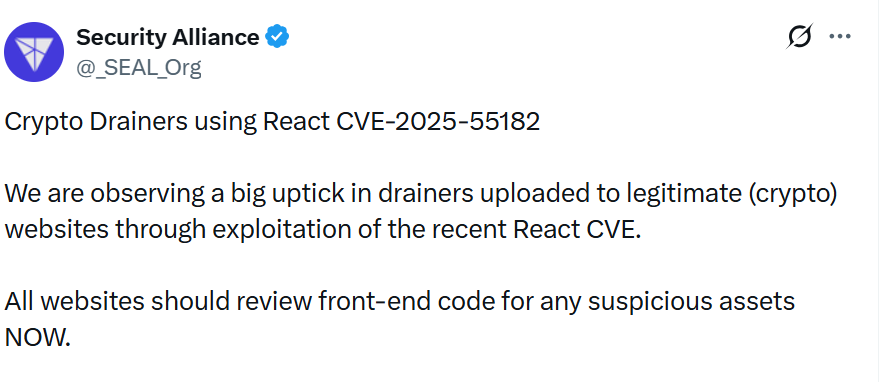
Source: Security Alliance

Websites with phishing warning should check code

Affected websites may have been suddenly flagged as a possible phishing risk without explanation, according to the SEAL Team. They recommend website hosts take precautions to ensure there are no hidden drainers that could put users at risk.

“Scan host for CVE-2025-55182. Check if your front-end code is suddenly loading assets from hosts you do not recognize. Check if any of the scripts loaded by your front end code are obfuscated JavaScript. Inspect if the wallet is showing the correct recipient on the signature signing request,” they said.

Related: North Korean ‘fake Zoom’ crypto hacks now a daily threat: SEAL

“If your project is getting blocked, that may be the reason. Please review your code first before requesting phishing page warning removal,” the SEAL Team added.

React has released a fix for the vulnerability

The React team published a fix for CVE-2025-55182 on Dec. 3 and advises anyone using the react-server-dom-webpack, react-server-dom-parcel, react-server-dom-turbopack, to upgrade immediately and close the vulnerability.

“If your app’s React code does not use a server, your app is not affected by this vulnerability. If your app does not use a framework, bundler, or bundler plugin that supports React Server Components, your app is not affected by this vulnerability,” the team added.

Magazine: Meet the onchain crypto detectives fighting crime better than the cops

Lecturas Relacionadas

How to Do Research Well: Deliberately Practice the Real Skills That Matter

No one truly teaches you how to do research. You're often given a desk, a pre-selected problem, and vague instructions to "create something new." Consequently, many people reverse-engineer the job based on visible outputs—papers, posts, announcements—learning only how to *appear* like a researcher rather than how to *become* one. True research capability is built from stacking small, trainable skills, nearly all of which can be developed through deliberate practice. **Pick Your Own Problem:** Most researchers absorb problems from advisors or trends, lacking the underlying reasoning. Choosing a problem you genuinely care about, as John Schulman advises, leads to original work. Develop "taste" like a muscle: predict experiment outcomes, guess paper results from methods, and track which findings remain important over time. **Upgrade Your Inputs:** Relying on shared reading lists (arXiv hot lists, filtered group chats) leads to unoriginal conclusions. Undervalued old literature often holds crucial insights (e.g., MoE, LSTM, backpropagation). Richard Sutton's "The Bitter Lesson" or Claude Shannon's 1952 talk on creative thinking are more predictive than lengthy modern surveys. Breadth matters as much as depth: draw from neuroscience, mechanism design, hardware knowledge, and honest statistics. Read papers directly, especially appendices and limitations sections. **Write Everything Down:** As Paul Graham noted, writing exposes flaws in seemingly mature ideas. Writing is the cheapest defense against self-deception. Following Feynman's principle, Darwin programmatically wrote down facts contradicting his theory to combat memory bias. Maintain a detailed log of hypotheses, setups, predictions, results, and updated understandings. Reviewing past logs fosters essential humility.

marsbitHace 48 min(s)

How to Do Research Well: Deliberately Practice the Real Skills That Matter

marsbitHace 48 min(s)

Following US Ban on Fable 5, Zhipu AI's Stock Soars 47%

On June 15th, shares of Zhipu AI surged dramatically on the Hong Kong stock market, peaking at a 47.6% gain before closing 32.82% higher. This sharp increase was directly triggered by two recent industry events. On June 12th, Anthropic announced it was suspending global access to its latest flagship models, Claude Fable 5 and Claude Mythos 5, to comply with a U.S. government export control order. The next day, Zhipu AI announced it would open access to its latest open-source flagship model, GLM-5.2, under the permissive MIT license. The Anthropic incident highlighted a critical issue beyond raw model capability: the risk of sudden, unpredictable loss of access to advanced AI models, especially for developers and enterprises deeply integrated with them. This has shifted industry and market focus toward factors like stability, sustainable access, and controllability. Zhipu's move, promoting "frontier intelligence for all," positions its openly available model as a reliable and accessible alternative. The GLM-5.2 model emphasizes "Long Horizon Task" capabilities with a 1M context window, targeting complex, multi-step coding and engineering workflows where maintaining context is crucial. Analysts note this event exposes the risk of dependency on closed-source models subject to single jurisdictional controls, potentially accelerating a shift toward domestic base models and localized deployments. The market's reaction signals a new valuation dimension in AI: providers who can offer stable, long-term, and sustainably accessible AI capabilities are gaining strategic importance.

marsbitHace 1 hora(s)

Following US Ban on Fable 5, Zhipu AI's Stock Soars 47%

marsbitHace 1 hora(s)

Fully Entering the AI Era: Alipay Bets on Conversation, WeChat Holds Fast to Social

In May 2026, Alipay announced over 300 million AI payment transactions. Shortly after, WeChat opened its mini-programs for AI integration, sparking controversy by requiring developer source code access. This highlights their diverging approaches to AI integration. Alipay is testing "Project Treasure," an optional AI-native interface replacing traditional app grids with a conversational window. Users can command complex tasks (e.g., "book a ride and order coffee") handled end-to-end by AI. This shift follows an abandoned standalone AI app, focusing instead on enhancing its existing user base. For unmodified mini-programs, Alipay's AI uses "screen-reading" to simulate user interactions, bypassing the need for developer overhaul. It also introduced "Token Pay" for micro-transactions and "AI Wallets" for autonomous agent spending. WeChat, prioritizing its core social function, is taking an embedded approach. Its AI agent will operate within existing contexts like group chats and official accounts, assisting without a separate interface. To enable this, WeChat offers developers two paths: granting source code access for direct AI control ("Automatic Mode") or manually encapsulating services into standardized "Skills." Both place significant burden on developers. Key differences emerge in handling legacy services: WeChat demands developer cooperation (code or labor), while Alipay's screen-reading offers immediate, if potentially less stable, compatibility. Alipay's 3 billion AI transactions demonstrate user acceptance of AI-driven commercial actions. The divergent strategies may reshape mini-program ecosystems—Alipay passively "AI-fying" services, WeChat potentially favoring resource-rich developers—and set competing technical standards. Ultimately, the competition centers on where users entrust the command to "help me get things done."

marsbitHace 1 hora(s)

Fully Entering the AI Era: Alipay Bets on Conversation, WeChat Holds Fast to Social

marsbitHace 1 hora(s)

Trading

Spot
Futuros

Artículos destacados

Qué es ATWO

I. Introducción al ProyectoArena Two es una plataforma interactiva descentralizada que permite a los fanáticos jugar un papel activo y tokenizado en los resultados de eventos en tiempo real. A diferencia de los modelos de transmisión tradicionales que reducen a los fanáticos a espectadores pasivos, Arena Two aprovecha la tecnología blockchain para permitir que los fanáticos voten directamente en tiempo real e influyan en los resultados en el campo.II. Información del TokenNombre del token: ATWO (Arena Two)III. Enlaces RelacionadosSitio web: https://arenatwo.com/Exploradores: https://basescan.org/token/0x499D35eBE6cEe9B2Ac35Fd003fcBbeeB9CFc7B32Twitter: https://x.com/arenatwoXNota: La introducción del proyecto proviene de los materiales publicados o proporcionados por el equipo oficial del proyecto, que es solo para referencia y no constituye asesoramiento de inversión. HTX no se hace responsable de ninguna pérdida directa o indirecta resultante.

179 Vistas totalesPublicado en 2026.05.18Actualizado en 2026.06.02

Qué es ATWO

Cómo comprar ATWO

¡Bienvenido a HTX.com! Hemos hecho que comprar Arena Two (ATWO) sea simple y conveniente. Sigue nuestra guía paso a paso para iniciar tu viaje de criptos.Paso 1: crea tu cuenta HTXUtiliza tu correo electrónico o número de teléfono para registrarte y obtener una cuenta gratuita en HTX. Experimenta un proceso de registro sin complicaciones y desbloquea todas las funciones.Obtener mi cuentaPaso 2: ve a Comprar cripto y elige tu método de pagoTarjeta de crédito/débito: usa tu Visa o Mastercard para comprar Arena Two (ATWO) al instante.Saldo: utiliza fondos del saldo de tu cuenta HTX para tradear sin problemas.Terceros: hemos agregado métodos de pago populares como Google Pay y Apple Pay para mejorar la comodidad.P2P: tradear directamente con otros usuarios en HTX.Over-the-Counter (OTC): ofrecemos servicios personalizados y tipos de cambio competitivos para los traders.Paso 3: guarda tu Arena Two (ATWO)Después de comprar tu Arena Two (ATWO), guárdalo en tu cuenta HTX. Alternativamente, puedes enviarlo a otro lugar mediante transferencia blockchain o utilizarlo para tradear otras criptomonedas.Paso 4: tradear Arena Two (ATWO)Tradear fácilmente con Arena Two (ATWO) en HTX's mercado spot. Simplemente accede a tu cuenta, selecciona tu par de trading, ejecuta tus trades y monitorea en tiempo real. Ofrecemos una experiencia fácil de usar tanto para principiantes como para traders experimentados.

196 Vistas totalesPublicado en 2026.05.18Actualizado en 2026.06.02

Cómo comprar ATWO

Qué es ZEST

I. Introducción al ProyectoEl Protocolo Zest es un protocolo de préstamos en Bitcoin que permite a los proveedores de liquidez de Bitcoin ganar rendimiento en Bitcoin a través de fondos de préstamos gestionados profesionalmente.II. Información del TokenNombre del token: ZEST (Protocolo Zest)III. Enlaces RelacionadosSitio web: https://www.zestprotocol.com/Exploradores: https://bscscan.com/token/0x5506599c722389a60580b5213ea1da60d64754a1Twitter: https://twitter.com/ZestProtocolNota: La introducción al proyecto proviene de los materiales publicados o proporcionados por el equipo oficial del proyecto, que es solo para referencia y no constituye asesoramiento de inversión. HTX no se hace responsable de ninguna pérdida directa o indirecta resultante.

218 Vistas totalesPublicado en 2026.05.19Actualizado en 2026.06.02

Qué es ZEST

Discusiones

Bienvenido a la comunidad de HTX. Aquí puedes mantenerte informado sobre los últimos desarrollos de la plataforma y acceder a análisis profesionales del mercado. A continuación se presentan las opiniones de los usuarios sobre el precio de A (A).

活动图片