Grayscale Discloses Potential Investment Candidates: Which Crypto Assets Are Under Consideration?

marsbitPublicado a 2026-01-15Actualizado a 2026-01-15

Resumen

Grayscale, a leading crypto asset manager, has disclosed its list of potential digital assets under consideration for future investment products, alongside an updated list of assets currently held in its existing products. These lists are organized using Grayscale's proprietary crypto sector classification framework. The "Asset Candidate List" features digital assets not currently held but identified as potential candidates. The "Existing Grayscale Product Assets" list details holdings as of January 12, 2026. The firm plans to update these lists quarterly. Grayscale emphasizes that the inclusion of an asset on the candidate list does not guarantee a product will be launched, as the process is complex and depends on internal controls, custody arrangements, and regulatory considerations. Assets may also be added to products without first appearing on the candidate list. The announcement includes a reminder that new products may not receive approval for secondary market trading. This information is for informational purposes only and not an offer to sell or buy securities.

Author: Grayscale

Compiled by: Deep Tide TechFlow
As a leading crypto asset management company, introducing a diverse range of investable digital assets to investors is a crucial part of our mission.

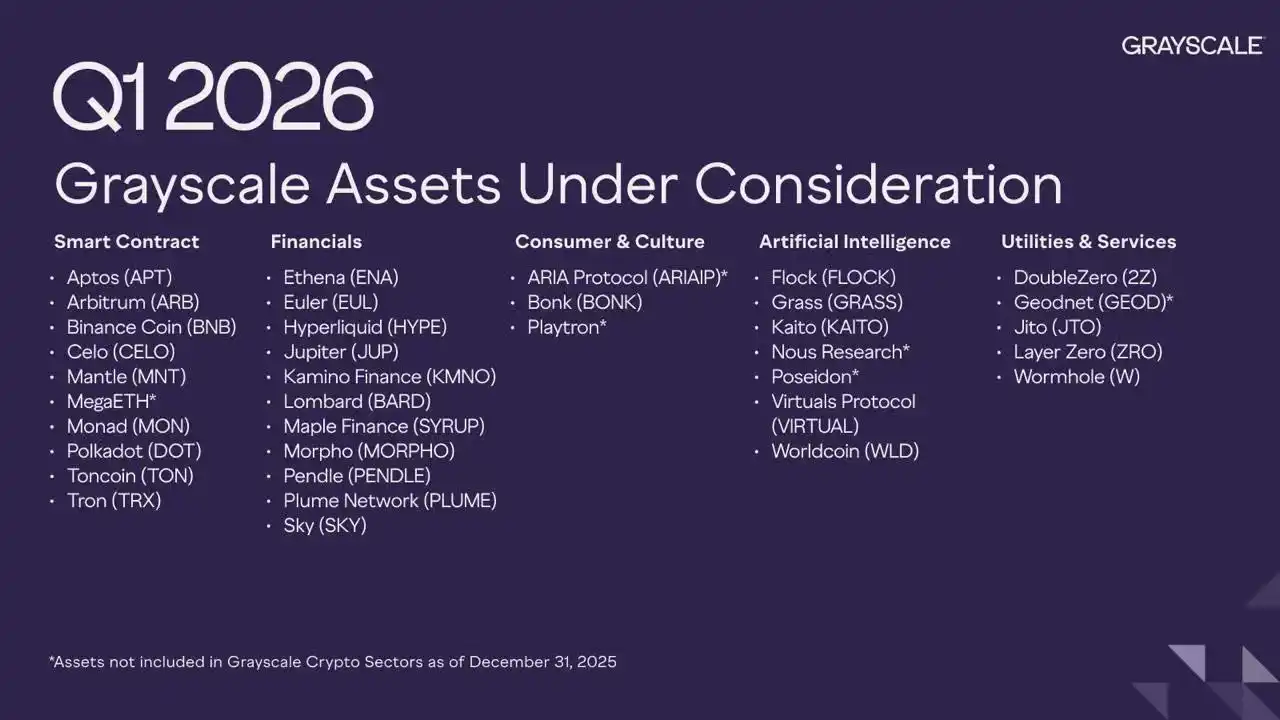
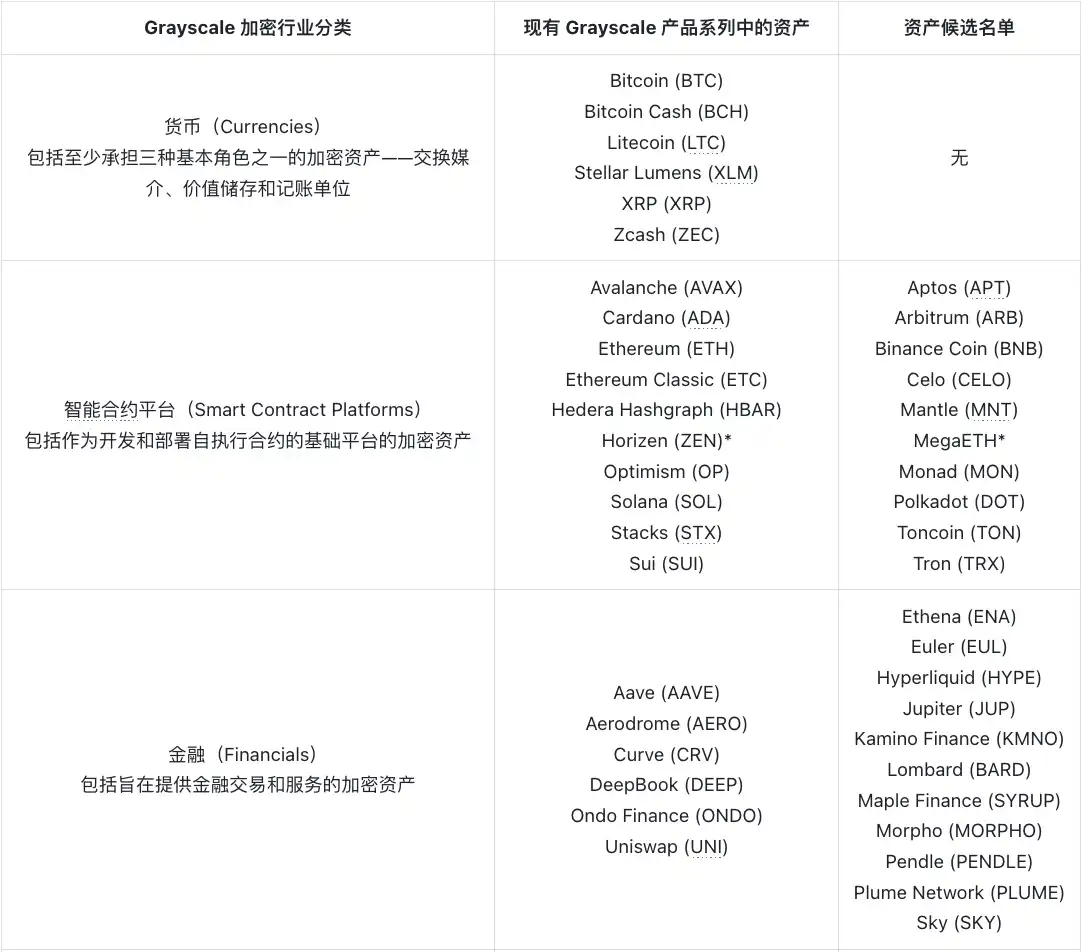
Therefore, we are pleased to share this candidate list of assets that may potentially be included in Grayscale investment products in the future, along with an updated list of assets currently in our existing product lineup. Both lists are categorized according to the Grayscale Crypto Sector Classification Framework we designed, which aims to set the standard for organizing crypto asset categories.

The "Asset Candidate List" includes digital assets that are not currently part of Grayscale investment products but have been identified by our team as potential candidates for future products.

The "Assets in Existing Grayscale Product Lineup" lists the digital assets held by Grayscale products as of January 12, 2026, which may be part of either single-asset products or multi-asset products.

As the crypto ecosystem expands and the Grayscale team reviews or re-evaluates additional assets, we plan to update this list as frequently as possible within 15 days after the end of each quarter. The following lists are as of January 12, 2026, and may change during the quarter as some multi-asset funds rebalance their compositions and we launch new single-asset products.
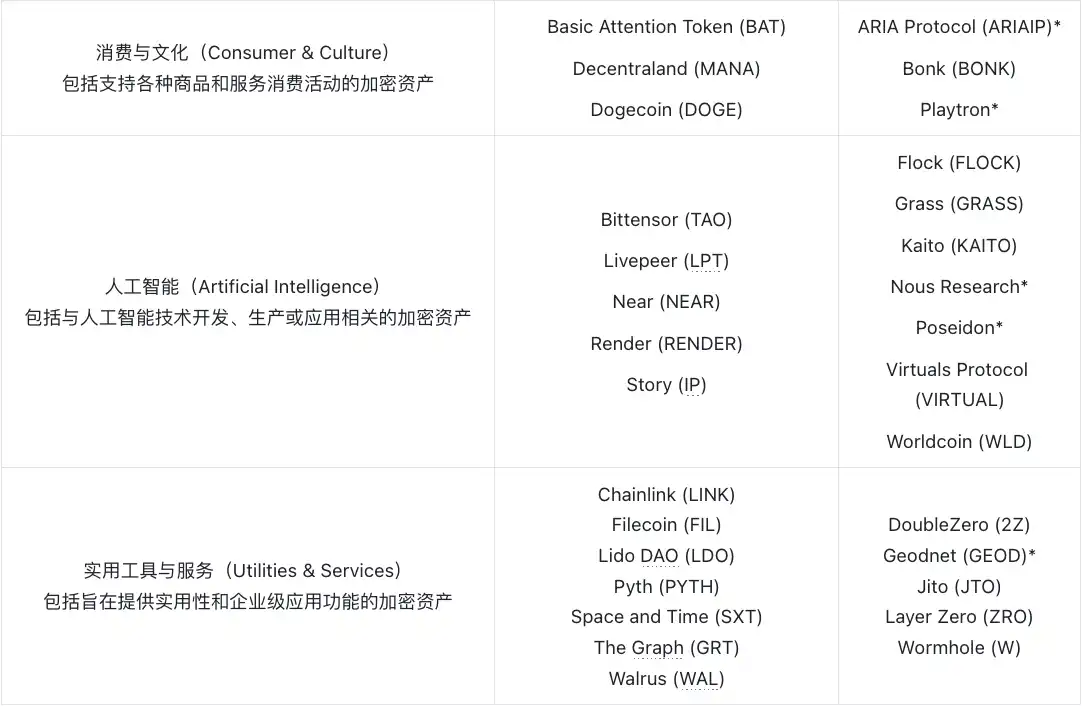
*As of December 31, 2025, assets not included in the Grayscale Crypto Sector Classification.

1 Assets may be directly included in the Grayscale product lineup without first being listed in this table, for example, if a decision is made to include an asset in a Grayscale product during the quarter.

The process of creating investment products similar to our existing ones is complex and multifaceted. It requires in-depth review and consideration and is influenced by various factors such as internal controls, custody arrangements, and regulatory requirements. It is important to note that this table is for informational purposes only, and not all candidate assets will be converted into our investment products. Grayscale may also explore other assets not listed in the table for inclusion in its product lineup. Similarly, assets may be directly included in the Grayscale product lineup without first being listed in this table.

Grayscale may attempt to have shares of new products quoted on secondary markets. Although shares of certain Grayscale products are approved for trading on secondary markets (such as OTCQX), for investors in new products, it cannot be assumed that such shares will receive similar approval due to potential concerns from the U.S. Securities and Exchange Commission (SEC) and/or the Financial Industry Regulatory Authority (FINRA) regarding the status of the underlying digital assets under federal securities laws.

This article does not constitute an offer to sell or a solicitation to buy any securities in any jurisdiction, nor should it be considered as legal to make such an offer, solicitation, or sale without registration or qualification under the securities laws of that jurisdiction. Grayscale, its affiliates, and clients may hold positions in the digital assets or securities discussed herein.

Preguntas relacionadas

QWhat is the purpose of Grayscale's 'asset candidate list'?

AThe 'asset candidate list' identifies digital assets not currently included in Grayscale investment products but have been identified by their team as potential candidates for future products.

QHow often does Grayscale plan to update its list of potential investment assets?

AGrayscale plans to update the list as frequently as possible, aiming for within 15 days after the end of each quarter.

QAs of the article's date, what framework does Grayscale use to categorize crypto assets for its products?

AGrayscale uses its own designed 'Grayscale Crypto Sector Classification Framework' to categorize crypto assets for its products.

QDoes inclusion on the candidate list guarantee an asset will be turned into a Grayscale investment product?

ANo, inclusion on the candidate list does not guarantee an asset will be turned into a product. It is for informational purposes only, and not all candidate assets will be converted.

QWhat is a significant regulatory consideration mentioned for new Grayscale products seeking secondary market trading?

AA significant consideration is that the SEC and/or FINRA may have concerns about the status of the product's underlying digital asset under federal securities laws, so approval for secondary market trading cannot be assumed.

Lecturas Relacionadas

When AI Begins to Audit the World: From Claude Discovering the ZEC Vulnerability, Watching the Encryption Industry Enter the 'Recursive Security Era'

**When AI Audits the World: From Claude's Discovery of a ZEC Vulnerability, Viewing the Crypto Industry Entering a "Recursive Security Era"** This article examines a pivotal shift in the blockchain security landscape, triggered by the convergence of two events: Anthropic's research on AI's "Recursive Self-Improvement" and Claude Opus 4.8's discovery of a critical vulnerability in Zcash's code. Traditionally, crypto security has relied on human experts and automated tools for periodic audits. However, the article argues AI is transitioning from a mere tool to an active participant in understanding and analyzing complex systems. Claude's ability to identify a subtle flaw in Zcash's zero-knowledge proof system demonstrates AI's potential to dramatically lower the cost and time required for risk discovery. This goes beyond finding a single bug; it signals a change in the very mechanism of how vulnerabilities are found. The core thesis introduces the concept of "Recursive Security," drawing a parallel to Anthropic's "Recursive Self-Improvement." Just as AI can accelerate its own development through feedback loops, security systems are evolving towards a continuous cycle of analysis, risk identification, remediation, and re-analysis. Security is becoming a persistent, evolving capability integrated into a system's lifecycle, rather than a one-time pre-launch audit. This shift is particularly urgent for the crypto industry, where system complexity from Layer-2 networks, modular architectures, and ZK-proofs is growing faster than human analysis capacity. AI excels at the pattern recognition and contextual understanding needed to navigate this complexity. Importantly, the article cautions that AI augments both defenders and potential attackers, accelerating the entire threat landscape. The future competitive advantage may not lie in having zero vulnerabilities, but in having the fastest risk discovery, validation, and response capabilities. The Claude-Zcash incident is thus an early signal of an era where AI-driven, recursive security systems become essential for managing risk in an increasingly complex digital world.

marsbitHace 37 min(s)

When AI Begins to Audit the World: From Claude Discovering the ZEC Vulnerability, Watching the Encryption Industry Enter the 'Recursive Security Era'

marsbitHace 37 min(s)

From MSTR to STRC+: Where Is the Limit of the Strategy Universe?

From MSTR to STRC+: The Evolution and Limits of the Strategy Universe This article examines the transformation of Strategy (formerly MicroStrategy) from a simple "Bitcoin treasury" company into a complex financial engineering firm building a BTC-backed credit system. **Core Thesis:** Strategy's true significance lies not just in its massive BTC holdings (~844k BTC), but in its attempt to transform this static reserve into a multi-layered credit curve within traditional capital markets and, subsequently, into on-chain yield infrastructure. **The MSTR Flywheel:** The initial model was a reflexive loop: BTC price rises → MSTR stock rises → company raises capital (debt/equity) at a premium → buys more BTC → increases per-share BTC exposure → MSTR premium grows. This "amplified Bitcoin" equity (MSTR) thrives on bullish momentum but is vulnerable to tightening premiums and rising funding costs. **Building the Credit Curve:** Strategy's innovation is slicing its single BTC balance sheet into different risk/return profiles via specialized securities: * **MSTR:** High-volatility equity layer absorbing full BTC upside/downside. * **STRC:** Key product. A perpetual preferred stock designed as "short duration high yield credit," offering ~11.5% floating monthly dividends. It attracts fixed-income investors seeking yield without direct BTC exposure, funding Strategy's operations. * **STRD/STRK/STRF:** Other preferred/share classes with varying durations, conversion rights, and fixed dividends. **Risks of the STRC Model:** STRC's high yield is not risk-free. Its stability depends on: 1) Sufficient BTC asset coverage, 2) Strategy's continued ability to pay dividends, and 3) Market faith in the MSTR/STRC funding flywheel. Stress points include deep BTC price declines eroding the asset buffer, rising dividend costs if STRC trades below par, and a broken flywheel if MSTR's premium (mNAV) falls persistently. **On-Chain Expansion: STRC+:** Projects like **Saturn** and **Apyx** aim to package STRC's (and other DAT preferred stock) cash flows into on-chain stablecoin yield (e.g., sUSDat, apyUSD). They offer DeFi a new yield source distinct from trading fees or incentives—cash dividends from traditional securities. However, this introduces compounded risks: off-chain custody, issuer credit risk, BTC volatility, and protocol execution risk. **Conclusion: The Ultimate Boundary** Strategy's endgame is not infinite BTC accumulation. It is the market's long-term acceptance of a new credit system where BTC serves as collateral for tradable securities whose cash flows can power on-chain financial applications. Its "universe" expands if this BTC-native credit curve gains legitimacy, but contracts if these instruments are repriced purely as high-risk, yield-bearing credit assets without stablecoin mythology.

marsbitHace 56 min(s)

From MSTR to STRC+: Where Is the Limit of the Strategy Universe?

marsbitHace 56 min(s)

Trading

Spot
Futuros
活动图片