GPUs Have No 'Price': Four Indices Clash, the Compute Market Is More Chaotic Than You Think

marsbitPublicado a 2026-04-08Actualizado a 2026-04-08

Resumen

The GPU compute market lacks a clear price benchmark, with four major indices on Bloomberg Terminal showing significant divergence—differing by over $2 and moving inconsistently. This reveals a fragmented and inefficient market for AI compute power, particularly for H100 and B200 GPUs. While demand surges and supply constraints are real, pricing is highly opaque and varies by contract type, provider, and location. The absence of standardized contracts, reliable benchmarks, and liquid secondary markets leads to hoarding and informal subleasing. Key issues include inconsistent pricing methodologies, unstandardized agreements, quality assurance gaps, and no forward pricing mechanism. Without coordinated improvements in infrastructure and market design, establishing a true price for GPU compute remains impossible.

Author: David Lopez Mateos

Compiled by: Deep Tide TechFlow

Deep Tide Guide: The media likes to summarize the rise and fall of GPU compute prices with a single number, but the reality is: the quotes from four index providers on the Bloomberg terminal diverge by more than $2, with inconsistent directions and rhythms. The author of this article is David Lopez Mateos, founder of the GPU compute trading platform Compute Desk. Using first-hand transaction data, he breaks down the real pricing structure of H100 and B200, revealing a primitive market with no consensus benchmark, no standard contracts, and no forward curve—compute power is being hoarded and sublet like short-term rental apartments.

Media headlines would make you think GPU compute prices are soaring. This narrative is comfortable, perfectly fitting into the macro framework of "supply crunch + bottomless AI demand," and it implies something reassuring: we have a well-functioning market with clear and readable price signals.

But we don't. This narrative is almost entirely built on a single index, and it implies something that shouldn't be implied: the GPU rental market has become efficient enough to be represented by a single number.

The supply crunch is real, but the crunch felt by different people is completely different—depending on who you are, where you are, what contract you're trading, and what compute asset. Faced with this opacity, the market's natural reaction is not orderly price discovery but hoarding: locking in GPU time you might not even need yet, because you're not sure if you can get it at any price next month. Where there is hoarding and no transparent benchmark, fragmented secondary markets emerge. At Compute Desk, we have already facilitated tenants subletting their clusters like apartments during major events. This is not a hypothesis; it is happening.

Indices Do Not Converge

In mature commodity markets, indices built on different methodologies tend to converge. Brent crude and WTI have a few dollars of spread due to geographic location and crude quality, but they move in sync directionally (Figure 1). This convergence is a hallmark of an efficient market.
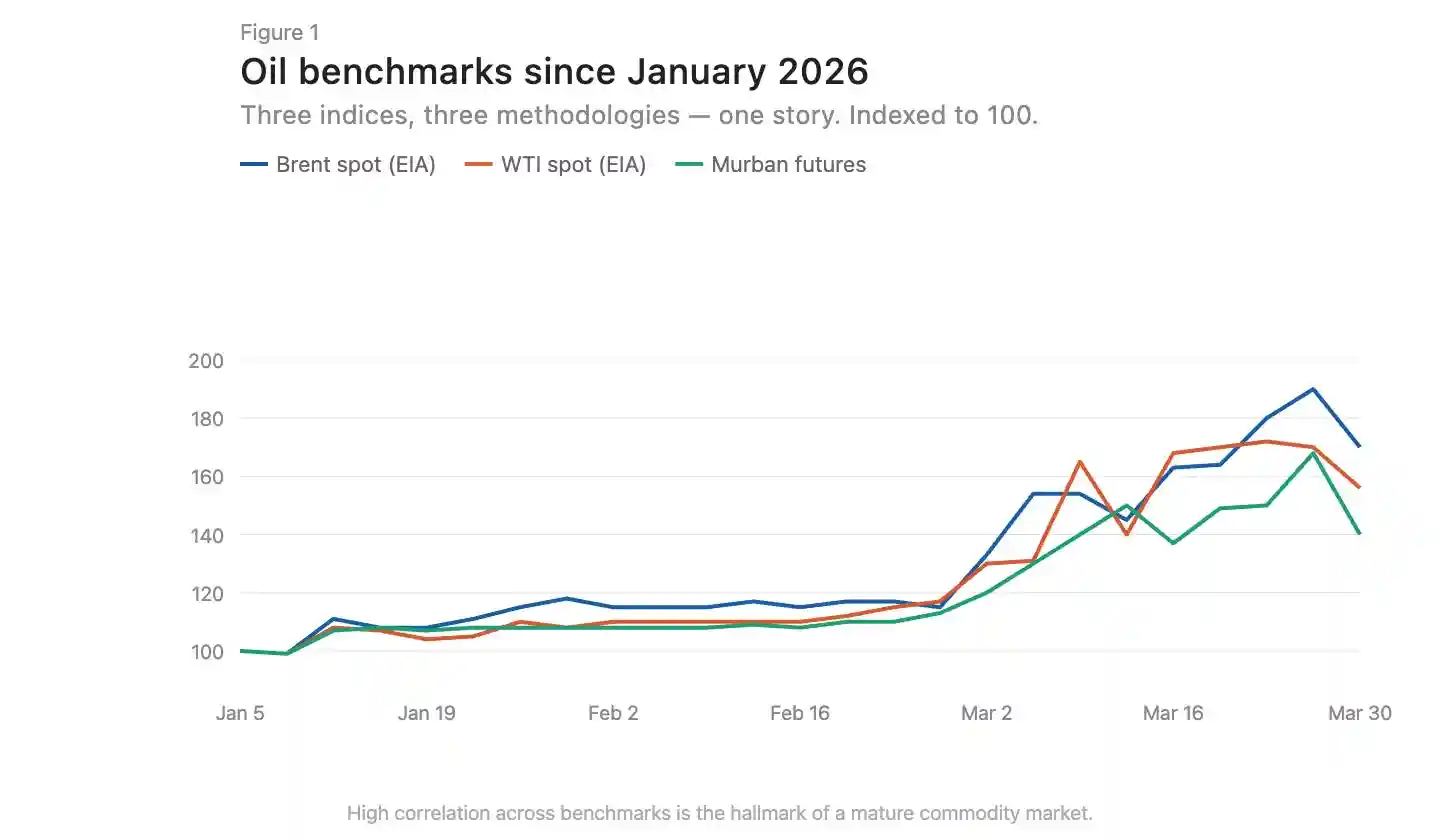
Caption: Comparison of Brent and WTI crude oil price trends, showing high directional alignment

There are now three GPU pricing index providers on the Bloomberg terminal: Silicon Data, Ornn AI, and Compute Desk. SemiAnalysis just released a fourth—a monthly H100 one-year contract price index based on survey data from over 100 market participants. Silicon Data and Ornn publish daily H100 rental indices, Compute Desk aggregates data at the Hopper architecture level, and SemiAnalysis captures negotiated contract prices rather than listed or crawled prices. Different methodologies, different frequencies, different angles of insight into the same market. Overlaying them reveals clear divergence (Figure 2).
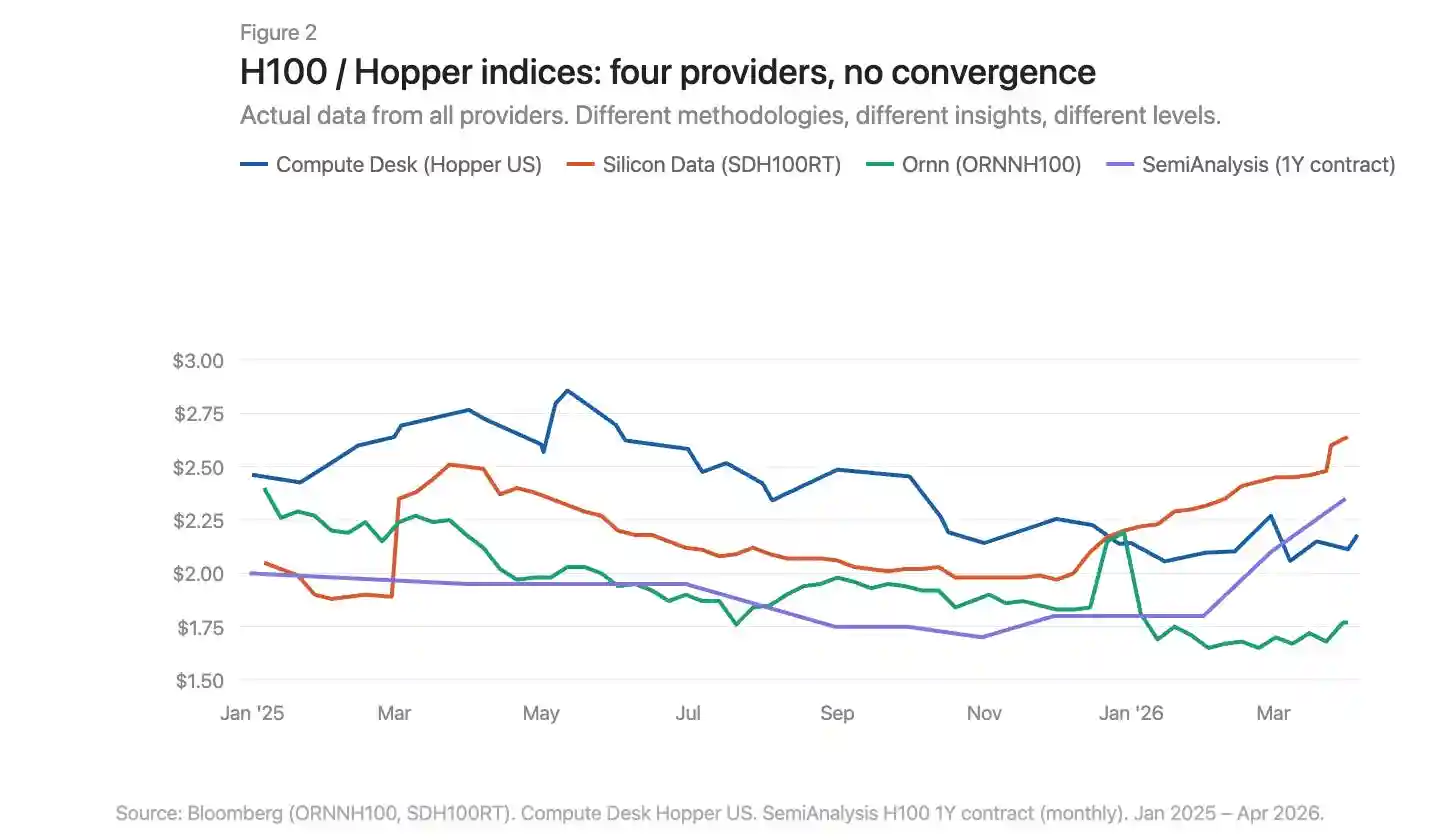
Caption: Overlay comparison of four GPU indices, showing significant divergence in price levels and trends

Where Exactly Is the Price Increase Happening

Using Compute Desk data, we can break down H100 price changes by supplier type and contract structure, and overlay Silicon Data's SDH100RT index (Figure 3). All indicators show prices rising, but the starting points and magnitudes vary greatly depending on the index and contract type.
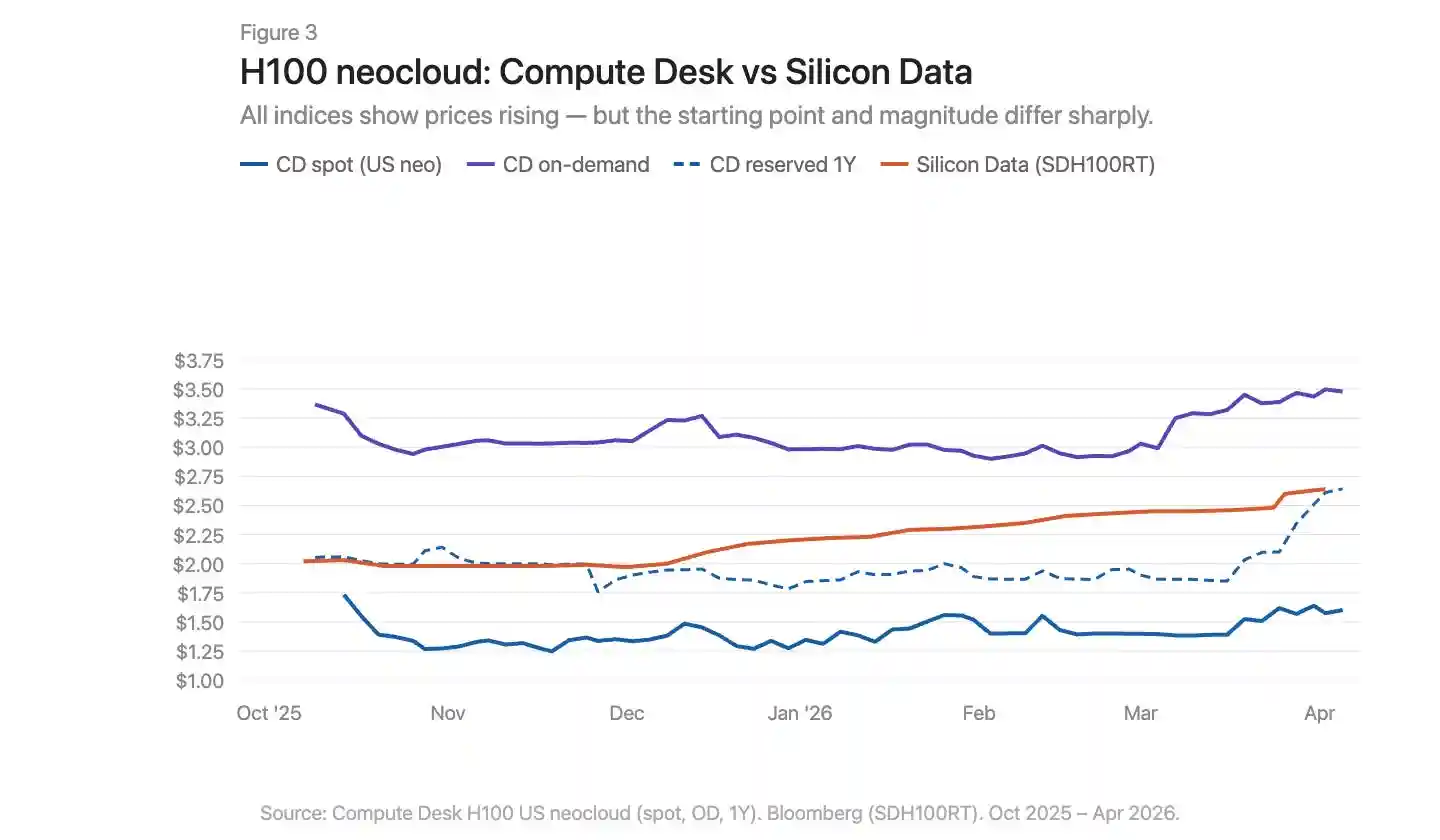
Caption: H100 price trends by contract type overlaid with the SDH100RT index

Compute Desk's H100 neocloud data tells a more specific story than the aggregate index. On-demand pricing was relatively stable throughout the winter, around $3.00/hour, then surged sharply to $3.50 in March. Spot pricing was noisier and lower, with only a slight upward trend until March. Silicon Data's SDH100RT shows a smoother, steady rise, increasing from $2.00 to $2.64 over the same period. The two indices remain at different price levels and describe different time rhythms: Compute Desk shows a March spike, Silicon Data shows a slow climb.

One-year reserved pricing was largely flat until February, then jumped sharply from $1.90 to $2.64 at the end of March—not a gradual catch-up, but a sudden repricing. This looks more like suppliers collectively adjusting contract rates after the on-demand market tightened, rather than a continuous structural demand driver.

The March story for B200 is even more dramatic (Figure 4). Compute Desk's on-demand index exploded from $5.70 to over $8.00 within weeks. Silicon Data's SDB200RT surged from $4.40 to $6.11 before falling back to $5.47. Both indices recorded this move, but the starting points differed by over $2, and the shapes of the rise and fall were different. B200 has less than five months of data, fewer suppliers, and larger spreads; the two indices are viewing the same event through very different lenses.
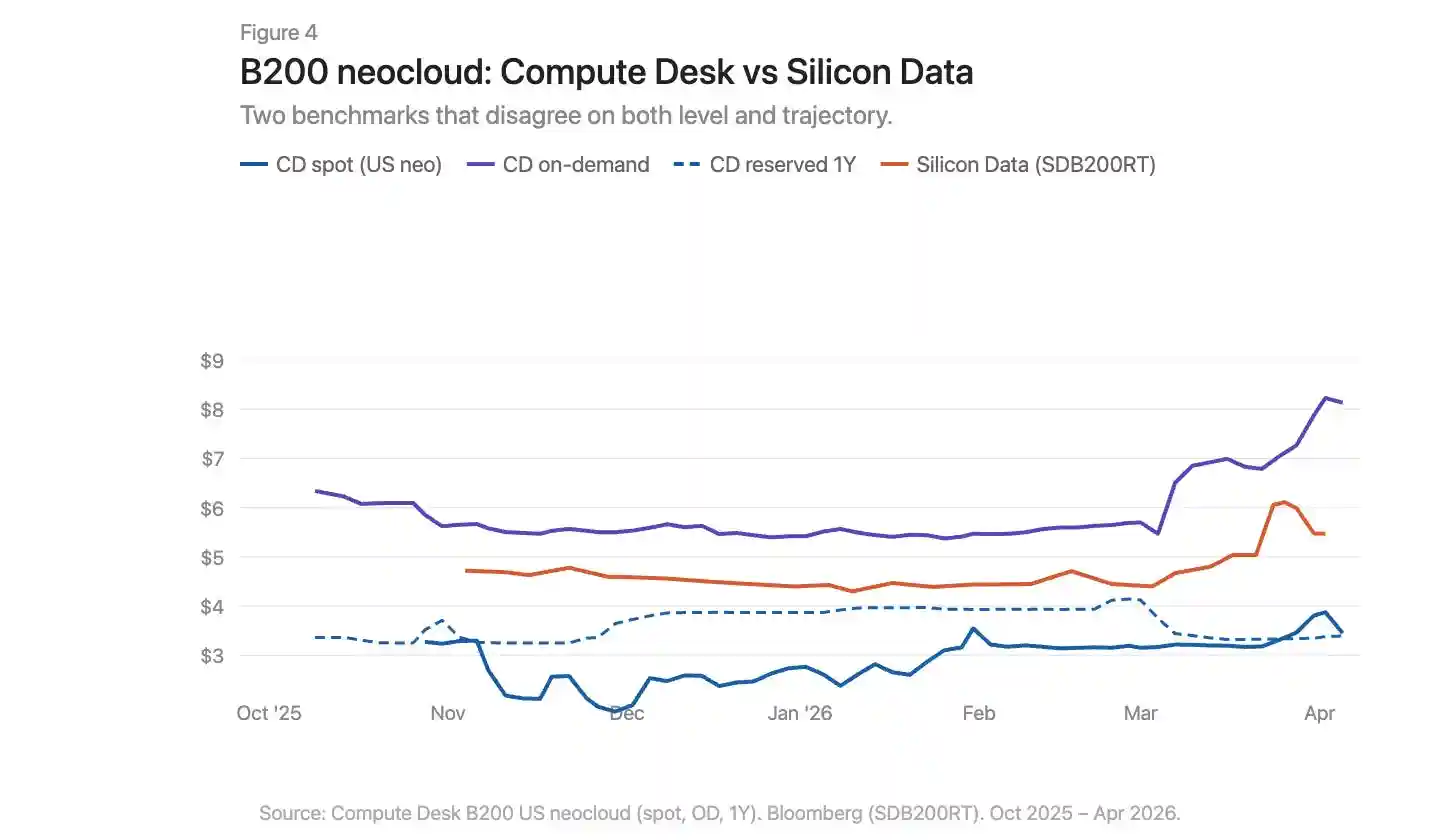
Caption: B200 on-demand and reserved price trends, overlaid with Compute Desk and Silicon Data data

Infrastructure Issues, Not Just Geographic Differences

Commodity markets have basis differentials. Appalachian natural gas is a textbook case: massive reserves sit atop structurally constrained pipeline capacity, with utilization rates in the Pennsylvania-Ohio corridor often exceeding 100%, and new projects like the Borealis Pipeline not coming online until the late 2020s.

The GPU market has a similar situation: an H100 in Virginia and an H100 in Frankfurt are not the same economic good. But geographic differences alone cannot explain why indices measuring the same market diverge so much. The dislocation in the GPU market is deeper than in Appalachian natural gas. The problem with natural gas is a single missing link: pipeline capacity connecting supply and demand. The infrastructure gap in the compute market exists on both the supply and demand sides. Physical infrastructure—the consistent networks, predictable configurations, and predictable availability needed for reliable compute distribution—is not yet mature and sometimes simply doesn't work. Financial infrastructure—standardized contracts that compress spreads despite physical differences, transparent benchmarks, arbitrage mechanisms—also doesn't exist yet.

The data tells one story. The real, painful experience of trying to procure compute in early 2026 tells another. On-demand capacity for all GPU types is virtually sold out. Finding 64 H100s is difficult: Compute Desk shows 90% of suppliers have zero on-demand cluster availability, and the reserved market isn't much better. In a well-functioning market, this level of scarcity would have pushed prices to a new equilibrium. But it hasn't. This suggests suppliers themselves lack real-time pricing intelligence to adjust. Prices are rising, but too slowly to clear the market. The gap between listed prices and true willingness to pay is being filled by hoarding, subletting, and informal secondary market transactions.

What Needs to Change

The current GPU compute market has seven core problems:

No consensus benchmark. Multiple indices coexist with different methodologies and contradictory conclusions.

Aggregate narratives mask structure. A single "H100 price" number masks huge differences between supplier types and contract terms.

Lack of transaction-level data. In bilateral markets, the deviation between listed prices and actual transaction prices is very large.

No contract standardization. Most GPU rentals are bilaterally negotiated with varying terms. Shorter, more standardized contract terms would improve liquidity and price discovery.

No delivery quality guarantee. Interconnect topology, CPU pairing, network stack, and uptime vary enormously. Buyers need to know the quality of the compute they are purchasing before committing.

Contracts lack liquidity. If demand changes during a reservation, options are limited: either eat the cost or sublet informally. The market needs infrastructure to transfer or resell committed compute, allowing capacity to flow to those who need it most.

No forward curve. Without the ability to price forwards, there is no hedging. This is why lenders discount GPU collateral by 40%-50%, keeping financing costs high.

Building a properly functioning market for the most important commodity of the century cannot advance on just one front. Measurement, standardization, contract structure, delivery quality, liquidity—these must advance in sync. Until then, no one can truly say what a GPU hour is worth.


Preguntas relacionadas

QWhy do the four GPU pricing indices on the Bloomberg terminal show significant discrepancies?

AThe indices differ because they use different methodologies, frequencies, and data sources. Some track daily H100 rental rates, others aggregate data at the Hopper architecture level, and one uses survey-based monthly contract prices. This lack of standardization leads to inconsistent price levels and trends.

QWhat does the divergence between GPU indices indicate about the current state of the compute market?

AThe divergence indicates an inefficient and immature market. Unlike mature commodity markets where indices converge, the GPU market lacks a consensus benchmark, standardized contracts, and transparent pricing, leading to fragmented and unreliable price signals.

QHow did H100 pricing behave across different contract types according to Compute Desk data?

AOn-demand pricing was stable at around $3.00/hour until March, then spiked to $3.50. Spot pricing was lower and noisier, with a slight uptrend in March. One-year reserved pricing was flat until late March, then jumped sharply from $1.90 to $2.64, indicating a sudden repricing rather than gradual demand growth.

QWhat infrastructure gaps are exacerbating the fragmentation in the GPU compute market?

ABoth physical and financial infrastructure are underdeveloped. Physically, inconsistent network reliability, configuration, and availability hinder uniform delivery. Financially, there are no standardized contracts, transparent benchmarks, or arbitrage mechanisms to compress price differences across regions and providers.

QWhat are the core problems preventing the GPU compute market from functioning efficiently?

AKey issues include: no consensus benchmark, aggregated narratives masking structural differences, lack of transaction-level data, absence of contract standardization, unguaranteed delivery quality, illiquid contracts with no resale mechanisms, and no forward curve for hedging or financing.

Lecturas Relacionadas

The Midlife Crisis of Crypto GPs: No PMF, No Next Check from LPs

The article "The Midlife Crisis of Crypto GPs: No PMF, No Next LP Check" analyzes the shifting crypto fundraising landscape. It argues the era of selling grand visions to LPs is over; GPs must now offer products with clear Product-Market Fit (PMF). The author categorizes crypto fundraising products into three types: Primary (VC funds), Liquid (trading strategies), and CeFi/DeFi Native Yield. This summary focuses on the Primary market. Key points include: * **Market Shift:** LPs are impatient, demand immediate returns, and are skeptical of future promises. The "easy money" narrative has faded. * **GP Value Erosion:** LP learning curves have shortened (aided by AI), reducing the value of a GP's basic "crypto knowledge." Superior judgment is now rare. * **Weakened LP Motivations:** Traditional reasons for LPs to invest in crypto VC funds (capturing industry beta, gaining access, leveraging GP judgment) have weakened due to new products like ETFs and increased LP sophistication. * **Surviving in Primary:** The primary market will likely persist for: 1) large funds in endowment mandates treating it as a lottery ticket, 2) family offices/HNWIs using proprietary capital, 3) a few funds with proven recent outperformance, and 4) funds with strong ecosystem "deal-making" capabilities. * **Conclusion:** For most GPs, rebuilding trust requires starting over in a niche, demonstrating alpha-generating ability, or providing concrete value/services to LPs.

marsbitHace 1 hora(s)

The Midlife Crisis of Crypto GPs: No PMF, No Next Check from LPs

marsbitHace 1 hora(s)

Crypto GPs' Midlife Crisis: No PMF, No LP's Next Check

The article "The Midlife Crisis of Crypto GPs: No PMF, No LP's Next Check" analyzes the shifting crypto fundraising landscape. It argues that the era of LPs funding vague "vision" is over; GPs must now offer products with clear Product-Market Fit (PMF) to secure capital. The market has matured. LPs, disillusioned by the last cycle's failures and wary of long lock-up periods, now demand tangible, near-term returns rather than speculative narratives. The proliferation of accessible crypto ETFs and other liquid products has reduced the need for VC blind pools as an entry point. The author categorizes crypto fundraising products into three types: Primary (VC funds, with blind pools or clear pipelines), Liquid (alpha/beta, directional/market-neutral strategies), and CeFi/DeFi Native Yield (crypto-specific mechanisms like staking, farming). Focusing on the Primary market, the piece details why traditional LP rationales for investing in crypto VCs have weakened: easier beta access via ETFs, diminished "access" and "judgement" premiums as LPs build internal teams, and a widespread lack of proven superior returns from GPs. Ultimately, only specific players are likely to remain at the primary VC table: large funds with access to patient endowment capital, family offices/HNWIs investing proprietary capital, the few funds with demonstrable excess returns from the last cycle, and those with clear "deal-making" or ecosystem resource advantages. For others, the path forward is to rebuild trust by proving alpha-generation capability in a niche or providing concrete, valuable services.

链捕手Hace 1 hora(s)

Crypto GPs' Midlife Crisis: No PMF, No LP's Next Check

链捕手Hace 1 hora(s)

The Age of Decoupling Has Arrived: Bitcoin is No Longer the Sole Compass of Crypto

The era of the cryptocurrency market moving in lockstep with Bitcoin is ending, as the industry splits into two distinct asset categories: endogenous and exogenous. Endogenous assets, like Bitcoin, derive value purely from the crypto market's cycles. Their narratives swing between being "interstellar money" in bull markets and "digital collectibles" in bear markets. Exogenous assets, however, are nominally crypto but operate with independent value drivers. Examples include: * **Venice:** An AI inference service using tokens for payments; its consumer-AI business model is decoupled from crypto price swings. * **Figure:** A fintech lender using blockchain to speed up loan approvals; its core value is in credit, not crypto. * **Stablecoin firms like BVNK:** Acquired by traditional finance giants (Mastercard, Stripe), their growth is tied to payment infrastructure, not market cycles. Hybrid projects like **Hyperliquid** (a decentralized exchange) show a shift, with a growing share of non-crypto trading (e.g., prediction markets). This divergence is fundamental. Endogenous assets remain highly correlated to Bitcoin, similar to gold miners to gold. Exogenous assets are evolving to have their own fundamentals, like the weak correlation between gold and the S&P 500. This changes investment analysis. Evaluating exogenous assets requires traditional fundamental research—assessing user bases, unit economics, and moats—more akin to fintech investing than charting Bitcoin. Promising exogenous sectors include: on-chain exchanges/brokers, AI-crypto fusion, privacy-focused digital banks, lending (institutional/private credit), stablecoins/real-world asset tokenization, payment rails, and non-financial crypto-consumer products. Currently, investing via equity is often safer than via tokens, as token value accrual mechanisms need further regulatory and industry development (e.g., the CLARITY Act). Nonetheless, the core trend is clear: crypto market drivers are diversifying from a single factor (Bitcoin) to multiple fundamentals, ending the era of uniform market moves.

marsbitHace 2 hora(s)

The Age of Decoupling Has Arrived: Bitcoin is No Longer the Sole Compass of Crypto

marsbitHace 2 hora(s)

Five Cryptos That Could Outperform Bitcoin Over the Next Cycle Due To Higher Growth Velocity

Bitcoin's growth often sets market trends, but analysts believe the next cycle's highest percentage gains may come from assets with greater growth velocity. While Bitcoin provides stability, several cryptocurrencies are positioned for stronger relative upside. This article highlights five such assets, with a particular focus on Ozak AI as the potential high-growth standout of the cycle. Ethereum (ETH) is noted for its ongoing evolution and institutional adoption. Solana (SOL) is recognized for its high throughput and history of sharp rallies. Chainlink (LINK) is highlighted as essential infrastructure for DeFi and AI applications. Avalanche (AVAX) is mentioned for its subnet architecture and enterprise potential. Ozak AI ($OZ) is presented as a distinct early-stage opportunity, currently in presale at $0.014 with a target listing price of $1.00. The project is building a full AI-native blockchain ecosystem, including prediction agents, a data stream network, and structured data vaults. Analysts suggest its early valuation stage and focus on AI infrastructure could allow for exponential growth velocity compared to more mature assets like Bitcoin, which requires massive capital inflows for significant price movement. The final takeaway positions Ozak AI as a high-asymmetry bet for investors seeking exponential upside alongside more stable assets.

TheNewsCryptoHace 2 hora(s)

Five Cryptos That Could Outperform Bitcoin Over the Next Cycle Due To Higher Growth Velocity

TheNewsCryptoHace 2 hora(s)

Trading

Spot
Futuros
活动图片




