Got Ripped Off by Polymarket, This Time the Bug is a "Time Warp"

Odaily星球日报Publicado a 2026-03-09Actualizado a 2026-03-09

Resumen

Title: Polymarket's "Time Warp" Bug During Daylight Saving Transition Causes User Losses On March 8, 2024, Polymarket, a prediction market platform, encountered a significant timing error due to the transition from Eastern Standard Time (EST) to Eastern Daylight Time (EDT) in the US. This annual clock adjustment, which skips the hour from 2:00 AM to 3:00 AM, disrupted the platform's automated event creation and settlement system. The issue affected Polymarket's "Crypto Up or Down" hourly prediction markets for assets like BTC, ETH, SOL, and XRP. Events scheduled to run from 1:00 AM to 2:00 AM ET were impacted. Due to the time change, the platform's front-end and API incorrectly displayed the event duration as "March 8, 1-1 AM ET"—a logically impossible interval—instead of the correct "1:00 AM to 3:00 AM ET" (which still represents one actual hour). This bug caused substantial problems for automated trading systems that rely on precise timing data from the API. One user, "@richrichardoz," reported losses exceeding $100,000 because their trading bot malfunctioned upon receiving identical start and end times. The user and others have called for Polymarket to switch its time standard to UTC (Coordinated Universal Time) to avoid such issues and to compensate affected users. The incident highlights a critical design flaw in using local time (which is subject to bi-annual changes) instead of UTC, the global standard for financial systems. This ensures time remains consistent, mo...

Original | Odaily Planet Daily (@OdailyChina)

Author | Azuma (@azuma_eth)

In conventional understanding, time is linear, but the crypto world has its "exceptions".

Yesterday, Eastern Time (ET) completed the switch from standard time to daylight saving time as per convention (generally on the second Sunday of March at 2:00 AM), moving the clock forward by one hour, jumping directly from 2:00 AM on March 8 to 3:00 AM. The time didn't vanish into thin air; it's just that the Eastern Time zone switches between Eastern Standard Time (EST) and Eastern Daylight Time (EDT) based on custom, aiming to artificially adjust the time scale to make fuller use of daylight hours (and save electricity in the process).

For daily life, this switch doesn't cause much impact, but on the prediction market Polymarket, yesterday's time zone change directly sparked an unexpected controversy.

Polymarket Runs Into Timing Controversy

The controversy occurred in the "Crypto Up or Down" prediction events on Polymarket.

Polymarket offers cryptocurrency up/down prediction events with timeframes of year, month, week, day, 4 hours, 1 hour, 15 minutes, and 5 minutes, covering mainstream tokens like BTC, ETH, SOL, and XRP. These events are automatically created and settled based on Eastern Time and have become a significant source of trading volume on Polymarket.

At 1:00 AM on March 8 (still under Eastern Standard Time at that moment), Polymarket launched a new batch of 1-hour up/down prediction events for BTC, ETH, SOL, and XRP. The relevant links are as follows.

  • BTC (Final Result: Up): https://polymarket.com/event/bitcoin-up-or-down-march-8-1am-et
  • ETH (Final Result: Down): https://polymarket.com/event/ethereum-up-or-down-march-8-1am-et
  • SOL (Final Result: Down): https://polymarket.com/event/solana-up-or-down-march-8-1am-et
  • XRP (Final Result: Down): https://polymarket.com/event/xrp-up-or-down-march-8-1am-et

According to the event's resolution rules — comparing the opening price and closing price of the 1-hour candlestick on Binance USDT trading pairs, starting from the event's start time — the above four events have all been settled.

However, because the end time of this batch of events coincided with the daylight saving time switch, the moment Eastern Time reached 2:00 AM, it directly jumped to 3:00 AM (meaning the period from 2:00 AM to 3:00 AM was skipped), causing some timing confusion for this batch of events on the Polymarket platform itself.


As shown on Polymarket's frontend interface, perhaps because 2:00 AM did not exist in yesterday's Eastern Time reckoning, the time period currently displayed for this batch of events is "March 8, 1-1 AM ET" (i.e., March 8, 1:00 AM - 1:00 AM). Under normal timing conditions, such events should display a 1-hour time period (for example, the previous day's similar event was "March 7, 1-2 AM ET", i.e., 1:00 AM - 2:00 AM). If accounting for the daylight saving time switch, a more reasonable time period for this batch should be "March 8, 1-3 AM ET" (i.e., 1:00 AM - 3:00 AM, still essentially 1 hour).

So no matter how you look at it, the currently displayed "March 8, 1-1 AM ET" is very strange.

Chinese user "Xiao Z" (@richrichardoz) posted on X about this, stating that besides the frontend, Polymarket's API also returned the "1-1 AM ET" time period, causing automated programs relying on the API data to "all crash", estimating losses exceeding $100,000 because of this.
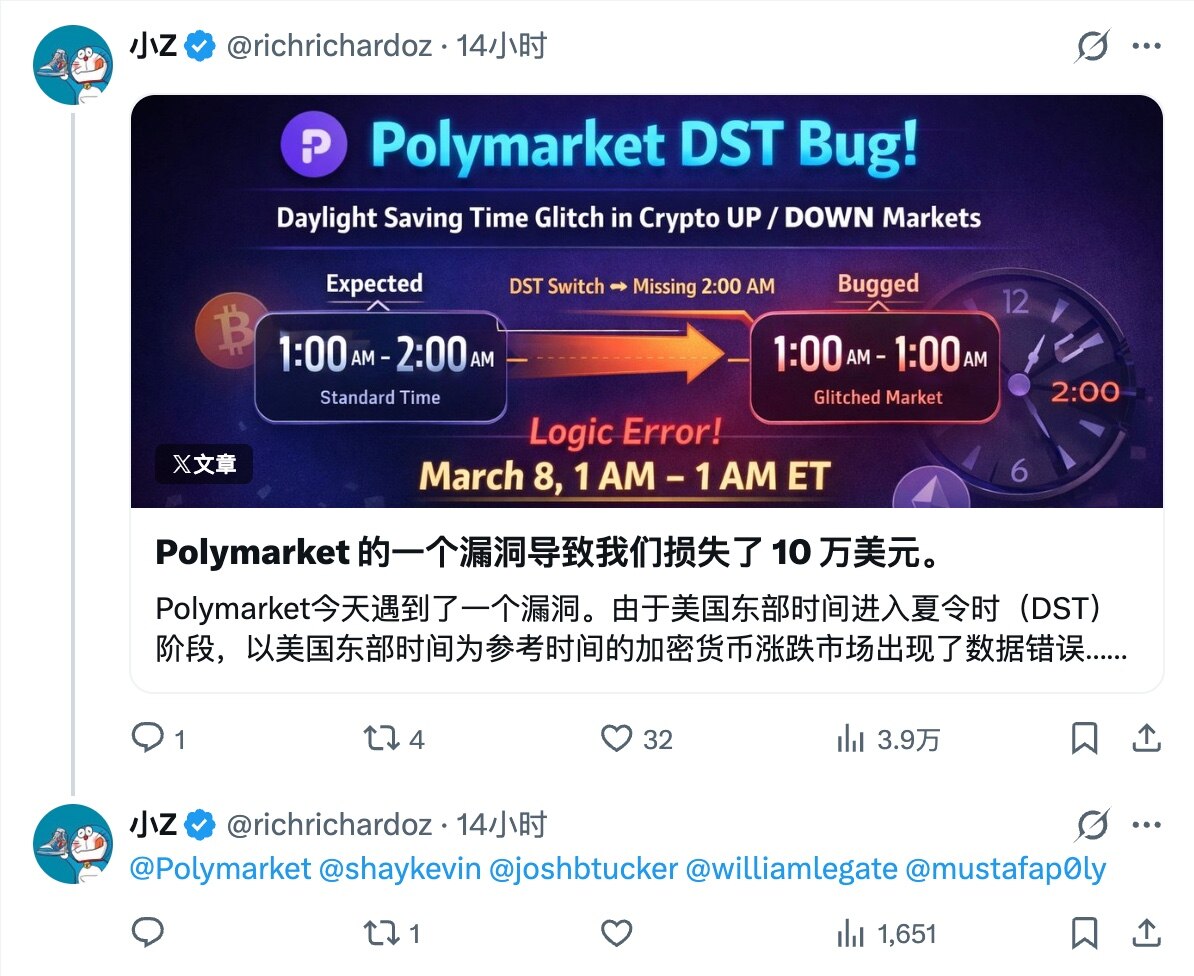
"Xiao Z" further explained that the start time and end time being exactly the same is a market state that is logically impossible. Many automated trading systems rely on the end time to determine the trading window; this error directly caused his program to lose a large sum of money. Therefore, he suggested that Polymarket change the time standard for related events to UTC time and compensate users affected by the data issue.
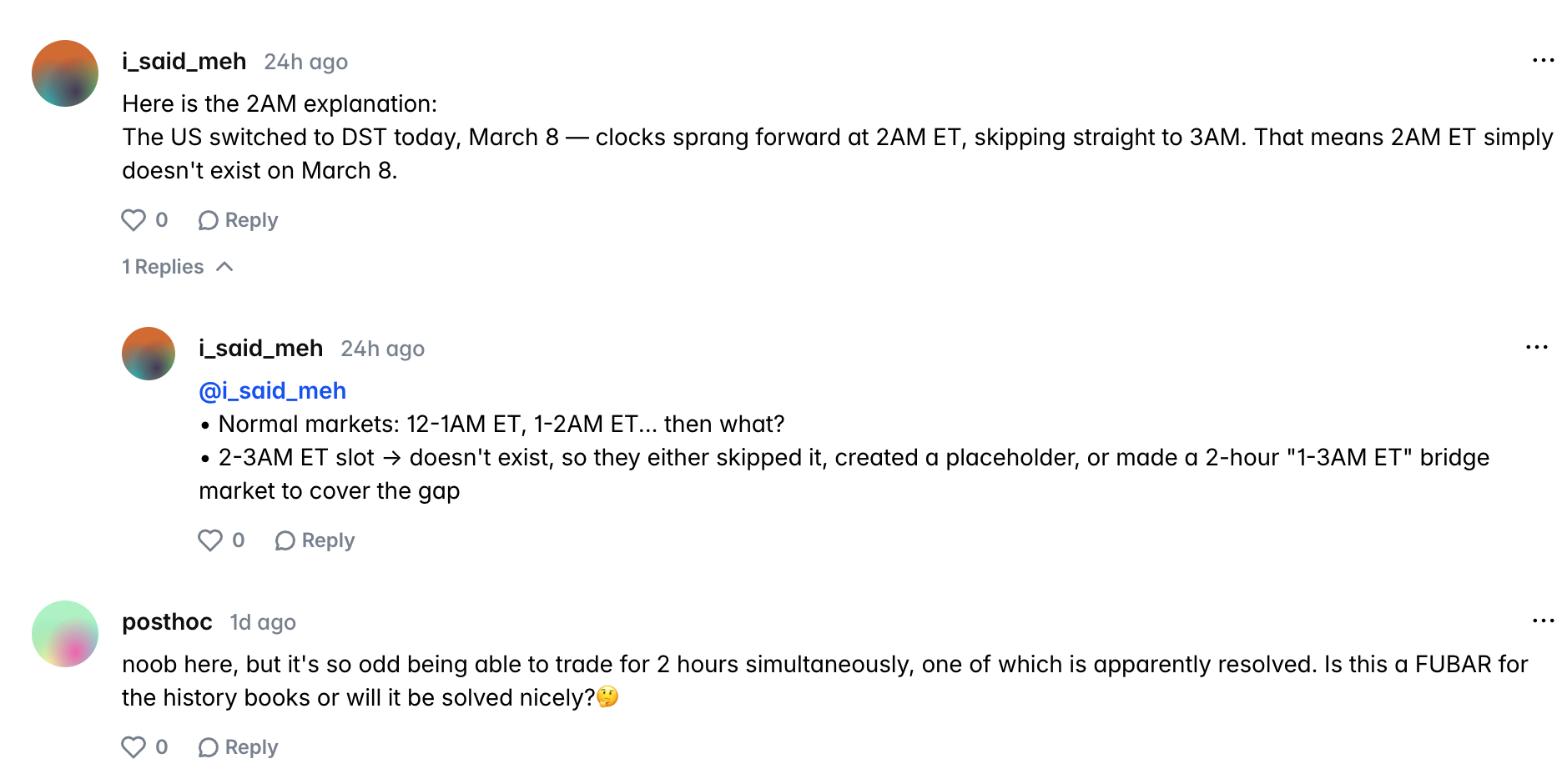
Besides this user, many external users have also left comments under the related events expressing confusion, but as of writing, Polymarket has not responded through official channels.

Time Standards in Traditional Financial Markets

Looking back at this controversy, although the scale of impact isn't huge, it exposed a fundamental design flaw in Polymarket's "Crypto Up or Down Market" events.

Influenced by historical customs, economic status, and industry practices, Eastern Time is still widely used across various industries. However, this is not very friendly to financial systems because Eastern Time switches between daylight saving time and standard time every year — artificially moving the clock forward or backward by one hour at specific times, resulting in "jumps" and "overlaps" in time respectively.

In modern financial systems, UTC time has long become the de facto universal standard. In the vast majority of financial infrastructure, internal systems typically use UTC timestamps as the sole standard time. Local times like Eastern Time are still used, but in terms of system logic, they often only exist in the presentation layer for users. This design is precisely to avoid the uncertainty of time systems, ensuring that time remains monotonic, unique, and globally consistent in financial transactions, settlements, and automated systems.

The key contradiction in Polymarket's controversy lies in the fact that the related events used Eastern Time as the timing standard but failed to fully consider the potential variable of the daylight saving time switch, ultimately causing confusion in the frontend and API data. Among the current user base of prediction markets, an increasing number of participants are trading via APIs and automated programs. Some minor issues that originally only affected frontend display can easily be amplified into real financial losses in automated systems.

Judging from the outcome, this controversy might not be considered a serious incident, and theoretically it could only happen at most twice a year, but what it reveals is a more serious design problem — as prediction markets gradually move towards becoming financial infrastructure, they must also adhere to the engineering standards used by financial infrastructure.


Preguntas relacionadas

QWhat was the specific bug that occurred on Polymarket related to time?

AThe bug was a 'time warp' caused by the switch from Eastern Standard Time (EST) to Eastern Daylight Time (EDT), where the hour from 2:00 AM to 3:00 AM was skipped. This led to a batch of 1-hour prediction events being incorrectly labeled with a time range of '1-1 AM ET' instead of the proper one-hour duration.

QWhich prediction markets on Polymarket were affected by this timing issue?

AThe affected markets were the 1-hour 'up or down' prediction events for Bitcoin (BTC), Ethereum (ETH), Solana (SOL), and XRP that started at 1:00 AM ET on March 8.

QWhat was the financial impact reported by user '@richrichardoz' due to this bug?

AUser '@richrichardoz' (also referred to as '小Z') reported that their automated trading systems, which relied on the API's end time data, malfunctioned due to the incorrect time data, resulting in estimated losses of over $100,000.

QWhat is the suggested solution to prevent such timing issues on Polymarket according to the article?

AThe article suggests that Polymarket should change the time standard for its events to UTC (Coordinated Universal Time) to avoid the complexities and inconsistencies of local time changes like daylight saving time.

QWhy does the article state that UTC time is the de facto standard in modern financial systems?

AUTC time is the standard because it provides a monotonic, unique, and globally consistent time reference. Financial infrastructure uses UTC internally to avoid the uncertainties caused by local time changes, such as daylight saving time transitions, which can disrupt trading, settlement, and automated systems.

Lecturas Relacionadas

US Senate Makes Important Amendments to "Conflict of Interest" Section of Cryptocurrency Bill

The U.S. Senate has taken a key step regarding the CLARITY Act, which could shape the future of the U.S. crypto market. On July 29, Senators Tom Tillis and Ruben Gallego finalized amendments to the bill's "conflict of interest" rules, one of its most contentious aspects. The bipartisan bill aims to tighten restrictions on high-level federal officials' ties to digital assets. The new text, crafted as an alternative to a White House-endorsed ethics code, is expected to impose stricter rules limiting officials' ability to issue or directly participate in digital asset projects. However, with Congress entering an August recess and the revised text not yet reviewed by much of the Senate, the bill's timeline is uncertain. Senate Majority Leader John Thune indicated a procedural vote could occur between July 29 and August 1 but expressed doubt the full bill could pass before the break. The House-approved CLARITY Act, passed in July 2025, has been under Senate negotiation for over a year. Key goals of the CLARITY Act include clarifying jurisdictional boundaries between the SEC and CFTC, setting rules for digital commodity spot markets, and addressing topics like stablecoin yields, DeFi, and illicit financing. The stablecoin yield provisions could significantly impact U.S.-based DeFi protocols, exchanges, and issuers, affecting their global competitiveness. The outcome is being closely watched by both the U.S. and global digital asset markets.

cryptonews.ruHace 4 min(s)

US Senate Makes Important Amendments to "Conflict of Interest" Section of Cryptocurrency Bill

cryptonews.ruHace 4 min(s)

Pavel Durov Designated as a Terrorist in Russia. What Does This Mean for Telegram Users?

Pavel Durov, the founder of Telegram, has been added to Russia's list of terrorists and extremists by Rosfinmonitoring, as published on July 30. The entry includes his name and date of birth. The designation follows an announcement by the Russian Federal Security Service (FSB) on July 29, which charged Durov with aiding terrorist activity. The FSB alleges that a Telegram dating bot named "DaiVinchik" was used to recruit 46 individuals for attacks on police and arson, orchestrated by Ukrainian special services. The FSB also accuses Telegram's administration of failing to remove channels and bots used by Ukrainian intelligence and extremist groups. Durov is reportedly subject to an international arrest warrant. Inclusion on the Rosfinmonitoring list leads to significant restrictions: the freezing of Durov's bank accounts and assets, severe limitations on financial transactions, and a ban on election participation, media interaction, and event organization. Transfers to his accounts may be considered terrorism financing. For ordinary Russian Telegram users, purchasing Telegram Premium is not classified as financing terrorism, according to an IT expert. General use of the messenger—messaging, managing channels—does not automatically make a user a participant in extremist activity. There has been no official decision to ban Telegram itself. It is noted that French authorities are also investigating Durov over allegations of inadequate measures against criminal activity on the platform and insufficient cooperation with law enforcement. Durov denies all charges.

cryptonews.ruHace 13 min(s)

Pavel Durov Designated as a Terrorist in Russia. What Does This Mean for Telegram Users?

cryptonews.ruHace 13 min(s)

Trading

Spot
活动图片