GOP hardliners vexed as defense bill advances without CBDC ban

cointelegraphPublicado a 2025-12-11Actualizado a 2025-12-11

Resumen

A group of Republican hardliners are angered after the U.S. House passed a $900 billion defense spending bill without including a promised ban on central bank digital currencies (CBDCs). GOP Representative Keith Self stated that conservatives were explicitly assured that strong anti-CBDC language would be part of the National Defense Authorization Act (NDAA), but the promise was broken. An amendment to reinstate the ban failed to advance. The provision would have prohibited the Federal Reserve from testing, developing, or issuing a digital currency and from offering financial services directly to individuals. Some Republicans, including Marjorie Taylor Greene, criticized House leadership for not upholding the commitment, citing concerns over government control of money. The House had previously passed a separate CBDC ban in July, but it has stalled in the Senate. Self vowed to continue fighting against CBDCs in future must-pass legislation.

A group of Republicans has called foul after the US House passed a massive defense spending bill on Wednesday, which omitted a ban on central bank digital currencies (CBDC) despite promises it would be included.

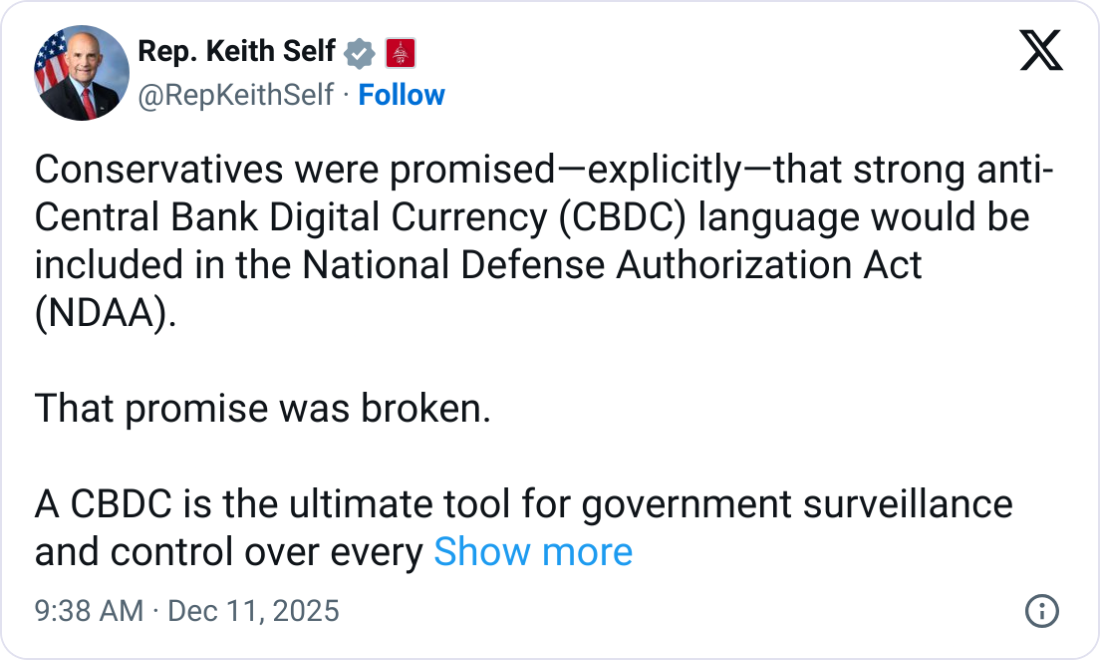
“Conservatives were promised — explicitly — that strong anti-Central Bank Digital Currency (CBDC) language would be included in the National Defense Authorization Act (NDAA). That promise was broken,” GOP Representative Keith Self wrote to X on Wednesday.

The House voted 312-112 to pass the NDAA on Wednesday, sending the $900 billion annual military funding bill to the Senate in a bid to have it passed before the end of the year.

Self had filed an amendment on Tuesday to include a CBDC ban, which had been removed from the bill, but it failed to advance and did not see a vote on the House floor.

Self said a group of Republicans was “assured that anti-CBDC language would be included. Instead, we have been forced into a take-it-or-leave-it bill that breaks that promise. Without that language, I’m inclined to leave it.”
Source: Keith Self

The more than 3,000-page bill is considered must-pass legislation and typically sees non-defense-related amendments that could otherwise be stalled or heavily revised if passed as standalone bills.

In July, House Republican leaders cut a deal with a group of party hardliners to put a CBDC ban in the defense spending bill after the group refused to move forward with three crypto bills unless a CBDC ban was guaranteed.

The bills had been held up in a record-long nine-hour procedural vote and included the stablecoin-regulating GENIUS Act, which President Donald Trump had pressured the GOP to quickly pass.

Related: Does GENIUS turn stablecoin issuers into stealth buyers of US debt?

GOP Representative Marjorie Taylor Greene slammed Speaker Mike Johnson on Monday for not keeping his promise of a CBDC ban, adding she supports crypto but “will never support giving the government the ability to turn off your ability to have full control of your money and to buy and sell.”

An early House version of the bill shared in August had included a CBDC ban, before it was subjected to amendments via multiple markups and committees.

The language of the provision banned the Federal Reserve from testing, studying, developing or issuing any digital currency or asset. It would have also stopped the central bank from offering financial products or services directly to individuals.

In July, the House passed a bill banning CBDCs, the Anti-CBDC Surveillance State Act, with a slim vote of 219-210, which has stalled in the Senate.

Self said he would “fight on in the next must-pass bill to ensure a CBDC never sees the light of day. Financial freedom isn’t negotiable.”

Legal Panel: Crypto wanted to overthrow banks, now it’s becoming them in stablecoin fight

Criptos en tendencia

Lecturas Relacionadas

Chip Stocks Lead U.S. Market Decline: Is AI Trading Being Hit by Both Interest Rates and Returns?

Chip stocks led a broad decline in US markets, with the Nasdaq dropping 2.2% and the S&P 500 falling 1.4%. This selloff reflects a dual challenge for the once-high-flying AI hardware trade: rising interest rate expectations and growing investor impatience for clear returns from massive AI capital expenditures. The pressure was most acute on hardware leaders. Nvidia fell about 4%, dipping below a $5 trillion market cap, while Micron plunged 13.2% ahead of its earnings report. Declines across memory, storage, AI, and mobile chips indicated a sector-wide retreat. The selloff spread globally, with South Korea's KOSPI index dropping nearly 10% as key suppliers SK Hynix and Samsung recorded double-digit losses. Investors appeared to be taking profits from the most crowded trades first. Macro headwinds intensified as market expectations shifted toward a more aggressive Federal Reserve. Forecasts for multiple rate hikes in 2026 pressured high-valuation tech stocks, which rely on long-term growth projections that become less attractive as discount rates rise. Concurrently, investors are scrutinizing the profit potential of the immense AI spending by cloud giants like Alphabet, Amazon, and Meta. While these expenditures drive demand for chips and hardware, the market is now questioning whether AI services will generate sufficient returns to justify the ongoing costs. This adjustment is not necessarily a bubble burst but a recalibration. AI demand fundamentals remain, but the narrative of endless growth can no longer fully offset concerns over higher interest rates and a longer path to profitability. Near-term direction may hinge on Micron's upcoming earnings guidance and incoming inflation data, which will influence both the AI demand outlook and the Fed's policy path. The market is transitioning from blindly buying growth to demanding clearer visibility on returns.

marsbitHace 36 min(s)

Chip Stocks Lead U.S. Market Decline: Is AI Trading Being Hit by Both Interest Rates and Returns?

marsbitHace 36 min(s)

OpenAI's New Paper: How to Train an AI that "Doesn't Deteriorate Under Pressure"?

OpenAI's new paper "Reinforcement Learning Towards Broadly and Persistently Beneficial Models" explores training AI to maintain safe, helpful, and honest behavior even under pressure, in unseen scenarios, or after being fine-tuned for harmful purposes. Moving beyond simple rule-based "don'ts," the research focuses on cultivating "beneficial traits" like honesty, risk-awareness, corrigibility, and transparency. It investigates if reinforcement learning (RL), often prone to "reward hacking" where models exploit loopholes, can instead be used to instill robust, generalized positive behaviors. Researchers created a multi-domain synthetic dialogue dataset covering areas like healthcare and law. They trained a model by replacing 5% of standard RL data with "beneficial trait" data. This model outperformed the baseline in 83% of 53 evaluations, showing average gains of 9.1% in alignment, safety, and helpfulness. Crucially, improvements generalized: a model trained only on healthcare "good behavior" data also performed better in 17 out of 19 non-healthcare alignment tests. The paper also tests "alignment persistence." When subjected to adversarial prompts or harmful fine-tuning, the beneficial trait model showed greater resilience, with smaller performance drops and less "spillover" of bad behavior to unrelated tasks. While not a complete solution, this work suggests a shift from post-hoc correction to proactively shaping robust, principled AI behavior, a critical step for deploying models in high-stakes, complex decision-making scenarios.

marsbitHace 39 min(s)

OpenAI's New Paper: How to Train an AI that "Doesn't Deteriorate Under Pressure"?

marsbitHace 39 min(s)

Semiconductor Stock Rebound: Is the Technical Correction Over or a Trend Reversal?

The core of recent semiconductor stock volatility is not about daily price swings, but rather the market questioning whether AI-driven semiconductor pricing has entered a new phase. Following a sharp sell-off in Korean stocks on June 23rd, led by Samsung and SK Hynix, a subsequent rebound is seen more as a technical positioning adjustment rather than a confirmed trend reversal. The key variable is HBM (High Bandwidth Memory), essential for AI chips. Its supply-demand imbalance granted memory makers significant pricing power. The current market focus is on whether this dynamic remains strong enough to justify elevated valuations. All eyes are on Micron's upcoming earnings report. The critical factor is not whether results meet already high expectations, but whether the company's guidance confirms that AI memory pricing power, order visibility, and future margins are still expanding. Micron's outlook will serve as a crucial test for the broader AI semiconductor chain, including Samsung, SK Hynix, and other infrastructure players. The recent bounce appears to be a pre-earnings positioning repair. For it to evolve into a sustained uptrend, concrete evidence is needed that the AI infrastructure expansion cycle's fundamentals—particularly for high-end memory—remain robust and can continue to surpass elevated market expectations. The risk is that strong demand alone may not be sufficient if future guidance hints at peaking momentum or increasing supply-side pressures.

marsbitHace 1 hora(s)

Semiconductor Stock Rebound: Is the Technical Correction Over or a Trend Reversal?

marsbitHace 1 hora(s)

Trading

Spot
Futuros

Artículos destacados

Cómo comprar BAN

¡Bienvenido a HTX.com! Hemos hecho que comprar Comedian (BAN) sea simple y conveniente. Sigue nuestra guía paso a paso para iniciar tu viaje de criptos.Paso 1: crea tu cuenta HTXUtiliza tu correo electrónico o número de teléfono para registrarte y obtener una cuenta gratuita en HTX. Experimenta un proceso de registro sin complicaciones y desbloquea todas las funciones.Obtener mi cuentaPaso 2: ve a Comprar cripto y elige tu método de pagoTarjeta de crédito/débito: usa tu Visa o Mastercard para comprar Comedian (BAN) al instante.Saldo: utiliza fondos del saldo de tu cuenta HTX para tradear sin problemas.Terceros: hemos agregado métodos de pago populares como Google Pay y Apple Pay para mejorar la comodidad.P2P: tradear directamente con otros usuarios en HTX.Over-the-Counter (OTC): ofrecemos servicios personalizados y tipos de cambio competitivos para los traders.Paso 3: guarda tu Comedian (BAN)Después de comprar tu Comedian (BAN), guárdalo en tu cuenta HTX. Alternativamente, puedes enviarlo a otro lugar mediante transferencia blockchain o utilizarlo para tradear otras criptomonedas.Paso 4: tradear Comedian (BAN)Tradear fácilmente con Comedian (BAN) en HTX's mercado spot. Simplemente accede a tu cuenta, selecciona tu par de trading, ejecuta tus trades y monitorea en tiempo real. Ofrecemos una experiencia fácil de usar tanto para principiantes como para traders experimentados.

579 Vistas totalesPublicado en 2024.12.11Actualizado en 2026.06.02

Cómo comprar BAN

Discusiones

Bienvenido a la comunidad de HTX. Aquí puedes mantenerte informado sobre los últimos desarrollos de la plataforma y acceder a análisis profesionales del mercado. A continuación se presentan las opiniones de los usuarios sobre el precio de BAN (BAN).

活动图片