GOP hardliners vexed as defense bill advances without CBDC ban

cointelegraphPublished on 2025-12-11Last updated on 2025-12-11

Abstract

A group of Republican hardliners are angered after the U.S. House passed a $900 billion defense spending bill without including a promised ban on central bank digital currencies (CBDCs). GOP Representative Keith Self stated that conservatives were explicitly assured that strong anti-CBDC language would be part of the National Defense Authorization Act (NDAA), but the promise was broken. An amendment to reinstate the ban failed to advance. The provision would have prohibited the Federal Reserve from testing, developing, or issuing a digital currency and from offering financial services directly to individuals. Some Republicans, including Marjorie Taylor Greene, criticized House leadership for not upholding the commitment, citing concerns over government control of money. The House had previously passed a separate CBDC ban in July, but it has stalled in the Senate. Self vowed to continue fighting against CBDCs in future must-pass legislation.

A group of Republicans has called foul after the US House passed a massive defense spending bill on Wednesday, which omitted a ban on central bank digital currencies (CBDC) despite promises it would be included.

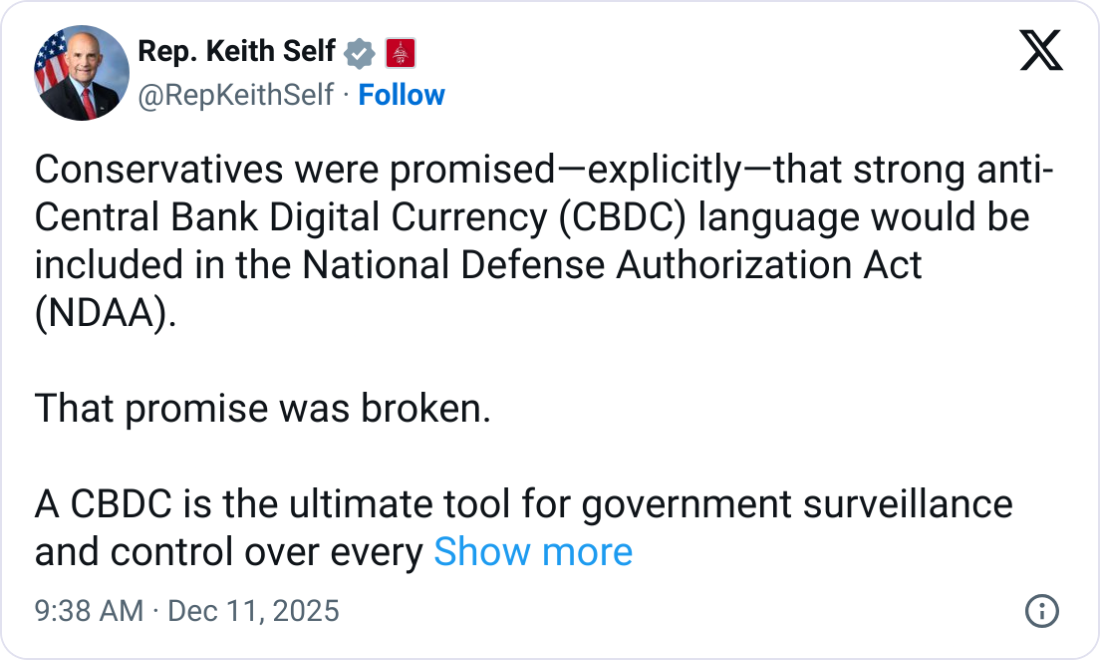
“Conservatives were promised — explicitly — that strong anti-Central Bank Digital Currency (CBDC) language would be included in the National Defense Authorization Act (NDAA). That promise was broken,” GOP Representative Keith Self wrote to X on Wednesday.

The House voted 312-112 to pass the NDAA on Wednesday, sending the $900 billion annual military funding bill to the Senate in a bid to have it passed before the end of the year.

Self had filed an amendment on Tuesday to include a CBDC ban, which had been removed from the bill, but it failed to advance and did not see a vote on the House floor.

Self said a group of Republicans was “assured that anti-CBDC language would be included. Instead, we have been forced into a take-it-or-leave-it bill that breaks that promise. Without that language, I’m inclined to leave it.”
Source: Keith Self

The more than 3,000-page bill is considered must-pass legislation and typically sees non-defense-related amendments that could otherwise be stalled or heavily revised if passed as standalone bills.

In July, House Republican leaders cut a deal with a group of party hardliners to put a CBDC ban in the defense spending bill after the group refused to move forward with three crypto bills unless a CBDC ban was guaranteed.

The bills had been held up in a record-long nine-hour procedural vote and included the stablecoin-regulating GENIUS Act, which President Donald Trump had pressured the GOP to quickly pass.

Related: Does GENIUS turn stablecoin issuers into stealth buyers of US debt?

GOP Representative Marjorie Taylor Greene slammed Speaker Mike Johnson on Monday for not keeping his promise of a CBDC ban, adding she supports crypto but “will never support giving the government the ability to turn off your ability to have full control of your money and to buy and sell.”

An early House version of the bill shared in August had included a CBDC ban, before it was subjected to amendments via multiple markups and committees.

The language of the provision banned the Federal Reserve from testing, studying, developing or issuing any digital currency or asset. It would have also stopped the central bank from offering financial products or services directly to individuals.

In July, the House passed a bill banning CBDCs, the Anti-CBDC Surveillance State Act, with a slim vote of 219-210, which has stalled in the Senate.

Self said he would “fight on in the next must-pass bill to ensure a CBDC never sees the light of day. Financial freedom isn’t negotiable.”

Legal Panel: Crypto wanted to overthrow banks, now it’s becoming them in stablecoin fight

Related Reads

From Airdrop Myth to King of Derivatives: A Look Back at Hyperliquid's 2025 Conquest

Reviewing crypto's growth in 2025, Hyperliquid stands out. It began the year with an epic airdrop and strong price performance, capturing attention. By year's end, it transformed into a top-four revenue-generating platform in crypto, earning over $650M and at one point capturing 70% of all perp trading volume. Its success was no accident. In Q1, it solidified its reputation by being first to list new assets like the TRUMP perp and launched HyperEVM, a smart contract layer. Q2 saw explosive growth: HYPE token surged 4x from April lows, and HyperEVM's TVL grew from $350M to $1.8B. The platform gained mainstream media coverage. In Q3, major wallets like Phantom and MetaMask integrated via Hyperliquid's builder codes, routing $158B in volume and earning partners nearly $50M. A high-profile stablecoin bid war was won by Native Markets, aligning with Hyperliquid's bootstrapped ethos. However, new competitors like Aster and Lighter emerged with aggressive airdrops. Q4 brought permissionless listings via HIP-3, enabling new markets like stock perps and yield-bearing collateral. Yet, HYPE fell nearly 50% from its September peak due to market conditions, a rare ADL event during a crash, and the start of team token unlocks. As perps go mainstream in 2026, Hyperliquid's true test begins. Its success came from building a superior product and ecosystem without shortcuts. Maintaining leadership will require doing it all over again in a crowded field.

marsbitHace 25 min(s)

From Airdrop Myth to King of Derivatives: A Look Back at Hyperliquid's 2025 Conquest

marsbitHace 25 min(s)

ETC Olympia Development Part 1: Implementing ECIP-1111 and ECIP-1112

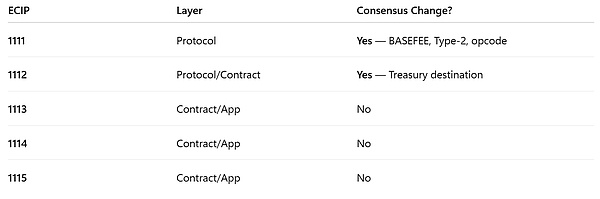
ETC Olympia Development Series Part 1: Implementing ECIP-1111 and ECIP-1112 This article introduces the first part of the Ethereum Classic Olympia development series, focusing on the implementation of ECIP-1111 and ECIP-1112. These two proposals are the only components within the broader Olympia framework that modify consensus behavior. ECIP-1111 modernizes the fee market by introducing an EIP-1559-style mechanism with a base fee and optional priority tip (miner tip). A key difference from Ethereum is that the base fee is not burned but is instead redirected to a treasury address defined by ECIP-1112. It also adds support for Type-2 transactions and the BASEFEE opcode (0x48), ensuring compatibility with modern EVM tooling and wallets. Crucially, it does not change miner rewards, monetary policy, or existing transaction types. ECIP-1112 defines an immutable, deterministic treasury smart contract that will receive the redirected base fees. This vault is designed to be receive-only upon activation, meaning it can accumulate value but cannot distribute funds until a separate, subsequent governance layer (defined in other ECIPs) is deployed and activated on the contract layer. The article emphasizes the modular architecture of Olympia. While the suite includes five ECIPs (1111-1115), only these two affect consensus. This separation ensures that the core protocol remains minimal and auditable, while future governance and funding mechanisms can evolve independently at the contract level without requiring further hard forks. The implementation is currently in the draft stage per the ECIP-1000 process. Any decision to move forward with mainnet activation will require extensive testing on the Mordor testnet and full community review.

金色财经Hace 29 min(s)

ETC Olympia Development Part 1: Implementing ECIP-1111 and ECIP-1112

金色财经Hace 29 min(s)

Trading

Spot
Futures
活动图片