Goldman Sachs Research Report: Cryptocurrency Market Cap Rises 34% in Q3, Profit Forecasts and Price Targets for Brokers and Crypto Stocks Revised Upward

marsbitPublicado a 2026-09-10Actualizado a 2026-09-10

Resumen

Goldman Sachs Research Report Update: Crypto Market Cap Surges 34% in Q3, Boosting Revenue Forecasts for Brokers & Crypto Stocks Goldman Sachs has raised revenue and price targets for covered brokers and crypto-related companies, citing a 34% increase in the total crypto market capitalization quarter-to-date (QTD) in Q3. The firm's updated analysis, published on September 8, led to a 10% average upward revision in Q3 revenue expectations for the coverage group. While overall trading volumes remain below Q2 levels (down 8% QTD), an August rebound of 16% showed marginal improvement. The market cap appreciation drives revenue through multiple channels beyond direct trading: higher custody and staking fees linked to asset values, and increased stablecoin revenue tied to stablecoin market capitalization. Consequently, Goldman raised its median 2026 EPS estimate by 1% and increased the median target price-to-earnings (P/E) multiple by 3.0x to 32.5x, resulting in a median total return expectation of +3% for the group. Key individual adjustments include raising Coinbase's (COIN) price target to $219 (Buy) from $196, reflecting a 7% increase in assumed platform assets and a 9% rise in expected Q3 trading volume. Similar target price increases of 12-14% were applied to other covered stocks like ETORO, Galaxy Digital (GLXY), BitGo (BTGO), and Circle (CRCL), with ratings largely maintained at Neutral. The report highlights that companies with diversified revenue streams from custody,...

Author: Rita

The cryptocurrency market capitalization has increased by 34% so far in the third quarter, leading Goldman Sachs to revise upward its profit forecasts and price targets for brokers and crypto-related companies. On September 8, Goldman Sachs released its Americas Brokers and Crypto report. Based on updated quarter-to-date data, the firm raised the average expected Q3 revenue for its coverage group by 10%, the median 2026 EPS estimate by 1%, and the median target P/E multiple by 3.0x. The median total return expectation for this group is now +3%. Trading volume remains below last quarter's level, but growth in custody, staking, and stablecoin revenues driven by market cap revaluation has been the primary driver behind the forecast revisions.

The impact of rising crypto market cap on revenue for brokers and crypto companies is multi-dimensional. Beyond direct digital asset gains/losses, custody and staking revenues are linked to market cap, and stablecoin revenues are linked to stablecoin market cap. Even if trading volume has not fully recovered, the market cap increase itself can drive upward revisions to revenue forecasts.

34% Crypto Market Cap Gain Drives Higher Revenue Forecasts

Goldman Sachs updated its crypto data for Q3-to-date in the report. The crypto market cap rose 34%, with end-of-period USDC balance up 1% sequentially, but the average balance down 5%. August trading volume rebounded 16% month-over-month, though the industry average volume for Q3-to-date is still down 8% sequentially. Based on this, Goldman Sachs adjusted revenue forecasts for several companies, raising the average expected Q3 revenue for the coverage group by 10%.

Specific adjustments include: Raising staking and custody revenue to reflect higher crypto market cap. Raising stablecoin revenue to reflect higher stablecoin market cap. Raising digital asset gain/loss to reflect profits from market cap increases. Slightly raising trading volume forecasts, as industry and company-specific volumes were marginally stronger than previously expected.

Looking at individual stocks: COIN's Q3 platform assets were raised from $269B to $288B, an increase of 7%. Trading volume was raised from $127B to $138.5B, an increase of 9%.

BTGO's platform assets were raised from $6.2B to $6.6B, an increase of 5%. Trading volume was raised from $4.1B to $4.5B, an increase of 10%.

CRCL's platform assets were raised from $27.3B to $27.6B, an increase of 1%. Trading volume was lowered from $0.9B to $0.8B, a decrease of 9%.

ETOR's platform assets remained unchanged at $19.1B. Trading volume was raised from $2.7B to $3.7B, an increase of 39%.

GEMI's platform assets were lowered from $100M to $90M, a decrease of 7%. Trading volume was raised from $270M to $370M, an increase of 37%.

GLXY's platform assets were raised from $9.1B to $9.5B, an increase of 7%. Trading volume was raised from $790M to $800M, an increase of 2%.

Goldman Sachs stated that these adjustments reflect the rise in crypto market cap and stablecoin market cap, as well as marginal improvements in trading volume.

Trading Volume Remains Soft but Rebounded in August

Despite the significant market cap increase, trading volume remains low. The industry average volume for Q3-to-date is down 8% sequentially, indicating market activity has not fully recovered. August volume rebounded 16% month-over-month, showing signs of marginal improvement.

The softness in trading volume contrasts with the rise in market cap. The market cap increase is mainly driven by the macro environment and recovery in crypto asset prices. Trading volume is constrained by retail participation and market sentiment. Goldman Sachs slightly raised its trading volume forecasts as industry and company-specific volumes were marginally better than expected, but remains cautious overall.

From a revenue structure perspective, trading volume is crucial for brokers and crypto companies. For platforms where trading fees are the primary revenue source, declining volume directly drags on revenue. For companies with custody, staking, and stablecoin businesses, market cap gains can partially offset the impact of lower volume. Goldman Sachs's forecast revisions are based on this logic.

Price Targets and Valuation Revisions

Goldman Sachs raised the median target P/E multiple for the coverage group from 29.5x to 32.5x, an increase of 3.0x, to reflect higher market multiples. The median 2026 EPS estimate was raised by 1%, and the median total return expectation is +3%.

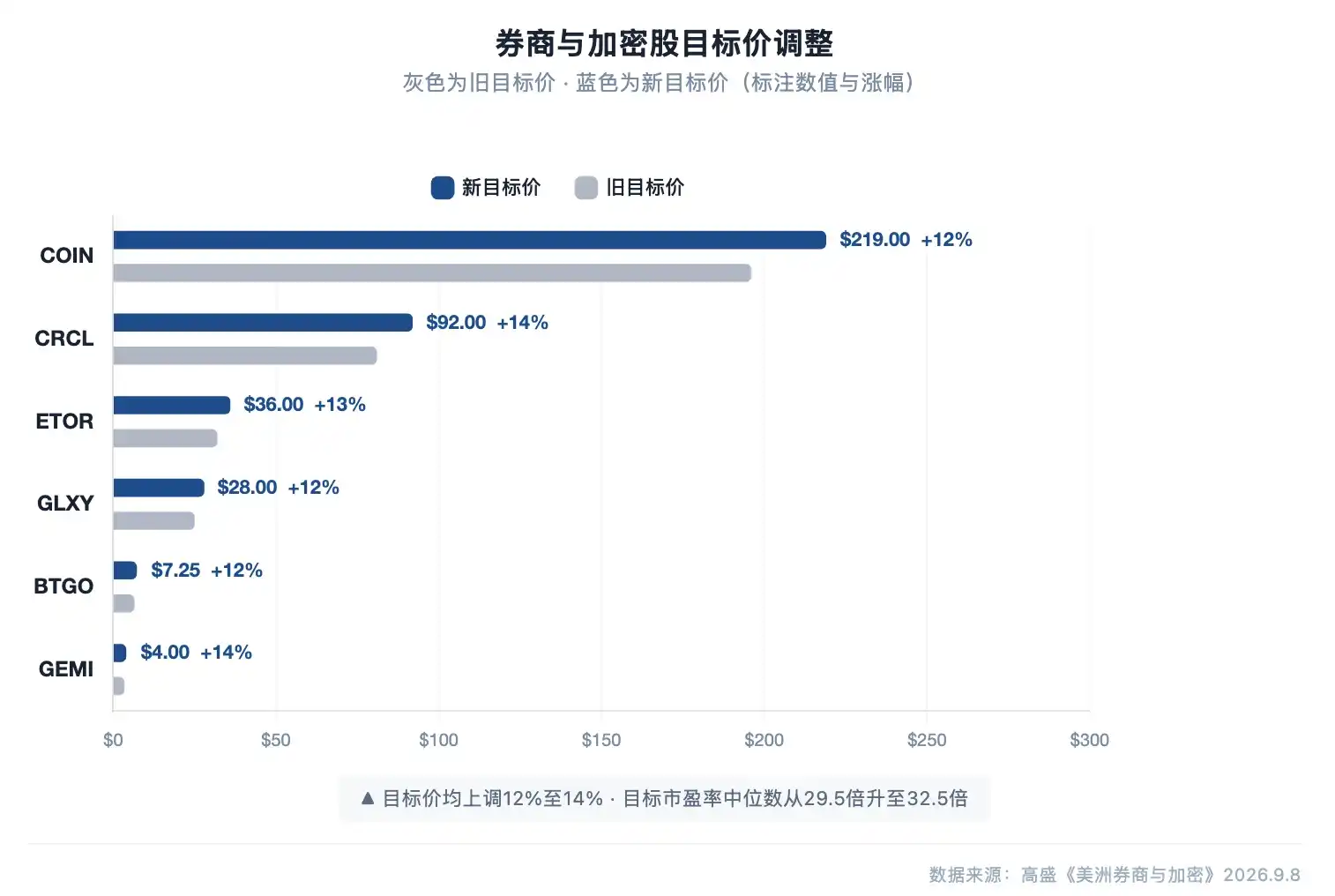
Individual stock price target adjustments are as follows:

COIN target price raised from $196 to $219, up 12%, Buy rating maintained.

ETOR raised from $32 to $36, up 13%, Neutral maintained.

GLXY raised from $25 to $28, up 12%, Neutral maintained.

BTGO raised from $6.50 to $7.25, up 12%, Neutral maintained.

CRCL raised from $81 to $92, up 14%, Neutral maintained.

GEMI raised from $3.50 to $4.00, up 14%, Sell maintained.

GLXY's target price is based on a sum-of-the-parts valuation. The Digital Asset segment uses 24.0x Q5-Q8 adjusted EPS, raised from 23.0x. The Data Center segment uses 15.5x Q5-Q8 adjusted EBITDA, raised from 14.5x. The Corporate segment uses 1.0x Q5 P/B, unchanged. All three adjustments reflect higher market multiples.
Median Total Return Expectation +3%

Goldman Sachs currently expects a median total return of +3% for broker and crypto stocks. This expectation is based on updated profit forecasts and target P/E multiples. Goldman Sachs believes that rising crypto market cap and marginal improvement in trading volume will drive modest stock price appreciation. Trading volume remains below last quarter's level, and regulatory risks persist, limiting upside potential.

Goldman Sachs suggests investors focus on companies with diversified revenue streams, such as platforms with higher exposure to custody, staking, and stablecoin businesses. These companies are more resilient to trading volume fluctuations and benefit from market cap increases. For companies primarily reliant on trading fees, volume recovery remains a key variable.

Disclaimer

This article is a summary and interpretation by Tide Research of a third-party brokerage research report (Goldman Sachs, September 8, 2026), combined with publicly available market information. The ratings, target prices, profit forecasts, and related judgments cited herein are the views of the analyst(s) from that brokerage firm, representing only the stance of their institution. They do not represent the views of Tide Research and do not constitute any investment advice.

The market carries risks, and investment decisions should be made independently. This article should not be used as a basis for trading any securities.


Preguntas relacionadas

QWhat is the main reason Goldman Sachs raised its revenue forecast and price targets for brokerage and crypto-related stocks?

AThe primary reason is the 34% increase in cryptocurrency market capitalization during the third quarter. This drove upward revisions for custody, staking, stablecoin revenue, and digital asset gains, which more than offset weaker trading volumes.

QAccording to the report, what is Goldman Sachs' median total return expectation for the covered group of brokerage and crypto stocks?

AGoldman Sachs currently expects a median total return of +3% for the covered brokerage and crypto stock group.

QHow did Goldman Sachs adjust its trading volume predictions, and what was the overall trend in Q3?

AGoldman Sachs modestly raised trading volume predictions as industry and company-specific volumes were slightly stronger than previously expected. However, the industry's average trading volume in Q3-to-date still declined 8% quarter-over-quarter, indicating continued softness despite a 16% month-over-month rebound in August.

QWhich company had the largest percentage increase in its price target from Goldman Sachs, and what was the change?

ACRCL and GEMI both had the largest percentage increase in their price targets at 14%. CRCL's target was raised from $81 to $92, while GEMI's was raised from $3.50 to $4.00.

QWhat type of companies does Goldman Sachs recommend investors focus on, and why?

AGoldman Sachs recommends investors focus on companies with diversified revenue streams, particularly those with higher exposure to custody, staking, and stablecoin businesses. These companies are better positioned to withstand trading volume volatility and benefit more directly from increases in overall market capitalization.

Lecturas Relacionadas

Fed Governor Bowman: No Urgent Need to Raise Interest Rates, Can Watch Economic Trends

Federal Reserve Governor and Vice Chair for Supervision Michelle Bowman stated that the Federal Reserve is in no immediate hurry to raise interest rates further. Speaking at the International Institute of Finance annual membership summit in Bangkok on October 14, Bowman emphasized the need to take time to assess the impact of the September rate hike and observe how economic and financial conditions evolve before making further policy decisions. While acknowledging inflation remains above target, she stressed a comprehensive, data-dependent approach. Her comments align with recent cautious tones from several Fed officials but highlight an ongoing internal debate. Other officials, including New York Fed President John Williams and Boston Fed President Susan Collins, have indicated openness to one more rate hike this year to combat persistent inflation. Market expectations now lean toward the Fed holding steady at its upcoming meeting, with future policy moves heavily dependent on incoming inflation data, particularly the upcoming September CPI report. Beyond monetary policy, Bowman addressed financial regulation. She critiqued some post-2008 crisis rules for pushing activity outside the formal banking system and called for a "comprehensive reorganization" of the Fed's internal supervisory structure following the Silicon Valley Bank collapse. On technology, she expressed concern about cybersecurity risks from advanced AI models and the capital demands of data center expansion, while also acknowledging the importance of allowing banks to innovate and exploring AI's potential applications in areas like fraud detection.

marsbitHace 40 min(s)

Fed Governor Bowman: No Urgent Need to Raise Interest Rates, Can Watch Economic Trends

marsbitHace 40 min(s)

The Scene From 1999 Is Repeating Itself

The article draws a stark parallel between the current U.S. stock market and the period leading up to the 2000 dot-com crash. While the S&P 500 hovers near record highs, this strength is deceptive. Beneath the surface, 60% of its components are already in a technical bear market. The index is being propped up almost entirely by the "Magnificent Seven" tech giants, reminiscent of the narrow leadership seen in 1999. Prominent figures like Paul Tudor Jones of Tudor Investment are issuing strong warnings, comparing the present market structure to 1999 and predicting 2027 could be the worst year for stocks since 2002, citing massive upcoming equity supply from IPOs (e.g., Anthropic, OpenAI) and lock-up expirations. Analysts from Goldman Sachs, Morgan Stanley, and BTIG echo concerns about extreme concentration and deteriorating market breadth. Key risks identified include an over-reliance on a few AI-related stocks for index returns and earnings growth, signs of peaking profit cycles, and a potential shift in market leadership from semiconductors to software. The upcoming earnings season for cloud giants, particularly their capital expenditure guidance, is seen as a critical near-term catalyst. Furthermore, rising bond yields (10-year Treasury above 5%) and soaring corporate debt issuance costs add to the pressure. The summary concludes by noting a profound disconnect: despite a 16-fold total return in the S&P 500 since 2009, consumer sentiment is at near-record lows, highlighting the unequal distribution of gains and rising cost-of-living pressures—a social tension that mirrors the speculative excesses of the late 1990s.

marsbitHace 47 min(s)

The Scene From 1999 Is Repeating Itself

marsbitHace 47 min(s)

Trading

Spot
活动图片