Goldman Sachs Predicts: Global Stock Markets Expected to Deliver 11% Return Over Next 12 Months

marsbitPublicado a 2026-01-14Actualizado a 2026-01-14

Resumen

Goldman Sachs Research forecasts an 11% total return (including dividends, in USD) for global equities over the next 12 months, anticipating the bull market to continue into 2026. This growth is expected to be primarily driven by corporate earnings and economic expansion, rather than further valuation increases, as current valuations are already at historical highs across major markets. The report, led by Chief Global Equity Strategist Peter Oppenheimer, highlights that diversification was a key theme in 2025 and will remain crucial in 2026. Last year, investors benefited from geographic diversification, with non-US markets outperforming. This trend is expected to continue, extending to style (growth vs. value) and sector diversification. While the market is in an "optimism" phase of the cycle, the AI-driven tech rally is not considered a bubble, as valuations for the largest companies remain below extreme historical levels. The analysts also suggest that investors look for alpha opportunities in non-tech sectors and companies benefiting from tech capital expenditure and the broader adoption of AI.

Author: Goldman Sachs

Compiled by: Deep Tide TechFlow

  • Following last year's strong growth, Goldman Sachs Research predicts that global stock markets are poised to continue climbing in 2026, with an expected return of 11% over the next 12 months (including dividends, in USD terms).
  • Although last year's stock market rally has left valuations at historically high levels, corporate earnings and economic growth worldwide are expected to continue supporting the markets.
  • Last year, investors benefited significantly from cross-regional diversification, a trend that is likely to continue. Additionally, diversifying across investment styles and sectors is expected to further enhance returns.

According to Goldman Sachs Research, the global bull market is likely to persist this year, driven by growth in corporate earnings and continued economic expansion. However, the gains in the stock market are expected to be more modest than the significant rally seen in 2025. In 2026, the global economy is anticipated to maintain its expansion across regions, with the US Federal Reserve expected to continue with moderate easing policies.

"In the current macroeconomic context, even with high valuations, a significant stock market correction or bear market in the absence of a recession would be unusual," wrote Peter Oppenheimer, Chief Global Equity Strategist at Goldman Sachs Research, in his report titled "Global Equity Strategy 2026 Outlook: Tech Tonic—a Broadening Bull Market".
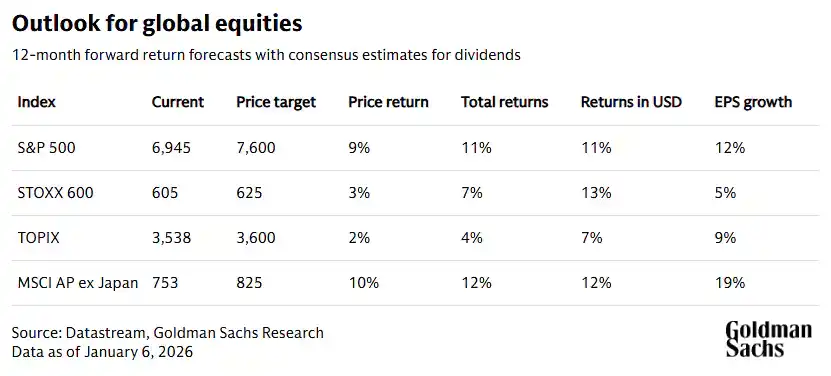
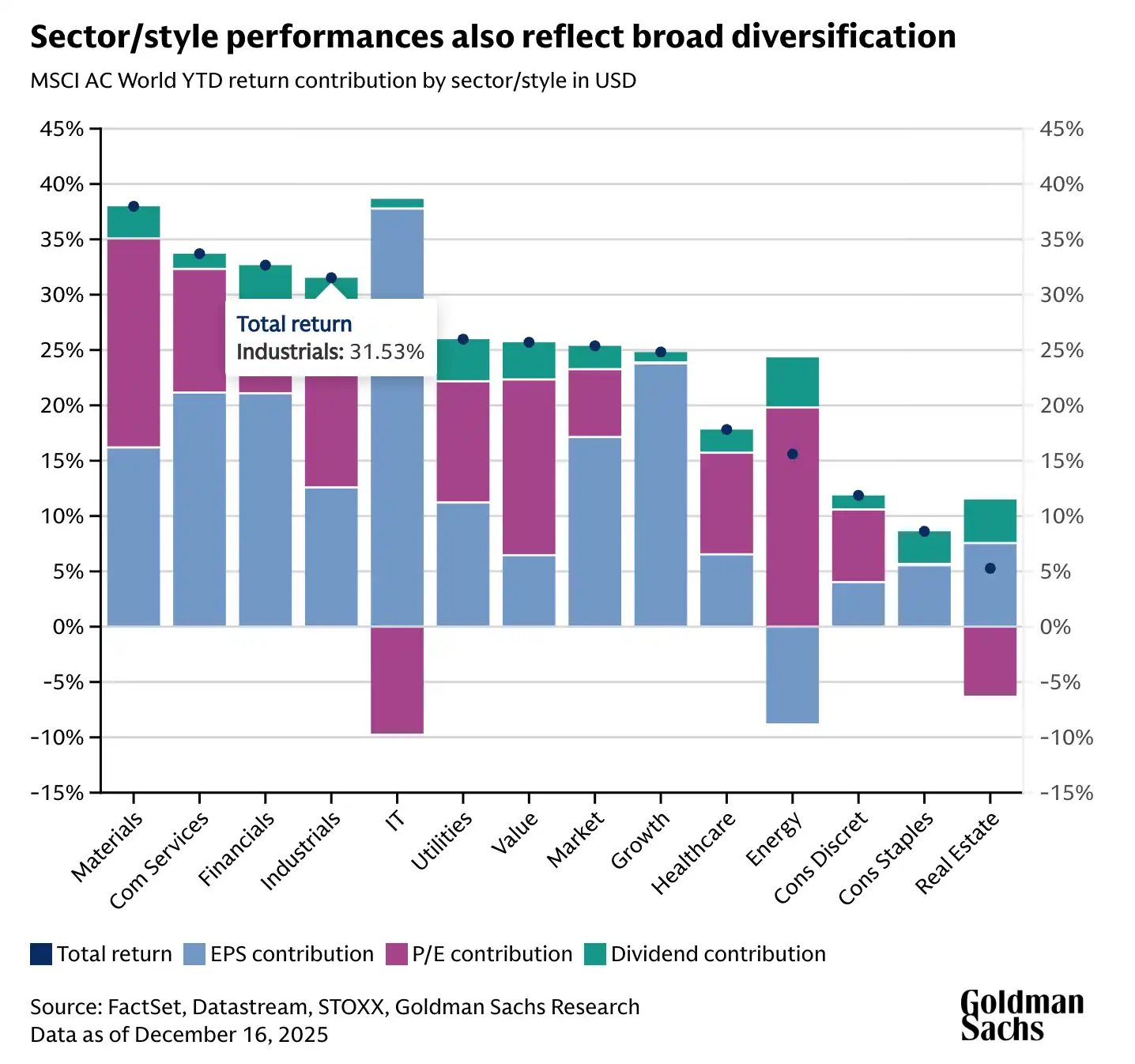
Diversification was a core theme emphasized by Goldman Sachs Research last year. In 2025, for the first time in many years, investors who diversified across regions were rewarded. Goldman Sachs analysts expect this trend to continue in 2026 and expand to include diversification across investment factors such as growth and value, as well as across various sectors. (Investment factors refer to asset characteristics such as size, value, or momentum that typically influence risk and return.)

What is the Outlook for Global Stock Markets in 2026?

Despite the strong performance of stock markets in 2025, outperforming commodities and bonds, the rally was not without its challenges. At the beginning of the year, stocks performed poorly, with the S&P 500 experiencing a nearly 20% correction from mid-February to April before rebounding.

Peter Oppenheimer, Chief Global Equity Strategist at Goldman Sachs Research, noted that the robust rally in global equities has left valuations at historically high levels across all regions, including the US, Japan, Europe, and emerging markets.
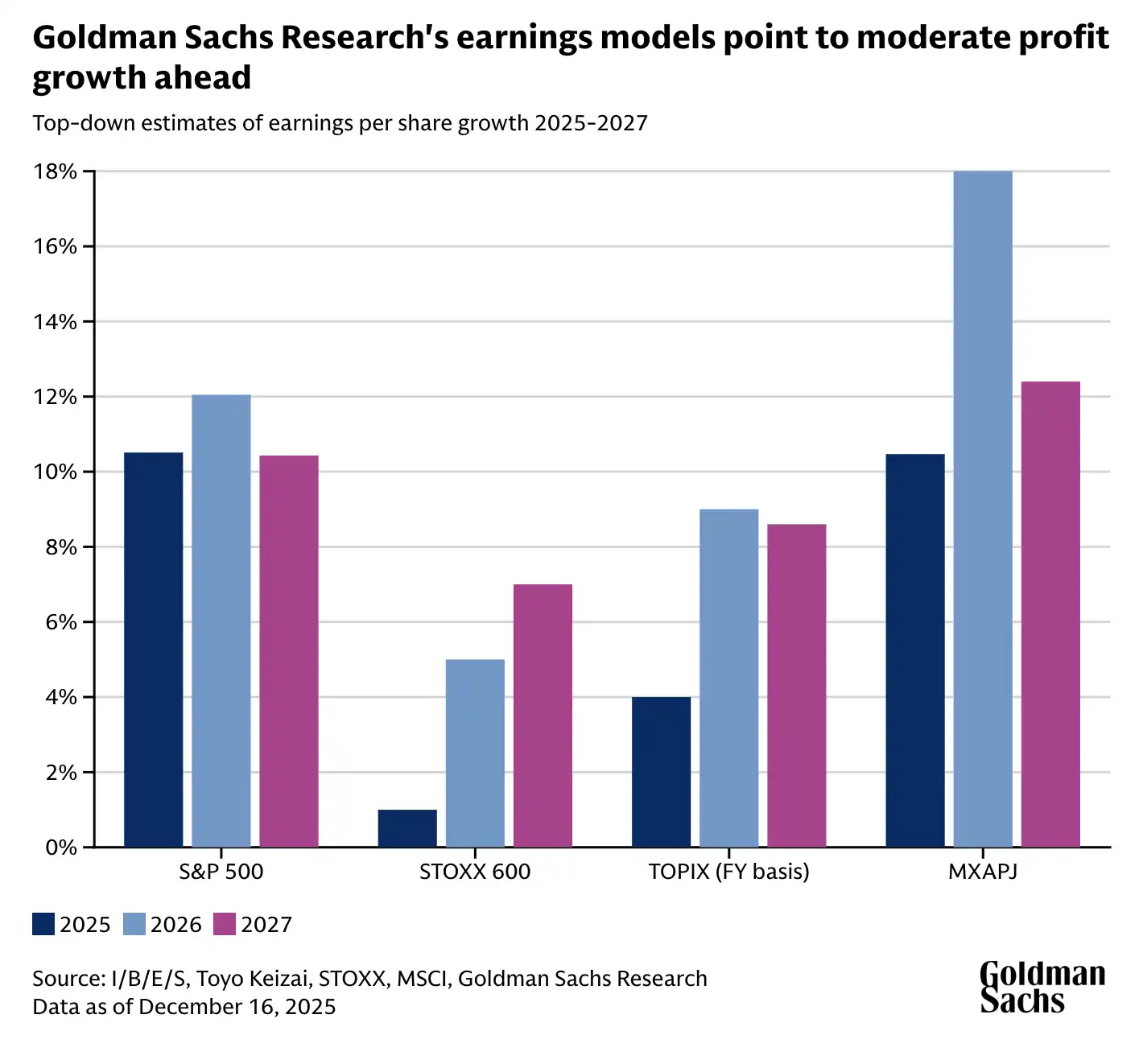
"Therefore, we believe returns in 2026 are more likely to be driven by fundamental earnings growth rather than further multiple expansion," Oppenheimer said. According to Goldman Sachs analysts' forecasts as of January 6, 2026, global share prices (weighted by regional market capitalization) are expected to rise 9% over the next 12 months, delivering an 11% return in USD terms (including dividends). He added, "The majority of the return comes from earnings."

Furthermore, according to another Goldman Sachs forecast, commodity indices are also expected to rise this year, with gains in precious metals once again offsetting declines in energy prices, a trend similar to 2025.

Oppenheimer's team also examined the typical progression of market cycles: the despair phase during bear markets; the short-lived hope phase during market rebounds; the longer growth phase where returns are driven by earnings growth; and finally, the optimistic phase where investor confidence increases and even becomes complacent.

Their analysis suggests that stocks are currently in the optimistic phase of a cycle that began with the bear market during the COVID-19 pandemic in 2020. "This late-cycle optimistic phase is often accompanied by rising valuations, suggesting there may be some upside risk to our core forecast," Oppenheimer's team wrote.

Should Investors Diversify Their Stock Portfolios in 2026?

In 2025, geographical diversification provided significant benefits to investors, which is not common. US stock market performance lagged behind other major markets for the first time in nearly 15 years. Due to a weaker US dollar, returns from European, Chinese, and Asian stock markets were nearly double the total return of the S&P 500.

Returns in the US market were primarily driven by earnings growth, especially from large technology companies. However, outside the US, the balance between earnings improvement and valuation expansion was more even. Last year, the growth-adjusted valuation gap between US stocks and the rest of the world narrowed.

"Even though absolute valuations in the US remain high, we expect these growth-adjusted valuation ratios to continue converging in 2026," Oppenheimer's team wrote.

Oppenheimer noted that diversification is still expected to provide better risk-adjusted returns in 2026. He advises investors to seek broad geographical opportunities, including increased focus on emerging markets. Simultaneously, investors should balance between growth and value stocks and pay attention to different sectors. Furthermore, there is potential for lower correlation between stocks, providing good opportunities for stock selection.
"As stock correlations decline and potentially remain low, we are also paying more attention to enhancing alpha," wrote Peter Oppenheimer, Chief Global Equity Strategist at Goldman Sachs Research. Alpha measures an asset's performance relative to a broader market index.

Oppenheimer added that non-tech sectors might perform strongly this year, and investors could profit from stocks benefiting from tech companies' capital expenditures. Moreover, as new AI capabilities are gradually realized, market attention may increasingly focus on companies outside the tech sector that benefit from AI development.

Are AI Stocks in a Bubble?

Overall, market focus on artificial intelligence "remains fervent," Goldman Sachs analysts noted. However, this does not mean a bubble exists in the AI field. "The dominance of the tech sector in the market was not triggered by the rise of AI," Oppenheimer wrote. "This trend began after the financial crisis and has been supported by its exceptional earnings growth."

Despite the soaring stock prices of large tech companies, current valuation levels have not reached the extremes seen in previous bubble periods. For example, comparing the valuation gap between the five largest companies by market cap in the S&P 500 and the other 495 stocks shows this gap is much smaller than in previous cycles, such as the peak of the tech bubble in 2000.


Preguntas relacionadas

QWhat is Goldman Sachs' predicted 12-month total return for global equities (in USD terms)?

AGoldman Sachs predicts a 12-month total return of 11% for global equities, including dividends, in USD terms.

QAccording to the report, what is the primary driver expected to fuel equity returns in 2026, rather than further valuation expansion?

AThe primary driver for equity returns in 2026 is expected to be fundamental earnings growth, rather than further expansion of valuations.

QWhat was a core theme for investors that Goldman Sachs highlighted for 2025 and expects to continue into 2026?

AA core theme was diversification, specifically cross-regional diversification, which Goldman Sachs expects to continue into 2026 and expand to include diversification across investment factors and sectors.

QDoes Goldman Sachs believe the AI sector is in a bubble? What evidence is provided?

ANo, Goldman Sachs does not believe the AI sector is in a bubble. They provide evidence that the valuation gap between the top 5 companies in the S&P 500 and the rest of the index is much smaller than it was at the peak of the tech bubble in 2000.

QWhat stage of the market cycle does Goldman Sachs analysis suggest equities are currently in?

ATheir analysis suggests that equities are in the 'optimism' phase of the market cycle, which is a later phase that began with the bear market during the COVID-19 pandemic in 2020.

Lecturas Relacionadas

SharpLink CEO: How to Understand Ethereum Developers Just Exceeded 1 Million?

SharpLink CEO reflects on the milestone of Ethereum surpassing 1 million historical developers, emphasizing that this figure represents the largest pool of technical talent ever assembled around an open, permissionless blockchain network. While approximately 232,000 developers remain active, the key question for the crypto industry is not which chain is fastest, but where the best builders choose to build long-term. Ethereum's advantage lies in a decade-long accumulation of infrastructure, standards, tools, liquidity, and a cohesive culture, making it the default operating system for programmable finance. This developer base is tackling complex challenges: the Glamsterdam upgrade aims to enhance scalability while preserving core principles; synchronous composability seeks to unify Rollup ecosystems; and significant efforts are underway for post-quantum security. Ethereum's deeper network effects stem from composability and shared standards (like the EVM and Solidity), creating a flywheel of more developers, tools, and liquidity. Three reinforcing strengths cement Ethereum's lead: credible neutrality (secured by ~900k validators), a modular architecture with interconnected Rollups, and a culture that attracts top researchers. The ecosystem is consolidating as the trusted coordination layer for internet-native finance, favored by large institutions valuing security and liquidity. The future of Ethereum is being built by this global community of founders and architects.

链捕手Hace 6 min(s)

SharpLink CEO: How to Understand Ethereum Developers Just Exceeded 1 Million?

链捕手Hace 6 min(s)

A Clod of Chinese Soil Chokes Two Japanese Giants

"Chinese Soil Chokes Japanese Giants" The production of a key electronic specialty gas, tungsten hexafluoride (WF6), vital for manufacturing AI chips, was halted by two leading Japanese producers—Kanto Denka and Central Glass. Their shutdown was not due to a technological failure but a sudden, critical shortage of a raw material they had long taken for granted: ultra-high-purity (6N-grade) tungsten powder, which is almost entirely sourced from China. Following a quiet Chinese export announcement in January 2026, tungsten powder shipments to Japan dropped to zero for months. Despite frantic efforts, Japanese companies found no viable alternative; imported powder was three times more expensive and lacked the required purity. Their existing stockpiles were exhausted by mid-2026. WF6 is essential for depositing tungsten into the microscopic contact holes of High Bandwidth Memory (HBM) chips, which are crucial for advanced processors like those from Nvidia. While Japanese firms had mastered producing ultra-pure WF6 gas, their entire supply chain relied on China's 6N tungsten powder—a dependency now revealed as a fatal vulnerability. China's dominance in this "soil" results from decades of painstaking R&D by companies like Xiamen Tungsten and China Tungsten & Hightech. They overcame immense technical hurdles, such as separating chemically similar molybdenum from tungsten, to achieve mass production of the world's purest tungsten powder. With their primary suppliers gone, Kanto Denka and Central Glass announced a permanent halt to WF6 production starting July 1, 2026. This immediately created a supply crisis for major semiconductor manufacturers like Samsung and SK Hynix, forcing them to urgently seek and certify new Chinese suppliers for WF6 itself. The reversal marks a dramatic shift: China has moved from exporting low-value raw materials to controlling the high-purity foundation of a critical global tech supply chain, upending a long-established industrial hierarchy.

marsbitHace 37 min(s)

A Clod of Chinese Soil Chokes Two Japanese Giants

marsbitHace 37 min(s)

Without Tencent, What's Left for Suiyuan?

The article centers on the crucial question posed in the title: what is Seyond Technology really worth if its dominant customer, Tencent, were to stop purchasing its AI chips? As the last of China's "Four AI Chip Dragons" to secure approval for a public listing, Seyond's IPO filing reveals a profound and controversial dependency. In 2025, 74.9% to over 80% of its revenue came from Tencent. The piece argues that this extreme customer concentration is not merely a vulnerability but a strategic outcome of China's AI industry evolution. It contrasts Seyond's path with its peers (Moore Thread, Biren Technology, and MetaX), noting that while others raced to market with ambitious stories, Seyond focused first on securing and delivering for a major client. Its explosive revenue growth—with Q1 2026 up 1474.85% year-on-year—is driven by concentrated orders from Tencent, which itself faces massive, escalating AI compute demands for products like its Yuanbao and Hunyuan models. The relationship is framed as a deliberate, symbiotic cultivation of a supply chain. As both a major shareholder (20.26%) and primary client, Tencent is actively fostering Seyond to build a controllable, stable alternative to NVIDIA, similar to how global tech giants historically nurtured key suppliers. The high switching costs—involving software stacks and deployed systems—create a deep "ecological moat" for Seyond within Tencent's ecosystem. The analysis positions the AI chip landscape in three tiers: NVIDIA as the global leader, Huawei's Ascend as the state-backed player, and commercial firms like Seyond competing for market orders. Seyond is increasingly seen as "Tencent's compute foundation," with its product roadmap closely aligned with the tech giant's needs. The conclusion is that the industry's metric for success is shifting from fundraising and technical specs to real orders, delivery capability, and ecosystem binding. Seyond's value, therefore, lies not just in its chips but in holding a massive, multi-year procurement order from China's largest internet company—a tangible asset arguably more telling than any technical whitepaper in the current climate. The core insight is that for domestic chips, the ultimate challenge isn't just catching up technologically with NVIDIA, but earning the trust, scenarios, and recurring orders from a major anchor client.

marsbitHace 1 hora(s)

Without Tencent, What's Left for Suiyuan?

marsbitHace 1 hora(s)

Trading

Spot
Futuros
活动图片