Author: Zhao Ying
Strong corporate earnings are providing the most powerful support for the bull market in U.S. stocks. Goldman Sachs partner John Flood believes that, as market positioning becomes "cleaner," the S&P 500 index could set a new all-time high within the year. The core logic driving this view is profitability.
According to Goldman Sachs data, the tracked year-over-year growth rate for S&P 500 earnings per share (EPS) in the second quarter is as high as 45%, far exceeding the market consensus expectation of 22% at the start of the quarter. Even excluding non-recurring items such as the combined approximately $151 billion in "other income" related to equity investments from Alphabet and Amazon, the S&P 500 EPS growth rate still reaches 26%. This not only represents an acceleration from the first quarter but is also the fastest growth rate since 2021. Meanwhile, analysts have begun to raise earnings expectations for 2027, with positive revisions observed across most sectors.
In terms of positioning, Goldman Sachs' sentiment and positioning indicators have retreated from previous highs. Most fast-moving positioning indicators have turned bearish: futures positioning, while still elevated, is no longer at extreme levels; the put/call ratio has declined; investor surveys show waning optimism; and U.S. equity positioning by active management funds (the NAAIM index is at 79.7) has also contracted. John Flood believes that this "cleaner" positioning environment creates conditions for further market upside.
Earnings Beat Expectations with Fastest Growth in Five Years
Goldman Sachs data shows that the tracked year-over-year EPS growth rate for the S&P 500 index reached 45% in the second quarter, significantly surpassing the initial quarter consensus of 22%. Within this, 19 percentage points of growth came from the combined $151 billion in "other income" related to equity investments from Alphabet and Amazon, with Microsoft contributing approximately $3 billion in similar income.
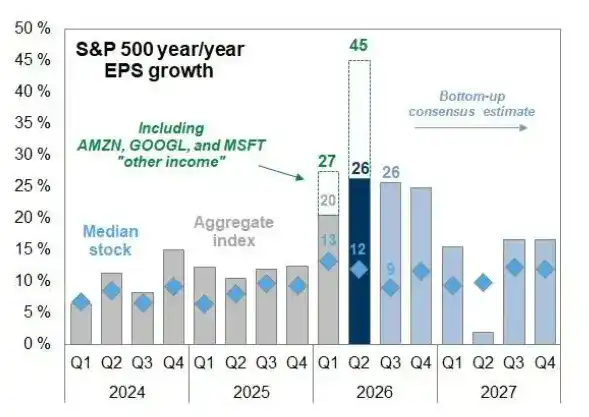
After excluding these non-core income sources, the S&P 500 EPS growth rate remains at 26%, further accelerating from the first quarter and marking the fastest pace since 2021. At the individual stock level, the tracked median EPS growth rate for S&P 500 constituents is 12%, also exceeding the initial quarter consensus of 9%, indicating that the earnings improvement is broad-based and not solely driven by a handful of tech giants.
Forward Estimates Continue to Be Revised Upward, Maintaining Positive Breadth
Strong second-quarter results not only reflect past operating performance but have also prompted analysts to continuously raise forward earnings estimates. Since the start of the third quarter, consensus expectations for the S&P 500's 2027 EPS have been revised upward by approximately 1%, with the energy and financial sectors seeing the largest increases.
In terms of revision breadth, the number of S&P 500 constituent companies with earnings estimates being raised continues to outnumber those being lowered, maintaining a positive revision breadth. Goldman Sachs believes this comprehensive upward revision trend is an important foundation supporting market valuations.
Positioning 'De-Froths,' Clearing Space for Upside
Regarding market sentiment and positioning, Goldman Sachs' sentiment and positioning indicators have fallen to the 53rd percentile, significantly lower than previous highs. Most fast-moving positioning indicators have turned bearish: futures positioning, while still high, is no longer at extreme levels; the put/call ratio has declined; investor surveys show decreased optimism; and U.S. equity positioning by active management funds (the NAAIM index at 79.7) has also contracted.
At the hedge fund level, de-leveraging has been particularly significant—total leverage has given back half of its gains for the year, and net leverage is down from the beginning of the year. For retail investors, leverage levels are starting to cool: South Korean stock market margin balances have retreated from historical highs, Japanese margin buying has started to pull back from its highest level since 1990, and U.S. investor purchases of semiconductor stocks have also moderated.
John Flood believes that this "de-frothing" of positioning signals a healthier market structure with reduced potential selling pressure, creating more favorable conditions for further index gains.
Valuations Relatively Low, AI Cycle Provides Long-Term Support
From a global cross-market comparison, Goldman Sachs data indicates that U.S. stock valuations are currently at a relatively "cheap" level compared to other major markets.
Meanwhile, John Flood points out that the main benefits of the AI super-cycle have not yet been fully realized. The world's largest technology companies continue to increase capital expenditures, driving an expansion in both the breadth and depth of earnings improvement.
However, Goldman Sachs also highlights a noteworthy seasonal risk: in the 13 mid-term election years since 1974, the median return for the S&P 500 from early August to Election Day has been 0%. This means that even if the earnings fundamentals remain strong, the timing of John Flood's call for a new high within the year still carries uncertainty. Goldman Sachs' conclusion is that the earnings picture provides strong support for the bulls, but sustainability remains the key variable.