Gold Surpasses $5,000 First, When Will the Crypto Market Reverse?

marsbitPublicado a 2026-01-26Actualizado a 2026-01-26

Resumen

The article discusses the outcome of a popular prediction on Polymarket from October last year: "First to $5,000: Gold or ETH?". While Ethereum had once approached $4,800 with high market confidence, gold ultimately surged past $5,100 per ounce on January 26, whereas Ethereum remained stagnant between $2,800 and $3,000. The rise in gold is attributed to macro factors including concerns over U.S. fiscal health, geopolitical tensions, and inflation-driven capital flight toward safe-haven assets. Institutional sentiment has turned strongly bullish, with banks like OCBC and Goldman Sachs raising their gold price targets. Meanwhile, tokenized gold products have seen record investment inflows. In contrast, the crypto market has faced significant outflows, with Bitcoin and Ethereum ETFs recording substantial withdrawals. Bitcoin has fallen 30% from its peak, and Ethereum is down around 40%. Analysts like Peter Brandt have turned bearish, citing completed bear channels. However, the article suggests that crypto’s downturn may be temporary—a phase in capital rotation toward safety. Once gold’s momentum slows or macro risks ease, capital may return to deeply oversold crypto assets. Bitcoin shows classic bottoming signals, including peak realized losses, while Ethereum’s high staking ratio reflects long-term confidence. The potential appointment of a crypto-friendly Fed chair could also boost the market. The piece concludes that gold’s rally may have further to go, and crypt...

Author:zhou, ChainCatcher

Remember that hot prediction event on Polymarket last October?

"First to $5,000: Gold or ETH?"
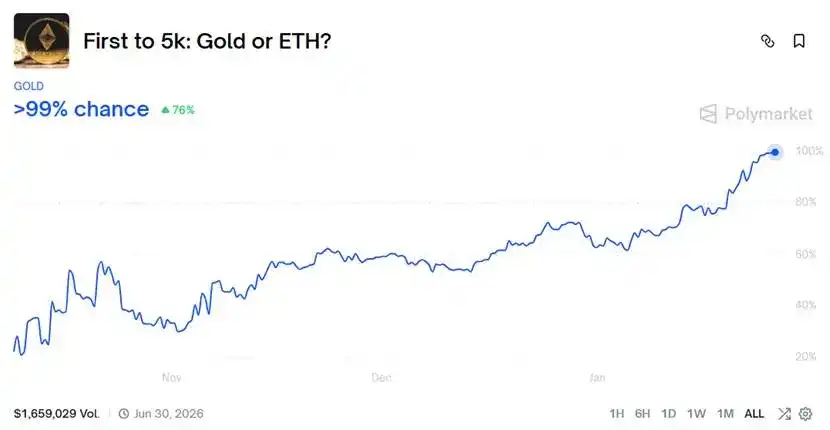
At that time, Ethereum's price surged to around $4,800, with the market giving it an 80% probability of breaking through $5,000. Many believed the era of digital gold had arrived.

Three months later, the market has given its answer.

On January 26, spot gold broke through $5,100 per ounce, while Ethereum is still oscillating between $2,800 and $3,000, with the overall crypto market remaining sluggish.

Amid extreme macroeconomic uncertainty, capital has collectively turned to the most traditional safe-haven assets, while cryptocurrencies, as high-volatility risk assets, were sold off first.

Gold Soars, Crypto Market Capital Votes with Its Feet

Gold's upward momentum stems from multiple macro factors.

First, signals of hedging against US dollar credit risk are becoming increasingly evident. The Danish academic pension fund AkademikerPension announced it would liquidate approximately $100 million in US Treasuries by the end of the month,直言 citing serious concerns about the US fiscal situation. Sweden's largest private pension fund, Alecta, also disclosed that since early 2025, it has significantly reduced its holdings of US Treasuries, amounting to approximately $7.7 to $8.8 billion. Institutions cite US policy uncertainty and持续 debt expansion as core reasons.

Second, geopolitical risks are intensifying. Less than a month into 2026, the world has already witnessed several major events, including the US proposing to "force-buy" Greenland, raiding and capturing the Venezuelan president, imposing 25% tariffs on countries trading with Iran, and further chaos within Iran. Coupled with the prolonged stalemate in the Russia-Ukraine conflict, geopolitical issues have not eased in the new year but have shown signs of恶化.

Additionally, inflation and currency depreciation pressures persist. Against the backdrop of massive central bank liquidity injections and fiscal deficit monetization, the purchasing power of fiat currency is constantly being diluted. Gold and silver, as hard assets, naturally become the首选 for capital seeking shelter.

In this context, institutional views on gold are rapidly turning optimistic. OCBC Bank has raised its year-end gold price target for 2026 to $5,600 per ounce; Goldman Sachs has also significantly adjusted its expectations, raising its year-end target from $4,900 to $5,400.

They emphasize that持续 buying by private investors and emerging market central banks is squeezing limited gold supply. Data shows that in 2025, global central banks net purchased over 1,100 tons of gold, and in 2026, it is expected to maintain a pace of over 60 tons per month. Against the backdrop of the Fed potentially restarting rate cuts, gold ETF holdings have also begun to回升.

On the crypto market side, on-chain gold investment enthusiasm has also reached new heights. According to Coingecko data, the total market capitalization of tokenized gold has now exceeded $525 million, and tokenized silver has also hit a historical record. According to Lookonchain monitoring, a whale lost $18.8 million on ETH in a short period and is now doubling down on gold. It spent $36.04 million to buy 7,536 XAUT at an average price of $4,786, with an unrealized profit of $2.3 million.

In contrast, the cryptocurrency market presents a截然不同的 picture. Bitcoin has fallen about 30% from last year's high, and Ethereum has dropped about 40%. Last week, both Bitcoin and Ethereum spot ETFs recorded massive net outflows: Bitcoin ETF net outflows were $1.33 billion (the second-highest weekly规模 in history), and Ethereum ETF net outflows were $611 million.

As of January 20, the performance of the two largest crypto treasury companies varied. Bitcoin treasury company MicroStrategy (MSTR) holds a total of 709,715 BTC with an average cost of $75,979, resulting in a floating profit of $10.813 billion. Ethereum treasury company Bitmine (BMNR) holds a total of 4,203,036 ETH with an average cost of $3,857, resulting in a floating loss of $3.232 billion.

Market sentiment is clearly偏向 bearish. The famous trader and chart analyst Peter Brandt, who successfully predicted Bitcoin's crash in 2018, stated that the Bitcoin bear market channel is complete and issued a sell signal again. He pointed out that Bitcoin's price needs to recover to $93,000 to negate the sell signal. Bloomberg analysts even believe that the possibility of Ethereum falling below $2,000 in the short term is higher than returning to $4,000.

Capital Rotation: The Day Gold Stops Rising is the Day Crypto Reverses?

However, the crypto market's sluggishness is more of a阶段性表现 of capital rotation. During periods of extreme risk aversion, capital flow typically first rushes into zero-credit-risk assets like US Treasuries and gold. Only after the peak of risk passes does it gradually flow back into stocks and crypto markets.

The current collective rise of gold, silver, and some大宗商品 is precisely the most concentrated stage of defensive allocation. Once gold's momentum weakens as it approaches institutional target prices, or a major macro risk shows signs of easing, profit-takers will likely begin searching for the next high-return opportunity. At that time, deeply回调ed crypto assets, with leverage fully washed out, will become the most natural承接 object.

Specifically for Bitcoin and Ethereum, their respective bottoming signals are becoming increasingly clear.

For Bitcoin, massive on-chain realized losses are often a classic bottom特征. CryptoQuant data shows that Bitcoin's realized loss (Realized Loss) has reached $4.5 billion, the highest level in three years. The last time this happened, Bitcoin's price was around $28,000 after about a year of brief adjustment.

On the institutional side, Bitcoin treasury companies continue to increase their BTC holdings through financing plans, especially after MSCI decided not to remove MSTR from its indices for now, prompting passive funds like Vanguard to follow up and buy MSTR stock. Arthur Hayes publicly stated that the core trading strategy this quarter is to go long on MSTR and Metaplanet.

The situation with Ethereum is similar. On one hand, over 36 million ETH has been staked, accounting for nearly 30% of the circulating supply, with the exit queue接近 zero. Validators are expressing long-term confidence in the network with their actions. On the other hand, BitMine recently obtained shareholder approval to increase the上限 of shares the company can issue to enhance future financing flexibility, and it will most likely continue to increase its Ethereum holdings.

It is worth mentioning that on Polymarket currently, the probability of BlackRock executive Rieder succeeding the Fed chair is close to 50%, significantly领先 competitors. Market analysis suggests that if this event materializes, his friendly stance towards RWA and the crypto ecosystem could provide a major boost to the crypto market.

However, history has proven countless times that when precious metal行情 go crazy, they are completely unreasonable.

How high can gold go next? No one knows. What needs to be done now is not to guess where the top is, let alone short it. In an era of inflation cycles and credit revaluation叠加, it is difficult to call a top for gold.

Loyal crypto investors may only need to patiently wait for the rotation signal to appear. Hopefully, that day will come sooner than we imagine.

Click to learn about open positions at ChainCatcher

Preguntas relacionadas

QWhat was the subject of the popular prediction event on Polymarket mentioned in the article?

AThe prediction event was 'First to $5,000: Gold or ETH?', which asked whether gold or Ethereum would be the first to break the $5,000 price level.

QWhich asset ultimately reached the $5,000 price target first, and what was its price on January 26th?

AGold reached the target first. On January 26th, the spot price of gold broke through $5,100 per ounce.

QWhat are the three main macro factors cited in the article as driving the rise in gold's price?

AThe three main drivers are: 1) Hedging against U.S. dollar credit risk, 2) Escalating geopolitical risks, and 3) Persistent inflation and currency devaluation pressures.

QAccording to the article, what is a potential signal for a reversal in the cryptocurrency market?

AA potential signal for a crypto market reversal is when the momentum in gold's price weakens after it nears institutional target prices, or when a major macro risk shows signs of easing, prompting profit-taking capital to seek higher returns in deeply corrected crypto assets.

QWhat on-chain metric for Bitcoin is mentioned as a classic bottoming feature, and what was its value?

AThe metric is Bitcoin's Realized Loss. The value mentioned is $4.5 billion, which is stated to be the highest level in three years.

Lecturas Relacionadas

After Three Consecutive Quarters of Decline, Can the Crypto Market Find a Window for Stabilization in Q3?

The cryptocurrency market has just concluded its worst-performing quarter since 2022, with total capitalization dropping 12.6% to $2.1 trillion. All core metrics indicate capital is leaving the sector, not just rotating within it. Bitcoin fell 14.2% and Ethereum dropped 25.4% in Q2, breaking their previous correlation with US tech stocks. A key driver is the reversal in US spot Bitcoin ETF flows, which saw a net outflow of approximately $4.67 billion in Q2, including a record monthly outflow near $4.5 billion in June. While recent data suggests long-term holders are accumulating again, sustained ETF outflows mean continued selling pressure. Market focus is now singularly on the Federal Reserve. The upcoming July FOMC meeting is seen as the most critical event for Q3. A dovish signal could support Bitcoin reclaiming a $68,000-$84,000 range, while a hawkish stance might establish a new trading band around $50,000-$56,000. Additionally, regulatory uncertainty persists, with the progress of the crucial *CLARITY Act* stalling in the Senate, reducing its perceived 2026 passage probability to 40-45%. Despite the broad downturn, a few sectors showed growth. Prediction markets saw nominal volume surge 48.7% year-over-year to $113.8 billion, and tokenized collectibles transaction volume rose 143% quarterly to $1.4 billion. The Real-World Asset (RWA) tokenization sector also continued steady growth, now representing ~$28.1 billion in on-chain value. The market's foundation for an extreme crash appears limited, with Bitcoin price hovering near its 200-week moving average. However, the trading paradigm has shifted from narrative-driven speculation to decisions based on price action, policy developments, and interest rate expectations, making a broad sentiment-driven rally unlikely in the near term.

marsbitHace 10 hora(s)

After Three Consecutive Quarters of Decline, Can the Crypto Market Find a Window for Stabilization in Q3?

marsbitHace 10 hora(s)

BIT Trading Moment: BTC Still Suppressed by Weekly 200 EMA, Rejection May Restart Decline; Storage and Semiconductors that Surged Last Night Begin Falling in Evening Trading

**Crypto & Stock Market Wrap: Bitcoin Tests Resistance, Stocks Retreat After AI Surge** Bitcoin consolidates around $66,000, facing key resistance near $68,000—an area seen as a major psychological and technical hurdle where previous rallies have failed. Analysts note the cryptocurrency is caught between its 200-week moving average (~$63,333) and 200-week EMA (~$68,328). A clear break above $68k is needed to signal a stronger bullish trend, while a rejection could lead to a retest of $63k support. Market sentiment remains cautious, with low futures open interest pointing to a low-liquidity rebound rather than a full bull market. Bitcoin spot ETFs saw another $203 million inflow. US stock futures pointed lower after a strong Tuesday session led by a massive rebound in semiconductors and memory stocks. The rally was fueled by renewed optimism about AI-driven hardware demand, with Micron, SanDisk, and SK Hynix surging. However, those gains reversed in pre-market trading. Super Micro Computer (SMCI) soared over 20% after hours on strong guidance and a record backlog. Other standouts included Rocket Lab and nuclear energy plays Oklo and X-Energy. Rising oil prices (Brent above $91) and climbing Treasury yields (10-year near 4.64%), however, are reigniting inflation concerns and acting as a headwind for equities. In Asia, markets were mixed. South Korea's KOSPI pared early gains to close slightly higher as semiconductor stocks like SK Hynix gave back initial surges. Japan's Nikkei edged lower as the yen hit a fresh 38-year low against the dollar, raising fears of potential market intervention. Key events to watch include the Samsung Galaxy launch, AMD's AI event, and a slew of major tech earnings from Alphabet, Tesla, and IBM after the close on Wednesday, followed by the ECB meeting and Intel's earnings on Thursday.

marsbitHace 11 hora(s)

BIT Trading Moment: BTC Still Suppressed by Weekly 200 EMA, Rejection May Restart Decline; Storage and Semiconductors that Surged Last Night Begin Falling in Evening Trading

marsbitHace 11 hora(s)

Former CFTC Chairman, Circle President Tarbert: Preaching Long-Termism While Cashing Out $30 Million Himself

Former CFTC Chairman and Circle President Heath Tarbert has consistently advocated for a long-term vision in public, urging patience from investors as Circle’s stock price has fallen significantly from its peak. However, it has been revealed that since Circle’s IPO, Tarbert has continuously sold his CRCL shares through pre-arranged trading plans, cashing out approximately $30 million, without making any public market purchases. This contrast between his public messaging and personal actions has drawn criticism. Tarbert joined Circle in July 2023 as Chief Legal Officer, leveraging his regulatory experience to help guide the company through its IPO and expansion. Despite promoting stablecoins as long-term infrastructure, he established a 10b5-1 trading plan just before Circle went public, leading to substantial stock sales over the following year. In March 2026, he initiated another plan to sell more shares. His career trajectory highlights a pattern of moving between high-level regulatory roles and influential positions in the financial sector. After resigning as CFTC Chairman in early 2021, he joined Citadel Securities as Chief Legal Officer just 27 days later, during a period of intense regulatory scrutiny for the firm. He later joined Circle, aiding its efforts to navigate regulatory challenges for its public listing. While Tarbert's expertise in policy and compliance is valuable to companies like Circle, his actions—advocating long-term confidence while personally divesting—raise questions about the alignment between his public statements and his private financial decisions, leaving investors who followed his advice to bear the market risks.

marsbitHace 11 hora(s)

Former CFTC Chairman, Circle President Tarbert: Preaching Long-Termism While Cashing Out $30 Million Himself

marsbitHace 11 hora(s)

Gate Research Institute: The 'Wall Street-ization' Wave of Crypto Financial Products – Competition or Integration?

The article titled "Gate Research Institute: Are Crypto Financial Products Sparking a 'Wall Street' Wave—Competition or Convergence?" explores the evolving relationship between the crypto ecosystem and traditional finance (TradFi). The piece begins by reflecting on Bitcoin's original 2009 vision of decentralization, disintermediation, and moving away from banks. It then contrasts this with the 2024 landscape, where key crypto assets like Bitcoin are increasingly held through Wall Street products like ETFs issued by giants like BlackRock. The article questions whether this signifies that TradFi is systematically taking over the rights to issue, price, custody, and distribute crypto financial assets. The core argument is that this is not a zero-sum takeover but rather a bidirectional convergence where each side addresses the other's weaknesses. Crypto offers 24/7 global markets, programmable settlement, and open access but lacks compliant channels, institutional-grade custody, deep fiat liquidity, and mainstream distribution. TradFi possesses these but is constrained by legacy systems, limited operating hours, and slow settlement. Two primary convergence paths are highlighted: * **Path A (CEX to TradFi):** Exemplified by Gate, which has progressed from offering tokenized stocks and CFDs to providing direct, real stock trading (US, Hong Kong, South Korea) within its platform, using USDT. * **Path B (TradFi to Crypto):** Exemplified by Robinhood, which has integrated crypto trading, acquired exchanges like Bitstamp, and is moving traditional assets like stocks onto the blockchain via tokenization and its own Layer 2. Both paths are ultimately competing to become the next-generation, unified financial account—a "super account" where users can seamlessly trade cryptocurrencies, stocks, ETFs, RWA (Real World Assets), and tokenized treasury products in one interface. The growth of RWA and tokenized treasuries (e.g., BlackRock's BUIDL) is presented as the asset-layer fusion, providing stable, yield-bearing assets on-chain and acting as a bridge between the two worlds. In conclusion, the "Wall Street-ization" of crypto is framed as a mutual transformation. Decentralized ideals persist in the protocol layer, while at the application layer, a more efficient, global, and accessible unified capital market is emerging from this convergence. The future competition lies not between crypto exchanges and stockbrokers, but between platforms vying to offer the most comprehensive asset coverage, liquidity, and user experience within a single account.

marsbitHace 11 hora(s)

Gate Research Institute: The 'Wall Street-ization' Wave of Crypto Financial Products – Competition or Integration?

marsbitHace 11 hora(s)

Trading

Spot
活动图片





