Gold Rushes Ahead of Quantitative Easing, Bitcoin Awaits Liquidity (Part 2)

marsbitPublicado a 2026-01-09Actualizado a 2026-01-09

Resumen

The article analyzes why Bitcoin has remained stagnant around $80,000 despite the U.S. entering a rate-cut cycle, while gold continues to rise. It attributes this divergence to two structural factors: high real interest rates due to persistent inflation and a "middle-layer blockage" where monetary easing isn't translating into looser financial conditions. Additionally, this is a defensive rate-cut cycle driven by recession risks and rising debt burdens, not growth, causing capital to prioritize safety over risk-taking assets like Bitcoin. The U.S. faces a debt trilemma: rolling over debt, shifting to short-term issuance, or allowing currency devaluation. Gold's surge reflects hedging against dollar devaluation. Bitcoin awaits confirmed liquidity expansion. The outlook involves two phases: an initial recession shock where gold may peak while Bitcoin faces a sell-off, followed by Fed-led liquidity expansion (QE) where Bitcoin absorbs excess liquidity and surges. Silver's role is noted, with its price action tied to industrial demand and the gold-silver ratio. Long-term, both gold and Bitcoin are expected to appreciate against fiat currencies due to persistent monetary debasement, with leadership shifting from gold to Bitcoin once liquidity floodgates open.

To understand why Bitcoin has reacted tepidly to interest rate cuts, it's helpful to start with gold. Gold is a globally priced asset. While retail investors typically trade in grams, its international pricing is denominated in troy ounces and tons. It is this global pricing structure that makes the influence of macroeconomic factors so significant.

Bitcoin shares this characteristic. Furthermore, its price is globally uniform, meaning any serious analysis must begin with the U.S. macroeconomic situation.

The puzzle is evident. The U.S. has entered a new cycle of interest rate cuts, yet Bitcoin's price lingers around $80,000, while the price of gold continues to climb. Conventional theory suggests that low interest rates should benefit risk assets like stocks and cryptocurrencies. However, so-called defensive assets are rallying against the trend.

This contradiction can be explained by two structural factors.

The "Middle Layer Blockage" Problem

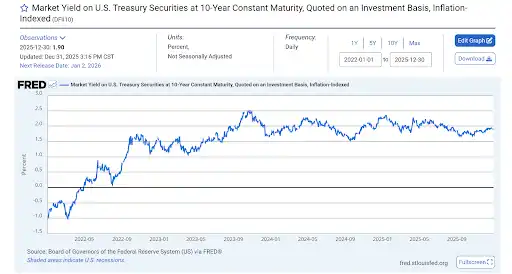
The market's focus is not on nominal interest rates, but on real interest rates. Inflation remains stubbornly high. As long as inflation persists, even if policy rates are cut, real rates struggle to break significantly lower from their elevated levels.

From the perspective of the real economy, rate cuts have not translated into easier financial conditions. Banks have not substantively loosened lending standards. Businesses remain reluctant to borrow. In other words, the intermediate link between policy and capital allocation remains blocked.

Meanwhile, the U.S. Treasury continues to issue a massive volume of new debt. In the second half of 2025, the pace of bond issuance for refinancing existing debt outpaced the liquidity released by rate cuts. The result seems counterintuitive but is crucial: overall liquidity did not expand; it actually contracted.

There simply isn't enough "available money" to push Bitcoin's price higher at the moment.
This is a Defensive Rate-Cut Cycle, Not a Growth Cycle.

This rate-cutting cycle is fundamentally different from previous ones that fueled bull markets. The Fed is cutting rates not because the economy is strong, but because unemployment is rising, corporate default rates are increasing, and the government's debt servicing costs are becoming unsustainable.

This is a defensive rate cut, driven primarily by recession fears and stagflation risks.

In this environment, capital behaves differently. Institutional investors prioritize survival over yield. Their first reaction is not to chase volatility but to reduce risk exposure and build cash buffers.

Despite its long lifecycle, Bitcoin remains one of the world's most liquid high-risk assets. When market stress increases, it is treated as a source of liquidity—a financial ATM. Risk-off flows start in crypto, not stop there.

This mirrors the logic during price expansions. Money flows into crypto last during price run-ups; it flows out of crypto first when uncertainty rises.

In contrast, as investors await a significant drop in real rates, gold is being used as a hedge against dollar devaluation.

The Deeper Issue: America's Debt Trilemma

U.S. interest payments now exceed defense spending, ranking as the federal government's third-largest expenditure after Social Security and Medicare.

Washington effectively has only three choices left.

First, roll over the debt indefinitely by issuing new bonds to pay off old ones. Given the total federal debt exceeds $38 trillion, this only exacerbates the problem.

Second, suppress long-term yields by shifting issuance towards short-term bills, lowering the average funding cost, but not addressing the fundamental imbalance.

Third, and most significantly, allow an implicit default through currency devaluation. When debt cannot be repaid in real terms, repay it with devalued dollars.

This is the structural reason behind gold's surge towards $4,500. The world is hedging against the late-stage credibility crisis of the U.S. dollar.

Rate cuts alone are insufficient. Many on Wall Street now openly state that to avoid collapse, the financial system needs continuous monetary expansion and managed inflation. This creates a vicious cycle: either print money leading to currency devaluation, or refuse to print triggering defaults.

History suggests the choice is inevitable. The Fed is unlikely to tolerate systemic collapse. The reintroduction of Quantitative Easing (QE) and Yield Curve Control (YCC) now seems more a question of timing than probability.

2026 Strategic Outlook: From Liquid Darkness to Flood

Once this framework is understood, the current divergence between gold and crypto makes perfect sense. Both assets hedge against it, but timing is crucial.

Gold is anticipating the future trend of monetary expansion; Bitcoin is waiting for confirmation.

In my view, the path forward unfolds in two phases.

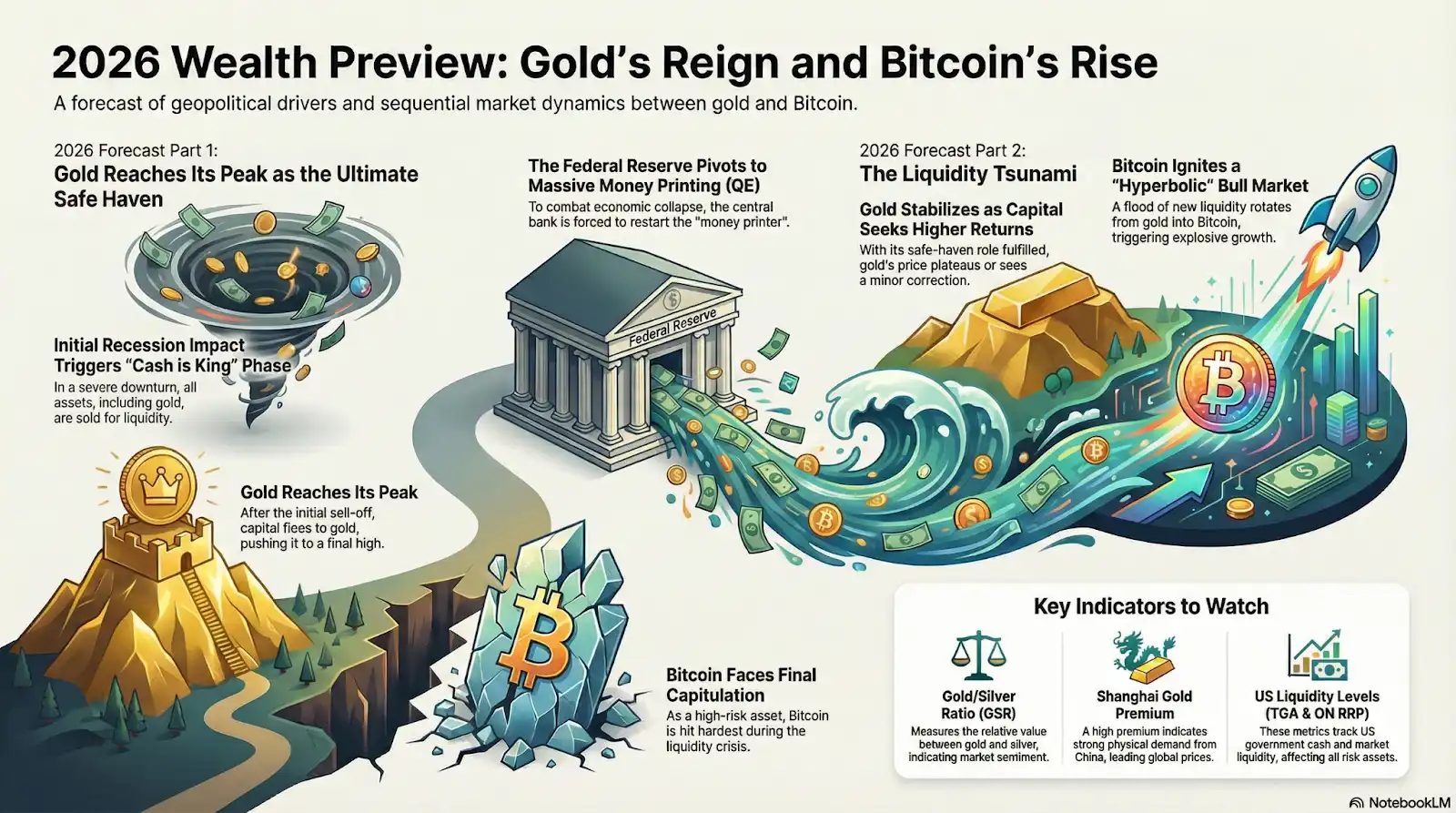
Act I: Recession Shock and the "Gold Peak"

When recession indicators are fully triggered—for example, U.S. unemployment rising above 5%—gold prices are likely to hold high or spike further. It will then be seen as the ultimate safe haven.

Bitcoin, however, could face a final leg down. In the initial phase of a recession, all assets are sold to raise cash. Margin calls and forced liquidations dominate market behavior.

History is clear on this. In 2008, gold fell nearly 30% before rebounding. In March 2020, gold dropped 12% in two weeks, while Bitcoin was halved.

Liquidity crises wash over all assets. The difference lies in which asset recovers first. Gold typically stabilizes and rebounds quicker; Bitcoin takes more time to rebuild market confidence.

Act II: Fed Capitulation and Bitcoin's Liquidity Explosion

Eventually, rate cuts will prove inadequate to handle the economic stress. Economic strain will force the Fed to expand its balance sheet again.

This is the moment the liquidity floodgates truly open.

Gold prices may consolidate or trade sideways. Capital will aggressively rotate into high-beta assets. Bitcoin, as the purest expression of excess liquidity, will absorb these flows.

In such scenarios, price moves are rarely gradual. Once momentum builds, Bitcoin's price can change violently within months.

A Note on Silver and the Gold-Silver Ratio

Silver's rally in 2025 was driven by two factors: its historical link to gold and its industrial demand. AI infrastructure, solar power, and electric vehicles are all heavily reliant on silver.

In 2025, inventories at major exchanges, including the Shanghai Futures Exchange and the London Bullion Market Association, fell to critical levels. In a bull market, silver typically outperforms gold, but in a bear market, it carries higher downside risk.

The gold-silver ratio remains a key metric.

Above 80, silver is historically cheap. Below 60, silver is expensive relative to gold. Below 50, speculative excess tends to dominate.

With the ratio currently around 59, the signal suggests a rotation towards gold, not aggressive accumulation of silver.

The Long View: Different Leaders, Same Destination

Setting aside the specific timing of 2026, the long-term conclusion remains unchanged. Both gold and Bitcoin are in an upward trend against fiat currencies.

The only variable is leadership. This year belongs to gold; the next phase belongs to Bitcoin.

As long as global debt expands and monetary authorities rely on currency debasement to relieve pressure, scarce assets will outperform. In the long run, fiat currency is the only consistently losing asset.

What matters now is patience, data, and discipline. The transition from gold dominance to Bitcoin dominance will not be announced—it will manifest through liquidity indicators, policy shifts, and capital rotation.

I will continue watching for these signals.

Criptos en tendencia

Preguntas relacionadas

QWhy has Bitcoin's price remained around $80,000 despite the US entering a rate-cutting cycle, while gold continues to rise?

ABitcoin's冷淡 reaction is due to two structural factors: the 'middle-layer blockage' where actual financial conditions haven't loosened despite rate cuts, and the defensive nature of this cycle where investors prioritize risk reduction over yield chasing. Gold, however, is rising as a hedge against dollar devaluation amid recession fears and stagflation risks.

QWhat is the 'middle-layer blockage' problem mentioned in the article?

AThe 'middle-layer blockage' refers to the disconnect between policy rate cuts and actual capital allocation. Despite lower nominal rates, high inflation keeps real rates elevated, banks haven't substantially eased lending standards, and businesses remain reluctant to borrow. Concurrently, massive new debt issuance by the US Treasury absorbs liquidity faster than rate cuts can release it, leading to a contraction in overall liquidity.

QHow does a defensive rate-cutting cycle differ from a growth-driven one, and its impact on assets?

AA defensive rate-cutting cycle, driven by rising unemployment, increased corporate defaults, and unsustainable government debt costs, prioritizes economic survival over growth. In this environment, investors reduce risk exposure and build cash buffers, causing capital to flow out of high-risk assets like Bitcoin first. Conversely, growth-driven cycles encourage risk-taking and benefit assets like stocks and crypto.

QWhat are the three options the US government faces regarding its debt dilemma, according to the article?

AThe three options are: 1) Rolling over debt indefinitely by issuing new bonds to repay old ones, exacerbating the problem; 2) Shifting issuance to short-term bills to suppress long-term yields and lower financing costs, without solving the fundamental imbalance; 3) Allowing implicit default through currency devaluation, repaying debt with devalued dollars.

QWhat is the two-phase strategic outlook for 2026 regarding gold and Bitcoin?

APhase 1: Recession shock leads to a 'gold peak' where gold holds high or rises further as the safest asset, while Bitcoin faces a final sell-off due to liquidity crises and forced liquidations. Phase 2: The Fed capitulates and expands its balance sheet, unleashing massive liquidity. Gold may consolidate, and Bitcoin absorbs excess liquidity, experiencing explosive price gains as the purest expression of surplus capital.

Lecturas Relacionadas

Agent Race Ends, Super Workbench Takes Over

The era of fragmented AI agents is ending. Over the past month, China's tech giants—Tencent, Alibaba, and ByteDance—have simultaneously shifted strategy: instead of launching new, standalone AI agents, they are consolidating their various agent projects into unified "super workbenches." Tencent integrated its QClaw teams into WorkBuddy, a strategic product hailed as a potential third flagship after QQ and WeChat. Alibaba is merging its QoderWork, Wukong, and MuleRun agents into a new "Qianwen Office" platform under DingTalk's leadership. ByteDance rebranded its TRAE SOLO coding agent to TRAE Work, signaling a broader focus on workflow collaboration. This convergence marks a pivotal industry consensus. The initial exploration phase, where companies rapidly built numerous overlapping agents for different scenarios, proved costly and inefficient. With open-source tools eroding technical barriers, competition has shifted from agent creation to resource consolidation and cost control. Historically, platform wars are won not by creating more products, but by simplifying them—as seen with browsers unifying web access and super-apps consolidating services. Now, the "super workbench" aims to become the unified AI entry point for work. This reflects a deeper market realization: the primary audience for AI is no longer just programmers (a market in the tens of millions) but all knowledge workers (a market of billions). The real opportunity lies in augmenting everyday tasks—managing emails, documents, data, and meetings—across the entire workday. The core battleground is becoming control over the primary AI entry point that employees use daily. Tencent's WorkBuddy leverages WeChat and Tencent Docs; Alibaba's Qianwen Office taps into DingTalk's organizational data; ByteDance's TRAE Work integrates with Feishu's workflows. Whoever owns this "super workbench" gains strategic control over orchestrating enterprise data and APIs. This shift is redefining enterprise software. Traditional SaaS applications, valued for their user interfaces, will recede into the background. Their core functionalities will be exposed as standardized "Skills" or APIs for the super workbench's agents to invoke. Software value will shift from selling user seats to charging based on API calls and outcomes delivered. The evolution of agents is moving through clear stages: first as novel standalone products, then as consolidated primary work entry points, and finally as pervasive, invisible capabilities embedded into the digital fabric. The recent moves by major tech firms signal the transition from the first stage into the second, accelerating toward the third. In the end, the most successful agent technology may become invisible—like electricity or the HTTP protocol—a fundamental, unnamed infrastructure powering work itself.

marsbitHace 16 min(s)

Agent Race Ends, Super Workbench Takes Over

marsbitHace 16 min(s)

Michael Saylor: 110 Reasons to Oppose BIP-110

Michael Saylor presents 110 arguments against Bitcoin Improvement Proposal (BIP) 110, a soft fork aimed at restricting certain non-monetary data storage uses (like inscriptions) on the Bitcoin blockchain. He acknowledges the proponents' valid concerns—such as node costs, fee pressure, and preserving Bitcoin's monetary focus—but fundamentally disagrees with the proposed solution. Saylor argues that BIP 110 represents a dangerous precedent of using consensus rules to enforce value judgments on transaction validity, moving away from Bitcoin's core principles of neutrality and permissionless innovation. His key objections are organized into eleven categories: 1) It violates neutrality and hard consensus by banning currently valid transactions. 2) It fails to meet the high burden of proof required for a consensus change, lacking concrete data on the alleged crisis. 3) Its seven bundled technical restrictions are overly broad, targeting generic script functionalities and blocking future upgrade paths. 4) It sacrifices compatibility and future optionality by closing off designed upgrade hooks. 5) Its temporary rules add significant complexity (grandfathering, expiry states) without sufficient justification. 6) The economic and security impacts, particularly on miner revenue and fee markets, are uncertain and unmodeled. 7) Superior, market-based tools (fee markets, relay/mining policies) already exist to manage blockchain load. 8) It stifles innovation by creating a chilling effect for developers. 9) Its modified activation mechanism (55% threshold, forced signaling) is aggressive and risks network splits. 10) The precedent it sets—using consensus to suppress disliked but legal uses—is more dangerous than the problem it aims to solve. 11) A better path exists: improving measurements, refining resource-based policies, and allowing market forces to work. Saylor concludes that Bitcoin's strength lies in its neutral rules, open markets, and hard consensus. Changing these foundational elements to target specific use cases is an unnecessary and risky "iatrogenic" intervention. He advocates for guarding Bitcoin's neutrality rather than acting as its redeemer.

marsbitHace 31 min(s)

Michael Saylor: 110 Reasons to Oppose BIP-110

marsbitHace 31 min(s)

Trading

Spot

Artículos destacados

Qué es BITCOIN

Entendiendo HarryPotterObamaSonic10Inu (ERC-20) y Su Posición en el Espacio Cripto En los últimos años, el mercado de criptomonedas ha sido testigo de un aumento en la popularidad de las monedas meme, capturando el interés no solo de los comerciantes, sino también de aquellos que buscan compromiso comunitario y valor de entretenimiento. Entre estos tokens únicos se encuentra HarryPotterObamaSonic10Inu (ERC-20), un proyecto intrigante que mezcla referencias culturales en el tejido de las criptomonedas. Este artículo profundiza en los aspectos clave de HarryPotterObamaSonic10Inu, explorando sus mecanismos, ethos impulsado por la comunidad y su relación con el paisaje cripto más amplio. ¿Qué es HarryPotterObamaSonic10Inu (ERC-20)? Como su nombre sugiere, HarryPotterObamaSonic10Inu es una moneda meme construida sobre la blockchain de Ethereum, clasificada bajo el estándar ERC-20. A diferencia de las criptomonedas tradicionales que pueden enfatizar la utilidad práctica o el potencial de inversión, este token prospera en el valor de entretenimiento y la fuerza de su comunidad. El proyecto tiene como objetivo fomentar un entorno donde los usuarios comprometidos puedan reunirse, compartir ideas y participar en actividades inspiradas por diversos fenómenos culturales. Una característica notable de HarryPotterObamaSonic10Inu es su cero impuestos en las transacciones. Este atractivo elemento tiene como objetivo incentivar el comercio y la participación comunitaria, sin cargos adicionales que puedan disuadir a los comerciantes de pequeña escala. El suministro total de la moneda está establecido en mil millones de tokens, una cifra que marca su intención de mantener una circulación sustancial dentro de la comunidad. Creador de HarryPotterObamaSonic10Inu (ERC-20) Los orígenes de HarryPotterObamaSonic10Inu están algo envueltos en misterio; los detalles sobre el creador siguen siendo desconocidos. El desarrollo de este token carece de un equipo identificable o de un plan explícito, lo cual no es inusual dentro del sector de monedas meme. En cambio, el proyecto ha surgido de manera orgánica, con su progreso muy dependiente del entusiasmo y la participación de su comunidad. Inversores de HarryPotterObamaSonic10Inu (ERC-20) En cuanto a inversiones externas y respaldo, HarryPotterObamaSonic10Inu también sigue siendo ambiguo. El token no lista ninguna fundación de inversión conocida o apoyo organizacional significativo. En cambio, la savia del proyecto es su comunidad de base, que informa su crecimiento y sostenibilidad a través de la acción colectiva y el compromiso en el espacio cripto. ¿Cómo Funciona HarryPotterObamaSonic10Inu (ERC-20)? Como una moneda meme, HarryPotterObamaSonic10Inu opera principalmente fuera de los marcos tradicionales que a menudo rigen el valor de los activos. Hay varios aspectos distintivos que definen cómo funciona el proyecto: Transacciones Sin Impuestos: Sin tarifas impositivas en las transacciones, los usuarios pueden comprar y vender el token libremente sin preocuparse por costos ocultos. Compromiso Comunitario: El proyecto prospera en la interacción comunitaria, aprovechando plataformas de redes sociales para crear entusiasmo y facilitar la participación. Las discusiones, el intercambio de contenido y el compromiso son elementos cruciales que ayudan a expandir su alcance y fomentar la lealtad entre los seguidores. Sin Utilidad Práctica: Cabe señalar que HarryPotterObamaSonic10Inu no ofrece utilidad concreta dentro del ecosistema financiero. Más bien, se clasifica como un token principalmente para actividades de entretenimiento y comunitarias. Referencia Cultural: El token incorpora astutamente elementos de la cultura popular para atraer interés, conectando con entusiastas de los memes y seguidores de las criptomonedas por igual. HarryPotterObamaSonic10Inu ejemplifica cómo las monedas meme operan de manera diferente a los proyectos de criptomonedas más tradicionales, ingresando al mercado como construcciones sociales innovadoras en lugar de activos utilitarios. Cronología de HarryPotterObamaSonic10Inu (ERC-20) La historia de HarryPotterObamaSonic10Inu está marcada por varios hitos notables: Creación: El token surgió de un meme viral, capturando la imaginación de muchos entusiastas de las criptomonedas. Las fechas específicas de creación no están disponibles, subrayando su ascenso orgánico. Listado en Exchanges: HarryPotterObamaSonic10Inu ha llegado a varios exchanges, permitiendo un acceso y comercio más fácil por parte de la comunidad. Iniciativas de Compromiso Comunitario: Actividades continuas destinadas a mejorar la interacción comunitaria, incluyendo concursos, campañas en redes sociales y generación de contenido por parte de fanáticos y defensores. Planes de Expansión Futuros: La hoja de ruta del proyecto incluye el lanzamiento de una colección de NFT, mercancía y un sitio de comercio electrónico relacionado con sus temas culturales, involucrando aún más a la comunidad e intentando añadir más dimensiones a su ecosistema. Puntos Clave Sobre HarryPotterObamaSonic10Inu (ERC-20) Naturaleza Impulsada por la Comunidad: El proyecto prioriza la participación colectiva y la creatividad, asegurando que la involucración de los usuarios esté a la vanguardia de su desarrollo. Clasificación como Moneda Meme: Representa la epítome de las criptomonedas basadas en el entretenimiento, diferenciándose de los vehículos de inversión tradicionales. Sin Afiliación Directa con Bitcoin: A pesar de la similitud en el nombre del ticker, HarryPotterObamaSonic10Inu es distinto y no tiene relación con Bitcoin u otras criptomonedas establecidas. Enfoque en la Colaboración: HarryPotterObamaSonic10Inu está diseñado para crear un espacio para la colaboración y el intercambio de historias entre sus poseedores, proporcionando una vía para la creatividad y el vínculo comunitario. Perspectivas Futuras: La ambición de expandirse más allá de su premisa inicial hacia NFTs y mercancías describe un camino para que el proyecto potencialmente ingrese a avenidas más tradicionales dentro de la cultura digital. A medida que las monedas meme continúan capturando la imaginación de la comunidad de criptomonedas, HarryPotterObamaSonic10Inu (ERC-20) se destaca debido a sus lazos culturales y su enfoque centrado en la comunidad. Si bien puede no encajar en el molde típico de un token impulsado por la utilidad, su esencia radica en la alegría y la camaradería fomentadas entre sus seguidores, destacando la naturaleza en evolución de las criptomonedas en una era cada vez más digital. A medida que el proyecto continúa desarrollándose, será importante observar cómo las dinámicas comunitarias influyen en su trayectoria en el cambiante paisaje de la tecnología blockchain.

2.0k Vistas totalesPublicado en 2024.04.01Actualizado en 2024.12.03

Qué es BITCOIN

Cómo comprar BTC

¡Bienvenido a HTX.com! Hemos hecho que comprar Bitcoin (BTC) sea simple y conveniente. Sigue nuestra guía paso a paso para iniciar tu viaje de criptos.Paso 1: crea tu cuenta HTXUtiliza tu correo electrónico o número de teléfono para registrarte y obtener una cuenta gratuita en HTX. Experimenta un proceso de registro sin complicaciones y desbloquea todas las funciones.Obtener mi cuentaPaso 2: ve a Comprar cripto y elige tu método de pagoTarjeta de crédito/débito: usa tu Visa o Mastercard para comprar Bitcoin (BTC) al instante.Saldo: utiliza fondos del saldo de tu cuenta HTX para tradear sin problemas.Terceros: hemos agregado métodos de pago populares como Google Pay y Apple Pay para mejorar la comodidad.P2P: tradear directamente con otros usuarios en HTX.Over-the-Counter (OTC): ofrecemos servicios personalizados y tipos de cambio competitivos para los traders.Paso 3: guarda tu Bitcoin (BTC)Después de comprar tu Bitcoin (BTC), guárdalo en tu cuenta HTX. Alternativamente, puedes enviarlo a otro lugar mediante transferencia blockchain o utilizarlo para tradear otras criptomonedas.Paso 4: tradear Bitcoin (BTC)Tradear fácilmente con Bitcoin (BTC) en HTX's mercado spot. Simplemente accede a tu cuenta, selecciona tu par de trading, ejecuta tus trades y monitorea en tiempo real. Ofrecemos una experiencia fácil de usar tanto para principiantes como para traders experimentados.

5.3k Vistas totalesPublicado en 2024.12.12Actualizado en 2026.06.02

Cómo comprar BTC

Qué es $BITCOIN

ORO DIGITAL ($BITCOIN): Un Análisis Integral Introducción al ORO DIGITAL ($BITCOIN) ORO DIGITAL ($BITCOIN) es un proyecto basado en blockchain que opera en la red Solana, cuyo objetivo es combinar las características de los metales preciosos tradicionales con la innovación de las tecnologías descentralizadas. Aunque comparte un nombre con Bitcoin, a menudo referido como “oro digital” debido a su percepción como un refugio de valor, ORO DIGITAL es un token separado diseñado para crear un ecosistema único dentro del paisaje Web3. Su meta es posicionarse como un activo digital alternativo viable, aunque los detalles sobre sus aplicaciones y funcionalidades aún están en desarrollo. ¿Qué es ORO DIGITAL ($BITCOIN)? ORO DIGITAL ($BITCOIN) es un token de criptomoneda diseñado explícitamente para su uso en la blockchain de Solana. A diferencia de Bitcoin, que proporciona un papel de almacenamiento de valor ampliamente reconocido, este token parece centrarse en aplicaciones y características más amplias. Aspectos notables incluyen: Infraestructura Blockchain: El token está construido sobre la blockchain de Solana, conocida por su capacidad para manejar transacciones de alta velocidad y bajo costo. Dinámicas de Suministro: ORO DIGITAL tiene un suministro máximo limitado a 100 cuatrillones de tokens (100P $BITCOIN), aunque los detalles sobre su suministro circulante no se han divulgado actualmente. Utilidad: Si bien las funcionalidades precisas no están delineadas explícitamente, hay indicios de que el token podría ser utilizado para diversas aplicaciones, potencialmente involucrando aplicaciones descentralizadas (dApps) o estrategias de tokenización de activos. ¿Quién es el Creador de ORO DIGITAL ($BITCOIN)? En la actualidad, la identidad de los creadores y el equipo de desarrollo detrás de ORO DIGITAL ($BITCOIN) sigue siendo desconocida. Esta situación es típica entre muchos proyectos innovadores dentro del espacio blockchain, particularmente aquellos alineados con las finanzas descentralizadas y fenómenos de monedas meme. Si bien tal anonimato puede fomentar una cultura impulsada por la comunidad, intensifica las preocupaciones sobre la gobernanza y la responsabilidad. ¿Quiénes son los Inversores de ORO DIGITAL ($BITCOIN)? La información disponible indica que ORO DIGITAL ($BITCOIN) no tiene patrocinadores institucionales conocidos ni inversiones destacadas de capital de riesgo. El proyecto parece operar en un modelo de peer-to-peer centrado en el apoyo y la adopción de la comunidad en lugar de rutas de financiamiento tradicionales. Su actividad y liquidez se sitúan principalmente en intercambios descentralizados (DEX), como PumpSwap, en lugar de plataformas de trading centralizadas establecidas, lo que resalta aún más su enfoque de base. Cómo Funciona ORO DIGITAL ($BITCOIN) Los mecanismos operativos de ORO DIGITAL ($BITCOIN) pueden elaborarse en función de su diseño blockchain y atributos de red: Mecanismo de Consenso: Al aprovechar el único proof-of-history (PoH) de Solana combinado con un modelo de proof-of-stake (PoS), el proyecto asegura una validación de transacciones eficiente que contribuye al alto rendimiento de la red. Tokenómica: Si bien los mecanismos deflacionarios específicos no se han detallado extensamente, el vasto suministro máximo de tokens implica que podría atender microtransacciones o casos de uso nicho que aún están por definirse. Interoperabilidad: Existe el potencial de integración con el ecosistema más amplio de Solana, incluyendo varias plataformas de finanzas descentralizadas (DeFi). Sin embargo, los detalles sobre integraciones específicas permanecen no especificados. Cronología de Eventos Clave Aquí hay una cronología que destaca hitos significativos relacionados con ORO DIGITAL ($BITCOIN): 2023: El despliegue inicial del token ocurre en la blockchain de Solana, marcado por su dirección de contrato. 2024: ORO DIGITAL gana visibilidad al estar disponible para trading en intercambios descentralizados como PumpSwap, permitiendo a los usuarios comerciar contra SOL. 2025: El proyecto presencia actividad de trading esporádica y potencial interés en compromisos liderados por la comunidad, aunque no se han documentado asociaciones notables o avances técnicos hasta el momento. Análisis Crítico Fortalezas Escalabilidad: La infraestructura subyacente de Solana soporta altos volúmenes de transacciones, lo que podría mejorar la utilidad de $BITCOIN en varios escenarios de transacción. Accesibilidad: El potencial bajo precio de trading por token podría atraer a inversores minoristas, facilitando una participación más amplia debido a oportunidades de propiedad fraccionada. Riesgos Falta de Transparencia: La ausencia de patrocinadores, desarrolladores o un proceso de auditoría conocidos públicamente puede generar escepticismo sobre la sostenibilidad y confiabilidad del proyecto. Volatilidad del Mercado: La actividad de trading depende en gran medida del comportamiento especulativo, lo que puede resultar en una volatilidad de precios significativa y en incertidumbre para los inversores. Conclusión ORO DIGITAL ($BITCOIN) surge como un proyecto intrigante pero ambiguo dentro del ecosistema de Solana en rápida evolución. Si bien intenta aprovechar la narrativa del “oro digital”, su alejamiento del papel establecido de Bitcoin como refugio de valor subraya la necesidad de una diferenciación más clara de su utilidad y estructura de gobernanza previstas. La aceptación y adopción futura dependerán probablemente de abordar la actual opacidad y de definir sus estrategias operativas y económicas de manera más explícita. Nota: Este informe abarca información sintetizada disponible hasta octubre de 2023, y pueden haber ocurrido desarrollos más allá del período de investigación.

181 Vistas totalesPublicado en 2025.05.13Actualizado en 2025.05.13

Qué es $BITCOIN

Discusiones

Bienvenido a la comunidad de HTX. Aquí puedes mantenerte informado sobre los últimos desarrollos de la plataforma y acceder a análisis profesionales del mercado. A continuación se presentan las opiniones de los usuarios sobre el precio de BTC (BTC).

活动图片