‘Gold is up $50, Bitcoin is down 4%’ – Peter Schiff highlights the rift between crypto and TradFi

ambcryptoPublicado a 2026-02-23Actualizado a 2026-02-23

Resumen

Amid global economic uncertainty, a stark divergence emerged between traditional safe-haven assets and cryptocurrencies. Gold and silver reached record highs, with gold surpassing $5,175 and silver exceeding $87. In contrast, Bitcoin fell over 5%, dropping below the key $65,000 support level. Economist Peter Schiff highlighted this growing rift, arguing Bitcoin failed to act as a reliable store of value during market stress. The Bitcoin-to-gold ratio has declined sharply, with one BTC now buying only 13 ounces of gold compared to 38 ounces in late 2024—a more than 62% drop in purchasing power. Similarly, Bitcoin’s value against silver has fallen over 70% since mid-2025. While some analysts see the current low ratio as a buying opportunity, the trend shows investors are favoring precious metals over crypto. For Bitcoin to reclaim its safe-haven status, it must demonstrate stability rather than behave like a high-risk tech stock.

During the weekend, the idea of a safe-haven investment was put to the test. At a time when investors were looking for protection from global economic uncertainty, the market showed a clear divide.

Gold and silver surged to record highs, while Bitcoin [BTC] moved in the opposite direction. Gold crossed $5,175, and silver rose above $87.

In contrast, Bitcoin fell more than 5%, dropping below the key $65,000 support level.

Instead of acting like a reliable store of value, Bitcoin weakened during a period of stress, raising fresh doubts about its role as a safe asset.

Peter Schiff slams Bitcoin once again

Economist and long-time Bitcoin critic Peter Schiff highlighted this shift on X. He argued that the growing gap between precious metals and cryptocurrencies was not temporary.

Needless to say, the crypto community pushed back on Schiff’s comments and added,

“It’s always “Bitcoin is down 4%” on red days but never “Bitcoin is up 300% in a year” on green ones. Zoom out, Peter. The chart still scares gold bugs more than volatility scares us.”

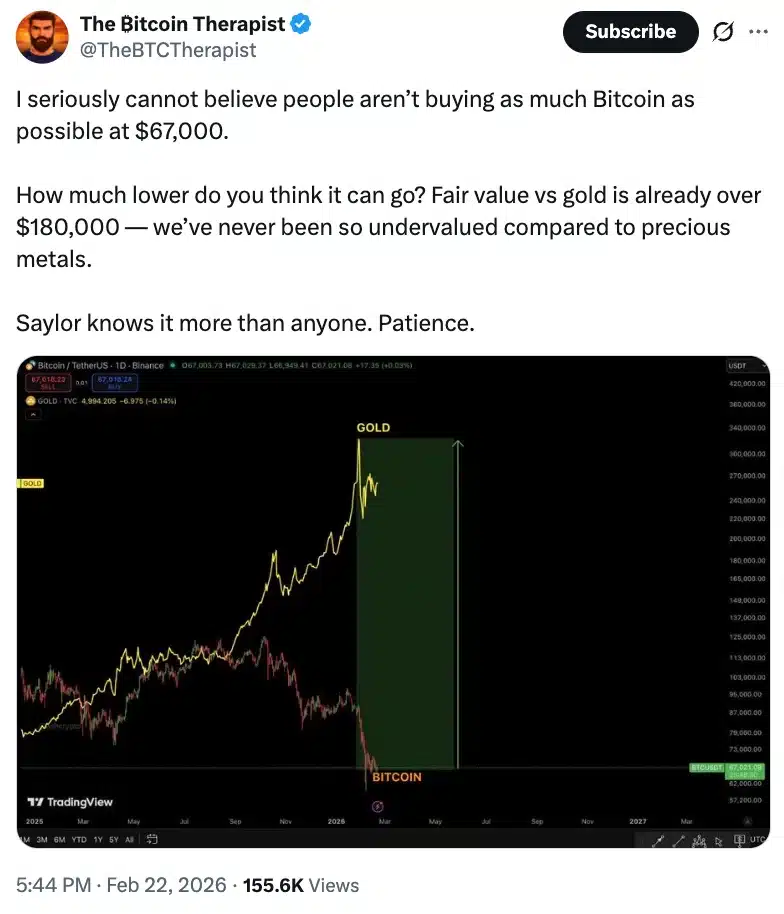
Echoing similar sentiments, another X user added,

Source: The Bitcoin Therapist/X
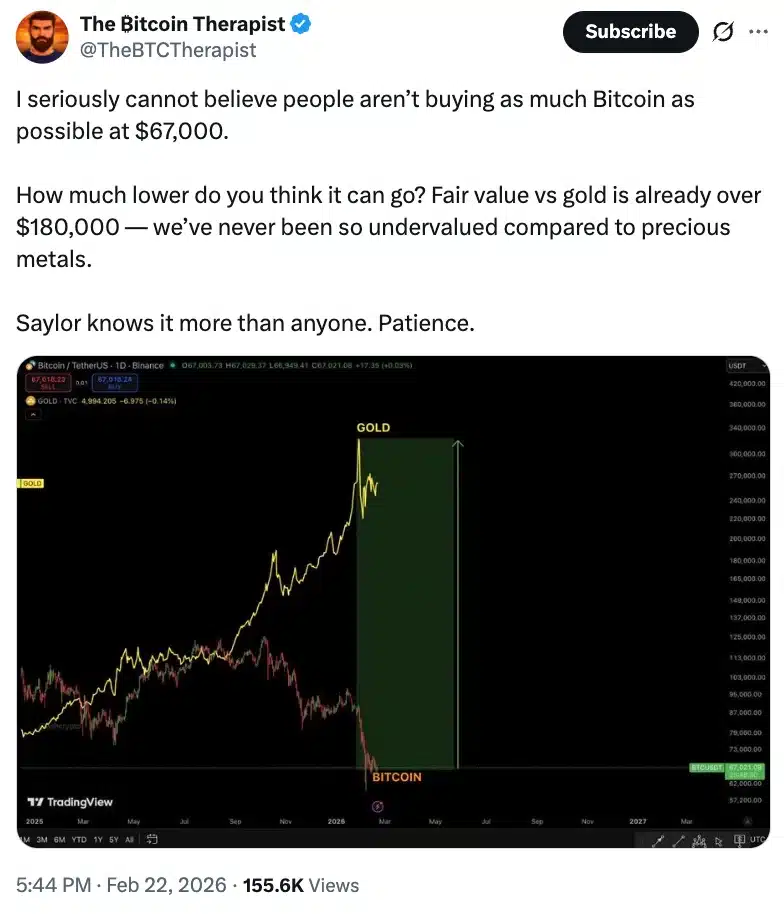
While gold climbed above $5,100 per ounce, Bitcoin failed to act like a safe asset and was trading about 30% below its October 2025 peak.

Bitcoin vs. Gold

At its peak in December 2024, one Bitcoin could buy about 38 ounces of gold. By February 2026, that figure had fallen to roughly 13 ounces.

This sharp decline shows that Bitcoin has lost more than 62% of its value compared to gold in just over a year. Even though Bitcoin still looks stable in dollar terms, it is losing real buying power when measured against gold.

Silver’s rise and Bitcoin’s struggle

The gap becomes even clearer when we compare Bitcoin with silver. Since May 2025, Bitcoin’s value compared to silver has dropped by more than 70%.

This change is also visible in global rankings.

According to CompaniesMarketCap, gold and silver now rank first and second in total market value. Bitcoin has fallen to around 13th place, behind many traditional companies and physical assets.

What’s more?

All in all, the strong trend of 2024 and 2025, when many people saw Bitcoin as a good way to protect against inflation, is now weakening.

However, some analysts believe that the current low Bitcoin-to-gold ratio could be a good long-term buying chance. They think Bitcoin is cheap compared to gold.

Still, the overall market direction is clear. Even though more money is entering the system, investors are choosing gold and silver instead of crypto.

Therefore, if Bitcoin wants to be seen as a safe haven again, it needs to stop acting like a risky tech stock and start behaving more like a stable store of value.


Final Summary

  • Bitcoin’s drop below $65,000 weakened confidence in its role as a long-term store of value.
  • The sharp fall in the Bitcoin-to-gold ratio shows that Bitcoin is losing real purchasing power, not just price momentum.


Preguntas relacionadas

QWhat did Peter Schiff highlight regarding the performance of gold and Bitcoin during a period of economic uncertainty?

APeter Schiff highlighted the growing gap between precious metals and cryptocurrencies, noting that gold surged to record highs while Bitcoin fell more than 5%, weakening during a period of stress and raising doubts about its role as a safe asset.

QHow much has Bitcoin's value declined compared to gold from its peak in December 2024 to February 2026?

ABitcoin has lost more than 62% of its value compared to gold, declining from being able to buy about 38 ounces of gold at its peak to roughly 13 ounces.

QAccording to the article, what ranks first and second in total market value on CompaniesMarketCap, and where does Bitcoin stand?

AGold and silver now rank first and second in total market value, while Bitcoin has fallen to around 13th place.

QWhat was the crypto community's response to Peter Schiff's criticism of Bitcoin's performance?

AThe crypto community pushed back, arguing that Schiff focuses on short-term losses and ignores long-term gains, such as Bitcoin being up 300% in a year, and advised to 'zoom out' to see the bigger picture.

QWhat does the article suggest Bitcoin needs to do to be seen as a safe haven asset again?

AThe article suggests that Bitcoin needs to stop acting like a risky tech stock and start behaving more like a stable store of value to regain its status as a safe haven asset.

Lecturas Relacionadas

Has Hook Summer Really Arrived? sato, Lo0p, FLOOD Ignite the New Narrative of Uniswap v4

"Hook Summer" Arrives? Sato, Lo0p, FLOOD Ignite Uniswap v4 Narrative Amidst a slight market recovery, attention within the Ethereum ecosystem has shifted to Meme coins built on Uniswap v4's Hook protocol. Following ASTEROID, tokens like sato, sat1, Lo0p, and FLOOD have become market focal points, with market caps ranging from millions to tens of millions, bringing concentrated liquidity to a narrative-dry market. Uniswap v4 Hooks are "plugin smart contracts" that allow developers to inject custom logic at key points in a liquidity pool's lifecycle (initialization, adding/removing liquidity, swaps, etc.), making the AMM programmable. Recent representative projects include: * **sato**: Market cap peaked over $38M; uses a v4 curve mechanism for minting/burning, locking ETH as reserve. * **sat1**: Market cap briefly exceeded $10M, positioning as an "optimized sato," but later declined significantly. * **Lo0p**: Market cap neared $6.6M; a "lending AMM protocol" allowing users to borrow ETH against deposited LO0P tokens without immediate selling pressure. * **FLOOD**: Market cap approached $6M; channels trading reserves into Aave v3 to generate yield, which is retained in the pool. The emergence of these Hook-based tokens could drive long-term growth for the Uniswap ecosystem by attracting users and liquidity to v4 pools. Combined with Uniswap's activated fee switch (partially used to burn UNI), the long-term outlook for UNI appears positive. However, short-term UNI price appreciation is not directly guaranteed. Factors include the sustainability and lifecycle of these new tokens, their price volatility, overall market conditions, and regulatory pressures. Currently, Uniswap v4's TVL ($595M) lags behind v3 and v2, indicating Hook adoption still requires time to mature. In summary, the Hook ecosystem serves as "long-term nourishment" for UNI, but acts more as a "catalyst" than a direct "booster" in the short term. Note: These are early-stage experimental tokens and may carry unknown risks.

marsbitHace 24 min(s)

Has Hook Summer Really Arrived? sato, Lo0p, FLOOD Ignite the New Narrative of Uniswap v4

marsbitHace 24 min(s)

Has Hook Summer Truly Arrived? sato, Lo0p, FLOOD Ignite the New Uniswap v4 Narrative

With the broader market showing signs of recovery, a new wave of interest has emerged around Ethereum-based meme coins. Following ASTEROID, tokens like sato, sat1, Lo0p, and FLOOD, built upon the Uniswap v4 Hook protocol, are capturing market attention. Their market capitalizations range from millions to tens of millions of dollars, injecting much-needed focused liquidity into a market lacking narratives. This article explores whether this trend signifies an incoming "Hook Summer" and its potential impact on UNI's price. Hooks are essentially plug-in smart contracts for Uniswap v4 liquidity pools, allowing developers to inject custom logic at key points in a pool's lifecycle (like initialization, adding/removing liquidity, swaps). This transforms the AMM into programmable building blocks. Key highlighted projects include: * **sato**: Peaked over $38M market cap. It utilizes a v4 curve for minting/burning; buying locks ETH as reserve to mint new tokens, while selling redeems ETH from the reserve and burns tokens. * **sat1**: Market cap briefly exceeded $10M, promoted as an "optimized sato," but later declined significantly. * **Lo0p**: Reached nearly $6.6M. It's a lending AMM protocol where buying LO0P tokens locks them as collateral, allowing users to borrow ETH from the pool reserve at 40% LTV, aiming to improve capital efficiency for idle ETH in LPs. * **FLOOD**: Peaked near $6M. Its mechanism directs asset reserves from buys into Aave v3 to generate yield, with fees and interest retained in the pool to potentially influence the token's price long-term. In the long term, the development of the Hook ecosystem can attract users and liquidity to Uniswap v4, benefiting UNI's fundamentals—especially combined with the recent activation of the protocol fee switch, where a portion of fees is used to burn UNI. However, in the short term, these Hook-based tokens are unlikely to directly drive significant UNI price appreciation. Their impact is moderated by factors like token sustainability, price volatility, and broader market and regulatory conditions. Currently, Uniswap v4's TVL ($595M) still trails behind v2 and v3, indicating adoption and growth will take time. The article concludes that while the Hook ecosystem provides long-term "nourishment" for UNI, its short-term role is more of a "catalyst" than a "booster." Readers are cautioned that these are early-stage experimental tokens and may carry unknown risks.

Odaily星球日报Hace 36 min(s)

Has Hook Summer Truly Arrived? sato, Lo0p, FLOOD Ignite the New Uniswap v4 Narrative

Odaily星球日报Hace 36 min(s)

Interview with Michael Saylor: I Did Say I Would Sell Bitcoin, But Never a Net Sale

Interview with Michael Saylor: I Said We'd Sell Bitcoin, But Never Be a Net Seller In a recent podcast, MicroStrategy Executive Chairman Michael Saylor clarified the company's stance on potentially selling Bitcoin. Following MicroStrategy's earnings call statement about being prepared to sell BTC to fund dividends for its STRC (Strategic) credit product, Saylor emphasized the distinction between selling and being a "net seller." Saylor explained the core business model: MicroStrategy sells credit instruments like STRC and uses the proceeds to buy Bitcoin, which is viewed as "digital capital" expected to appreciate around 30-40% annually. A portion of these capital gains can then be used to pay the dividends on the credit products. He stressed that even if the company sells some Bitcoin for dividends, it simultaneously buys much more with new credit issuance. For example, after raising $3.2 billion from STRC sales in April, the dividend obligation was only $80-90 million, making the company a net buyer. The clarification aims to counter market narratives questioning the value of Bitcoin on MicroStrategy's balance sheet if it were never sold, and to dismiss claims of a "Ponzi scheme." Saylor reiterated his personal philosophy for investors: "Don't be a net seller of bitcoin" and ensure your Bitcoin holdings increase each year. Saylor also discussed Bitcoin's role as the foundation for "digital credit," noting that STRC has become the largest and most liquid preferred stock issue in the U.S., offering high risk-adjusted returns (Sharpe ratio). He highlighted Bitcoin's deep liquidity, stating that even large purchases by MicroStrategy do not move the market significantly, which is driven by macro factors, geopolitical tensions, and capital flows from ETFs and credit products. Finally, Saylor reflected on his early inspiration from sci-fi books, which motivated his path to MIT, and maintained his fundamental thesis on Bitcoin remains unchanged: it is superior digital capital enabling superior digital credit.

链捕手Hace 40 min(s)

Interview with Michael Saylor: I Did Say I Would Sell Bitcoin, But Never a Net Sale

链捕手Hace 40 min(s)

Trading

Spot
Futuros

Artículos destacados

Cómo comprar 4

¡Bienvenido a HTX.com! Hemos hecho que comprar 4 (4) sea simple y conveniente. Sigue nuestra guía paso a paso para iniciar tu viaje de criptos.Paso 1: crea tu cuenta HTXUtiliza tu correo electrónico o número de teléfono para registrarte y obtener una cuenta gratuita en HTX. Experimenta un proceso de registro sin complicaciones y desbloquea todas las funciones.Obtener mi cuentaPaso 2: ve a Comprar cripto y elige tu método de pagoTarjeta de crédito/débito: usa tu Visa o Mastercard para comprar 4 (4) al instante.Saldo: utiliza fondos del saldo de tu cuenta HTX para tradear sin problemas.Terceros: hemos agregado métodos de pago populares como Google Pay y Apple Pay para mejorar la comodidad.P2P: tradear directamente con otros usuarios en HTX.Over-the-Counter (OTC): ofrecemos servicios personalizados y tipos de cambio competitivos para los traders.Paso 3: guarda tu 4 (4)Después de comprar tu 4 (4), guárdalo en tu cuenta HTX. Alternativamente, puedes enviarlo a otro lugar mediante transferencia blockchain o utilizarlo para tradear otras criptomonedas.Paso 4: tradear 4 (4)Tradear fácilmente con 4 (4) en HTX's mercado spot. Simplemente accede a tu cuenta, selecciona tu par de trading, ejecuta tus trades y monitorea en tiempo real. Ofrecemos una experiencia fácil de usar tanto para principiantes como para traders experimentados.

718 Vistas totalesPublicado en 2025.10.20Actualizado en 2025.10.20

Cómo comprar 4

Discusiones

Bienvenido a la comunidad de HTX. Aquí puedes mantenerte informado sobre los últimos desarrollos de la plataforma y acceder a análisis profesionales del mercado. A continuación se presentan las opiniones de los usuarios sobre el precio de 4 (4).

活动图片