Gnosis announces hard fork to recover funds from Balancer exploit

cointelegraphPublicado a 2025-12-23Actualizado a 2025-12-23

Resumen

Gnosis Chain has executed a hard fork to recover funds stolen during a $116 million Balancer exploit that occurred in November. The hard fork, carried out on Monday, follows a prior soft fork adopted by a majority of validators. According to Gnosis, the recovered funds are now out of the hacker’s control, though specific details on how users can reclaim their assets are still under community discussion. The team aims to enable fund recovery by Christmas, after which distribution mechanisms will be finalized. The original Balancer exploit targeted V2 Composable Stable Pools and resulted in over $116 million in outflows, with white hat hackers later recovering about $28 million. Despite 11 prior audits, the vulnerability was not detected.

Gnosis chain operators executed a hard fork to recover funds tied to a $116 million Balancer exploit in November.

In a Tuesday X post following a notice for node operators, Gnosis said it executed a hard fork to recover some of the funds from a significant exploit of Balancer. The project said the funds were “out of the hacker's control,” signaling a partial or full recovery.

The hard fork, executed on Monday, followed a majority of validators adopting a soft fork in November in response to the Balancer exploit affecting “Balancer‐managed contracts on Gnosis Chain.”
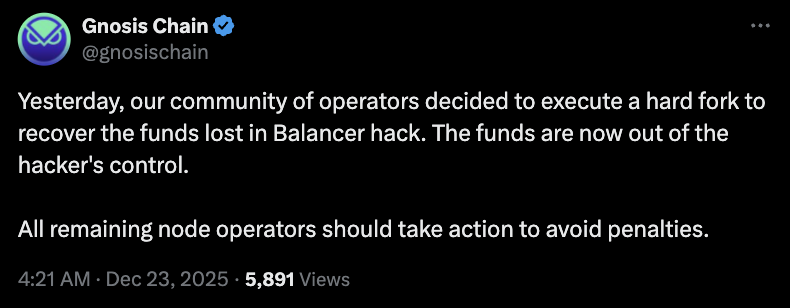
Source: Gnosis Chain

“There is still a live community discussion around how people will be able to claim back their funds, as well as how contributors involved in the rescue mission may be recognized or compensated,” said Gnosis head of infrastructure Philippe Schommers in a Dec. 12 forum post. “Right now we’re focused on enabling funds to be recovered by Christmas. Once they sit safely in a DAO controlled wallet we will figure out everything else.”

On Nov. 3, Balancer reported that the decentralized exchange and automated market maker had been exploited for more than $116 million worth of digital assets. Onchain data showed a hacker transferred millions in staked Ether (ETH) to a new wallet.

Related: Balancer exploit swells to $116M in outflows as team offers 20% bounty

Though Balancer later reported that white hat hackers had managed to recover about $28 million of the stolen funds, it did not appear to have regained access to the majority of digital assets.

11 audits didn’t prevent the Balancer exploit

According to a list of Balancer V2 audits available on GitHub, four different security companies conducted 11 audits of the platform’s smart contracts. The project reported that the exploit was “isolated to V2 Composable Stable Pools.”

Magazine: When privacy and AML laws conflict: Crypto projects’ impossible choice

Criptos en tendencia

Preguntas relacionadas

QWhat was the purpose of the hard fork executed by Gnosis chain operators?

AThe hard fork was executed to recover funds tied to a $116 million Balancer exploit that occurred in November.

QHow much was stolen in the Balancer exploit on Gnosis Chain?

AThe Balancer exploit resulted in the theft of more than $116 million worth of digital assets.

QWhat portion of the stolen funds were recovered by white hat hackers according to the article?

AWhite hat hackers managed to recover about $28 million of the stolen funds.

QWhat specific part of the Balancer protocol was the exploit isolated to?

AThe exploit was isolated to V2 Composable Stable Pools.

QWhat was the stated goal for the recovery of the funds as mentioned by Gnosis head of infrastructure Philippe Schommers?

AThe goal was to enable the funds to be recovered by Christmas and have them sit safely in a DAO-controlled wallet.

Lecturas Relacionadas

Is Ethereum Truly a "World Computer"?

Title: Is Ethereum Really a "World Computer"? Ethereum, envisioned as a "world computer" by its founder Vitalik Buterin, aims to be a decentralized platform for global applications. However, a recent analysis by Four Pillars raises questions about whether it is more accurately a "Western computer," based on the geographical distribution of its validators. Currently, the United States dominates with 38.19% of all validators, followed by Germany at 13.04%. Combined, these two countries account for over half of the network. In contrast, Asian representation is minimal, with Singapore holding only 3.15%. The concentration is partly due to affordable cloud hosting services like Hetzner and OVH in Europe and North America, as well as the prevalence of residential validators in the U.S., where individuals run nodes via home internet connections. When examining professionally operated validators, the distribution becomes more balanced. The U.S. share drops to 25.81%, while Asian countries like Singapore (7.28%), Hong Kong (6.44%), Japan (6.38%), and South Korea (4.59%) collectively approach the U.S. level. This shift reflects strategic deployments by institutions to meet regulatory requirements and reduce latency for local users. However, regions like South America, the Middle East, and Africa remain underrepresented. Ethereum's peer-to-peer network mechanisms, such as gossipsub, disadvantage areas with low node density, creating a feedback loop where delayed message propagation reduces validator performance and rewards. This imbalance challenges Ethereum's promises of censorship resistance and global accessibility. Despite these issues, opportunities exist for growth in underrepresented regions. As demand for localized staking infrastructure rises, early entrants in areas like the Middle East could establish dominant positions by offering compliant, low-latency solutions. The evolving validator landscape highlights both the structural challenges and the potential for Ethereum to move closer to its "world computer" ideal.

Foresight NewsHace 20 min(s)

Is Ethereum Truly a "World Computer"?

Foresight NewsHace 20 min(s)

WEEX TradFi Trading Competition Kicks Off, 50,000 USDT Prize Pool First-Come, First-Served, Open a Position and Get 5 U

WEEX Exchange Launches "TradFi Trading Competition" with a 50,000 USDT Prize Pool Amidst a crypto market downturn, WEEX Exchange highlights the growth of tokenized traditional finance (TradFi) assets as a key trend, allowing users to trade stocks, ETFs, and commodities using crypto. The platform has launched a "TradFi Trading Competition" from July 9th to 23rd, featuring a 50,000 USDT prize pool. The campaign offers three reward tiers: 1. **New User Bonus (25,000 USDT pool):** New users depositing ≥100 USDT, completing a specified spot trade, and one TradFi contract trade (margin ≥10 USDT) receive 200 USDT. 2. **Volume-Based Rewards (20,000 USDT pool):** All users can earn tiered bonuses for achieving TradFi contract trading volumes of 5,000 USDT (3 USDT), 20,000 USDT (10 USDT), and 100,000 USDT (50 USDT). Rewards are stackable. 3. **Participation Reward:** Any user opening a TradFi contract trade during the event receives 5 USDT instantly. The article promotes WEEX's TradFi features, which include trading tokenized shares of companies like NVIDIA and Tesla using USDT, 24/7 trading, fractional share investing starting from $5, and high leverage up to 100x for hedging. It positions these features as solutions to traditional investing barriers like high fees, strict trading hours, and high share prices. The summary concludes by encouraging users to join the competition and leverage WEEX's platform to access global TradFi markets.

marsbitHace 2 hora(s)

WEEX TradFi Trading Competition Kicks Off, 50,000 USDT Prize Pool First-Come, First-Served, Open a Position and Get 5 U

marsbitHace 2 hora(s)

Trading

Spot

Artículos destacados

Cómo comprar O

¡Bienvenido a HTX.com! Hemos hecho que comprar O1 exchange (O) sea simple y conveniente. Sigue nuestra guía paso a paso para iniciar tu viaje de criptos.Paso 1: crea tu cuenta HTXUtiliza tu correo electrónico o número de teléfono para registrarte y obtener una cuenta gratuita en HTX. Experimenta un proceso de registro sin complicaciones y desbloquea todas las funciones.Obtener mi cuentaPaso 2: ve a Comprar cripto y elige tu método de pagoTarjeta de crédito/débito: usa tu Visa o Mastercard para comprar O1 exchange (O) al instante.Saldo: utiliza fondos del saldo de tu cuenta HTX para tradear sin problemas.Terceros: hemos agregado métodos de pago populares como Google Pay y Apple Pay para mejorar la comodidad.P2P: tradear directamente con otros usuarios en HTX.Over-the-Counter (OTC): ofrecemos servicios personalizados y tipos de cambio competitivos para los traders.Paso 3: guarda tu O1 exchange (O)Después de comprar tu O1 exchange (O), guárdalo en tu cuenta HTX. Alternativamente, puedes enviarlo a otro lugar mediante transferencia blockchain o utilizarlo para tradear otras criptomonedas.Paso 4: tradear O1 exchange (O)Tradear fácilmente con O1 exchange (O) en HTX's mercado spot. Simplemente accede a tu cuenta, selecciona tu par de trading, ejecuta tus trades y monitorea en tiempo real. Ofrecemos una experiencia fácil de usar tanto para principiantes como para traders experimentados.

81 Vistas totalesPublicado en 2026.06.19Actualizado en 2026.06.29

Cómo comprar O

Cómo comprar PROS

¡Bienvenido a HTX.com! Hemos hecho que comprar Pharos (PROS) sea simple y conveniente. Sigue nuestra guía paso a paso para iniciar tu viaje de criptos.Paso 1: crea tu cuenta HTXUtiliza tu correo electrónico o número de teléfono para registrarte y obtener una cuenta gratuita en HTX. Experimenta un proceso de registro sin complicaciones y desbloquea todas las funciones.Obtener mi cuentaPaso 2: ve a Comprar cripto y elige tu método de pagoTarjeta de crédito/débito: usa tu Visa o Mastercard para comprar Pharos (PROS) al instante.Saldo: utiliza fondos del saldo de tu cuenta HTX para tradear sin problemas.Terceros: hemos agregado métodos de pago populares como Google Pay y Apple Pay para mejorar la comodidad.P2P: tradear directamente con otros usuarios en HTX.Over-the-Counter (OTC): ofrecemos servicios personalizados y tipos de cambio competitivos para los traders.Paso 3: guarda tu Pharos (PROS)Después de comprar tu Pharos (PROS), guárdalo en tu cuenta HTX. Alternativamente, puedes enviarlo a otro lugar mediante transferencia blockchain o utilizarlo para tradear otras criptomonedas.Paso 4: tradear Pharos (PROS)Tradear fácilmente con Pharos (PROS) en HTX's mercado spot. Simplemente accede a tu cuenta, selecciona tu par de trading, ejecuta tus trades y monitorea en tiempo real. Ofrecemos una experiencia fácil de usar tanto para principiantes como para traders experimentados.

100 Vistas totalesPublicado en 2026.06.22Actualizado en 2026.06.29

Cómo comprar PROS

Qué es VERONA

I. Introducción al Proyecto VERONA es una blockchain construida para todos, en todas partes a través de la abstracción de cadenas. Utilizando su capa de Abstracción Generalizada, VERONA se distingue por integrar funcionalidades complejas de blockchain, como cuentas, firmas e interoperabilidad, directamente a nivel de protocolo. Este enfoque permite interactuar con aplicaciones de blockchain sin necesidad de entender las tecnologías subyacentes.1) Información Básica Nombre: VERONA (VERONA)III. Enlaces Relacionados Enlace al sitio web oficial: https://xion.burnt.com/ Libro Blanco: https://xion.burnt.com/whitepaper.pdf Exploradores: https://explorer.burnt.com/ Redes Sociales: https://x.com/burnt_xion Nota: La introducción del proyecto proviene de los materiales publicados o proporcionados por el equipo oficial del proyecto, que es solo para referencia y no constituye asesoramiento de inversión. HTX no se hace responsable de ninguna pérdida directa o indirecta resultante.

113 Vistas totalesPublicado en 2026.06.22Actualizado en 2026.06.22

Qué es VERONA

Discusiones

Bienvenido a la comunidad de HTX. Aquí puedes mantenerte informado sobre los últimos desarrollos de la plataforma y acceder a análisis profesionales del mercado. A continuación se presentan las opiniones de los usuarios sobre el precio de A (A).

活动图片