Following the release of 11 plugins by Claude in early January, which triggered the "SaaSpocalypse," Claude has now introduced actual workflows with the new release of Claude for Small Business.
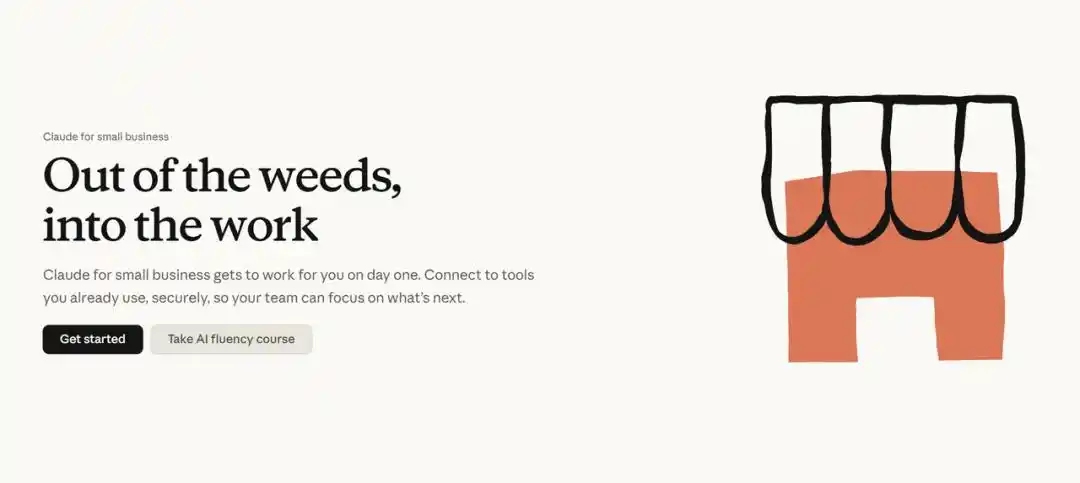
The interface of this new product reads: "Out of the weeds, into the work." Roughly translated to Chinese, it means: Stop getting bogged down in trivial matters and get back to the real work.
This time, Claude isn't just playing with concepts. It can directly integrate with tools businesses use daily, including QuickBooks, PayPal, HubSpot, Canva, DocuSign, Google Workspace, and Microsoft 365, among others.
Once connected, Claude can automatically handle routine business tasks such as payroll calculation and distribution, month-end financial closing, sales and marketing execution, and invoice follow-ups—without switching software or manual reconciliation.
Scrolling down on the official website, it directly showcases several dialogue examples.
how to do payroll, how to run month-end close, how to automatically generate Monday briefings.
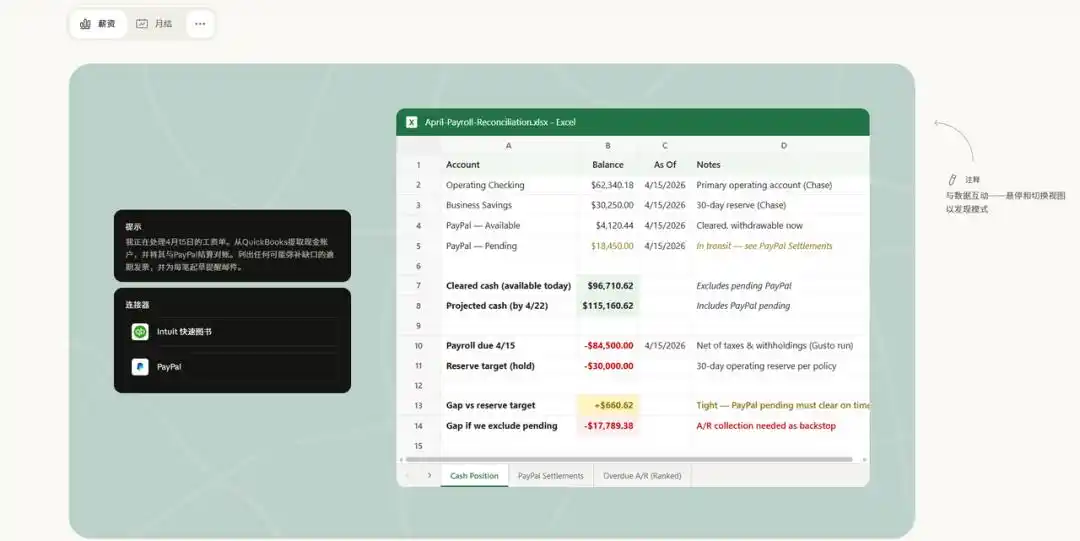
You input a command like: "Close out March for me. Reconcile my QuickBooks transactions against PayPal settlements, flag anything that doesn't match, and write the P&L narrative"
It will reconcile 147 transactions, flag 5 exceptions one by one, and write the profit and loss narrative, ready to be forwarded directly to the accountant.
Product Details Worth Highlighting
The most crucial point is that processing 147 transactions with a single command is remarkably smooth.
You simply need to switch to the Cowork tab in the Claude desktop app, turn on the Claude for Small Business plugin, and it's ready to use—no extra fees, just a Claude subscription.
Regarding security, Claude adheres to the permissions you set in each tool. What an employee cannot see in Gmail, they also cannot see through Claude.
Operationally, there's no need to worry about Claude making random operations that ultimately reduce efficiency. You can see which tool Claude is about to access before execution, and each step requires approval by default.
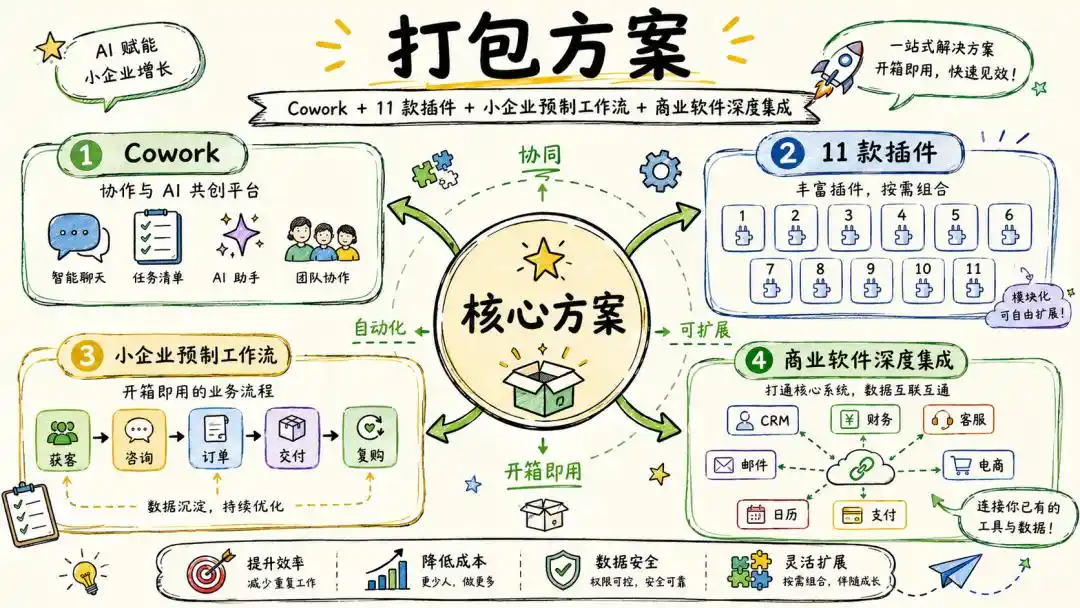
In terms of feature selection, this is a bundled package combining Cowork + 11 plugins + small business pre-built workflows + deep integration with business software. Claude has curated 15 workflows: Payroll, Invoice Follow-up, Month-end Close, Marketing, Contracts, Onboarding, etc., all high-frequency, practical scenarios that genuinely meet business needs.
Specific Functions and Scenarios
Seven functions, covering basically all the daily software usage scenarios for a small business owner.
QuickBooks Financial Core: Payroll planning, month-end closing, cash flow analysis, account reconciliation, generating profit & loss statements and cash flow statements, preparing materials for tax season.
PayPal: Settlement, invoicing, refunds, payment follow-up. Works with QuickBooks for cash reconciliation and fund forecasting.
HubSpot Sales and Marketing: Lead triage, customer dynamic analysis, marketing campaign attribution, sales trend analysis.
Canva: Posters, social media graphics, copy with supporting visual content, supports team collaboration, editing, and publishing.
DocuSign: Send contracts, track signing status, automatically archive signed documents.
Google Workspace and Microsoft 365 Office Collaboration: File storage, email processing, scheduling, document generation. Export reports, prepare document packages, team collaboration.
Common Commands
After enabling the Small Business plugin in Claude Cowork, you can use the following common commands to run automated workflows directly in tools like QuickBooks, HubSpot, PayPal, Canva, DocuSign, Stripe, etc.:
/plan-payroll Forecast cash flow + chase overdue invoices
/close-month Reconcile accounts + write P&L narrative
/run-campaign Build Canva assets + prepare HubSpot send
/monday-brief: Cash, pipeline, top three todos displayed on one screen
/chase-invoices: Batch invoice follow-up and chasing
/cash-flow-forecast: Cash flow forecasting and analysis
/business-pulse: Overall business health overview
/contract-review: Contract review and suggestions
/lead-triage: Lead classification and prioritization
/employee-onboarding: New employee onboarding process
Why Has This Market Been Untouched?
The needs of small businesses are completely different from those of large companies. Large companies are willing to pay hundreds of thousands annually for a software feature, with dedicated personnel to study how to use, deploy, and train on it.
A small business owner often combines the roles of finance, HR, and operations. The annual software budget might only be a few thousand dollars. With the same R&D investment, selling to one large client versus a hundred small ones yields similar revenue but much higher service costs. This led SaaS companies in the past to prefer large clients and avoid small businesses.
Thus, even though US small businesses contribute 44% of GDP and employ nearly half of the private workforce—a massive volume—they still haven't been seriously targeted by AI companies.
Claude's design logic aims to solve this problem—you don't need to learn AI, just tell it what to do. It shifts from users adapting to tools, to tools adapting to users' ways of working.
This addresses non-standard scenarios that were difficult for past SaaS to handle. Claude for Small Business, leveraging AI combined with traditional software, effortlessly solves complex business problems.
Moreover, it's priced at a monthly fee of $20–200 (including Claude membership), far below traditional SaaS per-user subscription fees.
Viewing the Product Within Anthropic's Strategy
In the enterprise market, Anthropic is emerging like a beast, increasingly close to disrupting the SaaS market.
On January 30, 2026, Claude Cowork released 11 plugins, directly replacing core SaaS functions in legal, finance, CRM, marketing, etc., causing instant market panic: Within 48 hours, the global software sector lost $285 billion; nearly $1 trillion evaporated within a week.

Instead of getting caught in endless rounds of parameter escalation on general models, they are slicing the market by industry.
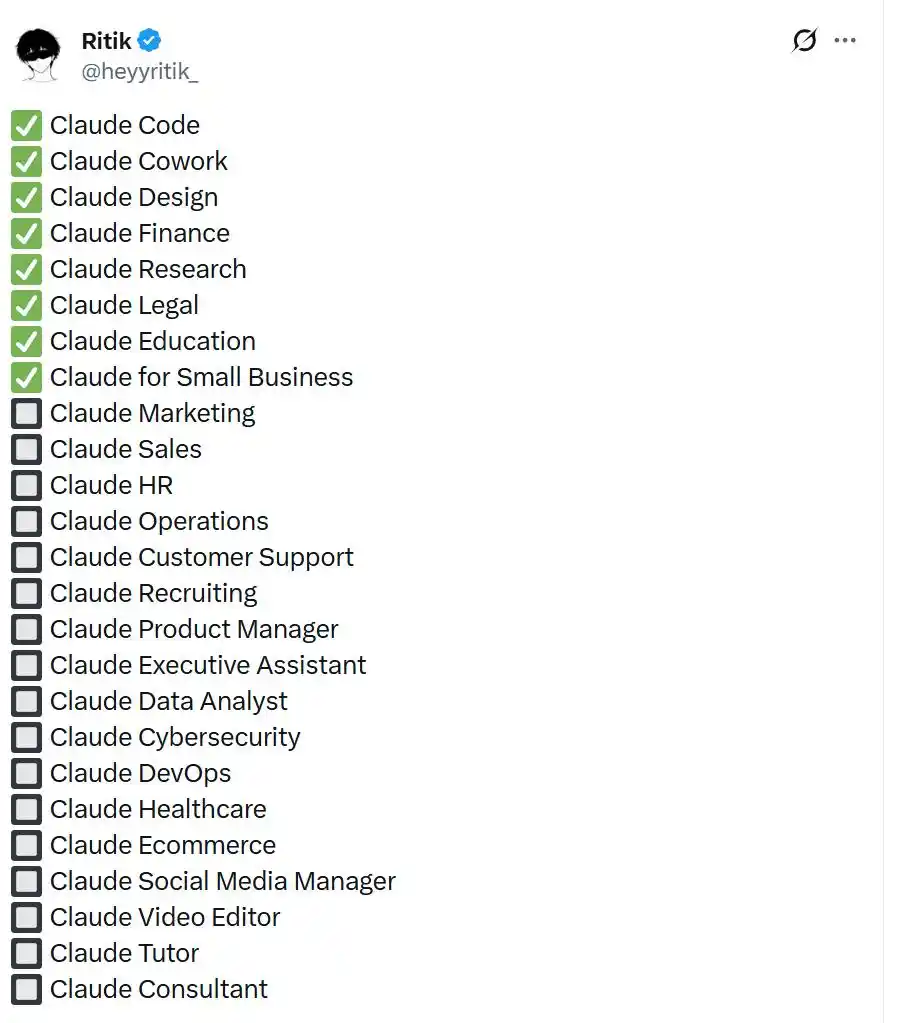
This is the aforementioned "SaaSpocalypse." This time, despite connecting traditional software, the trend of pre-built AI workflows making AaaS (Agent as a Service) mainstream is becoming increasingly evident.
From finance, legal, to the small business edition, Claude is being integrated into the existing tools and workflows of those industries. Enterprises are no longer just procuring SaaS but are procuring AI digital employees, which is also becoming an apparent phenomenon.
It can be seen that competition in general models has reached a plateau. Parameters, context windows, benchmark scores—the gap between each generation is narrowing. But penetration into industry-specific scenarios has just begun. The toolchains used in law, compliance processes in finance, and the daily operations of small businesses are completely different.
Expanding the ecosystem into different fields and permeating various industries might be one aspect of gaining a competitive edge.
An Interesting Side Note
Anthropic's CEO, Dario Amodei, previously stated that single-function SaaS companies might be consumed by AI.
Among the tools Claude has integrated this time, several are companies he mentioned. On one hand, he says they are at risk, and on the other hand, he integrates them. A relationship of both cooperation and competition is emerging between AI products and traditional SaaS.
You use my API, I become your entry point; you integrate my service, I gradually consume your interface. If Claude truly becomes the operational entry point for small businesses, will the business models of those integrated SaaS companies also change?
Software giant Salesforce has already made changes, recently announcing plans to open its API and launch "headless products"—simply put, removing the interface and exposing the underlying database for external calls.
After Claude released the 11 plugins last time, Salesforce's market value dropped by up to 26% year-to-date. Since the AI trend is unstoppable, Salesforce is adapting to it.
But who can say for sure that after software ate the world, AI won't eventually eat all SaaS?
What we see now is that because of AI, spring has come for SME owners, but the sky is falling for enterprise service software bosses.
This article is from the WeChat public account "Jingxuan AI," author: Jingxuan AI